

Google Ads Tips to Improve Clicks, Conversions, and ROI
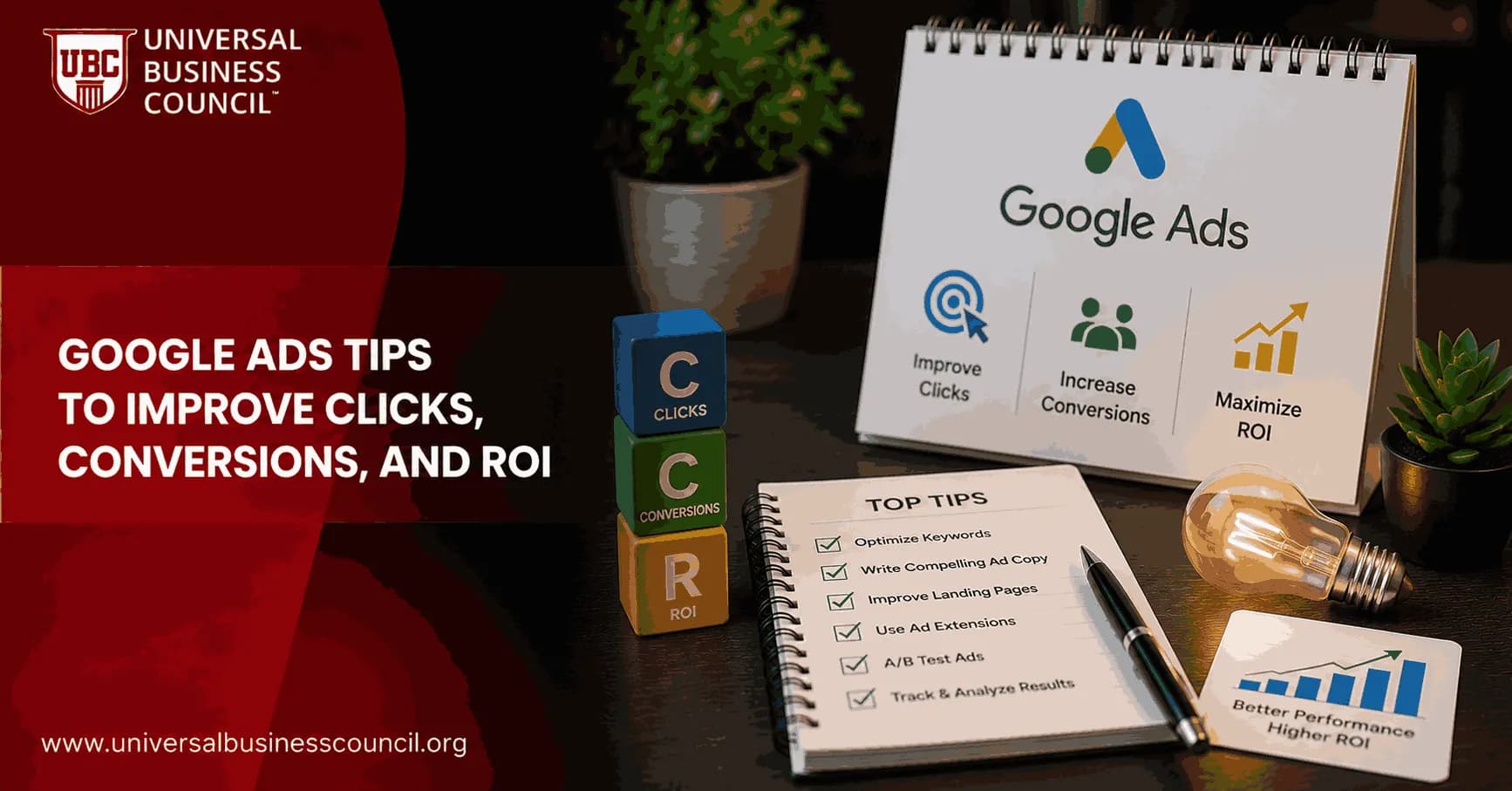
Google Ads tips that hold up in 2026 are not tricks. They are operating habits: cleaner targeting, better conversion tracking, sharper ad copy, faster landing pages, and bidding strategies that have enough data to make good decisions.
Clicks still matter. But clicks without qualified leads, purchases, booked calls, or pipeline are just paid traffic. To be blunt, a high CTR can hide a bad campaign when the search terms are weak and the landing page does not convert. The best Google Ads managers watch CTR, conversion rate, CPC, CPA, ROAS, and profit together.

Building that level of performance consistently requires more than platform familiarity. Many marketers strengthen their practical campaign management skills by earning a Certified Google Ads Expert credential, which focuses on optimization, bidding strategies, conversion tracking, and data-driven decision-making for real advertising accounts.
Start with measurement before you touch bids
If conversion tracking is wrong, every optimization after it is suspect. Smart Bidding runs on conversion signals. Google describes it as auction-time bidding that uses machine learning to optimize for conversions or conversion value. Feed it poor data and it will chase the wrong users.
Track the actions that actually matter
Set up primary conversions for actions tied to commercial value. For most accounts, that means purchases, qualified lead forms, phone calls, demo requests, or booked consultations. Use secondary conversions for softer actions such as newsletter signups or page views.
In ecommerce: pass transaction value into Google Ads and Google Analytics 4.
In B2B lead generation: import offline conversions from HubSpot, Salesforce, or your CRM when leads become sales opportunities.
For local services: track calls from ads, calls from landing pages, and submitted forms separately.
A practical warning. Many accounts count every form submission as equal. They are not. A student asking for free advice and a procurement director requesting pricing should not train the algorithm the same way.
Improve CTR with better targeting, not louder ads
The easiest way to lift click-through rate is to stop showing ads to the wrong people. Sounds obvious. It is where a lot of wasted spend hides.
Effective campaign optimization also depends on understanding customer behaviour, marketing strategy, analytics, and conversion optimization beyond Google Ads itself. A Certified Digital Marketing Expert program helps professionals connect paid advertising performance with broader business and digital marketing objectives.
Prioritize high intent keywords
Do not chase volume for its own sake. A broad keyword may bring more impressions, but specific terms often produce better CTR and conversion rate. For example, "CRM software pricing for small business" usually signals more intent than "CRM."
Use a mix of phrase match and exact match for your strongest commercial terms. Broad match can work, especially with Smart Bidding and strong negative keyword discipline, but it is not the right place to start when your tracking is messy or your budget is tight.
Build a serious negative keyword routine
Negative keywords are one of the simplest Google Ads tips, and still one of the most neglected. Review the search terms report weekly in active accounts. Sort by cost first, not clicks. That is where budget leakage shows up.
Common negatives include terms such as free, jobs, salary, template, PDF, DIY, definition, and training, depending on what you sell. Be careful here. If you offer professional training, "training" is not a negative. Context wins.
Layer audiences on search campaigns
Audience segments help you understand who responds to your keywords. Add relevant in-market segments, remarketing lists, customer match lists, and demographic observations where they fit. Start in observation mode when you want data without restricting reach. Then adjust bids, budgets, or campaign structure based on performance.
Write ads that match intent fast
Searchers scan. Your ad has a second or two to prove relevance. Put the core keyword or a close variant in the headline when it reads naturally. Then give the user a reason to click.
Use two to four ad variants per ad group
Keep enough ad variants active to test messaging, but not so many that the data gets thin. Two to four is a practical range for most ad groups. Test one main idea at a time:
Price or savings message
Speed or convenience message
Trust proof, such as accreditation or years in business
Direct CTA, such as Get a Quote or Book a Demo
Numbers help when they are real. "Plans from $49" is clearer than "Affordable plans." Do not invent discounts or inflate claims. Professionals notice.
Use assets to take up more useful space
Sitelinks, callouts, structured snippets, call assets, and location assets can improve visibility and CTR. Use them to answer the next question in the buyer's mind. Pricing, case studies, service areas, integrations, and consultation options all make good asset themes.
Improve conversion rate on the landing page
The ad earns the click. The landing page earns the money. Google includes landing page experience as part of Quality Score, alongside expected CTR and ad relevance. That makes the page both a conversion issue and a media cost issue.
Keep one page focused on one action
A landing page should have one primary conversion goal. Not five. If the ad promises a software demo, the page should make demo booking obvious above the fold. If the ad promotes a service quote, the form should support that action immediately.
The most common B2B mistake is asking for too much too soon. An eight-field form on mobile can quietly kill performance. Start with essentials such as name, business email, company, and one qualifying question. Ask the rest during follow-up.
Match the ad message to the page
If your ad says "Google Ads audit for ecommerce brands," the landing page headline should not say "Digital marketing solutions." That gap creates doubt. Match the keyword, offer, CTA, and proof points.
Put the CTA above the fold.
Use a headline and subheader that repeat the promise in plain language.
Add proof: reviews, testimonials, logos, credentials, or measurable outcomes.
Compress images and test mobile load speed with PageSpeed Insights.
Remove navigation when it distracts from the conversion goal.
Use Smart Bidding when the account has enough data
Automated bidding can improve ROI, but it is not magic. It needs clean conversion data and enough volume. A useful rule of thumb: consider Target CPA or Target ROAS once a campaign or portfolio has roughly 30 conversions per month. Less than that, and the system may not have enough signal.
Choose the right bidding strategy
Maximize clicks: useful for early traffic discovery, but risky when you care about lead quality.
Enhanced CPC: a middle ground when you still want some manual control.
Maximize conversions: good when the goal is volume and conversion tracking is reliable.
Target CPA: better when you know what a lead or sale should cost.
Target ROAS: best suited to ecommerce or accounts passing accurate conversion values.
Do not switch bid strategies every few days. Give tests enough time, and use Google Ads experiments where possible. One messy habit I see in audits: changing budget, ads, match types, and bidding all in the same week. Then nobody knows what caused the result.
Behind every successful Google Ads account is a reliable technology stack that includes analytics platforms, tag management, APIs, CRM integrations, cloud services, and privacy-conscious measurement tools. A broader Tech Certification can help professionals understand these technologies and build stronger tracking, reporting, and campaign optimization processes.
Segment campaigns around budget and profit
More granular structure gives you control. Separate campaigns by product line, service, geography, or margin where performance differs. A high-margin consulting service should not share the same budget logic as a low-margin entry offer.
Find the keywords that pay the bills
Pull a keyword report for the last 60 to 90 days. Identify the top converting terms and the top spenders with no conversions. Often, a small set of keywords drives a large share of results. Place the winners into tighter ad groups, such as single theme ad groups, with tailored ads and landing pages.
Pause or restrict terms that spend without progress. Add negatives from irrelevant queries. Then move budget toward segments with better CPA, ROAS, or qualified pipeline.
Use remarketing without annoying people
Remarketing can improve ROI because previous visitors already know something about your offer. Build lists for high intent behaviors: pricing page visitors, cart abandoners, demo page visitors, or users who started but did not submit a form.
Keep frequency under control. Exclude converters. Refresh creative. For B2B, align remarketing with the buying process rather than showing the same "Book a demo" ad for 60 days straight.
Make testing a weekly discipline
Good PPC teams do not wait for quarterly reviews to learn. They test continuously, and they test with discipline.
Check search terms and negatives every week.
Review spend by campaign, keyword, device, location, and audience.
Test one ad message against another.
Audit landing page speed and mobile usability monthly.
Compare CPA and ROAS against actual customer value, not just platform-reported conversions.
If you are building a formal skill path, this topic connects with Universal Business Council learning in digital marketing, marketing analytics, and business management. It is also a strong internal link opportunity for related certification content covering paid media strategy, campaign measurement, and customer acquisition.
Your next step
Open one active Google Ads campaign today and run a simple audit: conversion tracking, search terms, negatives, the top 20 percent of converting keywords, landing page speed, and bidding strategy. Fix the biggest leak first. If you manage budgets professionally, build deeper capability through Universal Business Council digital marketing certification pathways and practice these skills on real campaign data.
As artificial intelligence, predictive analytics, automation, and privacy-enhancing technologies continue to reshape digital advertising, marketers who combine strategic expertise with technical knowledge will have a significant advantage. A Deep Tech Certification provides structured learning in these emerging technologies, helping professionals stay prepared for the future of performance marketing and data-driven business growth.
FAQs
1. How can you improve Google Ads clicks, conversions, and ROI?
Improving Google Ads performance requires a combination of relevant keywords, compelling ad copy, optimized landing pages, accurate conversion tracking, and continuous campaign refinement. Success comes from attracting qualified visitors who are more likely to become customers, not simply generating more traffic.
2. Why is keyword research important?
Keyword research helps identify the search terms your target audience uses when looking for products or services. Choosing relevant, high-intent keywords improves ad relevance, increases click quality, and supports stronger conversion rates.
3. How do keyword match types affect performance?
Broad match, phrase match, and exact match determine how closely a user's search must align with your selected keywords. Using the right mix of match types helps balance campaign reach with targeting precision and budget efficiency.
4. Why should advertisers use negative keywords?
Negative keywords prevent ads from appearing for irrelevant searches, reducing wasted clicks and improving traffic quality. Regularly reviewing search term reports and updating negative keyword lists is a key optimization practice.
5. How can you write ads that attract qualified clicks?
Effective ad copy clearly communicates the value of your product or service, aligns with search intent, includes relevant keywords, and features a strong call-to-action. Setting accurate expectations helps attract users who are genuinely interested in your offering.
6. Why is Quality Score important?
Quality Score reflects Google's assessment of your keywords, advertisements, and landing pages. While it is only one factor in the ad auction, improving ad relevance and landing page experience may contribute to more efficient campaign performance.
7. How do landing pages improve conversions?
A well-designed landing page provides a consistent experience between the advertisement and the destination page. Fast loading speeds, clear messaging, mobile optimization, trust signals, and a focused call-to-action help encourage visitors to complete desired actions.
8. What role does conversion tracking play?
Conversion tracking records valuable actions such as purchases, lead form submissions, phone calls, or appointments. Accurate tracking allows advertisers to understand which campaigns generate business value and where optimization efforts should be focused.
9. How should advertisers choose bidding strategies?
The appropriate bidding strategy depends on campaign objectives and available performance data. Google Ads offers both manual and automated bidding options designed to optimize for goals such as clicks, conversions, conversion value, or impression share.
10. How can audience targeting improve ROI?
Audience targeting enables advertisers to reach users based on demographics, interests, purchase intent, previous website interactions, and customer lists. Combining audience targeting with keyword strategies often improves campaign efficiency and conversion rates.
11. Why is remarketing effective?
Remarketing re-engages users who have previously visited your website or interacted with your business. Since these audiences already know your brand, remarketing campaigns often generate stronger engagement and additional conversion opportunities.
12. How does AI improve Google Ads performance?
Google's AI can automate bidding, optimize audiences, generate responsive ad combinations, allocate budgets, and identify optimization opportunities. Advertisers should regularly review AI-driven recommendations to ensure they remain aligned with business goals.
13. What metrics should advertisers monitor?
Key metrics include impressions, clicks, click-through rate (CTR), cost per click (CPC), conversion rate, cost per acquisition (CPA), return on ad spend (ROAS), Quality Score, impression share, and conversion value. Monitoring these indicators helps guide data-driven decisions.
14. How does A/B testing improve campaigns?
A/B testing compares different versions of headlines, descriptions, landing pages, calls-to-action, and other campaign elements. Regular testing helps identify which variations deliver better engagement, conversions, and overall return on investment.
15. How important is mobile optimization?
Mobile optimization is essential because a significant portion of Google Ads traffic comes from smartphones and tablets. Responsive landing pages, fast load times, simple navigation, and easy-to-complete forms improve the mobile user experience.
16. What common mistakes reduce Google Ads performance?
Common mistakes include targeting overly broad keywords, ignoring negative keywords, using weak landing pages, failing to install conversion tracking, neglecting mobile users, writing generic ad copy, and making campaign changes without enough performance data.
17. How often should Google Ads campaigns be optimized?
Campaigns should be reviewed consistently, with the frequency depending on campaign size, budget, and traffic volume. Ongoing optimization helps advertisers respond to performance trends, changing customer behavior, and market conditions.
18. Can small businesses achieve strong Google Ads ROI?
Yes. Small businesses can improve ROI by focusing on highly relevant keywords, serving local audiences where appropriate, optimizing landing pages, tracking conversions accurately, and continually refining campaigns based on measurable results.
19. What tools help optimize Google Ads campaigns?
Advertisers commonly use Google Ads reporting, Google Analytics, Keyword Planner, conversion tracking, search term reports, CRM integrations, attribution reports, and third-party analytics platforms to evaluate and improve campaign performance.
20. What are the best Google Ads tips to improve clicks, conversions, and ROI?
The most effective Google Ads strategies combine thorough keyword research, compelling ad copy, optimized landing pages, precise audience targeting, AI-assisted bidding, accurate conversion tracking, and continuous testing. Rather than chasing more clicks alone, successful advertisers focus on attracting qualified traffic that supports measurable business outcomes such as leads, sales, and long-term customer value. In PPC, the cheapest click is not automatically the smartest investment. The click that turns into a satisfied customer usually has a much better story to tell than the one that merely inflated a dashboard.
Related Articles
View All
Digital Marketing
Google Ads ROI: How to Measure and Improve Campaign Profitability
Learn how to measure Google Ads ROI with conversion tracking, real cost data, ROAS, CPA, and profit-focused optimization tactics.

Digital Marketing
How to Write High-Converting Google Ads Copy That Filters for Better Clicks
Learn how to write Google Ads copy that matches intent, proves value, improves lead quality, and works with responsive search ads and AI-assisted testing.
Digital Marketing
Google Ads Optimization Checklist for Better ROI in 2026
A practical Google Ads optimization checklist for improving ROI through better tracking, campaign structure, keywords, bidding, audiences, and landing pages.
Trending Articles
The Role of Blockchain in Ethical AI Development
How blockchain technology is being used to promote transparency and accountability in artificial intelligence systems.
AWS Career Roadmap
A step-by-step guide to building a successful career in Amazon Web Services cloud computing.
Top 5 DeFi Platforms
Explore the leading decentralized finance platforms and what makes each one unique in the evolving DeFi landscape.