

Marketing Automation with AI: Building Smarter Customer Journeys Across Email, SMS, and Web
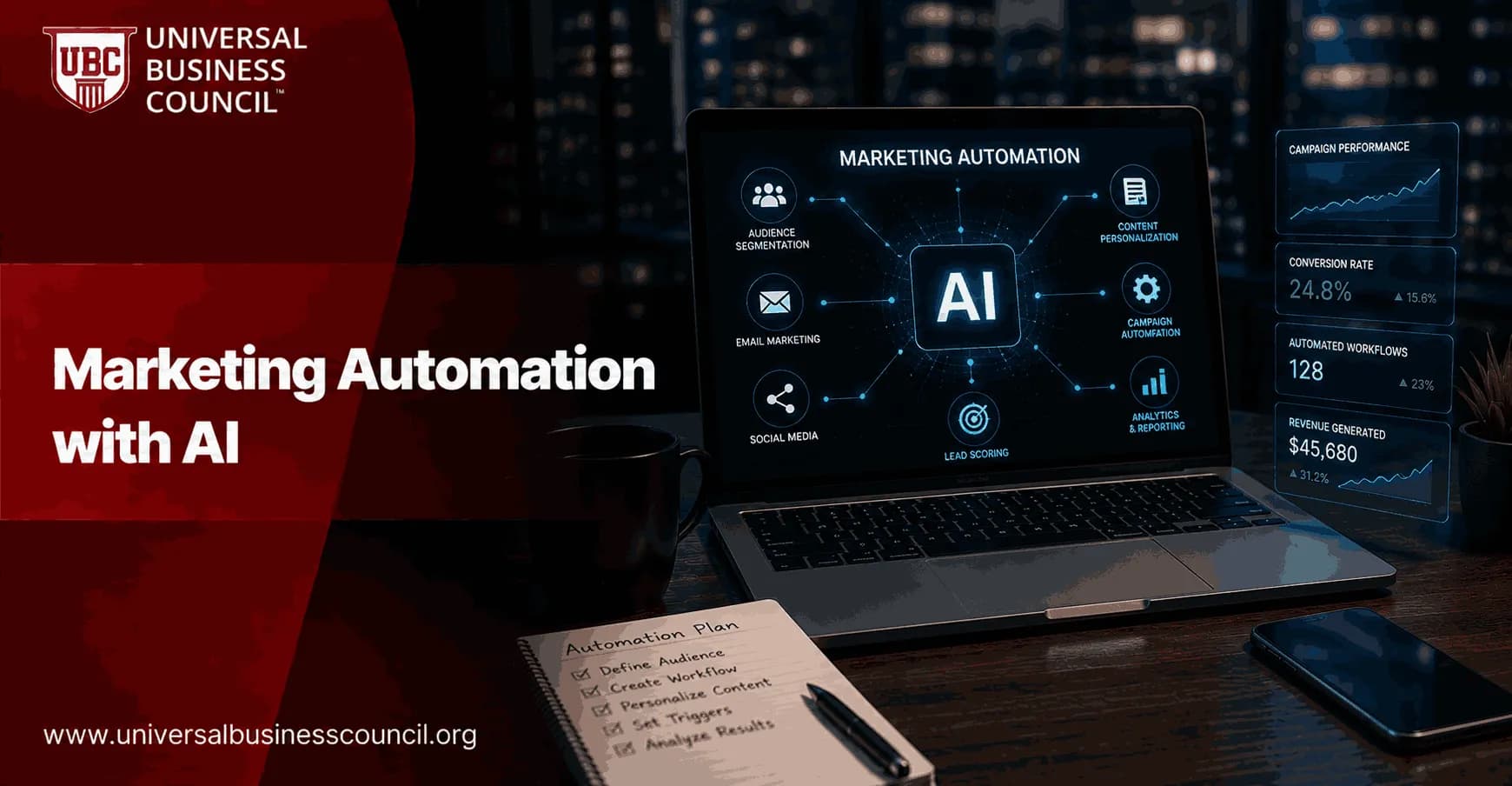
Marketing automation with AI is shifting automation from static, rule-based workflows to real-time decisioning that adapts messages, timing, and channels based on live customer behavior and context. Instead of simply scheduling campaigns, teams increasingly use machine learning, predictive analytics, and generative AI to decide what to send, to whom, when, and whether it should be delivered via email, SMS, or on-site web experiences.
Marketing teams face rising customer expectations, tighter budgets, and increased pressure to prove ROI. Industry research linked to Gartner suggests a large majority of marketing processes are already automated or AI-augmented, and some analyses report that AI-driven automation can reduce operational marketing costs by around 12% and customer acquisition costs by 30% to 40%. The practical implication is straightforward: competitive advantage now comes from integrating data, decisioning, content, and activation across channels, not from adopting isolated tools.

What Marketing Automation with AI Actually Means
Traditional marketing automation typically relies on fixed logic such as: if a user downloads an ebook, then send a three-email nurture sequence. That approach still works for many scenarios, but it can be rigid. It often assumes the same cadence, the same content, and the same channel preferences for broad segments.
Marketing automation with AI adds adaptive intelligence to this model. The newest direction across major platforms is AI-driven orchestration where segmentation, journey design, message generation, and optimization run in a continuous loop. In practice, AI systems can:
Predict likelihood to open, click, convert, churn, or purchase again
Select the next best action for each individual, not only the next step in a prebuilt flow
Optimize send time, cadence, and channel choice based on real response data
Generate and adapt message variants using generative AI, then learn from performance
Platforms such as Optimove frame the most valuable frontier as next-best-action decisioning, where AI chooses the best campaign or message for each customer rather than relying solely on marketer-defined rules.
Why Smarter Journeys Require Cross-Channel Orchestration
Modern customer journeys do not happen in one inbox. They unfold across email, SMS, and the web, often within the same day. AI makes cross-channel personalization a core use case by coordinating timing, content, and offers using behavioral, transactional, and engagement data.
When teams run channels in silos, customers can experience:
Conflicting offers across email and on-site banners
Over-messaging because each channel optimizes independently
Missed moments where SMS would have outperformed email, or vice versa
AI-driven orchestration addresses these issues by treating the journey as one system with multiple touchpoints. Measurement and operational analytics become more important as a result, since better measurement supports better orchestration and faster optimization loops.
How AI Improves Customer Journeys Across Email, SMS, and Web
Email: Predictive Personalization at Scale
Email remains a high-leverage channel for lifecycle messaging, education, and repeat purchases. AI can improve email performance by:
Send-time optimization for individuals or cohorts based on prior engagement patterns
Engagement prediction to decide whether a customer should receive a long-form message, a short update, or no email at all
Subject line and body copy personalization using generative AI and performance feedback loops
Next message recommendation based on opens, clicks, conversions, and browsing behavior
Rather than building a single best-performing email, teams can test and adapt variants continuously while maintaining brand and compliance oversight.
SMS: Timing-Sensitive Nudges with Guardrails
SMS is often best suited to high-intent moments and time-sensitive updates. In AI-powered automation, SMS becomes more effective when paired with behavioral triggers and frequency controls. Common examples include:
Cart reminders when intent signals spike
Appointment reminders and follow-ups to reduce no-shows
Delivery updates that reduce support demand and improve satisfaction
Retention prompts when churn risk increases
The key is coordinated decisioning: if a customer ignored email but responds to SMS, the system can adapt. If the customer has already converted, the system should suppress redundant messages.
Web: Adaptive Experiences in the Moment
On-site and in-app experiences are where intent tends to be highest because the customer is actively exploring. AI can personalize web journeys through:
Product and content recommendations aligned to browsing and purchase history
Dynamic landing pages tailored to inferred intent or lifecycle stage
Contextual offers and pop-ups triggered by engagement signals
Message reinforcement so the web experience matches what was communicated in email or SMS
This alignment is critical: cross-channel consistency builds trust and reduces friction, while inconsistency can reduce conversion and increase opt-outs.
Real-World AI Marketing Automation Use Cases
The highest-impact applications typically combine predictive models with practical workflow execution. Common use cases include:
Behavior-based segmentation where models cluster customers based on patterns, not just demographics
Personalized lifecycle messaging for onboarding, re-engagement, upsell, and win-back
Campaign recommendations that suggest audience, content, and timing combinations during build
Scheduling optimization for send times and cadence, reducing manual testing overhead
Next-best-action journeys that choose among multiple messages or offers based on predicted response
Workflow execution support where AI helps move from idea to activation, not only copy generation
HubSpot's 2025 AI trends research, based on a global survey of more than 1,500 marketers, highlights that teams are increasingly moving from experimentation to operational use, focusing on measurable outcomes such as productivity, personalization, and performance.
What a Strong AI-Powered Journey Looks Like Across Email, SMS, and Web
A practical model for marketing automation with AI is a journey that adapts across channels without feeling fragmented:
A customer browses a product page on the web.
The system infers intent and predicts likelihood to convert.
An email is triggered with a personalized offer or educational message aligned to that browsing context.
If there is no engagement, SMS follows with a time-sensitive reminder, respecting frequency caps and consent.
On the next site visit, web content updates to reinforce the same message rather than presenting a conflicting promotion.
Responses feed back into the model so the journey improves over time.
This is the difference between automation as a schedule and automation as a decisioning system.
Implementation Checklist: Adopting Marketing Automation with AI Responsibly
AI-powered journeys can underperform when teams treat AI as a layer added on top of inconsistent data and unclear governance. A practical implementation plan includes the following steps.
1) Start with Data Integration and Quality
AI-driven personalization depends on reliable behavioral, transactional, and engagement data. Prioritize:
Consistent customer identifiers across tools
Event tracking for web and product behavior
Clean consent and preference data for email and SMS
Unified reporting definitions for conversions and revenue attribution
2) Choose High-Impact Workflows First
Most teams see early ROI by focusing on:
Segmentation improvements for key lifecycle stages
Send-time optimization and cadence control
Content testing and performance-driven iteration
Analytics that link journeys to revenue and retention outcomes
3) Put Governance and Human Oversight in Place
As AI expands into decisioning, organizations need controls for privacy, brand safety, consent management, and explainability. AI should support marketers, not replace strategy and judgment. Define:
Approval rules for AI-generated copy and offers
Guardrails for frequency, suppression, and sensitive categories
Audit processes for model-driven decisions and exceptions
4) Measure Business Outcomes, Not Automation Volume
Track metrics that reflect genuine value, such as:
Customer acquisition cost and conversion rate
Retention and repeat purchase rate
Incremental lift versus control groups
Operational efficiency and time saved in campaign production
Skills and Certification Pathways for AI-Driven Marketing Automation
Executing AI-powered customer journeys requires a combination of marketing strategy, analytics, experimentation, and operational discipline. For internal upskilling and consistent standards, consider building capability in:
Marketing automation strategy - journey design, lifecycle frameworks, and testing
AI in marketing - predictive analytics fundamentals, model interpretation, and use-case selection
Data and measurement - attribution, dashboards, KPI design, and governance
Universal Business Council offers related learning paths that can support these needs, including certifications in Digital Marketing, AI Marketing, Marketing Analytics, and Customer Experience. These provide a structured foundation for teams implementing cross-channel orchestration across email, SMS, and web.
Conclusion: Adaptive Journeys Over Static Workflows
Marketing automation with AI is becoming the standard operating model for customer engagement across email, SMS, and web. Platforms are moving toward AI-driven orchestration where segmentation, content, decisioning, and optimization continuously inform one another. The most advanced direction is next-best-action decisioning that adapts to each customer in real time.
Teams that succeed will be those that connect data to execution, apply sound governance, and measure outcomes that matter. Start with high-impact workflows, build cross-channel consistency, and treat AI as a decisioning partner that improves with feedback. When implemented well, AI-driven automation delivers more timely, relevant experiences at scale while improving both efficiency and accountability.
FAQs
What is marketing automation with AI?
Marketing automation with AI combines artificial intelligence and automation tools to streamline marketing tasks, personalize customer experiences, and improve campaign performance with minimal manual effort.
Why is AI important for marketing automation?
AI helps marketers analyze data, make smarter decisions, personalize communications, predict customer behavior, and automate repetitive tasks more effectively.
How does AI-powered marketing automation work?
AI analyzes customer data, identifies patterns, predicts outcomes, and automatically triggers marketing actions based on customer behavior and predefined goals.
What marketing tasks can AI automate?
AI can automate email campaigns, lead nurturing, customer segmentation, content recommendations, social media scheduling, ad optimization, chat support, and reporting.
How does AI improve email marketing automation?
AI can personalize subject lines, recommend content, determine optimal send times, segment audiences, and automate follow-up sequences.
What is AI-driven lead nurturing?
AI-driven lead nurturing automatically delivers personalized content and interactions to prospects based on their interests, behavior, and stage in the buying journey.
How does AI support customer segmentation?
AI analyzes customer data to create dynamic audience segments, helping marketers target the right people with relevant messages and offers.
Can AI automate social media marketing?
Yes. AI can schedule posts, recommend content, analyze engagement, monitor trends, and optimize posting times across social platforms.
What role do chatbots play in AI marketing automation?
Chatbots provide instant customer support, answer questions, qualify leads, collect customer information, and guide users through purchasing decisions.
How does AI improve customer personalization?
AI analyzes customer preferences, browsing history, and interactions to deliver personalized content, product recommendations, and marketing messages.
What is predictive marketing automation?
Predictive marketing automation uses AI to forecast customer actions and automatically trigger campaigns based on likely future behaviors.
How can AI optimize advertising campaigns?
AI can adjust bids, identify target audiences, allocate budgets, test creatives, and improve ad performance in real time.
What are the benefits of AI-powered marketing automation?
Benefits include increased efficiency, improved customer engagement, higher conversion rates, reduced manual work, and better marketing ROI.
How does AI help with customer retention?
AI identifies customers at risk of leaving, recommends retention strategies, and automatically delivers targeted offers or engagement campaigns.
What types of businesses can benefit from AI marketing automation?
Businesses of all sizes, including e-commerce, SaaS, healthcare, finance, education, retail, and professional services, can benefit from AI automation.
What tools are commonly used for AI marketing automation?
Popular tools include CRM platforms, email marketing software, customer data platforms, chatbot solutions, analytics platforms, and AI content tools.
What challenges come with AI marketing automation?
Challenges include data privacy concerns, integration complexity, inaccurate data, over-automation, and maintaining a human touch in customer interactions.
Can small businesses use AI marketing automation effectively?
Yes. Many affordable AI-powered platforms allow small businesses to automate campaigns, personalize communications, and improve marketing performance without large teams.
How do you measure the success of AI marketing automation?
Success can be measured through metrics such as conversion rates, lead quality, customer engagement, revenue growth, customer retention, and return on investment.
What are the best practices for implementing AI marketing automation?
Start with clear goals, use high-quality data, segment audiences effectively, monitor performance regularly, maintain human oversight, test and optimize campaigns continuously, and ensure all automation aligns with your brand strategy.
Related Articles
View All
Digital Marketing
AI Email Marketing: Smarter Subject Lines, Send-Time Optimization, and Lifecycle Segmentation
Learn how AI email marketing improves subject lines, send-time optimization, and lifecycle segmentation with practical workflows, testing, and governance guidance.
Digital Marketing
How AI and Automation Power Programmatic Advertising in Modern Digital Marketing
AI now drives programmatic advertising through automated bidding, targeting, creative optimization, privacy-safe identity, and cross-channel measurement.
Digital Marketing
Building a Full-Funnel Digital Marketing Strategy with Programmatic Advertising
Learn how to build a full-funnel digital marketing strategy with programmatic advertising across awareness, consideration, conversion, and retention.
Trending Articles
The Role of Blockchain in Ethical AI Development
How blockchain technology is being used to promote transparency and accountability in artificial intelligence systems.
AWS Career Roadmap
A step-by-step guide to building a successful career in Amazon Web Services cloud computing.
Top 5 DeFi Platforms
Explore the leading decentralized finance platforms and what makes each one unique in the evolving DeFi landscape.