

AI Email Marketing: Smarter Subject Lines, Send-Time Optimization, and Lifecycle Segmentation
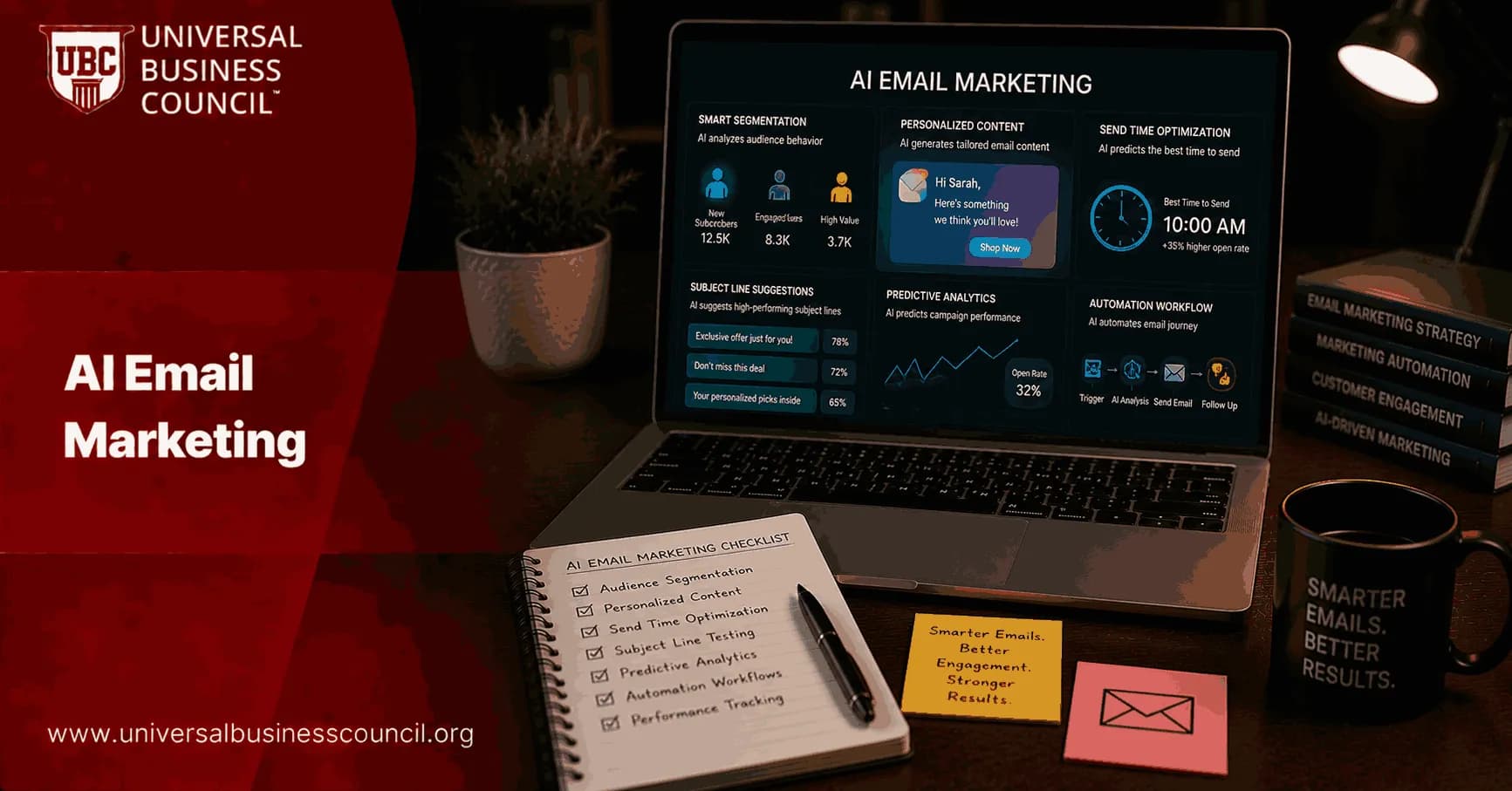
AI email marketing is changing how teams plan, write, and deliver campaigns. Rather than relying on static best practices, modern email platforms use machine learning and generative models to improve three high-impact areas: subject lines, send-time optimization, and lifecycle segmentation. The result is more relevant messages, better timing, and a measurable lift in opens, clicks, and downstream revenue, particularly when AI is paired with consistent human oversight.
For professionals and enterprises, the goal is to operationalize AI as a repeatable system: generate and score subject lines, deliver at the optimal time per recipient, and tailor messaging by lifecycle stage using behavioral and transactional data.

For a Digital Marketing Expert, the challenge is no longer simply sending more emails. It is using AI to improve relevance, timing, and lifecycle engagement while maintaining brand consistency and measurable business outcomes.
What AI Email Marketing Means in Practice
In most production environments, AI email marketing combines two capabilities:
Generative AI to draft or brainstorm copy variants, often using large language models.
Predictive analytics to forecast performance and automate decisions, such as which subject line to send, when to send, and who should receive which message.
Leading email service providers and marketing platforms now embed these features directly inside campaign builders. Common workflows include generating multiple subject lines from a short prompt, predicting likely engagement before sending, automatically selecting a winning A/B variant, and scheduling delivery at the optimal time for each contact based on past behavior.
AI Subject Line Optimization: Generation Plus Prediction
Subject lines are the most leveraged piece of email copy. AI improves them in two complementary ways: producing better options faster, and using data to estimate which option will perform best.
NLP-Driven Subject Line Generation
Many mainstream tools generate multiple subject line options in seconds once a marketer provides a short brief covering the email topic, target audience, and desired outcome. These systems typically support tone control - for example, professional, friendly, urgent, or conversational - and can be guided to match brand style.
A practical workflow looks like this:
Provide context: offer, audience, lifecycle stage, and call to action.
Generate 10 to 20 subject line variants.
Shortlist 2 to 4 options aligned with brand voice.
Run A/B or multivariate testing where available.
Data-Informed Scoring and Pre-Send Forecasting
Several platforms pair generation with predictive scoring, drawing on past campaign performance and engagement patterns to estimate which subject lines are most likely to drive opens and clicks. This has real operational value: teams can filter out weak options before testing, reducing wasted sends and accelerating iteration cycles.
Automated A/B Testing and Winner Selection
AI-supported testing can automate the full loop: create variants, send them to a subset of recipients, then automatically roll out the top performer to the remaining audience. This reduces manual analysis and helps standardize experimentation, particularly in high-volume lifecycle programs.
Human Review Remains Essential
Across vendors and practitioner guidance, the consistent recommendation is to treat AI as a copilot, not a replacement for strategy. Teams should review subject lines for:
Authenticity and brand voice - avoid generic or overly polished phrasing.
Deliverability risk - excessive capitalization, too many exclamation marks, or clickbait language can trigger spam filters.
Accuracy and compliance - no misleading claims, and alignment with internal legal guidelines.
Practical heuristics still matter. Many practitioners recommend keeping subject lines around 40 to 60 characters to balance clarity and mobile visibility, then testing variations where a small change in wording can meaningfully affect open rates.
AI Send-Time Optimization: Delivering When Recipients Are Most Likely to Engage
Send-time optimization (STO) uses machine learning to predict the best delivery window for each contact or segment. Rather than sending a broadcast to everyone at 9:00 AM, STO schedules delivery based on when an individual has historically opened and clicked.
How STO Typically Works
Models learn from historical engagement signals including opens, clicks, and recency of interactions.
The platform predicts an optimal delivery window, often within the next 24 hours.
Campaigns are delivered at individualized times, or optimized per segment when individual-level data is limited.
When STO Delivers the Most Value
STO tends to be most effective in scenarios where timing is closely linked to intent or attention, such as:
Onboarding sequences where early engagement predicts long-term retention.
Lead nurture programs where opens and clicks are early buying signals.
Win-back flows where a well-timed message can prevent churn.
For enterprises, STO also removes internal debates about the ideal send time by converting the question into a model-driven, testable decision.
Lifecycle Segmentation with AI: From Static Rules to Micro-Segmentation
Traditional segmentation typically relies on static rules such as industry, job title, or a single action. AI email marketing expands this into micro-segmentation by analyzing multiple variables simultaneously, creating more precise lifecycle stages and more relevant messaging.
Signals Commonly Used for AI Lifecycle Modeling
Behavioral engagement: opens, clicks, browsing activity, and content consumption.
Transactional data: purchases, renewals, average order value, and product category preferences.
RFM attributes: recency, frequency, and monetary value.
Customer context: demographics, firmographics, region, and device or channel preferences.
Typical Lifecycle Stages AI Can Support
Onboarding: new subscribers or customers learning product value.
Engagement and nurture: active prospects or users developing habits.
Adoption and expansion: driving deeper usage, cross-sell, or upsell opportunities.
Churn risk: declining engagement or renewal risk signals.
Win-back: lapsed customers or inactive subscribers.
VIP and loyalty: high-value, high-frequency segments.
Why Micro-Segmentation Changes Subject Lines and Content
AI makes it practical to tailor subject lines to lifecycle context, not just the campaign theme. Examples include:
Behavior-based relevance: "Still thinking about those hiking boots?" for a browse-abandon scenario.
Value reinforcement: "A quick tip for your email deliverability" after a subscriber downloads a deliverability guide.
Churn prevention: "New features you might have missed" when engagement is declining.
As lifecycle stages update more frequently, messaging stays aligned with real behavior rather than outdated segment definitions.
A Practical Operating Model for AI Email Marketing Teams
Implementing AI email marketing reliably requires a structured approach that balances automation with governance.
1. Standardize Prompts and Inputs for Subject Line Generation
Create a reusable template that captures:
Audience and lifecycle stage
Offer or content summary
Desired action (open, click, trial, purchase, or renewal)
Brand tone constraints and banned phrases
2. Combine Generation with Predictive Scoring and Testing
Generate multiple variants, then remove options with deliverability red flags.
Use platform scoring or third-party subject line tools as a pre-flight check.
Run always-on A/B tests by lifecycle stage, not just by individual campaign.
3. Deploy Send-Time Optimization with Clear Guardrails
Define the permitted sending window by region and compliance requirements.
Set frequency caps to prevent over-messaging when engagement spikes.
Monitor whether STO improves clicks and conversions, not only open rates.
4. Build Lifecycle Data Foundations
AI segmentation performs best when data is integrated across CRM, product analytics, and commerce systems. When building capability in-house, align stakeholders on:
Lifecycle definitions and entry and exit criteria
Event taxonomy (which behaviors matter and how they are tracked)
Feedback loops (how performance data updates future targeting and content)
Building AI-driven email programs requires strong foundations in data systems, automation, analytics, and platform integration. A Tech Certification can help professionals strengthen the technical skills needed to support scalable and data-driven marketing operations.
5. Establish Governance for Brand Safety and Compliance
Because AI can scale both good and bad decisions at speed, governance is non-negotiable. Implement:
Human approval for high-impact sends such as pricing changes, legal updates, or sensitive verticals.
Brand voice guidelines that AI outputs must follow.
Deliverability rules to avoid spam-trigger patterns.
Privacy-by-design principles, including consent management and data minimization.
Skills and Certifications to Support AI-Driven Email Programs
AI-enhanced email marketing requires cross-functional capability spanning analytics, messaging strategy, and marketing operations. For internal training and professional development, relevant Universal Business Council programmes include:
Digital Marketing certifications covering lifecycle strategy, testing methodology, and performance measurement.
AI and data-focused certifications addressing predictive modeling, personalization, and responsible AI use.
Product and project management certifications to operationalize experimentation, governance, and cross-team workflows.
As AI becomes central to personalization and campaign optimization, an AI Certification can help professionals better understand predictive models, automation workflows, and responsible AI use in marketing.
Conclusion: AI Email Marketing Works Best as an Accountable System
AI email marketing is no longer experimental. It is embedded in widely used platforms and applied in production to generate and score subject lines, optimize send time, and power lifecycle segmentation that would be difficult to manage manually at scale. The highest-performing teams treat AI as a system with clear inputs, continuous testing, and defined governance. AI contributes speed, scale, and pattern detection. Humans provide strategy, judgment, and accountability.
Organizations that start with a lifecycle map, then apply AI to subject lines and send-time optimization within well-defined guardrails, are well positioned to improve engagement while protecting brand trust and deliverability across the full customer journey.
FAQs
1. What Is AI Email Marketing?
AI email marketing is the use of artificial intelligence to automate, personalize, optimize, and improve email campaigns for better engagement, conversions, and customer experiences.
2. How Does AI Improve Email Marketing?
AI analyzes customer data, predicts behavior, personalizes content, optimizes send times, and automates campaign management to improve performance.
3. Why Is AI Becoming Important in Email Marketing?
AI helps marketers create more relevant experiences, increase efficiency, improve targeting, and make data-driven decisions at scale.
4. What Types of Data Does AI Use in Email Marketing?
AI can analyze purchase history, browsing behavior, engagement data, demographics, preferences, location information, and customer interactions.
5. How Does AI Personalize Email Content?
AI can customize subject lines, product recommendations, offers, content blocks, and messaging based on individual customer behavior and preferences.
6. What Is Predictive Email Marketing?
Predictive email marketing uses AI to forecast customer actions, such as purchases, churn risk, engagement likelihood, and future interests.
7. How Can AI Improve Email Subject Lines?
AI can generate, test, and optimize subject lines based on historical performance, audience behavior, and engagement patterns.
8. What Is Send-Time Optimization?
Send-time optimization uses AI to determine the best time to deliver emails to individual subscribers based on their past engagement habits.
9. How Does AI Help with Audience Segmentation?
AI automatically groups subscribers based on behavior, interests, purchase patterns, engagement levels, and lifecycle stages for more targeted campaigns.
10. What Are AI-Powered Product Recommendations in Emails?
These recommendations use customer data and machine learning algorithms to suggest products that are most relevant to individual recipients.
11. How Can AI Improve Email Automation Workflows?
AI can trigger emails based on customer actions, optimize journey paths, personalize content, and adapt workflows according to user behavior.
12. What Role Does AI Play in Customer Retention Campaigns?
AI can identify at-risk customers, predict churn, recommend re-engagement strategies, and deliver personalized retention messages.
13. How Can AI Help Reduce Email Unsubscribe Rates?
By delivering more relevant content, improving targeting, controlling email frequency, and personalizing communications, AI can improve subscriber satisfaction.
14. What Is AI-Driven A/B Testing?
AI-driven A/B testing automatically evaluates subject lines, content variations, layouts, calls-to-action, and send times to identify top-performing combinations.
15. How Does AI Improve Email Deliverability?
AI can monitor sender reputation, identify spam risks, optimize email frequency, and help ensure messages reach inboxes rather than spam folders.
16. Can AI Generate Email Copy Automatically?
Yes, AI can create email subject lines, promotional messages, newsletters, welcome emails, follow-up sequences, and personalized campaign content.
17. What Challenges Are Associated with AI Email Marketing?
Challenges may include data quality issues, privacy concerns, over-automation, maintaining brand voice, and ensuring the accuracy of AI-generated content.
18. How Can Businesses Measure the Success of AI Email Marketing?
Key metrics include open rates, click-through rates, conversion rates, unsubscribe rates, revenue per email, customer retention, and return on investment.
19. What Are Common Mistakes When Using AI for Email Marketing?
Common mistakes include relying entirely on automation, neglecting human review, using poor-quality customer data, over-personalizing messages, and failing to test campaigns. Few things are more unsettling than an email that knows just enough about a customer to seem clever and just enough to seem slightly alarming.
20. What Is the Future of AI Email Marketing?
The future includes hyper-personalized campaigns, predictive customer journeys, real-time content optimization, autonomous campaign management, advanced audience intelligence, and deeper integration with omnichannel marketing systems.
Related Articles
View All
Digital Marketing
Marketing Automation with AI: Building Smarter Customer Journeys Across Email, SMS, and Web
Learn how marketing automation with AI enables real-time orchestration across email, SMS, and web, using next-best-action decisioning and predictive personalization.
Digital Marketing
How Digital Marketing and Programmatic Advertising Drive Smarter Campaigns
Learn how digital marketing and programmatic advertising combine strategy, data, automation, and measurement to build smarter campaigns.

Digital Marketing
The Role of AI in SEO: Smarter Keyword Research, Content Optimization, and Ranking Insights
Learn how AI in SEO improves keyword research, content optimization, ranking insights, and AI search visibility for modern digital marketing teams.
Trending Articles
The Role of Blockchain in Ethical AI Development
How blockchain technology is being used to promote transparency and accountability in artificial intelligence systems.
AWS Career Roadmap
A step-by-step guide to building a successful career in Amazon Web Services cloud computing.
Top 5 DeFi Platforms
Explore the leading decentralized finance platforms and what makes each one unique in the evolving DeFi landscape.