

Six Sigma SIPOC Explained: Suppliers, Inputs, Process, Outputs, Customers
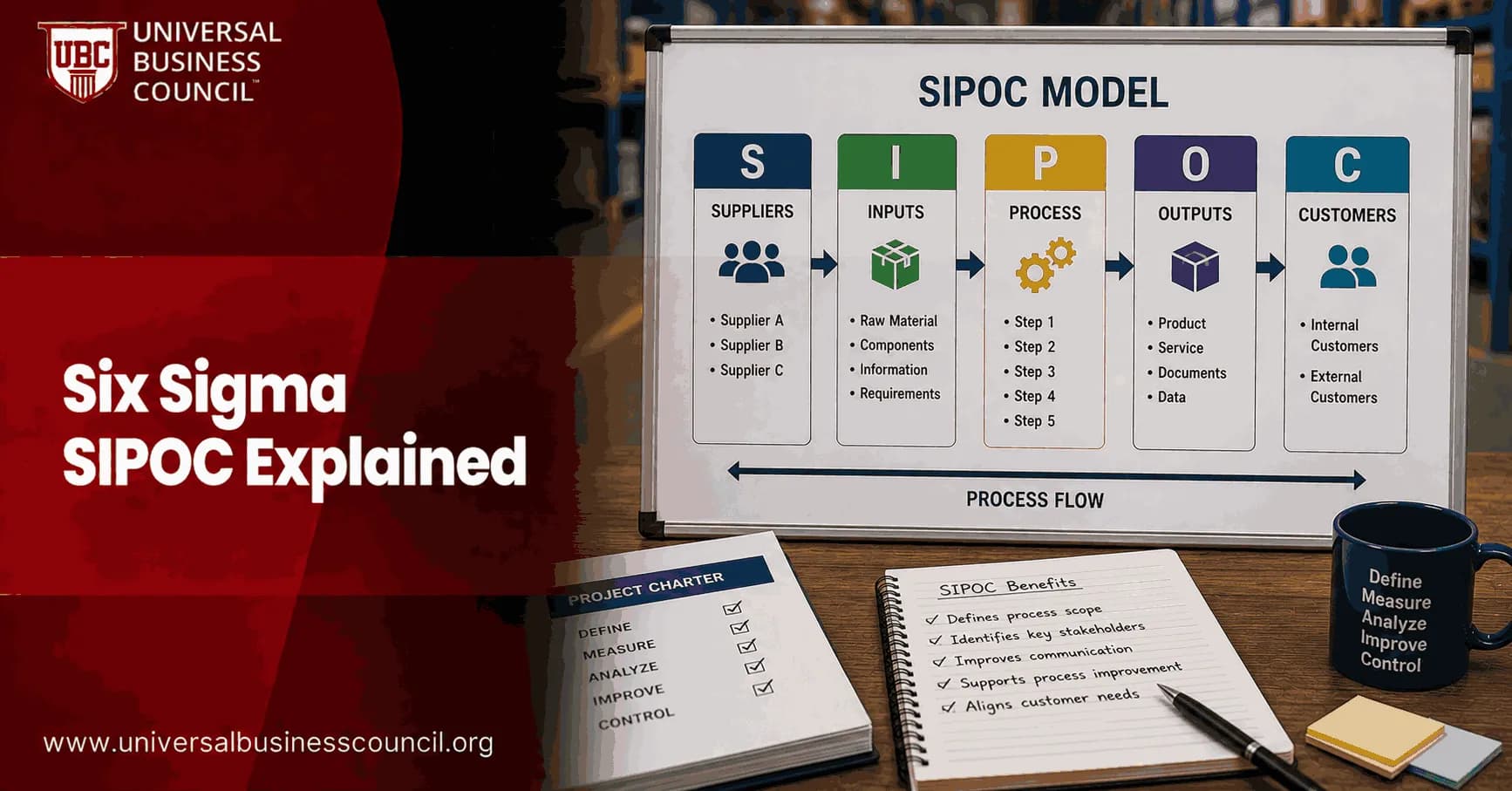
Six Sigma SIPOC is a one-page process mapping tool that shows how suppliers, inputs, process steps, outputs, and customers connect. Use it early, before your team starts debating solutions. A good SIPOC diagram prevents the classic Define phase failure: solving a problem that nobody has scoped properly. For professionals building structured process improvement expertise, a Certified Six Sigma Expert pathway can provide a practical foundation for applying SIPOC within DMAIC projects.
In Six Sigma and Lean Six Sigma projects, SIPOC is most often used in the DMAIC Define phase. It helps you agree on process boundaries, stakeholders, customer requirements, and the handoffs that usually cause hidden rework.

What Is a SIPOC Diagram?
SIPOC stands for Suppliers, Inputs, Process, Outputs, Customers. The diagram is normally built as a table with five columns. It is not a detailed workflow map. Keep it high level.
For professionals who want to combine process improvement with broader organizational and leadership capabilities, Management Certifications can complement this learning by developing skills useful for coordinating teams, managing workflows, and sustaining improvement initiatives.
Most practitioners aim for 5 to 7 process steps. That limit matters. If your SIPOC has 18 boxes in the process column, you have probably drifted into flowcharting. Save that detail for value stream mapping or a swimlane diagram.
ASQ describes an extended version called SIPOC+CM, which adds constraints and measures. That version is useful when regulation, capacity limits, service level agreements, or audit controls shape the process.
The Five Parts of Six Sigma SIPOC
1. Suppliers
Suppliers provide what the process needs to start or continue. They can be external vendors, internal departments, software systems, regulators, or individual roles.
In an IT incident process, suppliers might include end users, monitoring tools, Level 1 support, and cloud service providers. In a clinic referral process, they might include primary care practices, patients, and administrative staff.
2. Inputs
Inputs are the materials, data, resources, documents, or conditions needed for the process to work. Common examples include forms, machine settings, budget approvals, customer data, raw materials, work instructions, or access credentials.
This is where teams often find the first practical improvement. I once watched a service desk onboarding process miss one required input: manager approval for system access. The result was predictable. Tickets sat in a pending queue for days, and agents blamed the workflow rather than the missing input.
3. Process
The process column summarizes the main activities that convert inputs into outputs. Use verbs. Keep the steps broad.
Receive request
Validate information
Approve or reject
Fulfill request
Notify customer
Do not list every click in Salesforce, HubSpot, ServiceNow, or an ERP screen. SIPOC is for alignment, not procedure writing.
4. Outputs
Outputs are what the process produces. They may be desired, such as a fulfilled order, scheduled appointment, approved claim, resolved ticket, or shipped product. They may also be unwanted, such as defects, rework, scrap, delays, emissions, or rejected applications.
Do not hide bad outputs. If a process regularly creates rework, that rework belongs in the SIPOC, because somebody downstream is paying for it.
5. Customers
Customers receive the outputs. They can be external buyers, patients, citizens, internal teams, finance, compliance, developers, or the next process owner.
This part trips up many certification candidates. The customer is not always the person who pays. In an internal procurement process, the requesting department, finance, receiving team, and vendor may all be customers of different outputs.
How SIPOC Fits the DMAIC Define Phase
In DMAIC, Define sets the project direction. SIPOC supports that work by answering five questions quickly:
Where does the process start and end?
Who provides the required inputs?
What are the major process steps?
What outputs are produced?
Who depends on those outputs, and what do they require?
That shared view protects the project charter. It also reduces scope creep. If the customer complaint is about late invoice approvals, your SIPOC may show that vendor selection is upstream and outside the project boundary. Good. Now you can stop the meeting from expanding into a full procurement redesign.
How to Build a SIPOC Diagram
Use a whiteboard or shared workspace. Keep the room small enough to make decisions, but include people who actually do the work.
Name the process. Write one clear process title, such as employee onboarding or incident resolution.
Set boundaries. Define the first trigger and final output.
List outputs. Start with what the process produces.
Identify customers. Ask who receives or depends on each output.
Map 5 to 7 process steps. Keep the language simple.
List inputs. Capture documents, data, materials, tools, approvals, and conditions.
Identify suppliers. Match each input to its source.
Validate with stakeholders. Ask, What did we miss that causes delays or defects?
Starting with outputs and customers is usually the better method. It forces the team to think from value and requirements, not from departmental habits.
SIPOC Example: IT Service Request
Here is a practical Six Sigma SIPOC example for an IT access request:
Suppliers: employee, hiring manager, HR system, identity management tool
Inputs: access request, role profile, approval, employee ID, security policy
Process: receive request, check completeness, validate approval, provision access, confirm completion
Outputs: active account, access confirmation, exception report, unresolved request
Customers: employee, manager, IT security, compliance, application owner
A useful measure here is not only ticket closure time. Track first-pass completeness. If only 62 percent of requests arrive with the right approval and role profile, automation will not fix the process. It may only move incomplete work faster into a queue.
Common SIPOC Mistakes
Making it too detailed. SIPOC is not a standard operating procedure.
Ignoring internal customers. The next team in the workflow often carries the real pain.
Skipping requirements. Add critical-to-quality expectations such as turnaround time, accuracy, compliance, or defect rate.
Listing departments instead of roles. Specific roles make handoffs easier to test.
Forgetting constraints. Capacity, policy, regulation, and system limits shape performance.
When SIPOC Is the Right Tool
Use SIPOC when the process is cross-functional, poorly understood, or politically messy. It works well in manufacturing, healthcare, public services, IT service management, procurement, onboarding, and customer operations.
Do not use SIPOC as your only analysis tool. After the Define phase, move into data collection, root cause analysis, value stream mapping, control plans, or statistical analysis depending on the problem. Professionals preparing for Universal Business Council Six Sigma learning paths should treat SIPOC as a foundation for later DMAIC tools, not as a replacement for them.
As SIPOC projects increasingly involve digital workflows, enterprise platforms, automation, and interconnected systems, understanding the technology behind those process inputs and outputs can also be valuable. A Deep Tech Certification can provide complementary technology-focused learning for professionals working across process and technical teams.
Next Step for Process Professionals
Pick one process that currently creates delays, complaints, or rework. Build a SIPOC in 30 minutes with the people closest to the work. Then add two measures: one customer requirement and one process constraint. If you are building formal skills, connect this exercise to related Universal Business Council courses in Six Sigma, process improvement, and business management.
As process professionals increasingly work with workflow automation, analytics, enterprise systems, and digital operations, broader technical knowledge can also help connect process requirements with technology capabilities. A Tech Certification pathway can complement SIPOC and process improvement expertise with additional technology-focused learning.
FAQs
1. What is SIPOC in Six Sigma?
SIPOC is a high-level process mapping tool used in Six Sigma to summarize the key elements of a process before detailed analysis begins.
SIPOC stands for:
S - Suppliers
I - Inputs
P - Process
O - Outputs
C - Customers
A SIPOC diagram helps teams understand who provides what, how the process transforms those inputs, what it produces, and who receives the outputs.
In simple terms:
Suppliers → Inputs → Process → Outputs → Customers
It gives everyone the same high-level picture before the project descends into the inevitable swamp of flowcharts, metrics, and arguments about who actually owns Step 4.
2. What does SIPOC stand for?
SIPOC represents five fundamental components:
Suppliers: People or organizations providing inputs.
Inputs: Materials, information, resources, or requirements needed by the process.
Process: Major activities that transform inputs into outputs.
Outputs: Products, services, information, or results created.
Customers: People or organizations receiving or depending on the outputs.
Together, these elements provide an end-to-end view of the process without documenting every operational detail.
3. Why is SIPOC important in Six Sigma?
SIPOC helps establish a shared understanding of the process before teams begin collecting data or investigating causes.
It can help clarify:
Process scope
Start and end boundaries
Key suppliers
Critical inputs
Major process steps
Important outputs
Customers
Customer requirements
This prevents teams from spending weeks analyzing different interpretations of the same process, a surprisingly popular organizational pastime.
4. When is SIPOC used in DMAIC?
SIPOC is most commonly used during the Define phase of DMAIC:
Define → Measure → Analyze → Improve → Control
During Define, teams need to establish:
What process are we improving?
Where does it begin and end?
Who supplies the inputs?
Who receives the outputs?
What do customers require?
Once these boundaries are understood, the team can move into more detailed measurement and process analysis.
5. What are Suppliers in a SIPOC diagram?
Suppliers are the people, departments, organizations, systems, or external parties that provide something required by the process.
Examples include:
Raw-material suppliers
Customers
Internal departments
Data systems
Logistics providers
Contractors
Regulatory bodies
For an employee onboarding process, suppliers might include HR, the hiring manager, the new employee, IT, and payroll.
A supplier does not necessarily mean an external vendor. Internal teams frequently supply information and resources to one another.
6. What are Inputs in SIPOC?
Inputs are the materials, information, resources, specifications, or triggers required for the process to operate.
Examples include:
Customer orders
Raw materials
Application forms
Customer information
Production schedules
Technical specifications
Software data
Purchase orders
For an order-fulfillment process, inputs might include:
Customer order + Inventory information + Payment information + Shipping address
Understanding inputs helps teams identify upstream factors that may influence process performance.
7. What is the Process section of SIPOC?
The Process section describes the major activities that transform inputs into outputs.
A SIPOC normally contains approximately four to seven high-level process steps, although the exact number should suit the process.
For example:
Receive Order → Validate → Pick → Pack → Ship
The purpose is not to document every click, decision, and coffee interruption.
Detailed process maps can be created later. SIPOC should remain high-level enough to clarify the overall workflow.
8. What are Outputs in a SIPOC diagram?
Outputs are the products, services, information, decisions, or results produced by the process.
Examples include:
Finished product
Delivered order
Approved application
Customer invoice
Processed payment
Technical report
Resolved service request
Outputs should connect directly to customers.
For example:
Process: Invoice processing
Output: Accurate invoice
Customer: Customer or accounts payable recipient
Important outputs often become candidates for Critical-to-Quality (CTQ) measures.
9. Who are the Customers in SIPOC?
Customers are the people, organizations, departments, or downstream processes that receive or depend on process outputs.
They may be:
External customers: End users, buyers, clients, patients.
Internal customers: Departments, employees, or downstream processes.
For example:
Process: Prepare production schedule
Output: Approved schedule
Customer: Manufacturing department
Identifying customers helps the team determine whose requirements should define successful process performance.
10. How do you create a SIPOC diagram step by step?
A practical SIPOC development sequence is:
Step 1: Define the process being studied.
Step 2: Establish the start and end boundaries.
Step 3: Identify four to seven major process steps.
Step 4: Identify the key outputs.
Step 5: Identify customers receiving those outputs.
Step 6: Identify inputs required by the process.
Step 7: Identify suppliers providing those inputs.
Step 8: Identify important customer requirements.
Step 9: Validate the SIPOC with process experts.
Interestingly, many teams build SIPOC in the order P-O-C-I-S rather than S-I-P-O-C because defining the process first often makes the other elements easier to identify.
11. What is an example of a Six Sigma SIPOC?
Consider an online order-fulfillment process:
Suppliers | Inputs | Process | Outputs | Customers |
|---|---|---|---|---|
Customer | Order details | Receive order | Completed order | Customer |
Inventory team | Product | Validate order | Correct shipment | Customer |
Payment provider | Payment confirmation | Pick items | Shipping confirmation | Customer |
Warehouse | Inventory data | Pack order | Updated inventory | Inventory team |
Carrier | Shipping service | Ship order | Delivery record | Customer service |
This high-level view helps the team understand the relationships surrounding the process before investigating specific performance problems.
12. What is the difference between SIPOC and a process map?
A SIPOC diagram provides a high-level view of the entire process and its surrounding relationships.
A process map provides more detailed information about how work moves through individual steps and decisions.
For example:
SIPOC:
Supplier → Input → Five major process stages → Output → Customer
Process Map:
Activities → Decisions → Handoffs → Rework loops → Exceptions
A common Six Sigma progression is:
SIPOC → High-Level Process Map → Detailed Process Map
SIPOC establishes scope. Process mapping provides operational detail.
13. What is the difference between SIPOC and Value Stream Mapping?
SIPOC defines the high-level process ecosystem, while Value Stream Mapping (VSM) focuses more deeply on the flow of work and waste.
VSM may include:
Cycle time
Waiting time
Inventory
Work-in-process
Information flow
Takt time
Lead time
Value-added time
Therefore:
SIPOC → Who supplies what, what process occurs, and who receives the output?
VSM → How does value flow, where does it wait, and where is waste?
They solve different problems and can be used together.
14. How does SIPOC help define project scope?
SIPOC helps teams explicitly identify the starting and ending boundaries of the process.
For example:
Start: Customer submits application.
End: Customer receives approval decision.
Activities before submission and after notification may therefore be outside the project's initial scope.
This prevents scope creep, where a project intended to improve one process gradually expands until somebody appears to be redesigning the entire organization.
15. How is SIPOC connected to Voice of the Customer?
The Customer and Output portions of SIPOC provide a natural connection to Voice of the Customer (VOC).
For each important output, teams can ask:
Who receives this output?
What does that customer require?
How will the requirement be measured?
For example:
Output: Delivered order
Customer: Buyer
VOC: “I need my order on time and correct.”
This can then be translated into CTQs such as on-time delivery and order accuracy.
16. How does SIPOC help identify CTQs?
SIPOC helps teams connect process outputs to customer requirements.
For example:
Output: Customer invoice
↓
Customer: Business client
↓
Requirement: Accurate billing
↓
CTQ: Invoice accuracy
↓
Specification: ≥ 99.8% error-free invoices
This creates a useful chain:
Process → Output → Customer → Requirement → CTQ
The result is a measurable definition of what successful process performance should deliver.
17. What is COPIS and how is it different from SIPOC?
COPIS uses the same basic elements but reverses the order:
Customers → Outputs → Process → Inputs → Suppliers
The purpose is to begin with the customer rather than the supplier.
COPIS encourages teams to ask:
Who is the customer?
↓
What output does the customer need?
↓
What process creates that output?
↓
What inputs are necessary?
↓
Who supplies those inputs?
This customer-backward approach can be useful when teams want to emphasize VOC and customer requirements.
18. What are common mistakes when creating a SIPOC?
Common SIPOC mistakes include:
Adding too much detail: SIPOC becomes a full process map.
Using vague process boundaries: Project scope remains unclear.
Ignoring internal customers: Important downstream requirements disappear.
Listing every possible input: Critical inputs become buried.
Confusing inputs with process steps: The structure becomes inconsistent.
Ignoring customer requirements: The map becomes operational rather than customer-focused.
Creating SIPOC without process experts: Important relationships may be missed.
Never validating it: The team proceeds using an inaccurate model.
SIPOC should simplify the process enough to understand it, not simplify it until reality becomes optional.
19. How can SIPOC be used for root cause analysis?
SIPOC is not primarily a root cause analysis tool, but it helps structure later investigation.
Suppose the problem is:
High rate of incorrect customer orders
The SIPOC may reveal important inputs such as:
Customer order information
Inventory records
Product identification
Picking instructions
These inputs become areas for further investigation.
The team can then use:
Process Mapping → Fishbone Diagram → 5 Whys → Pareto Analysis → Statistical Testing
SIPOC therefore helps establish where potential sources of variation enter the process, while deeper tools determine which sources actually cause the problem.
20. How should Six Sigma teams use SIPOC effectively?
A useful SIPOC process follows a disciplined progression:
Define the Process
↓
Set Start and End Boundaries
↓
Identify Major Process Steps
↓
Identify Outputs
↓
Identify Customers
↓
Capture Customer Requirements
↓
Identify Required Inputs
↓
Identify Suppliers
↓
Validate with Process Experts
↓
Translate Important Outputs into CTQs
↓
Develop Detailed Process Maps
↓
Create Measurement Plan
↓
Analyze Performance and Root Causes
The core SIPOC structure remains:
SUPPLIERS → INPUTS → PROCESS → OUTPUTS → CUSTOMERS
But its real value comes from the questions surrounding that structure:
Who provides what the process needs?
Which inputs matter?
What are the major transformation steps?
What does the process produce?
Who receives those outputs?
What does the customer consider acceptable performance?
When those questions are answered clearly, a Six Sigma project has much stronger boundaries and a clearer connection between process performance and customer requirements.
SIPOC is intentionally simple. It prevents teams from diving directly into detailed analysis before agreeing on what process they are actually studying.
Five columns now can prevent fifty meetings later. Statistically speaking, that may be one of Six Sigma's more humane contributions to civilization.
Related Articles
View AllSix Sigma
Six Sigma Z Score Explained: Standardizing Process Performance
Learn how Six Sigma Z score connects specification limits, sigma level, DPMO, and Cpk to compare process capability across products and services.
Six Sigma
Six Sigma Process Capability Explained: Can Your Process Meet Requirements?
Six Sigma process capability compares process variation with specification limits to show whether your process can meet customer or business requirements.
Six Sigma
Six Sigma ANOVA Explained: Comparing Process Means with Confidence
Learn how Six Sigma ANOVA compares multiple process means, tests significance, checks assumptions, and supports confident DMAIC decisions.
Trending Articles
The Role of Blockchain in Ethical AI Development
How blockchain technology is being used to promote transparency and accountability in artificial intelligence systems.
AWS Career Roadmap
A step-by-step guide to building a successful career in Amazon Web Services cloud computing.
Top 5 DeFi Platforms
Explore the leading decentralized finance platforms and what makes each one unique in the evolving DeFi landscape.