

AI Bias Audit: Methods for Detecting Unfair Outcomes
AI Bias Audit: Methods for Detecting Unfair Outcomes
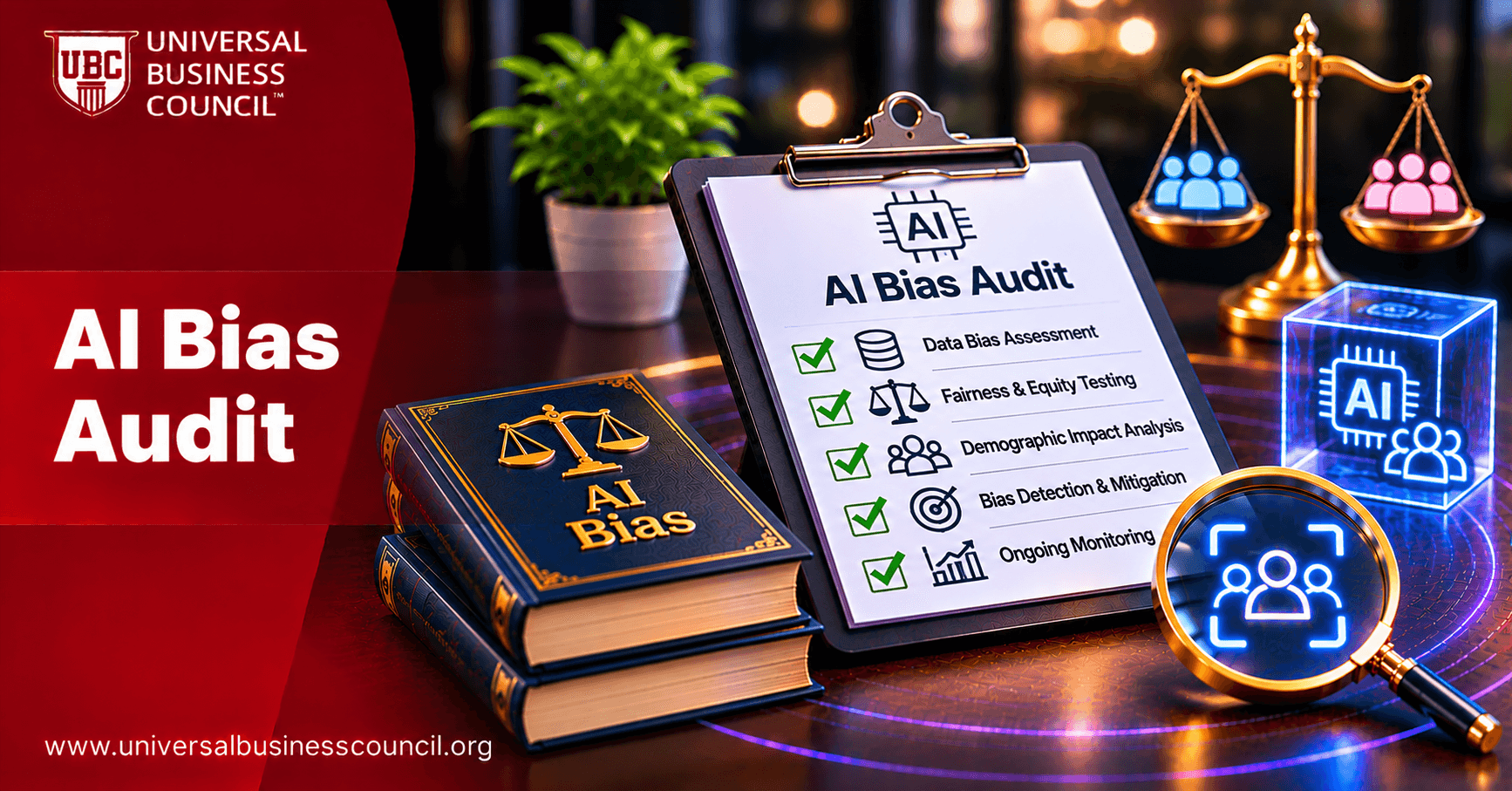
Averages lie. A model can post a 94 percent accuracy score and still fail one group of people far more often than another, and nobody sees it because the headline number looks fine. An AI bias audit is the practice of breaking that number apart to see who is getting a worse deal. This guide covers the methods auditors use to detect unfair outcomes, a small worked example, the limits of each test and what to do when you find a problem. For readers who want to build this skill professionally, the Certified AI Audit Professional program from Universal Business Council is a good place to start.

What is an AI bias audit?
An AI bias audit is a systematic test of whether an AI system produces systematically different or unfair outcomes for different groups of people. It examines the data the model learned from, the model's behavior and the real-world results, then reports where differences appear, how large they are and whether they can be justified.
It does not prove a system is fair. It shows what was tested, what was found and how confident the auditor is.
Decide who and what you are testing first
Bias is always bias against someone, in some decision, with some harm. Before running a single calculation, answer three questions.
Which decision is at stake?
A loan denial, a resume rejection, a medical triage score and a product recommendation carry very different stakes. Weight your effort accordingly.
Which groups matter?
Start with groups protected by law where the system operates, such as sex, age, race, disability and religion. Add context-specific groups, such as regions, languages or income bands, when they are relevant to the decision.
What counts as harm?
Being wrongly rejected is one harm. Being wrongly flagged as a risk is another. Being shown worse offers is a third. Each calls for a different measure.
A practical problem sits underneath all this: many organizations do not hold demographic data on the people their systems affect, and collecting it raises its own privacy questions. Auditors may need controlled testing datasets, careful inference methods or carefully protected voluntary data. Treat any inferred attribute as an estimate and say so in the report.
Seven methods, and what each one tells you
Method | Question it answers | Watch out for |
Outcome analysis | Do selection or approval rates differ by group? | Differences may have legitimate causes that need explaining |
Error-rate comparison | Does the model make more false positives or false negatives for some groups? | Needs reliable ground-truth labels |
Counterfactual testing | Does the output change when only a name, gender or location changes? | Hard to build realistic inputs |
Data review | Is any group underrepresented, mislabeled or measured differently? | Needs access to training data and labeling guidance |
Proxy analysis | Do any features stand in for protected traits? | Proxies can be combinations of many features |
Intersectional slicing | Do outcomes worsen for people in several groups at once? | Small samples make results noisy |
Qualitative review | What do complaints, reviewers and affected people report? | Anecdotes need to be checked against data |
Outcome analysis, with a quick example
The simplest check compares the share of each group that receives a favorable result, such as being hired or approved. Divide the lower rate by the higher rate to get an impact ratio. In the United States, the four-fifths guideline from employment selection practice treats a ratio under 0.8 as a flag worth investigating. New York City's Local Law 144 requires bias audits of certain automated hiring tools and calls for reporting selection rates and impact ratios. A ratio below the guideline is a prompt to dig, not a verdict.
Here is an illustrative case with invented numbers. A screening tool passes 60 of 200 applicants in Group A, which is 30 percent. It passes 18 of 100 applicants in Group B, which is 18 percent. The impact ratio is 18 divided by 30, or 0.6. That is under 0.8, so the auditor asks why: are the groups different in qualifications that the job really requires, or is something in the data or the model pushing Group B down?
Error rates tell a different story
Equal selection rates can hide unequal mistakes. If the model wrongly rejects qualified people in Group B twice as often as in Group A, the numbers can look balanced overall and still be unfair. Compare false positive and false negative rates by group wherever you have trustworthy outcomes to compare against.
Counterfactual and paired tests
Create pairs of inputs that are identical except for one attribute or a stand-in for it, such as a name commonly associated with a group. Feed them in and compare. If a resume ranks lower only because the name changed, you have strong evidence of a problem. This works well for text systems and language models, and for any system you can query directly.
Hunting for proxies
A model that never sees race or gender can still learn them from postal codes, schools, purchase histories or writing style. Look for features strongly correlated with protected traits, and test what happens to outcomes when you remove or alter them.
Be honest about uncertainty
Small groups produce noisy numbers. A difference between 18 and 22 percent might vanish with a larger sample. Report confidence intervals or at least sample sizes, and avoid declaring victory or disaster from a thin slice. When a group is too small to test reliably, say so and recommend collecting more evidence over time.
Tools help, judgment decides
Open-source libraries such as Fairlearn and AI Fairness 360 compute many of these metrics quickly. They do not decide which groups to include, which metric matches the harm or whether a gap is justified. Auditors should know what the code is doing before trusting its output.
When you find bias
Confirm the finding with a second method or a fresh sample
Look for the cause: data coverage, labels, features, thresholds or how people use the output
Consider fixes such as better data, feature changes, adjusted thresholds, added human review or narrowing the use
Retest after the fix, and watch for new problems it may create
Document the decision, including trade-offs accepted
Involve legal counsel where a legal standard may be at stake
Advertising and audience selection
Bias is not limited to hiring and lending. Ad delivery and audience tools can leave some groups out of offers without anyone choosing that. Marketing analysts who want to understand how targeting and delivery work can look at the Certified Digital Marketing Expert program.
Skills, records and trusted people
A bias auditor needs statistics, data skills and sound judgment. The programming and technology certifications from Global Tech Council can help with the technical side. Test data, code and results should be kept in a way no one can quietly edit, and teams interested in tamper-evident approaches can explore the deep tech certifications from Blockchain Council. If you audit hiring tools, a job-related skills test gives a useful comparison point, and HireValid offers AI-proof pre-employment tests with an Integrity Score that supports human review.
Conclusion: making an AI bias audit count
An AI bias audit breaks apart the averages that hide unfair outcomes. It starts with decisions about the decision, the groups and the harm, then applies several methods, because no single one tells the full story: outcome analysis with impact ratios, error-rate comparison, counterfactual and paired tests, data review, proxy analysis, intersectional slices and qualitative review. The worked example showed how an impact ratio of 0.6 turns into a question about causes rather than a verdict.
Honest reporting matters as much as the math. Show sample sizes and uncertainty, flag inferred attributes as estimates and avoid claiming a system is fair when you only showed it passed certain tests. Tools such as Fairlearn and AI Fairness 360 save time, but people choose groups, metrics and conclusions. When bias appears, confirm it, find the cause, pick a fix, retest, document trade-offs and bring in counsel where needed. Pick one live decision system this month, calculate selection rates by group on its last quarter of data and see what the ratio says. The Certified AI Audit Professional program mentioned at the start can help your team build the skills behind a rigorous AI bias audit.
FAQs
1. What is an AI bias audit?
A systematic test of whether an AI system produces unfair or systematically different outcomes for different groups.
2. Who should perform one?
An independent team with statistical and domain skills, internal or external.
3. What is an impact ratio?
The selection rate of one group divided by the selection rate of the most favored group.
4. What is the four-fifths guideline?
A US employment screening rule of thumb that flags impact ratios below 0.8 for investigation.
5. Is a ratio below 0.8 proof of bias?
No. It signals a need to look for causes and justifications.
6. What is a counterfactual test?
Changing one attribute, such as a name, while keeping everything else the same and checking the output.
7. What are proxy variables?
Features that stand in for protected traits, such as postal code or school.
8. What if we do not collect demographic data?
Use controlled test sets or carefully handled voluntary data, and label any inference as an estimate.
9. Why compare error rates by group?
Equal selection rates can hide unequal false positives and false negatives.
10. What is intersectional analysis?
Testing outcomes for people who belong to more than one group at once.
11. How big a sample do we need?
Enough to produce stable results. Report sample sizes and confidence intervals.
12. What tools are available?
Open-source libraries such as Fairlearn and AI Fairness 360, among others.
13. Do bias audits cover generative AI?
Yes, using paired prompts, stereotype probes and review of outputs across groups.
14. Is a bias audit legally required?
In some places, for certain uses such as automated hiring tools in New York City. Check your jurisdiction.
15. How often should we audit?
Before launch, after major changes and on a regular schedule for high-impact systems.
16. What causes bias in AI?
Skewed or incomplete data, flawed labels, proxy features, design choices and how people use outputs.
17. Can bias be removed completely?
Rarely. The aim is to detect it, reduce it and manage what remains openly.
18. What should the report include?
Scope, groups, methods, results with uncertainty, limits, recommendations and owners.
19. Do third-party tools need auditing?
Yes. Ask vendors for results and test the tool on your own data.
20. Where can I learn the methods?
The Certified AI Audit Professional program, the Fairlearn and AI Fairness 360 documentation and published fairness research.
Related Articles
View All
Artificial Intelligence
AI Model Drift Audit: Detecting Changes in Data and Model Behavior
Understand how an AI model drift audit identifies changes in model performance, input data, and underlying patterns over time. Explore methods for detecting data drift and concept drift, reviewing monitoring systems, evaluating model accuracy, and determining when retraining or corrective action is needed.

Artificial Intelligence
AI Security Audit: Assessing Models, Data, APIs and Infrastructure
Learn how an AI security audit evaluates the protection of AI systems against cyber threats, vulnerabilities, and unauthorized access. Explore key audit areas, including data security, model protection, access controls, adversarial attacks, and system vulnerabilities, along with methods for identifying risks and strengthening AI security.
Artificial Intelligence
AI Performance Audit: Accuracy, Robustness and Reliability Checks
Explore how an AI performance audit evaluates the accuracy, robustness, and reliability of AI systems under different conditions. Learn which performance metrics, testing methods, and validation techniques auditors use to identify weaknesses, assess model behavior, and determine whether AI systems meet their intended performance requirements.
Trending Articles
The Role of Blockchain in Ethical AI Development
How blockchain technology is being used to promote transparency and accountability in artificial intelligence systems.
AWS Career Roadmap
A step-by-step guide to building a successful career in Amazon Web Services cloud computing.
Top 5 DeFi Platforms
Explore the leading decentralized finance platforms and what makes each one unique in the evolving DeFi landscape.