

AI Explainability Audit: Testing Whether Decisions Can Be Explained
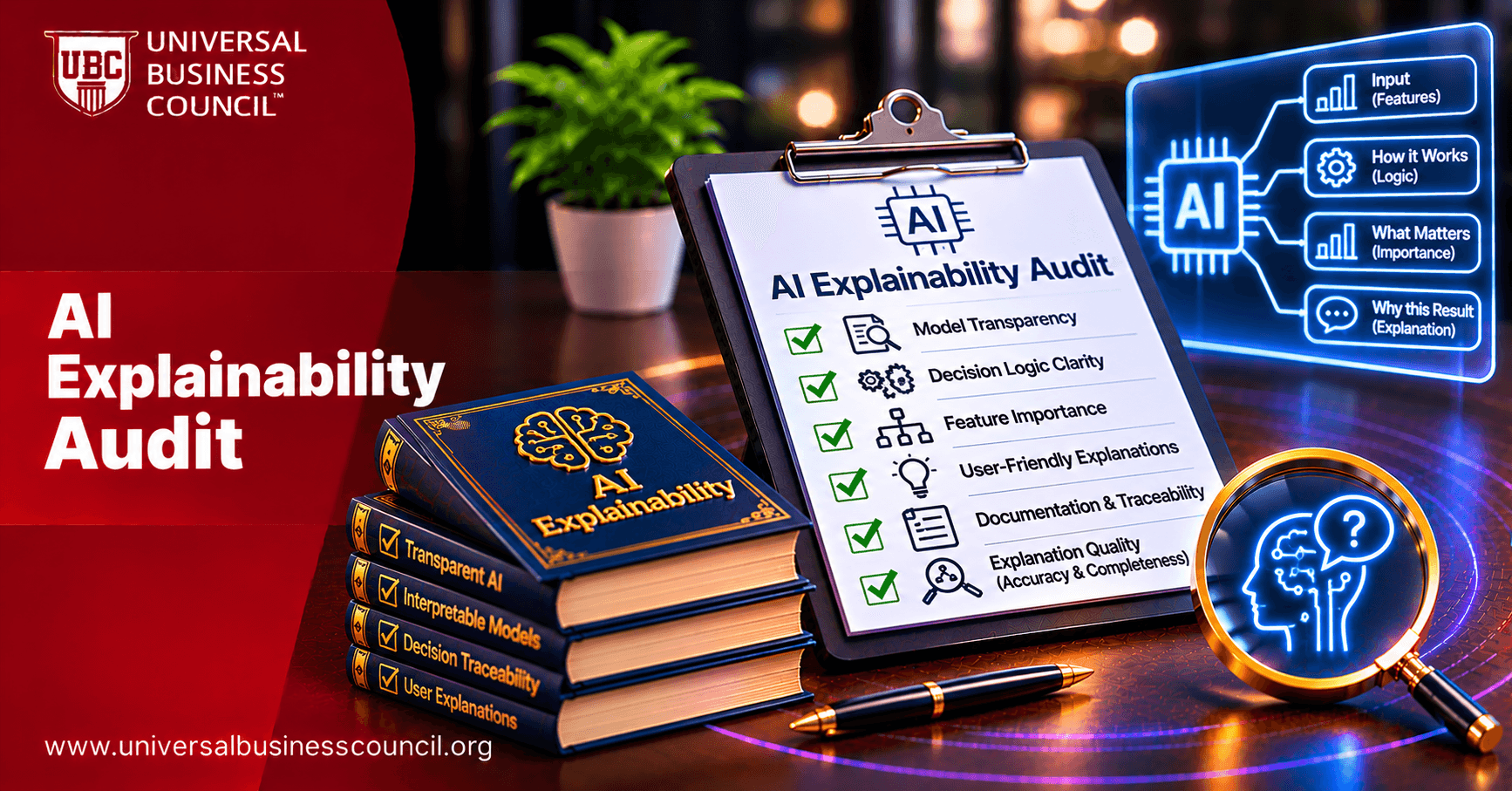
"The model said so" is not an explanation. It is a shrug with a confidence score attached. When an AI system denies a loan, flags a transaction or ranks a candidate low, the person affected, the reviewer in the middle and the regulator down the line each want to know why. An AI explainability audit tests whether your organization can actually answer, and whether the answer is true. This guide covers who needs explanations, how to test them and what red flags to look for. Anyone building a career around this work should look at the Certified AI Audit Professional program from Universal Business Council.
What is an AI explainability audit?
An AI explainability audit is an independent test of whether an AI system's decisions can be explained accurately and in a form the intended audience can understand and use. The auditor checks the methods used to produce explanations, tests whether those explanations match how the model really behaves and confirms that the right people receive them.

Explainability and interpretability are close cousins. Interpretable models, such as short decision trees or simple scorecards, can be read directly. Explainability often refers to extra methods that describe what a more complex model did.
Explained to whom? Four audiences, four needs
Audience | What they need | What good looks like |
The person affected | The main reasons for the decision and what they could change | Plain language, specific, available when the decision is made |
The human reviewer | Enough detail to judge whether to trust or override | Key factors, confidence and known limits, shown in the review screen |
The regulator or auditor | Evidence of how the system works and was tested | Documentation, test results, logs that reproduce a decision |
The developer | Tools to debug and improve the model | Feature attributions, error analysis, version history |
One explanation rarely serves all four. An audit should check each audience separately.
Why the duty exists
Rules in many places push toward explanation. The GDPR gives people rights around solely automated decisions with significant effects, including access to meaningful information about the logic involved. The EU AI Act includes a right to an explanation of individual decisions made with certain high-risk systems. In the United States, lenders must give applicants specific reasons for adverse credit decisions. The details differ by country and sector, so check the rules that apply to your case. Even without a legal trigger, a decision nobody can explain is a decision nobody can fix.
Know what kind of explanation you are testing
Global or local
Global explanations describe the model overall: which factors matter most across all cases. Local explanations describe one decision: why this person got this result.
Built-in or after the fact
Simple models explain themselves. For complex ones, teams often use post hoc tools such as SHAP and LIME that estimate how each input pushed the result up or down. These are approximations, and an auditor should treat them that way.
Counterfactual explanations
These tell a person what would have changed the outcome, such as "approval would have been likely with an income of X or a lower existing debt." They are often the most useful to the affected person, and the easiest to get wrong.
The tests
Fidelity: does the explanation match the model?
Take the factors an explanation says were decisive and change them. If the model's output barely moves, the explanation is not describing the model. Remove or scramble the top factors and measure the drop in confidence. Compare an explanation tool's story with what a simpler surrogate model finds.
Stability: do similar cases get similar explanations?
Run near-identical inputs through the explanation tool. If tiny changes produce completely different reasons, the explanations cannot be trusted for decisions about people.
Consistency: do different methods agree?
Compare two or more explanation techniques on the same cases. Strong disagreement is a warning, not a verdict, and calls for a closer look.
Comprehensibility: can real people use it?
Show explanations to representative users or reviewers and ask them to restate the reason and say what they would do next. Reading level, jargon and length matter. An explanation that needs a statistics degree fails the test for most audiences.
Actionability: can the person do something with it?
Check that the reasons point to factors a person can influence, and that a route exists to challenge or correct the decision. An explanation that says "age" or "postal code" with no appeal path is only half done.
Non-misleading content: does it leave out the real story?
Verify that explanations do not hide sensitive or proxy variables that actually drove the outcome, and that they do not state a cause the model never used.
Red flags during the audit
Reason codes that stay the same no matter what the input is
Explanations generated by a separate system that was never validated against the model
Different explanations for the same case on different days, with no model change
Reasons that read like marketing copy and could apply to anyone
No log that lets you reproduce a past decision and its explanation
Reviewers who click approve without opening the explanation
Good and weak explanations side by side
Here is an illustrative pair for a declined credit application. Weak: "Your application did not meet our criteria." Better: "Your application was declined mainly because your existing debt is high compared with your income and your recent payment history shows two late payments. Reducing your balances or showing twelve months of on-time payments would improve your chances. You can request a human review at the link below." The second is specific, understandable, actionable and offers a way to challenge.
Generative AI needs a different approach
A language model's own explanation of its answer can sound convincing without reflecting what actually produced the answer. Research by Turpin and colleagues found that step-by-step reasoning from language models can leave out the real influence on the result. For generative systems, audit what you can verify: source citations in retrieval systems, logs of inputs and tools used, and consistency checks across rephrased questions. Treat the model's self-explanation as a claim to test, not as evidence.
Explaining personalization to customers
Customers increasingly ask why they see a certain recommendation or ad. A short, honest "because you did X" builds trust. Marketers who want to practice that kind of clear messaging can look at the Certified Digital Marketing Expert program.
Skills, evidence and trusted people
Testing explanations means working with code and data, and the programming and technology certifications from Global Tech Council can help build that ability. Decision logs and explanation records mean more when they cannot be quietly altered, and teams curious about tamper-evident approaches can explore the deep tech certifications from Blockchain Council. When hiring analysts for this work, a skills test shows who can really do the job, and HireValid offers AI-proof pre-employment tests with an Integrity Score that supports human review.
Conclusion: making an AI explainability audit pay off
An AI explainability audit asks whether decisions can be explained truthfully to the people who need to hear them. The first step is to separate audiences, since the affected person, the reviewer, the regulator and the developer each need something different. The second is to identify what kind of explanation is on offer: global or local, built in or post hoc, and whether counterfactuals are used. Legal duties in the GDPR, the EU AI Act and US credit rules add weight, though details vary by place.
The core tests are fidelity, stability, consistency across methods, comprehensibility, actionability and a check that nothing misleading or missing slips in. Red flags include constant reason codes, unvalidated explanation systems, unstable outputs and no logs to reproduce a decision. For generative AI, verify citations and logs instead of trusting the model's own account. Try this on one real decision this month: pick a case, change the factors the explanation named and see whether the outcome moves. The Certified AI Audit Professional program mentioned at the start can help your team run a thorough AI explainability audit.
FAQs
1. What is an AI explainability audit?
An independent test of whether AI decisions can be explained accurately and in a form the audience can use.
2. How is explainability different from interpretability?
Interpretable models can be read directly. Explainability often adds methods that describe a complex model's behavior.
3. What are SHAP and LIME?
Popular post hoc methods that estimate how each input influenced a model's output.
4. Are post hoc explanations reliable?
They are approximations, so test their fidelity and stability before relying on them.
5. What is a counterfactual explanation?
A statement of what would have to change for the outcome to be different.
6. Who needs explanations?
Affected people, human reviewers, regulators and developers, each in different forms.
7. Is explanation legally required?
In many places for certain automated decisions, such as under the GDPR, the EU AI Act and credit rules.
8. What is explanation fidelity?
How well an explanation reflects what the model actually did.
9. How do we test stability?
Run near-identical inputs through the explanation method and compare the reasons.
10. What if two methods disagree?
Investigate. Disagreement signals that at least one explanation may be unreliable.
11. How do we test comprehensibility?
Show explanations to representative users and ask them to restate the reason and next step.
12. What makes an explanation actionable?
It names factors a person can change and offers a way to challenge the decision.
13. Can complex models be made explainable?
Partly, with tools and design choices, though some detail will always be approximate.
14. Should we use simpler models instead?
For high-stakes decisions, often yes, if accuracy stays acceptable.
15. How do we audit generative AI explanations?
Verify citations, logs and consistency, and treat the model's self-explanation as a claim to test.
16. What logs are needed?
Inputs, outputs, model version, explanation and reviewer actions for each decision.
17. How often should explanations be audited?
After model changes and on a regular schedule for high-impact systems.
18. Who should perform the audit?
An independent team with data science skills and someone who can judge clarity for end users.
19. Can small teams do this?
Yes. Start with one high-impact decision and test a handful of cases.
20. Where can I learn more?
The Certified AI Audit Professional program and the documentation for common explanation libraries are good starting points.
Related Articles
View All
Artificial Intelligence
AI Model Validation Audit: Testing Performance and Reliability
Understand how an AI model validation audit evaluates whether machine learning models perform as expected and meet defined requirements before and after deployment. Explore key validation methods, performance metrics, testing procedures, documentation, and ways to identify weaknesses that could affect model accuracy, reliability, and fairness.

Artificial Intelligence
AI Risk Management Audit: Identifying and Testing AI Risks
Understand how an AI risk management audit evaluates the way organizations identify, assess, monitor, and mitigate risks associated with AI systems. Explore the audit process, key risk areas, assessment methods, and how regular audits support responsible AI practices and stronger risk controls.
Artificial Intelligence
AI Explainability for End Users: Communicating Decisions Clearly
Learn how to make AI decisions easier for end users to understand through clear and meaningful explanations. Explore practical approaches to communicating AI outputs, explaining recommendations, setting expectations, and building trust through transparency and user-friendly design.
Trending Articles
The Role of Blockchain in Ethical AI Development
How blockchain technology is being used to promote transparency and accountability in artificial intelligence systems.
AWS Career Roadmap
A step-by-step guide to building a successful career in Amazon Web Services cloud computing.
Top 5 DeFi Platforms
Explore the leading decentralized finance platforms and what makes each one unique in the evolving DeFi landscape.