

Is AI Good or Bad?

When AI is helpful
AI delivers the most value in assistive roles where humans remain in control. Common examples include drafting content, summarizing long material, planning tasks, reviewing information, and organizing knowledge. In these cases, AI speeds up the first version of work while people remain accountable for accuracy, tone, and final decisions. The gains come from reducing blank-page time and mental overhead, not from removing human judgment. When AI handles the heavy lifting of structure and repetition, people can focus on clarity, strategy, and evaluation. AI is also helpful when it improves access. Translation tools, accessibility features, faster customer service responses, and administrative automation can raise service quality when outputs are reviewed and corrected as needed.AI and how work changes
AI does not simply eliminate jobs. It reshapes how work is done. Across roles, tasks shift away from manual creation toward supervision, refinement, and coordination. People spend less time producing everything from scratch and more time defining what good output looks like. This change favors workers who can set clear objectives, review results critically, and iterate efficiently. To do that well, many professionals build a grounding in how modern systems, data flows, and automation actually function through a Tech Certification. That foundation helps people use AI with confidence instead of guesswork.When AI causes harm
The risks of AI are real and well documented. Problems arise when AI is placed in high-stakes environments without safeguards. These include biased decision making, misinformation, privacy violations, and opaque systems where errors cannot be explained or corrected. Disinformation is a clear example. Generative systems can produce content that sounds authoritative but is incorrect. Bias is another. In sensitive contexts like identification, lending, or enforcement, uneven error rates are not abstract technical flaws. They affect real people and real outcomes. Most of these failures do not happen because AI is too advanced. They happen because systems are deployed without limits, testing, or accountability.Why the debate feels endless
Discussions about whether AI is good or bad often fail because very different uses are grouped together. Low-risk assistance such as drafting or summarizing is usually beneficial. Medium-risk decision support such as screening or triage can improve efficiency but needs oversight. High-risk autonomy such as healthcare decisions or legal judgments is dangerous without strict controls. AI behaves very differently across these levels. Broad claims rarely hold up because context matters more than capability.A practical way to evaluate AI use
Instead of asking whether AI is good or bad in general, it is more useful to ask a few grounded questions:- What happens if the system is wrong
- Can outputs be explained and reviewed
- Is there a clear human override
- Who is accountable when something fails
- Has the system been tested in the real context it affects
Infrastructure and real costs
Even when AI is beneficial, it has costs. Large-scale systems consume energy, infrastructure, and capital. AI is not only a software decision. It is also a power, cost, and sustainability decision. Responsible use means asking whether automation is necessary and efficient, not just technically possible. As systems grow more complex, understanding architecture, deployment constraints, and reliability becomes critical. That deeper perspective is why some professionals move beyond surface usage and explore system-level learning through Deep tech certification programs offered by the Blockchain Council.How organizations make AI a net positive
Organizations that succeed with AI tend to follow similar patterns. Humans stay involved in meaningful decisions. Autonomy is limited based on risk. Context and data quality are improved before automation. Accountability is clearly defined when errors occur. People are trained before tools are rolled out widely. When AI is treated as a workflow change rather than a tool experiment, outcomes improve. Adoption becomes smoother, trust increases, and value is easier to measure.Conclusion
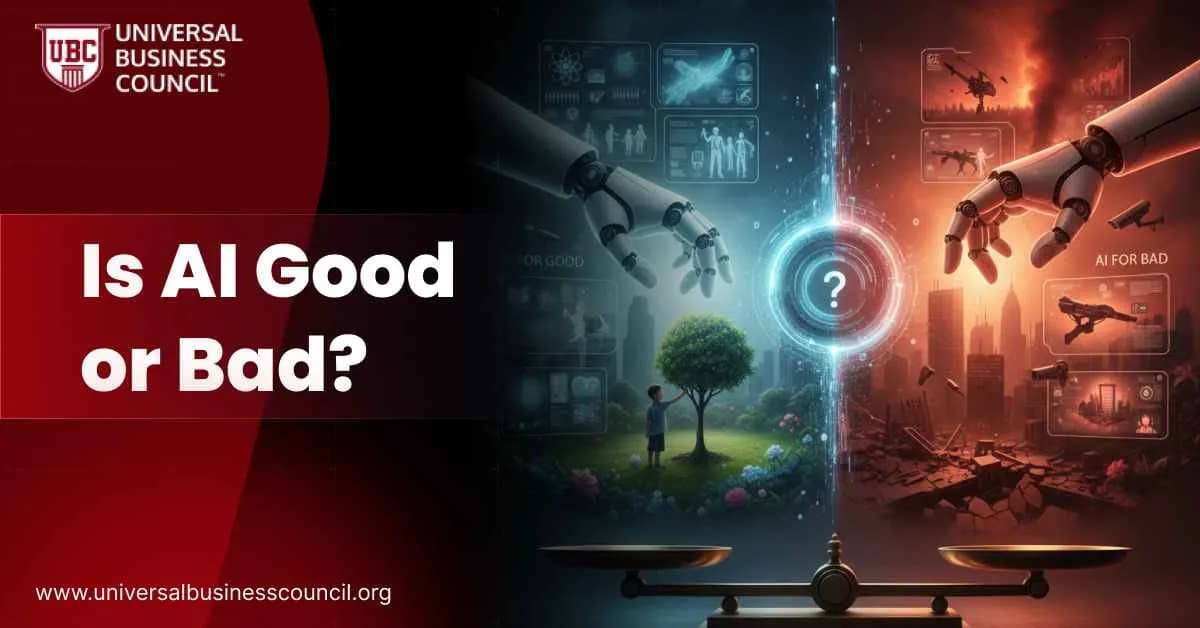
AI is not morally good or bad by default. It amplifies design choices, incentives, and governance. Used thoughtfully, AI saves time, improves quality, and expands access. Used carelessly, especially in high-stakes environments, it can cause serious harm. The real question is not whether AI is good or bad. The real question is whether it is deployed with clarity, limits, and humans still accountable for the results.Related Articles
View All
Artificial Intelligence
Gemini 4 Argon: Features, Pricing, and Availability
Gemini 4 Argon is Google’s new flagship AI model for coding, science, finance, law and security. See its main features, API and subscription pricing, and where you can access it today.

Artificial Intelligence
What Is Meta Muse Wonder? Features and How It Works
Meta Muse Wonder is a new frontier AI model built for agents with Active Memory and Active Focus. Learn what it is, how it works, its features, pricing and how to access it.

Artificial Intelligence
What Is Google Playground? Features and How It Works
What is Google Playground? Learn how Google's new AI platform turns text prompts into playable browser games, which models power it, its features, pricing and access, Unity Spark plans, rival tools, and limits.
Trending Articles
The Role of Blockchain in Ethical AI Development
How blockchain technology is being used to promote transparency and accountability in artificial intelligence systems.
AWS Career Roadmap
A step-by-step guide to building a successful career in Amazon Web Services cloud computing.
Top 5 DeFi Platforms
Explore the leading decentralized finance platforms and what makes each one unique in the evolving DeFi landscape.