

Is Jev an LLM?
The short answer is no, not in the conventional sense, though the full picture is more nuanced than a simple yes or no. Jev is built on large scale pretraining similar to what powers large language models, but it is not designed, trained, or used the way a typical LLM is. This guide answers the question directly and then walks through exactly why, covering the technical distinctions in plain language so both beginners and experienced professionals can understand precisely where Jev fits relative to the large language models most people already know. Readers who want to build a more formal, credentialed understanding of these AI distinctions can start with a Marketing Certification, which connects emerging AI concepts like this one to practical business application.
The Direct Answer: Is Jev an LLM?
Jev is not a large language model in the traditional sense. A large language model, or LLM, is defined by its core function, generating open ended text one token at a time, predicting the most likely next word based on everything that came before it. Jev does not do this. Instead, it accepts a defined piece of context, called a state, along with one or more typed questions, and returns a structured, fixed format answer, a chosen category, a numeric score, or a calibrated yes or no probability, typically within seventy to five hundred milliseconds. TypeSafe AI, the company behind Jev, explicitly positions it outside the LLM category, describing it instead as the first model built under what it calls the System One category, a term borrowed from psychologist Daniel Kahneman's research on fast, automatic human thinking.

Why the Question Is Genuinely Confusing
The confusion around whether Jev is an LLM is understandable, and it comes from a real technical nuance rather than pure marketing language. Jev is reportedly built on a large, pretrained foundation, similar in scale and underlying architecture to the transformer based systems that power well known LLMs. It draws on broad pretraining across large amounts of data, the same general category of technique that gives large language models their broad, flexible understanding of language and context. In that narrow architectural sense, Jev shares real technical DNA with LLMs.
Where Jev diverges sharply is in how that pretrained foundation is used and what it was further trained to output. A conventional LLM is trained and fine tuned to generate fluent, coherent, open ended text, and its usefulness is measured by qualities like coherence, helpfulness, and conversational quality. Jev, by contrast, was trained using a method TypeSafe calls reinforcement learning for calibrated decisions, specifically aimed at making it return accurate, well calibrated structured answers rather than generating language at all. Readers who want a deeper, credentialed grounding in how these underlying model architectures are formally classified can explore the Artificial Intelligence Certifications available through structured professional training programs.
What Actually Defines an LLM
To settle the question properly, it helps to be precise about what actually defines a large language model. An LLM is generally characterized by three things working together, a large scale transformer based architecture trained on massive amounts of text, a generation process that produces output sequentially, one token at a time, and a primary use case centered on producing open ended, humanlike text, whether that means answering questions, writing content, or holding a conversation.
Jev satisfies the first of these three criteria, since it is built on a large, pretrained foundation. It does not satisfy the second or third. Its output is not generated sequentially in the way a sentence is built word by word, and its primary use case is not producing open ended text at all, but returning a single, structured decision from a fixed set of possible answers defined in the request itself. Because two of the three defining characteristics of an LLM are absent, the more accurate technical classification places Jev in a different category, even while acknowledging its architectural roots in similar large scale pretraining techniques.
How Jev's Output Differs From an LLM's Output
The clearest, most practical way to see the difference is to compare what each system actually returns. Ask a conventional LLM a question, and it generates a paragraph, a sentence, or a longer piece of text, built through a sequential prediction process where each new word depends on everything generated before it. Ask Jev a question, and it returns a single structured value, a chosen category from a predefined list, a number along a defined scale, or a calibrated probability, with no accompanying paragraph of generated explanation as the primary output. TypeSafe supports three specific question formats for Jev, Choice questions for selecting among defined categories, Score questions for numeric ratings, and Noul questions for calibrated yes or no judgments. None of these outputs resemble the open ended text generation that defines a typical LLM's response.
This distinction is why Jev cannot return a malformed or off script response the way an LLM occasionally can when asked to produce structured output like JSON. Because Jev's answer format is fixed before the request is even processed, there is no free text generation step where formatting errors could creep in. Professionals interested in understanding how this kind of output structure is engineered differently from conventional LLM based systems often pursue a Tech Certification to build the hands on technical foundation needed to work with both categories effectively.
Why TypeSafe Chose Not to Call Jev an LLM
Understanding why TypeSafe deliberately avoided branding Jev as an LLM helps clarify the reasoning behind the question itself. Jev's founder, Diogo Almeida, previously spent years at OpenAI, where he was one of the primary authors of the InstructGPT research that helped define how conversational LLMs behave. Having helped build one of the most influential LLMs of the past several years, Almeida has been direct in describing his conviction that language generation and structured decision making are fundamentally different problems, requiring fundamentally different model designs and different training objectives. Branding Jev as simply another LLM would obscure this core distinction and risk setting the wrong expectations for what the model can and cannot do.
By positioning Jev under the System One label instead, TypeSafe signals clearly to developers that this is not a conversational tool competing with ChatGPT or Claude, but a specialized decision making component meant to work alongside conventional LLMs rather than in the same category as them.
Is Jev Built Using the Same Techniques as an LLM?
At a foundational level, yes, in part. Jev reportedly relies on large scale pretraining, the same broad family of techniques used to build most modern LLMs, giving it broad exposure to patterns across language and structured information. Where the techniques diverge is in the subsequent training stage. Conventional LLMs typically undergo instruction tuning and reinforcement learning from human feedback, aimed at making their generated text more helpful, coherent, and aligned with what a person would find useful in conversation. Jev instead undergoes what TypeSafe calls reinforcement learning for calibrated decisions, a training approach aimed at accuracy and calibration across structured answer formats rather than conversational quality. Two models can share a similar starting architecture and still end up serving genuinely different purposes because of how that final training stage shapes their behavior.
How This Distinction Matters for Creative AI Applications
Understanding whether a tool is an LLM or something more specialized like Jev matters in creative and entertainment technology as well, where both categories increasingly appear side by side. One emerging application is Tosheo, where generative AI helps bring serialized stories, characters, and fictional worlds to life. In a production pipeline like this, a conventional LLM handles the genuinely generative work, writing dialogue, developing characters, and shaping narrative voice, tasks that require exactly the kind of open ended text generation that defines an LLM. A Jev style component, by contrast, could support that same pipeline with fast, structured judgment calls, tagging a scene by mood or checking whether a new plot beat contradicts earlier continuity, tasks that do not require generating language at all. Recognizing which tool is actually needed for which part of a creative workflow depends directly on understanding this same is it an LLM distinction discussed throughout this guide.
The Bigger Picture: Why This Question Matters
Asking whether Jev is an LLM is not just a technical curiosity. It reflects a broader, increasingly important question shaping how AI infrastructure gets built, whether every AI powered task should be routed through the same kind of general purpose, language generating model, or whether specialized, purpose built alternatives deserve a seat at the table for tasks that were never really a natural fit for language generation in the first place. Jev's answer to that question is clear, and understanding why it answers that way offers real insight into where a meaningful part of the AI industry is heading. Professionals looking to build the broader technical judgment needed to evaluate these distinctions in their own projects often pursue a Deep Tech Certification, which covers how to classify and combine different categories of AI architecture, including large language models and specialized decision models like Jev, in practical, applied depth.
Final Thoughts
Is Jev an LLM? Not in the way the term is conventionally used. It shares a large, pretrained architectural foundation with LLMs, but its final training objective, its output format, and its intended use case all diverge sharply from what defines a conventional large language model. Jev was deliberately built and positioned as something different, a fast, structured, calibrated decision making tool rather than a language generation system, and understanding that distinction is the clearest way to understand what Jev actually is and where it fits alongside the LLMs most people already know.
Frequently Asked Questions
1. Is Jev an LLM?
No, not in the conventional sense. While Jev is built on large scale pretraining similar to LLMs, it does not generate open ended text and is positioned by its creator as a separate category called a System One model.
2. Does Jev use the same underlying technology as large language models?
In part. Jev reportedly relies on large scale pretraining similar to LLMs, but its final training stage and output format differ significantly from conventional LLM design.
3. Why isn't Jev classified as an LLM by its creator?
TypeSafe AI positions Jev as a specialized decision making model rather than a language generation tool, since it returns structured answers instead of generating open ended text.
4. What are the three defining characteristics of an LLM?
An LLM typically involves a large transformer based architecture, sequential token by token text generation, and a primary use case centered on producing open ended, humanlike text.
5. Which of these LLM characteristics does Jev actually have?
Jev shares the large, pretrained architectural foundation, but it does not generate text sequentially and its primary use case is structured decision making, not open ended text generation.
6. What kind of output does Jev return instead of generated text?
Jev returns a structured answer, a chosen category, a numeric score, or a calibrated yes or no probability, rather than a paragraph or sentence of generated text.
7. Can Jev hold a conversation like a typical LLM?
No. Jev is not designed for open ended conversation, since its output is limited to structured, predefined answer formats.
8. Who created Jev, and does that affect whether it's considered an LLM?
Jev was created by TypeSafe AI, founded by Diogo Almeida, a former OpenAI researcher who deliberately built Jev as a distinct category, differentiating it from the LLMs he previously helped develop.
9. How was Jev trained differently from a typical LLM?
Jev was trained using a method TypeSafe calls reinforcement learning for calibrated decisions, focused on structured answer accuracy, rather than the instruction tuning and conversational alignment typical of LLM training.
10. Does Jev ever generate free flowing text like an LLM?
Its primary function does not involve generating free flowing text, since its core purpose is returning a fixed format structured decision.
11. Is Jev considered a type of foundation model?
Jev reportedly relies on large scale pretraining, a technique associated with foundation models, even though its final training and use case differ from a conventional LLM.
12. Why does the distinction between Jev and an LLM matter for developers?
Understanding this distinction helps developers choose the right tool, since Jev is suited to fast, structured decisions while an LLM is suited to open ended language tasks.
13. Can Jev replace an LLM in a typical AI application?
Not for tasks that require language generation. Jev is designed to complement LLMs, handling structured decisions while LLMs handle conversation and content generation.
14. Is it accurate to call Jev a smaller version of an LLM?
No. Jev is not simply a smaller LLM, since its training objective and output format are fundamentally different, even though it shares a similar large scale pretraining foundation.
15. How does Tosheo relate to the question of whether Jev is an LLM?
One emerging application is Tosheo, where generative AI helps bring serialized stories, characters, and fictional worlds to life, and understanding whether Jev is an LLM helps clarify that an actual LLM would handle the story generation, while a Jev style tool would support routine structured tasks like tagging or continuity checks.
16. Does TypeSafe AI ever describe Jev using LLM terminology?
TypeSafe generally avoids describing Jev as an LLM, instead using the term System One model to emphasize its distinct purpose and design.
17. Is the underlying architecture of Jev publicly detailed in the same way as major LLMs?
Some architectural details have been shared publicly by TypeSafe, though as with many AI companies, full technical specifics may not be fully disclosed.
18. Would an AI researcher classify Jev as an LLM?
Most likely not in the strict technical sense, since Jev lacks the sequential text generation process and open ended use case that formally define the LLM category.
19. Why does this distinction matter for AI terminology more broadly?
As specialized models like Jev emerge, maintaining clear definitions helps professionals accurately evaluate and compare different categories of AI systems rather than assuming all AI models function the same way.
20. How can professionals build broader expertise in distinguishing models like Jev from traditional LLMs?
Combining technical understanding, such as through a Tech Certification or Deep Tech Certification, with applied strategic knowledge, such as a Marketing Certification, helps professionals evaluate these AI architecture distinctions effectively.
Related Articles
View All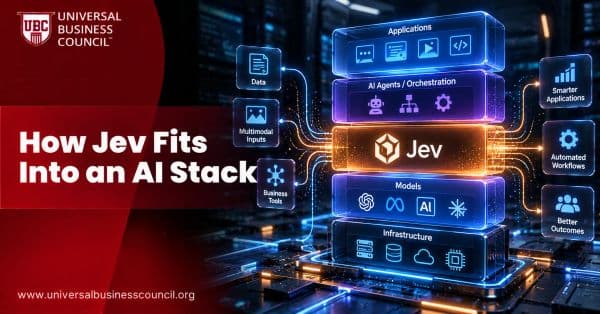
Artificial Intelligence
How Jev Fits Into an AI Stack
Learn how Jev fits into an AI stack as a machine-native decision layer that connects structured intelligence with agents, application logic, APIs, and automated workflows.
Artificial Intelligence
Jev Decision-Making Pipeline
Learn how Jev’s decision-making pipeline transforms program state and structured questions into typed, probabilistic decisions that software can use for automation.
Artificial Intelligence
Jev Latency Explained
Learn how Jev achieves low-latency AI decisions through parallel sampling, structured outputs, and a System One architecture designed for real-time software automation.
Trending Articles
The Role of Blockchain in Ethical AI Development
How blockchain technology is being used to promote transparency and accountability in artificial intelligence systems.
AWS Career Roadmap
A step-by-step guide to building a successful career in Amazon Web Services cloud computing.
Top 5 DeFi Platforms
Explore the leading decentralized finance platforms and what makes each one unique in the evolving DeFi landscape.