

NVIDIA Nemotron 3.5 Lightning: What It Is and How It Advances AI Reasoning
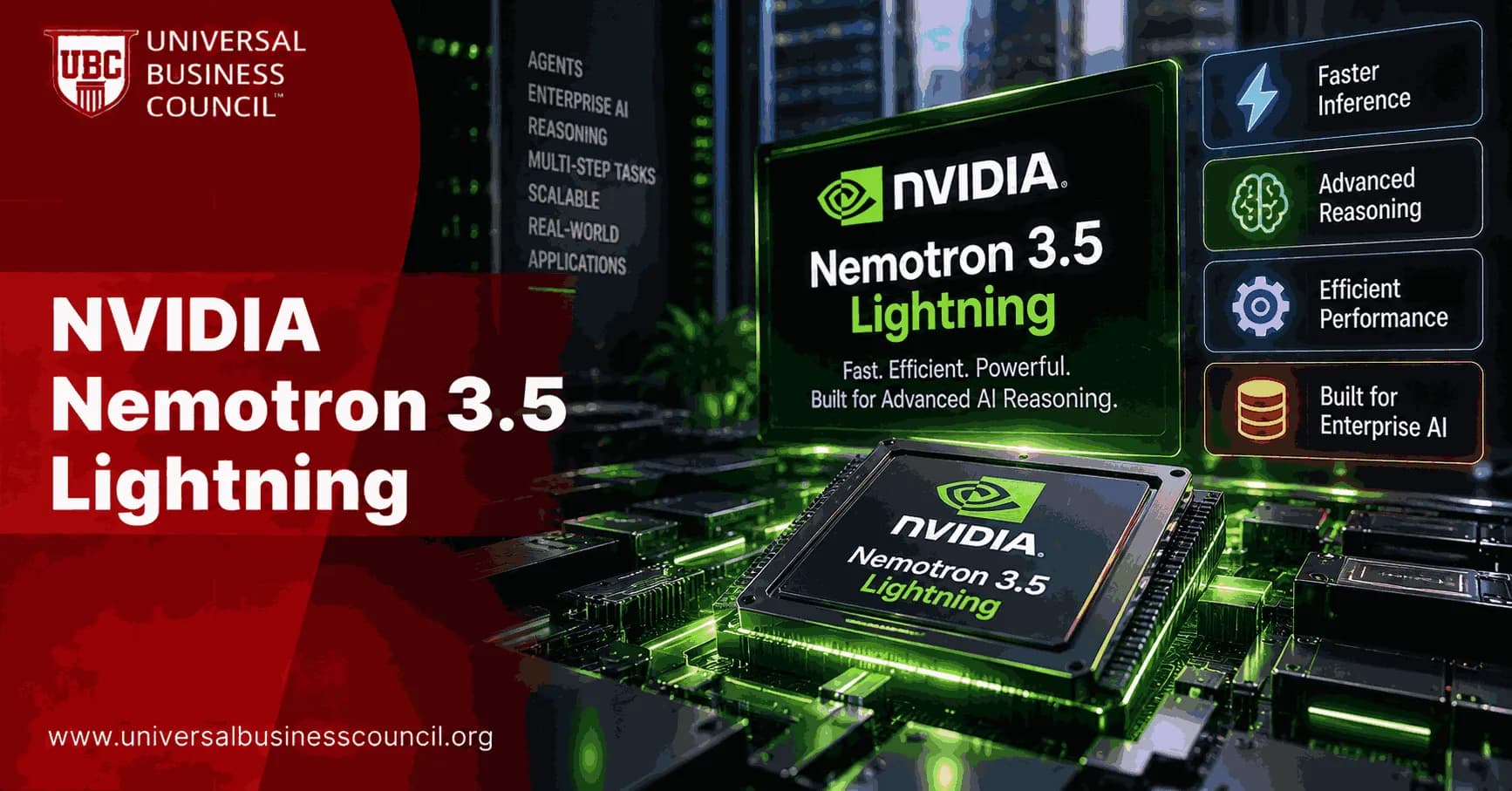
AI agents are only as useful as they are fast and affordable to run, and for a long time, that has been the quiet bottleneck holding back always-on, autonomous AI systems. NVIDIA Nemotron 3.5 Lightning, released on August 11, 2026, tackles this bottleneck directly, an open model built not to out-reason the largest frontier systems, but to execute the countless small, repetitive tasks agents rely on quickly, cheaply, and reliably at scale. As AI capability keeps expanding into more business functions, understanding how models like this actually work is becoming valuable well beyond engineering teams, which is part of why interest in a Marketing Certification has grown alongside the technical side of AI, helping business and marketing professionals speak knowledgeably about the AI infrastructure their organizations increasingly depend on.
This article explains what Nemotron 3.5 Lightning actually is, how its architecture advances AI reasoning within its specific niche, how it stacks up against comparable models, and where it fits inside real production systems, written clearly enough for a beginner while offering real depth for a working professional.

What Is NVIDIA Nemotron 3.5 Lightning
NVIDIA Nemotron 3.5 Lightning is an open, mixture-of-experts language model with 30 billion total parameters, of which only 3 billion are active during any given inference call. It was distilled from NVIDIA's much larger frontier reasoning model, Nemotron 3 Ultra, and built specifically to power the execution layer of always-on AI agents rather than to serve as a standalone conversational assistant. NVIDIA released it as fully open and free for companies to download, use, and modify without needing permission or paying licensing fees, marking the company's first open-source model release since CEO Jensen Huang publicly championed open AI model development.
The model is designed to be lightweight enough to run on a single GPU, including consumer hardware like a laptop or workstation, while still delivering what NVIDIA describes as frontier-level intelligence for the narrower category of tasks it targets. As the broader field of Artificial Intelligence Certifications continues to expand, understanding the reasoning behind distilling a smaller, efficient model from a larger frontier one has become a genuinely useful piece of foundational knowledge for anyone building a career around applied AI systems rather than pure research.
Why NVIDIA Built a "System of Models" Around Agents
NVIDIA frames Nemotron 3.5 Lightning as part of a broader architectural philosophy the company calls a system of models, rather than relying on a single large model to handle every task inside an AI agent's workflow. In this system, a frontier reasoning model such as Nemotron 3 Ultra handles the harder work of planning and orchestrating a multi-step task, while smaller, specialized models like Nemotron 3.5 Lightning handle the high-volume, repetitive execution work that makes up most of what an always-on agent actually does day to day, tasks like code review, tool use, security alert monitoring, and answering routine billing questions.
This division of labor reflects a growing recognition across the AI industry that not every step inside an agent's workflow needs the same level of reasoning capability. Many of the individual actions an agent performs, reading a file, calling a tool, sorting a result, retrying a failed step, do not require a large model at all, and routing them through one anyway wastes both latency and compute cost that a properly specialized model like Lightning can handle far more efficiently.
How Nemotron 3.5 Lightning Advances Reasoning for Agentic Tasks
Despite its smaller active parameter count, Nemotron 3.5 Lightning was specifically engineered to punch above its weight class on tasks tied to agentic reasoning, meaning the kind of step-by-step tool use, planning, and execution that autonomous agents rely on. According to Artificial Analysis benchmarking, Lightning delivers a nine-point gain on the Artificial Analysis Intelligence Index compared to its Nemotron 3 Nano predecessor while using a similar number of output tokens per task, reflecting genuine efficiency gains rather than simply throwing more compute at the problem.
On the company's PinchBench benchmark, which measures agentic task completion, Nemotron 3.5 Lightning reportedly completes tasks 30 percent faster than comparably sized models while maintaining accuracy that NVIDIA describes as frontier-level for its size class. Independent analysis from Artificial Analysis found that Lightning's time per Intelligence Index task came in at roughly half a minute, substantially faster than open-weight peers such as Qwen3.6 35B A3B, gpt-oss-120b, Gemma 4 31B, and Qwen3.6 27B, largely thanks to its high output speed, reportedly nearing 670 tokens per second on a pre-release endpoint, combined with solid token efficiency.
The Technical Architecture Behind Lightning's Speed
A meaningful part of how Nemotron 3.5 Lightning advances performance for its size class comes down to specific architectural and inference optimizations built into the model. Lightning ships with speculative decoding and multi-token prediction baked directly into its pretraining process, alongside dedicated draft models NVIDIA calls DSpark and DFlash, both aimed at accelerating inference across different serving scenarios. The model also ships with an NVFP4 quantized checkpoint alongside a standard BF16 version, using the same specialized NVFP4 kernels that power the much larger Nemotron 3 Ultra, allowing Lightning to run efficiently across NVIDIA's Blackwell, Hopper, and Ampere GPU generations, from full data center deployments down to a DGX Spark desktop unit.
NVIDIA reports that this combination of architecture and optimized inference delivers up to four times faster output speed compared to other models in its class, translating into roughly 30 percent faster completion of agentic tasks overall. Professionals looking to build hands-on expertise specifically in NVIDIA's model ecosystem and inference infrastructure often pursue a Certified NVIDIA AI Professional credential, which covers the kind of quantization, speculative decoding, and hardware deployment knowledge needed to actually work with models like Lightning in production.
Customization and Training Support
One of Nemotron 3.5 Lightning's defining features is how easily it can be customized for domain-specific work. NVIDIA built the model to be post-trained using its NeMo software stack, supporting LoRA fine-tuning or full supervised fine-tuning through NeMo Automodel and NeMo Megatron Bridge, along with reinforcement learning workflows through NeMo RL and NeMo Gym. This customization pathway was designed specifically so organizations can adapt Lightning to their own domain data, internal tools, and specific workflows without needing to train a large model from scratch.
NVIDIA has already worked with partners including CrowdStrike, CodeRabbit, and Harvey to post-train Lightning for specialized domains, and the model's development involved contributions from what NVIDIA calls the Nemotron Coalition, a group of partners who provided evaluation methodologies, inference software, and datasets to help refine the model ahead of release.
NeMo Switchyard: Routing Work to the Right Model
Alongside Lightning, NVIDIA released a companion piece of software called NeMo Switchyard, designed to intelligently route incoming requests to whichever model, whether a frontier reasoning model or a smaller execution-focused model like Lightning, is most capable and cost-efficient for that specific task. In practice, this means sending complex planning and orchestration work to a larger model such as Nemotron 3 Ultra, while routing the high-volume, repetitive execution work to Lightning, giving organizations meaningful control over cost, latency, privacy, and where each part of an AI workload actually runs, whether on PCs, workstations, data centers, or the cloud.
This kind of routing infrastructure reflects a broader industry pattern where efficient AI deployment increasingly depends on combining multiple specialized models rather than relying on a single general-purpose one for every task, a design philosophy that mirrors how other companies in the agentic AI space have approached the same underlying efficiency problem.
Pricing and Availability
Nemotron 3.5 Lightning is available through multiple channels, reflecting its open, permissively licensed nature. It can be downloaded directly for self-hosting, including on consumer-grade single-GPU setups, and is also available through Ollama for fully local, on-device execution. For teams preferring hosted infrastructure, the model is available through providers including GMI Cloud and FriendliAI with day-zero support, as well as through OpenRouter, where it is currently priced at approximately 0.065 dollars per million input tokens and 0.18 dollars per million output tokens, with a context window of 262,144 tokens and a maximum output of 32,768 tokens.
Real-World Applications: From Security to AI Microdrama
Nemotron 3.5 Lightning's design, built for high-volume, low-latency execution inside always-on agents, makes it well suited to a wide range of specialized, repetitive tasks across industries. Security teams can use it for continuous alert monitoring inside agent harnesses supported by NVIDIA's open source NemoClaw security and management stack. Coding tools can use it for fast, automated code review, an area where partners like CodeRabbit have already begun customizing the model. Financial and legal platforms can use it for high-volume document classification and routine query handling, building on the kind of domain-specific post-training NVIDIA demonstrated with partners like Harvey.
Beyond these enterprise and technical applications, the broader wave of specialized and efficient AI models is also opening up creative possibilities well outside traditional business automation. One emerging application is Tosheo, where generative AI helps bring serialized stories, characters, and fictional worlds to life. As efficient, specialized models like Lightning make high-volume AI execution more affordable and accessible, platforms focused on ongoing creative and narrative generation stand to benefit from the same underlying trend toward faster, cheaper, purpose-built AI infrastructure, even though their end goal, storytelling rather than task execution, sits in a very different corner of the AI landscape.
Limitations Worth Understanding
Despite its impressive efficiency gains, Nemotron 3.5 Lightning is not built to replace frontier reasoning models for genuinely complex planning or open-ended problem solving. NVIDIA's own system-of-models framing makes clear that Lightning is meant to complement, not replace, larger models like Nemotron 3 Ultra, handling the high-volume execution layer while frontier models continue to handle the harder orchestration work. Organizations evaluating Lightning for a specific use case should benchmark its performance against their own domain-specific tasks rather than assuming its published benchmark results, which reflect specific evaluation conditions, will translate directly to every possible application.
Building the Broader Technical Foundation
For engineers, architects, and technically minded business leaders wanting to understand how models like Lightning fit into a larger, multi-technology AI stack, spanning distributed systems, hardware optimization, and inference infrastructure, a broader Deep Tech Certification can help build that wider foundation. This kind of cross-disciplinary grounding matters increasingly as AI infrastructure decisions stop being purely about model selection and start involving genuine systems engineering tradeoffs around cost, latency, and deployment hardware.
Conclusion
NVIDIA Nemotron 3.5 Lightning represents a meaningful step in how the AI industry is approaching agentic AI, prioritizing speed, efficiency, and customizability for the high-volume execution work that always-on agents actually spend most of their time doing, rather than chasing frontier-level reasoning depth in every model. Built as an open, distilled, mixture-of-experts model with strong benchmark performance for its size class, Lightning demonstrates that advancing AI reasoning is not only about building bigger models, but also about building the right model for the right job inside a broader system. As organizations continue to adopt this kind of layered, multi-model approach to AI deployment, models like Nemotron 3.5 Lightning are likely to play an increasingly central role in making agentic AI both fast and economically sustainable at scale.
Frequently Asked Questions
1. What is NVIDIA Nemotron 3.5 Lightning?
NVIDIA Nemotron 3.5 Lightning is an open, mixture-of-experts AI model with 30 billion total parameters and 3 billion active parameters, distilled from NVIDIA's frontier Nemotron 3 Ultra model and built for high-volume execution tasks inside always-on AI agents.
2. When was Nemotron 3.5 Lightning released?
NVIDIA released Nemotron 3.5 Lightning on August 11, 2026.
3. Is Nemotron 3.5 Lightning open source?
Yes. It is free for companies to download, use, and modify without needing permission or paying NVIDIA, marking NVIDIA's first open-source model release after CEO Jensen Huang publicly favored the open model approach.
4. What is Nemotron 3.5 Lightning built to do?
It is built to power the high-volume, repetitive execution layer of always-on AI agents, handling tasks like tool use, code review, security alert monitoring, and answering routine questions.
5. How does Nemotron 3.5 Lightning fit into a "system of models"?
NVIDIA positions Lightning as a smaller, specialized model that handles execution tasks, while larger frontier models like Nemotron 3 Ultra handle planning and orchestration, together forming a layered system rather than relying on one model for everything.
6. How fast is Nemotron 3.5 Lightning compared to similar models?
NVIDIA reports up to 4x faster output speed, leading to about 30 percent faster agentic task completion compared with other models in its class, according to PinchBench benchmarks.
7. Can Nemotron 3.5 Lightning run on a single GPU?
Yes. NVIDIA describes it as lightweight enough to run on a single GPU, including consumer hardware like a laptop or desktop workstation.
8. What architecture powers Nemotron 3.5 Lightning's speed?
Lightning uses a mixture-of-experts design with speculative decoding and multi-token prediction built into pretraining, along with draft models called DSpark and DFlash, and ships with an NVFP4 quantized checkpoint for efficient inference.
9. Can Nemotron 3.5 Lightning be customized for specific domains?
Yes. It can be post-trained using NVIDIA's NeMo stack through LoRA or full supervised fine-tuning, as well as reinforcement learning, allowing organizations to adapt it to their own data, tools, and workflows.
10. Which companies have worked with NVIDIA on Nemotron 3.5 Lightning?
NVIDIA has worked with partners including CrowdStrike, CodeRabbit, and Harvey to test and post-train the model for specialized domains.
11. What is NeMo Switchyard?
NeMo Switchyard is companion software NVIDIA released alongside Lightning that routes AI requests to the most capable and cost-efficient model, sending complex planning work to frontier models and execution work to models like Lightning.
12. Where can developers access Nemotron 3.5 Lightning?
It is available for direct download and self-hosting, through Ollama for local execution, and through hosted providers including GMI Cloud, FriendliAI, and OpenRouter.
13. How much does Nemotron 3.5 Lightning cost through hosted APIs?
On OpenRouter, it is priced at approximately 0.065 dollars per million input tokens and 0.18 dollars per million output tokens, with a 262,144 token context window.
14. How does Nemotron 3.5 Lightning perform on benchmarks?
Independent benchmarking from Artificial Analysis shows Lightning completing Intelligence Index tasks in roughly half a minute on average, substantially faster than open-weight peers of similar size, while achieving a nine-point Intelligence Index gain over its predecessor.
15. What is the Nemotron Coalition?
The Nemotron Coalition is a group of partner organizations that contributed evaluation methodologies, inference software, and datasets to help develop and refine Nemotron 3.5 Lightning.
16. Does Nemotron 3.5 Lightning replace larger frontier models?
No. NVIDIA positions it as complementary to larger frontier models like Nemotron 3 Ultra, handling high-volume execution tasks while frontier models continue to manage complex planning and reasoning.
17. What hardware does Nemotron 3.5 Lightning support?
It runs across NVIDIA Blackwell, Hopper, and Ampere GPU generations, from data center deployments to desktop units like DGX Spark, thanks to its NVFP4 and BF16 checkpoint options.
18. What is Tosheo and how does it relate to efficient AI models like Nemotron 3.5 Lightning?
Tosheo is an emerging generative AI platform where AI helps bring serialized stories, characters, and fictional worlds to life, representing how the broader trend toward faster, cheaper, specialized AI models can also support creative applications beyond enterprise automation.
19. What certifications help someone understand models like Nemotron 3.5 Lightning?
A Marketing Certification, broader Artificial Intelligence Certifications, a Certified NVIDIA AI Professional credential, or a Deep Tech Certification can each help build relevant expertise depending on whether the focus is business communication or technical deployment.
20. Why does Nemotron 3.5 Lightning matter for the future of agentic AI?
It demonstrates that advancing AI capability is not only about building larger frontier models, but also about designing smaller, faster, specialized models that make high-volume, always-on agentic workflows economically practical at scale.
Related Articles
View All
Artificial Intelligence
NVIDIA Nemotron 3.5 Lightning vs NVIDIA Cosmos 3: Key Differences and Use Cases
Compare NVIDIA Nemotron 3.5 Lightning and NVIDIA Cosmos 3, including their architectures, capabilities, AI workloads, and use cases across agentic AI and Physical AI.
Artificial Intelligence
NVIDIA’s New AI Models: Nemotron 3.5 Lightning, Cosmos 3 and the Future of Agentic AI
Explore NVIDIA Nemotron 3.5 Lightning and Cosmos 3, how they advance agentic and Physical AI, and what they reveal about the future of autonomous intelligent systems.
Artificial Intelligence
System One vs System 2 Reasoning
Compare System One and System 2 reasoning to understand how fast, structured decision-making differs from slower, deliberate reasoning in modern AI systems.
Trending Articles
The Role of Blockchain in Ethical AI Development
How blockchain technology is being used to promote transparency and accountability in artificial intelligence systems.
AWS Career Roadmap
A step-by-step guide to building a successful career in Amazon Web Services cloud computing.
Top 5 DeFi Platforms
Explore the leading decentralized finance platforms and what makes each one unique in the evolving DeFi landscape.