

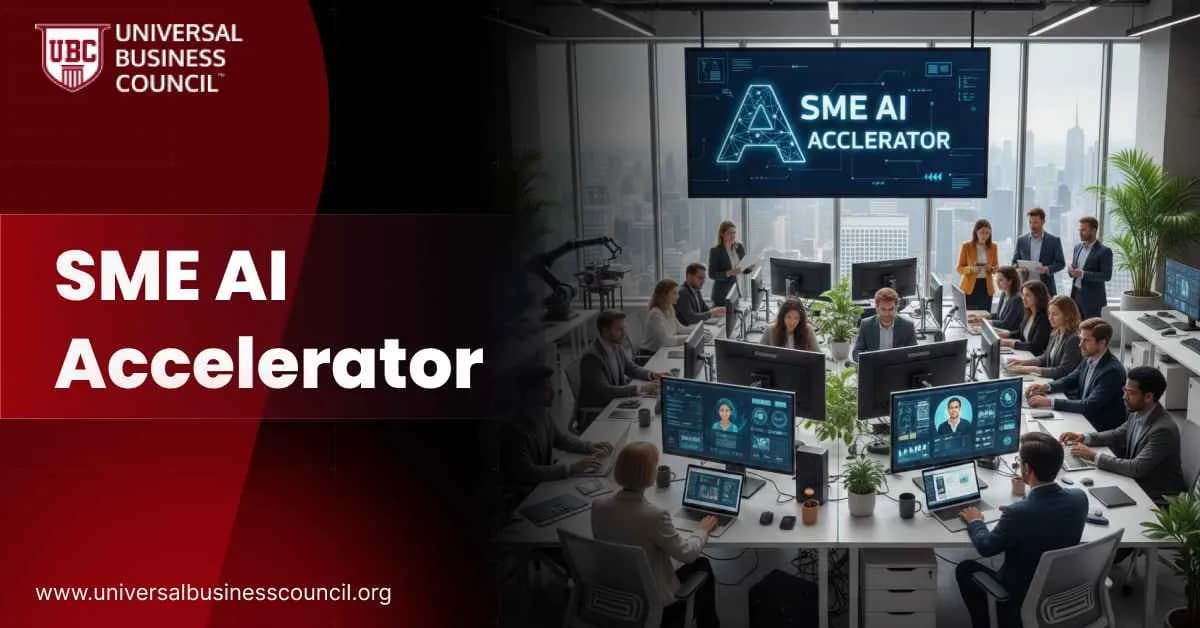
SME AI Accelerator

Why This Program Exists Now
AI adoption has been uneven. Large enterprises have integrated automation, predictive tools, and generative systems at far higher rates than smaller businesses. SMEs often face:- Limited technical resources
- Lack of dedicated AI specialists
- Concerns about compliance and risk
- Time constraints that discourage experimentation
What the SME AI Accelerator Includes
The initiative is designed around applied enablement rather than theoretical instruction. According to the launch framing, the program includes:- Free training delivered through OpenAI’s learning channels
- Virtual sessions and workshops
- Guidance tailored for non-technical teams
- Practical examples focused on productivity gains
Initial Rollout Countries
The program’s first wave covers six European countries:- France
- Germany
- Italy
- Poland
- Ireland
- United Kingdom
Practical Use Cases for SMEs
Training programs only matter if they lead to measurable wins quickly. SMEs benefit most when AI is applied to repetitive, high-volume tasks with clear metrics.Customer support efficiency
AI can assist with routine support workflows such as:- Drafting responses to delivery or shipping inquiries
- Handling refund and return requests
- Answering common product questions
- Summarizing customer issues for escalation
Marketing operations acceleration
Lean marketing teams can use AI to generate:- Campaign copy variations
- Email subject line tests
- Social media content drafts
- Localized product descriptions
Administrative and back-office tasks
AI is especially effective at reducing time spent on routine documentation and analysis, including:- Meeting note summarization
- Supplier comparison summaries
- Internal policy drafting
- Customer feedback clustering
Travel and hospitality workflows
Booking.com’s involvement highlights travel as a strong adoption entry point. SMEs in hospitality manage constant guest communication. AI can help with:- Drafting guest responses
- Improving listing descriptions
- Standardizing pre-arrival and post-stay messaging
- Organizing booking inquiries
What Makes This Initiative Notable
Two aspects stand out. First, scale. The stated ambition to reach 20,000 SMEs moves beyond a small pilot. Second, the emphasis is on capability building rather than tool promotion. The messaging focuses on closing skills gaps and enabling repeatable workflows. This matters because sustainable AI adoption requires discipline, not enthusiasm alone.Risks SMEs Should Consider
Even structured programs do not eliminate risk. SMEs should remain attentive to:- Data confidentiality and responsible handling
- Over-automation of sensitive decisions
- Lack of measurable performance tracking
- Reduced response times
- Increased tickets resolved per week
- Hours saved in documentation tasks
- Conversion lift from marketing experiments
Skills Development and Long-Term Readiness
The accelerator may introduce tools and workflows, but long-term competitiveness depends on deeper literacy. As SMEs integrate AI into operations, governance becomes part of daily management. This is where broader professional development enters the picture. Leaders and technical staff increasingly need structured exposure to secure deployment, data protection, and compliance standards. For those pursuing advanced infrastructure-level understanding, Deep tech certification visit the Blockchain Council through Deep tech certification visit the Blockchain Council offers pathways into modern technology governance and architecture thinking.Bottom Line
The SME AI Accelerator represents a January 2026 initiative designed to help 20,000 small and medium-sized enterprises adopt AI through free, practical training and workshops. By focusing on applied workflows rather than theory, it attempts to narrow the adoption gap between SMEs and large enterprises. If executed with discipline and measurable goals, the program can translate AI from abstract hype into operational efficiency. If not, it risks becoming another well-intentioned training series that generated enthusiasm without structural change. SMEs do not need slogans. They need productivity gains that show up in weekly reports.Related Articles
View All
Artificial Intelligence
Gemini 4 Argon: Features, Pricing, and Availability
Gemini 4 Argon is Google’s new flagship AI model for coding, science, finance, law and security. See its main features, API and subscription pricing, and where you can access it today.

Artificial Intelligence
What Is Meta Muse Wonder? Features and How It Works
Meta Muse Wonder is a new frontier AI model built for agents with Active Memory and Active Focus. Learn what it is, how it works, its features, pricing and how to access it.

Artificial Intelligence
What Is Google Playground? Features and How It Works
What is Google Playground? Learn how Google's new AI platform turns text prompts into playable browser games, which models power it, its features, pricing and access, Unity Spark plans, rival tools, and limits.
Trending Articles
The Role of Blockchain in Ethical AI Development
How blockchain technology is being used to promote transparency and accountability in artificial intelligence systems.
AWS Career Roadmap
A step-by-step guide to building a successful career in Amazon Web Services cloud computing.
Top 5 DeFi Platforms
Explore the leading decentralized finance platforms and what makes each one unique in the evolving DeFi landscape.