

What Is GLM 5.2?
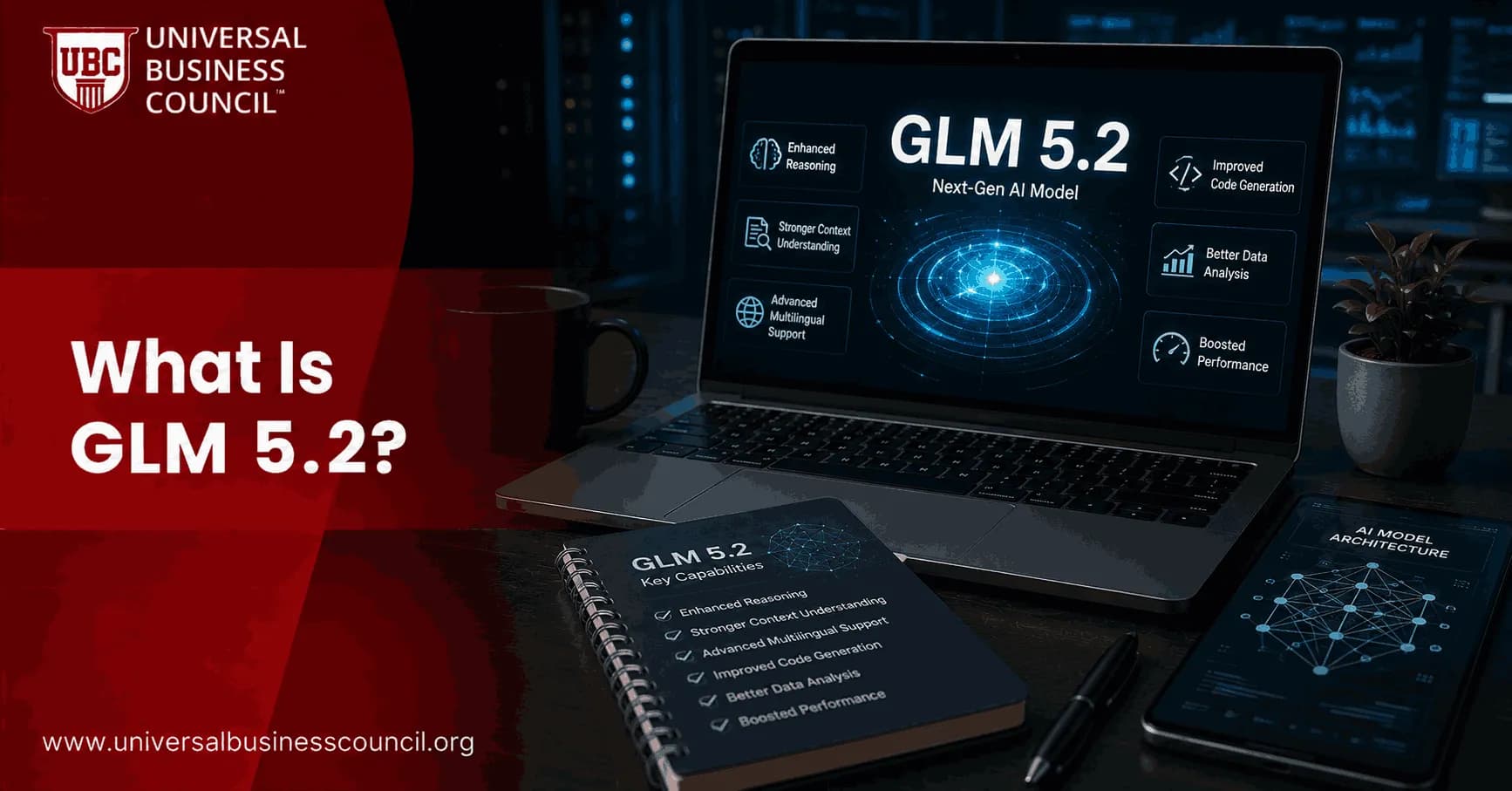
Artificial intelligence is advancing at a pace that surprises even experienced professionals. Consequently, staying informed about new models has become essential. GLM 5.2 is one of the most significant open-weight AI model releases of 2026. Furthermore, it challenges closed proprietary systems at a fraction of the cost. This guide explains what GLM 5.2 is, how it works, and why it matters for businesses, developers, and AI professionals worldwide.
What Is GLM 5.2?
<invoke name="GLM 5.2" /> is the latest flagship model in the General Language Model (GLM) series. It was developed by Z.ai, the international brand of Zhipu AI, a research company spun out of Tsinghua University in Beijing. The model was first released on June 13, 2026, to GLM Coding Plan subscribers. Additionally, its MIT-licensed open weights became publicly available on June 16, 2026.

The name "GLM" stands for General Language Model. The series has evolved significantly over successive generations, from GLM to GLM-2, GLM-3, GLM-4, GLM-5, GLM-5.1, and now GLM 5.2. Each generation brought stronger reasoning, longer context, and better coding performance. However, GLM 5.2 represents the most significant leap in the series so far.
Key Facts at a Glance
Developer: Z.ai (Zhipu AI)
Release Date: June 13–16, 2026
Parameters: ~744–753 billion total; ~40 billion active per token
Architecture: Mixture-of-Experts (MoE)
Context Window: 1 million tokens
License: MIT (fully open-source, no regional restrictions)
Primary Strength: Long-horizon coding, agentic tasks, and reasoning
Why GLM 5.2 Is Different from Previous Models
Many version updates are minor refinements. Therefore, it is natural to question whether GLM 5.2 is truly significant. The answer, supported by real-world benchmarks and developer feedback, is a clear yes.
Massive Context Window Expansion
The predecessor model, GLM-5.1, supported a context window of approximately 200,000 tokens. By contrast, GLM 5.2 extends this to a fully usable 1 million tokens. That is a five-times increase. Furthermore, Z.ai emphasises that this 1 million token window is genuinely usable, meaning the model maintains coherent reasoning across the entire window, not just at the edges.
This matters enormously for real-world tasks. Developers working with large codebases, legal teams processing lengthy contracts, and researchers handling extensive documents all benefit directly from this capability.
Improved Benchmark Performance
On SWE-bench Pro, a standard test for software engineering capability, GLM-5.1 scored 58.4. GLM 5.2 scores 62.1. That is not a minor improvement. It positions GLM 5.2 competitively against some of the strongest closed proprietary models available in 2026.
Additionally, GLM 5.2 achieved the following notable results:
Ranked first on Design Arena among all evaluated models
Ranked second on Code Arena Frontend
Topped the open-weight category of the Artificial Analysis Intelligence Index v4.1 with an overall score of 91 out of 100
Scored 81.0 on Terminal-Bench 2.1, outperforming the rest of the open-weight field
Significant Cost Advantage
GLM 5.2 produces results comparable to premium closed models at roughly one-sixth of the cost per token. Consequently, organisations that need frontier-level AI capabilities but face budget constraints now have a credible alternative.
The Architecture Behind GLM 5.2
Understanding the architecture helps professionals make informed deployment decisions. Therefore, this section explains the core technical design of GLM 5.2 in accessible terms.
Mixture-of-Experts Design
GLM 5.2 uses a Mixture-of-Experts (MoE) architecture. This means the model has roughly 744 to 753 billion total parameters. However, only approximately 40 billion parameters are active during any single token prediction. This design dramatically reduces inference costs while preserving the full capacity of a much larger model.
IndexShare — Smarter Sparse Attention
Long-context inference is computationally expensive. To address this, Z.ai introduced a technique called IndexShare. Standard sparse attention mechanisms compute a fresh attention index at every transformer layer. IndexShare, instead, reuses a single indexer across every four sparse attention layers. This reduces per-token floating point operations by 2.9 times at 1 million token context lengths. The result is that filling the 1 million token context window becomes economically practical rather than prohibitively expensive.
Multi-Token Prediction for Faster Output
GLM 5.2 also features an upgraded Multi-Token Prediction (MTP) layer. Traditional language models predict one token at a time. MTP allows the model to predict several tokens simultaneously in a single forward pass. This improves generation throughput by up to 20% during acceptance in speculative decoding. Consequently, responses arrive faster on long, complex tasks.
SLIME Training Framework
The model was trained using Z.ai's SLIME reinforcement learning framework. This framework uses a critic-based Proximal Policy Optimisation (PPO) approach. It trains the model on long-horizon agentic tasks, complex tool use, and multi-step reasoning. Additionally, SLIME incorporates anti-reward hacking safeguards, combining rule-based filters with a secondary AI judge during training to prevent the model from gaming evaluation metrics.
Pre-Training Scale
GLM 5.2 was pre-trained on 28.5 trillion tokens. This is a substantial increase over the 23 trillion tokens used for GLM-4. The broader pre-training foundation contributes directly to stronger general reasoning across domains.
What Can GLM 5.2 Do? Core Capabilities
GLM 5.2 is designed primarily as a coding-first, agent-oriented model. However, its capabilities extend well beyond software development.
Long-Horizon Software Engineering
GLM 5.2 excels at multi-step coding tasks that unfold over long sessions. It can retain module boundaries, API contracts, architectural constraints, and directory structures throughout a full engineering workflow. Therefore, developers working on complex projects experience less context fragmentation as tasks progress.
Agentic Workflows and Tool Use
The model handles agentic tasks where it must decompose a goal, use tools, interpret results, and continue executing over many steps. This makes GLM 5.2 suitable for building autonomous AI agents capable of completing real engineering workflows from requirements to deployable products.
Reasoning with Adjustable Effort
GLM 5.2 offers two thinking effort levels: High and Max. Users can choose the level that balances capability against speed and cost. For complex problems, Max thinking effort is recommended. For faster, lighter queries, High mode provides a practical alternative.
Security and Vulnerability Detection
Independent evaluations have shown that GLM 5.2 performs strongly on cybersecurity reasoning tasks. Without any additional scaffolding, it outperformed premium closed models on IDOR vulnerability detection benchmarks, scoring a 39% F1 rate at approximately $0.17 per vulnerability found.
GLM 5.2 Compared to Other Leading Models
Context is essential when evaluating a new AI model. Therefore, comparing GLM 5.2 to other widely used models reveals its true position in the 2026 AI landscape.
Benchmark | GLM 5.2 | Competitor Range |
SWE-bench Pro | 62.1 | GPT-5.5: ~58.6 |
Terminal-Bench 2.1 | 81.0 | Close to top closed models |
AI Intelligence Index v4.1 | 51 (open-weight leader) | Ahead of DeepSeek V4 Pro (44) |
Design Arena | Ranked 1st | Above GPT-5.5 |
GLM 5.2 achieves these results while being fully open-source under the MIT License. Consequently, organisations can self-host, fine-tune, and deploy it without licensing fees or usage restrictions tied to proprietary platforms.
How to Access and Use GLM 5.2
GLM 5.2 is accessible through multiple pathways, catering to different levels of technical expertise.
Via the Z.ai API
Z.ai offers a metered API for GLM 5.2. Developers can integrate the model into applications using standard API calls. Pricing sits well below most proprietary alternatives, making it attractive for production deployments at scale.
Via the GLM Coding Plan
Z.ai provides subscription tiers including Lite, Pro, Max, and Team plans under the GLM Coding Plan. These tiers offer varying levels of access and usage limits suited to individual developers and enterprise teams.
Open-Weight Self-Hosting
The model weights are publicly available on Hugging Face under the zai-org/GLM-5.2 repository. Organisations can download, fine-tune, and deploy GLM 5.2 entirely on their own infrastructure. Tools such as Unsloth Dynamic GGUFs also enable local deployment on consumer-grade hardware.
Who Should Use GLM 5.2?
GLM 5.2 is relevant across a broad range of professional contexts. Understanding who benefits most helps guide adoption decisions.
Software Engineers and Developers
The model is purpose-built for coding tasks. It handles multi-file refactoring, debugging, repository generation, and terminal automation with strong consistency. Therefore, developers working on complex, long-duration projects gain the most direct benefit.
AI Researchers and Data Scientists
Researchers exploring open-weight models benefit from GLM 5.2's transparent architecture and permissive licensing. Additionally, its strong benchmark performance across reasoning tasks makes it a strong baseline for experimental work.
Enterprise Teams
Organisations that require AI capabilities without dependency on closed commercial platforms now have a viable option. GLM 5.2's MIT license permits commercial use, fine-tuning, and self-hosting without additional fees. Consequently, enterprise teams gain full infrastructure control.
AI Consultants and Educators
For professionals who advise clients on AI adoption, understanding GLM 5.2 is increasingly important. AI educators can also use the model to demonstrate open-weight frontier capabilities in training environments. Professionals who hold a recognised AI Expert credential are better positioned to evaluate, deploy, and explain models like GLM 5.2 to clients and stakeholders. Such certification validates your ability to assess emerging AI technologies accurately and professionally.
GLM 5.2 and the Business World
The rise of powerful open-weight models like GLM 5.2 has direct implications for how businesses operate, compete, and invest in technology.
Reducing AI Costs Without Sacrificing Quality
For many businesses, the primary concern about AI adoption is cost. GLM 5.2 addresses this directly. At roughly one-sixth the cost of comparable closed models, it enables teams to run production-grade AI workflows without excessive spend. Furthermore, the open-weight nature eliminates vendor lock-in.
Enabling AI-Powered Marketing and Strategy
Businesses increasingly rely on AI to power content generation, customer engagement analysis, and marketing automation. GLM 5.2's strong reasoning and long-context capabilities make it well-suited for these applications. However, deploying AI effectively in a business context requires strategic knowledge. Professionals who hold a Marketing Certification understand how to align AI tools with business goals, customer journeys, and brand strategies. This combination of AI capability and business knowledge drives measurably better outcomes.
Powering Autonomous Business Agents
The agentic capabilities of GLM 5.2 open the door to autonomous systems that handle complex, multi-step business processes without continuous human intervention. From customer service workflows to data analysis pipelines, organisations can automate sophisticated operations using GLM 5.2 as the reasoning backbone.
The Broader Significance of GLM 5.2
GLM 5.2 represents more than a model release. It reflects a broader shift in the global AI landscape.
Closing the Gap Between Open and Closed AI
For years, the assumption was that the most capable AI models would remain locked behind proprietary APIs. GLM 5.2 challenges that assumption directly. Its benchmark performance shows that the gap between open-weight and closed proprietary models is narrowing faster than most analysts predicted.
Advancing Global AI Access
The MIT license on GLM 5.2 carries no regional restrictions. Therefore, developers, researchers, and businesses anywhere in the world can access and deploy the model freely. This democratisation of frontier AI capability has significant implications for emerging economies and smaller organisations that previously lacked access to cutting-edge tools.
Encouraging Competition and Innovation
The release of GLM 5.2 increases competitive pressure across the AI industry. Consequently, it accelerates the pace at which all providers improve their models and reduce their prices. This benefits end users universally.
How to Stay Ahead in the Age of GLM 5.2
Understanding a model like GLM 5.2 is only the starting point. Staying ahead requires a broader foundation in AI, technology, and business strategy.
Build Your AI Knowledge Base
Professionals who invest in structured AI education consistently outperform those who rely on informal exposure alone. Holding a recognised AI Expert certification demonstrates that your knowledge extends beyond surface-level familiarity. It confirms that you understand model architectures, deployment considerations, and responsible AI practices at a professional level.
Develop Technical and Business Skills Together
The most effective AI professionals combine technical fluency with business acumen. Understanding how models like GLM 5.2 work technically is valuable. However, knowing how to apply that understanding to drive business outcomes is what separates great practitioners from good ones.
Stay Current with Certifications and Continuing Education
The AI landscape changes rapidly. Regularly updating your credentials through programmes that stay aligned with industry developments ensures your expertise remains relevant. Additionally, pursuing a recognised Tech Certification in areas such as MLOps, cloud infrastructure, or AI deployment gives you the practical skills to implement models like GLM 5.2 at production scale.
The Future of GLM 5.2 and the GLM Series
GLM 5.2 sets a new standard for open-weight AI. Moreover, it signals the direction in which the GLM series is heading. Future iterations will likely push context windows further, improve multimodal capabilities, and refine long-horizon reasoning even more. Organisations that begin working with GLM 5.2 now will build the institutional knowledge needed to adopt future versions seamlessly.
Furthermore, the success of GLM 5.2 validates a broader trend: open-weight AI will continue to compete with and, in specific domains, outperform proprietary systems. Therefore, professionals and businesses that develop deep familiarity with open-weight models gain a durable strategic advantage.
Combining that model-level knowledge with credentials such as an AI Expert certification and a Marketing Certification provides a well-rounded foundation for navigating the AI-driven economy. Additionally, a Tech Certification ensures that your deployment and infrastructure skills keep pace with the models themselves.
Frequently Asked Questions
1. What does GLM stand for in GLM 5.2?
GLM stands for General Language Model. It is the flagship AI model series developed by Z.ai, the international brand of Zhipu AI, a Beijing-based research company originally founded as a spinout from Tsinghua University.
2. When was GLM 5.2 released?
GLM 5.2 was announced on June 13, 2026. The MIT-licensed open weights and public API access became available on June 16, 2026.
3. Who developed GLM 5.2?
GLM 5.2 was developed by Z.ai, which is the international consumer-facing brand of Zhipu AI. The company is headquartered in Beijing, China, and was originally spun out of Tsinghua University's Knowledge Engineering Group.
4. How many parameters does GLM 5.2 have?
GLM 5.2 has approximately 744 to 753 billion total parameters. However, only around 40 billion parameters are active during any single token prediction, thanks to its Mixture-of-Experts architecture.
5. What is the context window of GLM 5.2?
GLM 5.2 supports a 1 million token context window. Z.ai emphasises that this window is genuinely usable, meaning the model maintains coherent reasoning across the full context rather than degrading at higher token counts.
6. Is GLM 5.2 open-source?
Yes. GLM 5.2 is released under the MIT License, one of the most permissive open-source licences available. There are no regional restrictions, revenue clauses, or attribution requirements for commercial use. The weights are available on Hugging Face.
7. How does GLM 5.2 compare to GPT-5.5?
GLM 5.2 outperforms GPT-5.5 on several coding and engineering benchmarks, including SWE-bench Pro and Design Arena. It achieves these results at approximately one-sixth of the cost per token.
8. What is IndexShare in GLM 5.2?
IndexShare is an architectural optimisation introduced in GLM 5.2. Instead of computing a fresh attention index at every sparse attention layer, it reuses a single indexer across every four layers. This reduces per-token compute by 2.9 times at 1 million token context length, making long-context inference economically practical.
9. What is the SLIME framework used in GLM 5.2?
SLIME is a reinforcement learning training infrastructure developed by Z.ai. It uses a critic-based PPO formulation to train GLM 5.2 on long-horizon agentic tasks and complex tool use. It also includes anti-reward hacking safeguards to ensure training integrity.
10. What is Multi-Token Prediction in GLM 5.2?
Multi-Token Prediction (MTP) allows GLM 5.2 to predict several tokens simultaneously in a single forward pass rather than one at a time. The upgraded MTP layer in GLM 5.2 increases speculative decoding acceptance length by up to 20%, improving overall generation speed.
11. Can I run GLM 5.2 locally?
Yes. The open weights can be downloaded from Hugging Face and run locally. Tools such as Unsloth Dynamic GGUFs enable local deployment, even on consumer-grade hardware, using quantised versions of the model.
12. What industries can benefit from GLM 5.2?
GLM 5.2 is particularly beneficial for software development, cybersecurity, legal document processing, research, AI consulting, marketing automation, and any domain that requires complex, long-horizon reasoning.
13. How does GLM 5.2 handle agentic tasks?
GLM 5.2 is specifically designed for agentic workflows. It can decompose complex goals into sub-tasks, use external tools, interpret results, and continue executing across many steps without losing context. This makes it suitable for building autonomous AI agents.
14. What thinking effort levels does GLM 5.2 offer?
GLM 5.2 provides two thinking effort levels: High and Max. Max thinking effort is recommended for the most complex tasks. High mode offers a faster, lower-cost alternative for less demanding queries.
15. What benchmarks did GLM 5.2 top?
GLM 5.2 ranked first on Design Arena, second on Code Arena Frontend, and first in the open-weight category of the Artificial Analysis Intelligence Index v4.1. It also scored 81.0 on Terminal-Bench 2.1 and 62.1 on SWE-bench Pro.
16. How is GLM 5.2 priced compared to closed models?
GLM 5.2 costs approximately one-sixth as much per token as comparable closed proprietary models such as GPT-5.5. Additionally, self-hosted deployments using open weights eliminate API costs entirely.
17. Does GLM 5.2 have any usage restrictions?
No. The MIT License places no regional restrictions on GLM 5.2. Organisations anywhere in the world can use, modify, fine-tune, and commercially deploy the model without additional permissions or fees.
18. What is the difference between GLM 5.1 and GLM 5.2?
GLM-5.1 had a context window of approximately 200,000 tokens and scored 58.4 on SWE-bench Pro. GLM 5.2 extends the context window to 1 million tokens and scores 62.1 on SWE-bench Pro. The architectural improvements, particularly IndexShare and the upgraded MTP layer, are also new in the 5.2 generation.
19. How can professionals prepare for working with models like GLM 5.2?
Professionals should invest in structured AI education, such as obtaining an AI Expert certification, and complement it with technical skills through a Tech Certification. Additionally, a Marketing Certification helps professionals apply AI tools strategically within business contexts.
20. Is GLM 5.2 suitable for non-technical business users?
Directly using the model via API or self-hosting requires technical knowledge. However, non-technical business users can access GLM 5.2 through platforms and tools that integrate it into user-friendly interfaces. Understanding its capabilities at a strategic level also allows business leaders to make informed AI adoption decisions.
Related Articles
View All
Artificial Intelligence
Gemini 4 Argon: Features, Pricing, and Availability
Gemini 4 Argon is Google’s new flagship AI model for coding, science, finance, law and security. See its main features, API and subscription pricing, and where you can access it today.

Artificial Intelligence
What Is Meta Muse Wonder? Features and How It Works
Meta Muse Wonder is a new frontier AI model built for agents with Active Memory and Active Focus. Learn what it is, how it works, its features, pricing and how to access it.

Artificial Intelligence
What Is Google Playground? Features and How It Works
What is Google Playground? Learn how Google's new AI platform turns text prompts into playable browser games, which models power it, its features, pricing and access, Unity Spark plans, rival tools, and limits.
Trending Articles
The Role of Blockchain in Ethical AI Development
How blockchain technology is being used to promote transparency and accountability in artificial intelligence systems.
AWS Career Roadmap
A step-by-step guide to building a successful career in Amazon Web Services cloud computing.
Top 5 DeFi Platforms
Explore the leading decentralized finance platforms and what makes each one unique in the evolving DeFi landscape.