

What Is Jev AI?

Most people's first encounter with artificial intelligence is a chatbot: type a question, watch words appear one at a time, get an answer. Jev AI breaks from that pattern entirely. Released by TypeSafe AI in September 2026 as the first model in a new category called System One models, Jev does not write, explain, or converse. It makes fast, typed decisions instead, and understanding what that actually means is genuinely useful for anyone trying to keep up with where AI is headed beyond the chatbot format. This kind of foundational literacy is part of why interest in a Marketing Certification has grown alongside more technical AI education, helping business professionals speak knowledgeably about newer, less conversational categories of AI like this one.
This article explains what Jev AI is, how it works, what makes it different from the AI most people are familiar with, and where it is already being used, written clearly enough for a complete beginner while offering real depth for a working professional.

What Jev AI Actually Is
Jev AI is the first publicly released model in TypeSafe AI's System One category, introduced by Diogo Almeida, a co-creator of ChatGPT and reinforcement learning from human feedback, who left OpenAI specifically to build machine-native decision infrastructure. Rather than generating text, Jev takes in a state, meaning a block of context describing a situation, along with a set of predefined questions, and returns typed answers with calibrated probabilities in a single parallel step.
The name System One comes from psychologist Daniel Kahneman's well-known distinction between fast, intuitive human thinking, called System 1, and slower, more deliberate reasoning, called System 2. Traditional AI chatbots behave more like System 2, working through a problem step by step in generated text. Jev is built to behave like System 1: fast, automatic, and confident, without any explanation attached. Understanding this kind of foundational split between reasoning-based and decision-based AI models is exactly the kind of concept covered across broader Artificial Intelligence Certifications, which increasingly address newer, less conversational categories of AI alongside the more familiar generative tools.
Why Jev AI Was Built in the First Place
The idea behind Jev grew out of a specific, widely repeated inefficiency across modern AI systems. As companies built more automation and AI agents powered by large language models, a common pattern emerged: using a full LLM call, meant for open-ended reasoning and writing, to make small, simple decisions that never needed language generation at all, like sorting a support ticket into a category or deciding whether a transaction looks suspicious. This works, but it is slow and expensive, since language models generate text one word at a time, and every additional decision routed through one adds latency and cost.
Jev exists to fix exactly this problem. TypeSafe reports that Jev responds in roughly 70 to 500 milliseconds per call, tens to hundreds of times faster than comparable large language models on decision tasks, priced at a small fraction of a cent per million input tokens with output tokens offered free.
How Jev AI Actually Works
Every interaction with Jev follows the same basic shape: a state and a set of questions. The state is raw, unstructured context, the text of a support ticket, the details of a transaction, a description of a game environment, describing the situation to be evaluated. The questions specify exactly what kind of answer is being asked for, using one of three formats.
A Choice question asks Jev to pick one option from a fixed list of up to 255 possibilities, suited to classification tasks like sorting a request into a category. A Score question asks for a numeric rating within a defined range, suited to tasks like risk assessment. A Yes or No question asks for a simple binary judgment. Every answer, regardless of type, comes back with a calibrated confidence score, trained through a method TypeSafe calls Reinforcement Learning for Calibrated Decisions, or RLCD, which rewards the model specifically for producing honest, well-calibrated probabilities rather than confident-sounding text.
What Makes Jev AI Different From ChatGPT and Similar Tools
The clearest way to understand Jev is to compare it directly against a familiar chatbot. ChatGPT and similar large language models generate free-form text sequentially, one token at a time, which is what allows them to write essays, hold conversations, and explain complex ideas. Jev cannot do any of that. It cannot write an email, explain its reasoning, or hold a conversation at all. It can only evaluate the specific typed questions it is given about the specific state it is handed, and return a structured answer.
This tradeoff is deliberate. Because Jev evaluates every question in a request in parallel rather than generating text sequentially, adding more questions to a single call barely slows it down, and because its output is always constrained to a predefined set of valid answers, TypeSafe states it cannot produce a hallucinated or invalid response the way a text-generating model occasionally can.
Where Jev AI Is Already Being Used
Jev's design fits naturally into a handful of practical, high-volume use cases. Customer support platforms can use it to classify incoming tickets by category and urgency without a full language model call for that structured step. Financial platforms can use its Score and Yes or No answer types to flag suspicious transactions instantly. Developers building AI agents with frameworks like LangChain have started inserting Jev as a lightweight decision layer between tool calls, letting an agent make fast structured choices without triggering an expensive language model call at every step.
TypeSafe has also demonstrated Jev controlling a character inside a version of the classic game Doom, making rapid movement and combat decisions many times per second, a pace that would be genuinely difficult for a token-by-token text generation model to sustain. Building the kind of engineering skill needed to design and deploy systems around a fundamentally different model architecture like this increasingly calls for a broader Tech Certification, since working with decision-focused AI models requires understanding tradeoffs that differ meaningfully from prompting a chatbot.
What Jev AI Cannot Do
It is important to be direct about Jev's limits. It cannot write text, generate code, explain a decision in words, or reason through a genuinely novel, multi-step problem. It has no memory across separate requests and cannot ask a clarifying question if the information it is given is ambiguous. On TypeSafe's own benchmark suite, Jev reportedly performs close to mid-tier general purpose language models on classification-style tasks, a solid result for a fast, low-cost model, but not a claim that it competes with the most advanced chatbots on open-ended tasks, since that was never its purpose.
Public demonstrations involving simulated vehicles or drones have so far been shown only in controlled simulation environments, not validated on real-world hardware with genuine safety systems, so any claims in that direction deserve a cautious reading rather than being taken as proof of physical-world deployment readiness.
Jev AI vs Traditional Machine Learning Classifiers
Jev is sometimes compared to older, narrower machine learning models used for classification and fraud detection for years, and the comparison is useful up to a point. Like a traditional classifier, Jev returns structured, typed answers rather than open-ended text. Unlike a traditional classifier, which is trained from scratch on a labeled dataset for one specific task, Jev is a general-purpose model that can attempt a new typed decision task on the fly, without a dedicated training cycle for each new use case, accessed through an API call similar to how a large language model is called.
This flexibility comes with a tradeoff. A highly specialized classifier trained on a company's own historical data for one exact, high-volume task may still outperform Jev on that narrow job, while Jev's advantage lies in handling a wider range of new or evolving decision tasks quickly, without building and training a custom model for each one.
Understanding Jev AI's Confidence Scores
One of Jev's more genuinely useful features is that every typed answer comes with a calibrated confidence score, meaning a stated confidence of 80 percent should, across many decisions, correspond to roughly 80 percent of those decisions actually being correct. This lets a system built around Jev set sensible thresholds, automatically acting on high-confidence answers while routing lower-confidence cases to a human reviewer, rather than treating every decision with the same blanket level of trust. Building genuinely reliable systems around this kind of probabilistic output, rather than assuming every AI-generated number is automatically trustworthy, is a skill that benefits from a broader Deep Tech Certification, since designing confidence-aware automation requires understanding both the model's training method and the practical cost of getting a specific decision wrong.
A Very Different Kind of AI: Tosheo
While Jev is built entirely around fast, structured decision-making with no room for creativity or storytelling, other corners of the AI world are heading in the opposite direction, expanding imaginative and narrative possibility rather than narrowing toward a single confident answer. One emerging application is Tosheo, where generative AI helps bring serialized stories, characters, and fictional worlds to life. Seeing Jev and a platform like this side by side is a useful reminder that "AI" today spans a genuinely wide range of purposes, from split-second automated judgment calls to open-ended creative storytelling, and neither approach makes the other any less relevant.
Why Jev AI Matters for the Broader AI Landscape
Jev represents a meaningful argument that not every AI-powered decision needs language generation behind it. A large share of the small, repeated judgment calls buried inside modern software, sorting, scoring, flagging, do not need a model that can write an essay. They need a model that can decide quickly, cheaply, and honestly. Whether or not System One models become a lasting category, Jev's release has already sparked genuine discussion about matching the right kind of AI model to the right kind of task, rather than defaulting to a general-purpose chatbot for everything.
Conclusion
Jev AI is TypeSafe AI's first System One model, built to make fast, typed decisions rather than generate text, evaluating a given state against predefined Choice, Score, or Yes or No questions and returning calibrated, confidence-scored answers in a fraction of a second. It cannot write, explain, or converse, and it is not meant to replace chatbots like ChatGPT, but rather to complement them, handling the structured, repetitive judgment calls that a full language model was never really needed for in the first place. As more AI agents and automated systems look for ways to cut cost and latency, models like Jev offer a genuinely different and increasingly relevant piece of the broader AI toolkit.
FAQs
1. What Is Jev AI?
Jev AI is an artificial intelligence model developed by TypeSafe AI for fast, structured decision-making. Instead of primarily generating text, Jev takes information and structured questions and returns typed decisions with probabilities and confidence estimates.
2. Who Created Jev AI?
Jev AI was created by TypeSafe AI and was publicly introduced on September 15, 2026. TypeSafe describes Jev as its first public System One Model.
3. What Is a System One Model?
A System One Model is TypeSafe AI's term for a class of AI models designed to make fast, structured decisions that software can use directly. These models are built around a different architecture, sampling approach, and training method than conventional language models.
4. How Does Jev AI Work?
Jev receives unstructured state or contextual information together with structured questions. It then produces a typed probabilistic decision that an application can use in its workflow.
5. What Makes Jev AI Different From Traditional LLMs?
Traditional LLMs are generally optimized to generate text, code, or conversational responses. Jev is designed around structured decisions, probabilities, and confidence, making it more suitable for machine-to-machine workflows and software automation.
6. Can Jev AI Generate Text?
Jev is not designed primarily for open-ended text generation. TypeSafe describes it as giving up string generation in favor of structured outputs that software can consume directly.
7. What Types of Decisions Can Jev AI Make?
Jev supports structured decision types including Noul, Choice, and Score. These can be used for yes-or-no decisions, selecting from predefined options, and evaluating something on a defined scale.
8. What Is Noul in Jev AI?
Noul is a TypeSafe decision primitive for yes-or-no-style questions. It can return a probabilistic assessment rather than simply providing a binary answer.
9. What Is Choice in Jev AI?
Choice allows Jev to select an option from a predefined set. This can support tasks such as classification, routing, categorization, and workflow decisions.
10. What Is Score in Jev AI?
Score allows Jev to evaluate something using a defined scale. It can be useful for tasks such as prioritization, assessment, ranking, and risk-related workflows.
11. What Are Typed Outputs in Jev AI?
Typed outputs are structured results that follow a predefined data type or schema. This allows software to consume Jev's decisions without having to interpret unrestricted natural-language responses.
12. Does Jev AI Provide Confidence Estimates?
Yes. TypeSafe describes Jev as providing calibrated probabilities and confidence information with its decisions. Applications can use these signals to determine when to act automatically and when to request additional review.
13. Can Jev AI Be Used With AI Agents?
Yes. Jev can serve as a decision layer within AI-agent workflows. For example, an agent could use Jev to decide which action to take, whether a task should be retried, or whether a result requires further review.
14. What Are the Main Use Cases for Jev AI?
Jev can be used for classification, routing, scoring, extraction, verification, moderation, risk assessment, workflow branching, and AI-agent decision-making. TypeSafe's workflow evaluations also demonstrate structured approaches for automation tasks.
15. How Fast Is Jev AI?
TypeSafe positions Jev as a highly efficient model for System One tasks. The company reports that Jev can complete supported decision workloads much faster than comparable LLM-based workflows, although actual performance depends on the specific workload and implementation.
16. Is Jev AI Cheaper Than Traditional AI Models?
TypeSafe positions Jev as a lower-cost option for structured decision workloads. Its current website reports pricing and performance comparisons against selected LLM workflows, but these figures are TypeSafe's own measurements and can change over time.
17. Can Jev AI Replace ChatGPT or Other LLMs?
Jev is not intended to universally replace general-purpose LLMs. It is designed for a different role, particularly structured decision-making, while LLMs remain useful for open-ended generation, conversation, reasoning, and other language-intensive tasks.
18. Can Jev AI Make Incorrect Decisions?
Yes. Structured outputs and calibrated probabilities do not guarantee that every decision is correct. Developers should use testing, monitoring, appropriate confidence thresholds, and human review for high-impact applications.
19. How Can Developers Access Jev AI?
Developers can access TypeSafe's System One API for structured decision-making. The API documentation currently supports questions and answers based on Noul, Choice, and Score decision types.
20. Why Is Jev AI Important?
Jev represents TypeSafe AI's approach to building AI that functions as a software decision component rather than primarily as a conversational interface. Its focus on typed outputs, calibrated uncertainty, and fast decision-making is intended to make AI easier to integrate into automated software and agentic workflows.
Related Articles
View All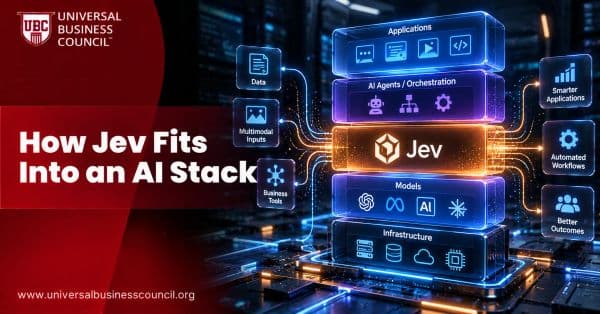
Artificial Intelligence
How Jev Fits Into an AI Stack
Learn how Jev fits into an AI stack as a machine-native decision layer that connects structured intelligence with agents, application logic, APIs, and automated workflows.
Artificial Intelligence
Jev Decision-Making Pipeline
Learn how Jev’s decision-making pipeline transforms program state and structured questions into typed, probabilistic decisions that software can use for automation.
Artificial Intelligence
Jev Latency Explained
Learn how Jev achieves low-latency AI decisions through parallel sampling, structured outputs, and a System One architecture designed for real-time software automation.
Trending Articles
The Role of Blockchain in Ethical AI Development
How blockchain technology is being used to promote transparency and accountability in artificial intelligence systems.
AWS Career Roadmap
A step-by-step guide to building a successful career in Amazon Web Services cloud computing.
Top 5 DeFi Platforms
Explore the leading decentralized finance platforms and what makes each one unique in the evolving DeFi landscape.