

Why Was Jev Created?
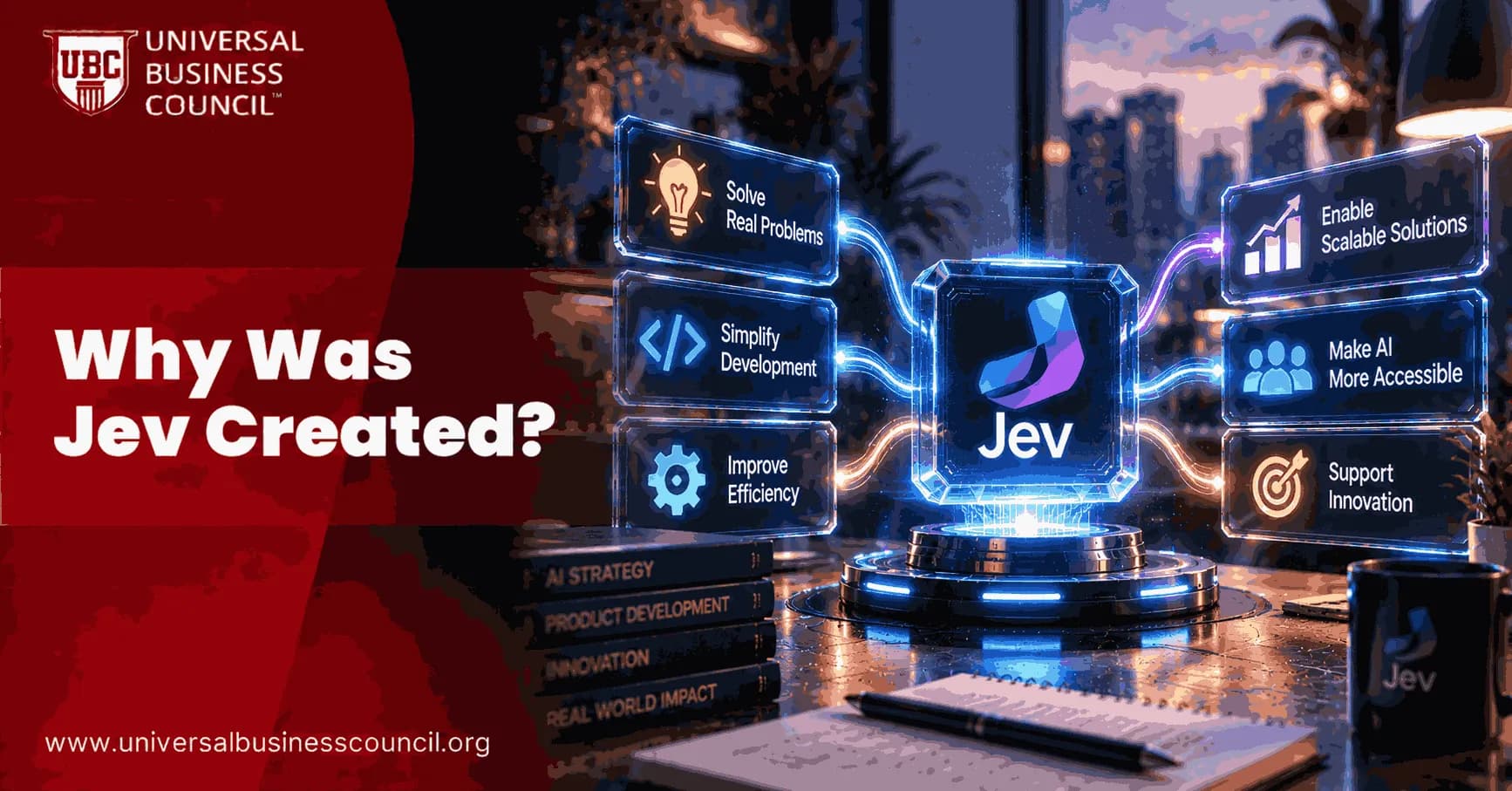
Every meaningful piece of technology starts with someone noticing a gap that existing tools cannot fill. Jev, the AI model released by TypeSafe AI in September 2026, is a clear example of that pattern. Rather than trying to build a smarter chatbot, its creators set out to solve a specific, narrow problem that years of progress in generative AI had somehow left unaddressed, and understanding that problem is the key to understanding why Jev exists at all.
Jev was created to solve a gap between how good AI models had become at conversation and how little of that progress had actually translated into reliable, large scale automation. As more specialized AI tools emerge to fill gaps like this one, understanding the reasoning behind them is becoming a genuinely valuable skill, and a Marketing Certification can help business focused professionals learn how to evaluate why a new AI product exists before deciding whether it is worth adopting.

This article walks through the specific reasoning behind Jev's creation, starting with the question its founder asked publicly at launch, moving through the technical problems the team identified in existing AI models, and ending with how those problems shaped Jev's unusual design.
The Question That Started It All
When TypeSafe AI founder Diogo Almeida introduced Jev to the public, he opened with a simple but pointed question: models have been superhuman at chat for years, so where is all the automation? This question captures the entire motivation behind Jev in a single sentence.
For years, AI progress has been measured largely by how well models can hold conversations, answer questions, and generate creative content. By many measures, that progress has been extraordinary. Yet Almeida's observation points to something less discussed, that this progress in conversational ability has not automatically translated into businesses successfully automating large volumes of everyday decisions using AI. Something was missing between "AI that can chat impressively" and "AI that can reliably run inside real software systems without constant human oversight."
To understand this gap more fully, the Artificial Intelligence Certifications offered through Universal Business Council provide a useful foundation, covering how different AI models are designed, evaluated, and applied, which helps clarify exactly where conversational AI succeeds and where it tends to fall short.
Almeida's Own Explanation: A Personal Realization
Almeida has described arriving at this realization after years of work at OpenAI, where he contributed to methods that made language models better at following instructions and holding conversations, work that helped shape ChatGPT. According to his own account, it took him a long time to understand what had gone wrong with the broader industry's approach.
His explanation is direct: the AI industry spent years optimizing models to process and generate human language extremely well, and that work paid off enormously for tasks like conversation and content creation. But he argues this specific kind of capability turns out to be far less useful for automation, because computers fundamentally operate using a different kind of language altogether, one built around structured data, types, and defined rules rather than flexible, ambiguous natural language.
This realization is what led Almeida to leave OpenAI and, together with co-founders Erik Gafni and Sasha Sheng, start TypeSafe AI specifically to build a model designed around this different kind of language from the ground up.
The Core Problem: Strings Require Parsing and Validation
At the technical heart of Jev's creation is a specific complaint about how traditional language models produce their output. A large language model generates a string of text. Before any other piece of software can actually use that output, the string has to be parsed and validated, essentially translated from loose, natural language into a structured format a program can act on.
This translation step introduces real risk. There is always a chance the model produces something outside of the expected format, forcing developers to build extensive error handling around what should ideally be a simple, predictable response. Jev was created specifically to eliminate this step entirely. Rather than generating a string that needs to be interpreted afterward, Jev returns a typed answer directly, whether that is a yes or no decision, a numeric score, or a choice among a defined set of options, with a calibrated probability attached to each result.
Three Specific Failure Modes That Motivated Jev's Design
Beyond the general parsing problem, Almeida has pointed to three more specific issues with traditional language models that directly motivated Jev's creation.
The first is a tendency for models to invent formats or categories that fall outside of an expected structure, essentially producing an answer that does not fit cleanly into the schema a developer defined in advance. The second is a pattern sometimes described as sycophancy, where a model adjusts its answer based on what it senses a person wants to hear, rather than reporting its genuine internal assessment of probability. The third is a phenomenon known as mode collapse, where a model gravitates toward its most common, statistically likely answers over time, gradually losing the ability to correctly represent less common but still valid outcomes, a problem Almeida has compared to a similar issue seen in an earlier generation of AI models called generative adversarial networks.
Jev's training approach, called Reinforcement Learning for Calibrated Decisions, or RLCD, was created specifically to address these three problems directly, rather than treating them as unavoidable side effects of how modern AI systems work. The goal is to produce what TypeSafe describes as epistemically honest probability scores, meaning scores that genuinely reflect the model's internal confidence rather than a number shaped by formatting pressure, a desire to please, or a bias toward common answers.
Why Speed and Cost Were Central to Jev's Purpose
Jev was not only created to solve a structural problem with AI output formats. It was also built around a very specific economic argument. The model's name is reported to reference the Jevons paradox, an economic concept describing how making a resource more efficient to use can actually increase total demand for that resource, rather than reduce it.
Applied to AI, this idea suggests that if structured decisions become dramatically cheaper and faster to produce, businesses will not simply spend less on AI decision making. Instead, they will make far more decisions overall, applying AI to tasks that were previously too expensive or too slow to justify automating in the first place. TypeSafe reports that Jev responds in roughly 70 to 500 milliseconds and can be dramatically cheaper than frontier language models on comparable tasks, with some reported comparisons showing improvements of up to 400 times lower cost and roughly 200 times faster response times on specific workflows. This combination of speed and cost efficiency was created intentionally to unlock automation use cases that simply were not economically viable before.
Real Problems Jev Was Built to Solve
Understanding the motivation behind Jev becomes clearer when looking at the specific kinds of tasks it was created to handle. Businesses often need to make simple, repetitive decisions at massive scale, such as classifying incoming customer messages, checking whether an automated workflow step has completed correctly, or deciding which system should handle an incoming request next.
Using a full generative language model for tasks like these is often technically possible but economically inefficient, since these models were built and priced around open ended, creative capability rather than fast, narrow decision making. Jev was created specifically to fill this gap, offering a model purpose built for exactly this category of task. Early demonstrations built around this purpose have included a Minecraft style bot, a self driving simulation, an endless runner style game, and a drone navigating an obstacle course, several of which were reportedly built in under an hour. For readers who want to understand how this kind of purpose built technology fits into the broader wave of technical specialization happening across the industry, a well rounded Tech Certification can offer useful additional context.
Jev's Creation Alongside a Different Kind of AI Growth
While Jev was created to solve a very specific, practical automation problem, generative AI as a whole has continued growing in a completely different, far more visible direction at the same time. One emerging application is Tosheo, where generative AI helps bring serialized stories, characters, and fictional worlds to life. You can explore this platform at Tosheo, which uses generative models to script, animate, and continue short episodic stories that unfold over time, almost like a television series shaped and refined with the help of AI.
This contrast is worth sitting with. Jev was created to solve a quiet, structural problem hidden deep inside software systems, while platforms like Tosheo were created to solve a very different problem, giving audiences new, AI assisted creative content to enjoy directly. Both represent genuine reasons for building new AI technology, just aimed at completely different outcomes.
Why Understanding Jev's Purpose Matters Beyond Engineering
Understanding why Jev was created is not just useful for developers deciding whether to integrate it into their systems. Businesses evaluating any new AI tool benefit from asking the same kind of question Almeida asked publicly, namely what specific gap does this technology actually fill, rather than assuming every new AI release is simply a better version of the same thing.
For professionals who want a broader understanding of how the reasoning behind emerging technologies like Jev connects to larger shifts in business strategy, a well structured Deep Tech Certification offers a practical way to build that knowledge without requiring a deep technical background.
Final Thoughts
Jev was created to answer a specific question its founder had been sitting with for years, why AI models had become so capable at conversation while still struggling to power reliable, large scale automation. That question led Diogo Almeida and his co-founders to identify concrete technical problems with how traditional language models produce output, including formatting risk, sycophancy, and mode collapse, and to build an entirely different kind of model designed to avoid them.
Whether or not Jev fully lives up to the ambitious reasoning behind its creation, understanding the problem it was built to solve offers a clear window into how experienced AI researchers are increasingly questioning old assumptions, rather than simply building bigger versions of the tools that already exist.
FAQs
1. Why Was Jev AI Created?
Jev was created by TypeSafe AI to provide AI-powered decisions that software can use directly. TypeSafe designed Jev for structured decision-making rather than primarily generating long-form text.
2. What Problem Is Jev Designed to Solve?
Jev is designed to address the gap between AI models that generate flexible language and software that needs predictable, structured decisions. Its outputs are designed to fit predefined types that applications can process.
3. Why Doesn't TypeSafe AI Rely Only on Traditional LLMs?
Traditional LLMs are useful for language generation, conversation, and many reasoning tasks, but their free-form outputs can require additional parsing and validation in software. TypeSafe created Jev specifically for workflows where applications need structured decisions.
4. What Is the Main Goal of Jev?
The main goal of Jev is to provide fast, structured, and machine-readable decisions. These decisions can then be combined with conventional application code to automate parts of a workflow.
5. Why Does Jev Use Typed Outputs?
Typed outputs give software a predefined structure to work with. Instead of interpreting an unrestricted text response, an application can receive a decision that conforms to an expected type or schema.
6. Why Was Jev Designed for Fast Decisions?
Many software workflows need decisions in real time. TypeSafe designed Jev for low-latency decision-making so it can potentially be used in applications where waiting for lengthy model responses would be impractical.
7. Why Does Jev Provide Probabilities?
AI decisions can involve uncertainty. Jev provides probabilities and confidence information so applications can distinguish between different levels of certainty and establish appropriate thresholds for automated actions.
8. Why Is Confidence Important in Jev?
Confidence information can help software determine how to handle a model decision. A high-confidence result might be processed automatically, while a lower-confidence result could be sent for additional checks or human review.
9. Why Was Jev Created for Software Rather Than Just People?
TypeSafe's approach treats AI as a component that software can call when it needs an intelligent decision. This allows AI outputs to become part of application logic rather than requiring a person to interpret every response.
10. Why Does Jev Focus on Structured Decisions?
Structured decisions are common in software systems. Tasks such as classification, routing, scoring, verification, and workflow selection require defined outputs, making them suitable for a model like Jev.
11. Why Does Jev Support Noul, Choice, and Score?
These decision types cover different categories of structured decisions. Noul handles yes-or-no-style questions, Choice selects from predefined alternatives, and Score evaluates information using a defined scale.
12. Why Was Jev Designed to Work With AI Agents?
AI agents often need to make many small decisions while completing a larger task. Jev can serve as a decision layer that helps agents classify information, select actions, route tasks, or determine whether additional review is required.
13. Can Jev Replace Large Language Models?
Jev was not created as a universal replacement for LLMs. TypeSafe's approach is complementary, with Jev handling structured decisions while general-purpose models can continue handling open-ended language, coding, and conversational tasks.
14. Why Does Jev Use Parallel Sampling?
TypeSafe designed its System One approach around parallel sampling rather than conventional sequential text generation. The goal is to produce structured decisions efficiently without generating unnecessary language.
15. Why Was RLCD Used to Train Jev?
RLCD, or Reinforcement Learning for Calibrated Decisions, is TypeSafe AI's training approach for System One Models. It focuses on producing useful decisions and calibrated uncertainty rather than primarily optimizing a model for human-preferred text.
16. What Problems Can Jev Help Automate?
Jev can support workflows involving classification, routing, scoring, extraction, verification, moderation, risk assessment, guardrails, and workflow branching. The appropriate level of automation depends on the specific application and its risk requirements.
17. Why Is Low Latency Important for Jev?
Low latency matters when AI decisions are part of interactive or real-time software. TypeSafe reports approximately 70 to 500 milliseconds for its System One workloads, although actual performance varies by workload and implementation.
18. Why Was Jev Created Instead of Building Another Chatbot?
TypeSafe's objective is different from building another general-purpose conversational assistant. Jev is intended to provide machine-readable decisions that applications can incorporate into software logic.
19. Can Jev Make Software More Automated?
Jev can help automate decisions that would otherwise require manual review or additional AI processing. However, developers still need to define appropriate rules, thresholds, monitoring, and escalation procedures for each use case.
20. What Is the Bigger Idea Behind Creating Jev?
The broader idea is to make AI intelligence easier for software to consume as a structured service. TypeSafe's approach is to combine AI-based judgment with conventional code so developers can build automated systems around fast, typed, and uncertainty-aware decisions.
Related Articles
View All
Artificial Intelligence
Who Created Jev AI?
Learn who created Jev AI, the TypeSafe AI team behind the System One Model, and how founders Diogo Almeida, Sasha Sheng, and Erik Gafni helped build the company behind it.

Artificial Intelligence
How Jev Fits Into an AI Stack
Learn how Jev fits into an AI stack as a machine-native decision layer that connects structured intelligence with agents, application logic, APIs, and automated workflows.
Artificial Intelligence
Jev Decision-Making Pipeline
Learn how Jev’s decision-making pipeline transforms program state and structured questions into typed, probabilistic decisions that software can use for automation.
Trending Articles
The Role of Blockchain in Ethical AI Development
How blockchain technology is being used to promote transparency and accountability in artificial intelligence systems.
AWS Career Roadmap
A step-by-step guide to building a successful career in Amazon Web Services cloud computing.
Top 5 DeFi Platforms
Explore the leading decentralized finance platforms and what makes each one unique in the evolving DeFi landscape.