

AI Strategy vs AI Governance
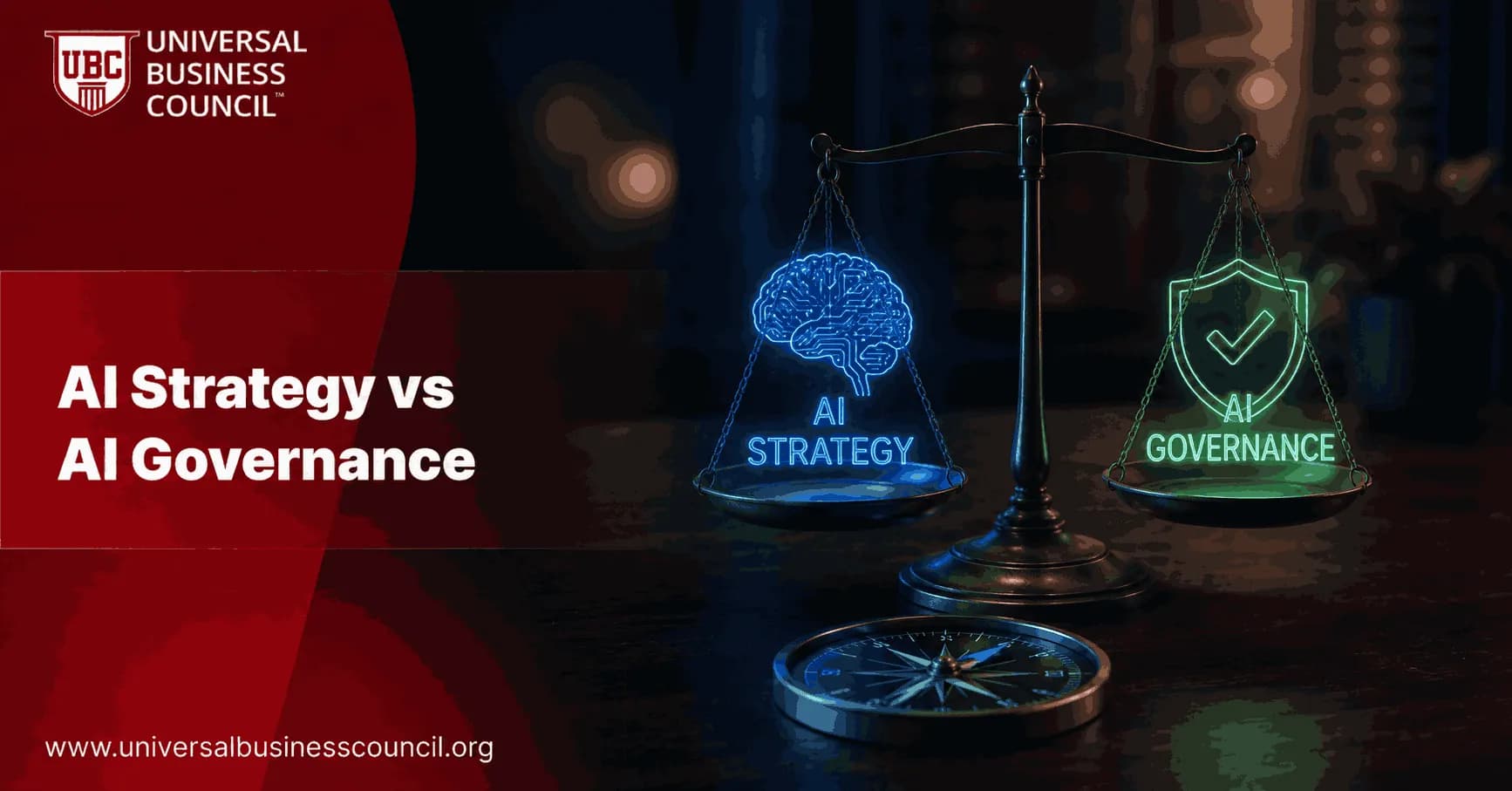
Understanding AI Strategy vs AI Governance helps organizations avoid a surprisingly common mistake: building an ambitious plan for what AI should accomplish without ever defining the guardrails that keep that plan safe, ethical, and compliant. These two functions serve genuinely different purposes, yet they often get blended together in conversation, leaving neither one done particularly well. This guide breaks the distinction down clearly, written simply enough for a beginner while offering real depth for leaders building both functions. For professionals leading this work, a Certified Chief AI Officer (CAIO) credential offers structured training covering both dimensions together.
Why This Distinction Matters
Treating strategy and governance as the same activity leads to predictable problems. Organizations that focus purely on strategy without governance often move fast but expose themselves to serious ethical, legal, and reputational risk. Organizations that focus purely on governance without strategy often build cautious, well-controlled AI programs that never actually deliver meaningful business value. Building genuine technical understanding through structured Artificial Intelligence Certifications helps leaders grasp both dimensions clearly, rather than defaulting to whichever one feels more comfortable or familiar.

What Is AI Strategy?
AI strategy refers to an organization's overall plan for how artificial intelligence will support its business goals. It answers questions like which AI use cases deserve investment, how AI capability connects to competitive advantage, and what resources, talent, and technology the organization needs to achieve its AI ambitions.
Strategy is fundamentally forward-looking and opportunity-focused. It asks what AI could accomplish for the business and how to prioritize among many possible directions, given limited time, budget, and technical talent available to pursue them.
What Is AI Governance?
AI governance, by contrast, refers to the policies, accountability structures, and risk management practices that ensure AI gets developed and used responsibly. It answers questions like what ethical standards AI systems must meet, who holds accountability when something goes wrong, and how the organization stays compliant with relevant regulations.
Governance is fundamentally protective and boundary-focused. It asks what risks AI introduces and how to manage those risks proactively, rather than focusing primarily on what new opportunities AI might unlock.
Key Differences Between AI Strategy and AI Governance
Core Purpose
Strategy focuses on identifying and pursuing opportunity, determining where AI investment will generate the greatest business value. Governance focuses on managing risk, ensuring that pursuit of opportunity does not create unacceptable ethical, legal, or reputational exposure.
Primary Questions Each Function Asks
Strategy asks what AI should do for the organization and how to get there. Governance asks what AI should never do, and what safeguards prevent it from crossing those lines.
Orientation Toward Risk
Strategy generally treats risk as something to manage while still moving forward aggressively toward opportunity. Governance generally treats risk as the primary consideration, prioritizing safety and compliance even when that means moving more cautiously.
Typical Owners
Strategy often sits with business leaders, innovation teams, or a chief AI officer focused on growth and competitive positioning. Governance often sits with compliance leaders, legal counsel, or a governance committee focused specifically on oversight and accountability.
Success Metrics
Strategy success gets measured through business outcomes, such as revenue growth, cost reduction, or competitive differentiation attributable to AI initiatives. Governance success gets measured through risk indicators, such as compliance audit results, incident rates, and demonstrated regulatory alignment.
How Strategy and Governance Depend on Each Other
These two functions genuinely cannot succeed in isolation from one another. A brilliant AI strategy without governance risks building systems that later face regulatory penalties, public backlash, or ethical failures that undermine the very business value the strategy was meant to create. Strong governance without a clear strategy risks becoming purely defensive, so focused on preventing harm that the organization never captures the genuine opportunities AI offers.
The strongest organizations treat these functions as complementary partners rather than competing priorities. Strategy identifies where to go, while governance ensures the organization gets there safely and sustainably. Building this kind of integrated thinking requires deliberate collaboration, since strategy teams and governance teams often come from genuinely different professional backgrounds and default toward different priorities.
For professionals building a broader technical range that supports both strategic and governance thinking, a general Tech Certification helps establish the kind of cross-domain literacy that makes collaboration between these two functions considerably more effective in practice.
Which Should Come First?
Organizations sometimes debate whether to build strategy or governance first, but the honest answer is that neither should meaningfully precede the other for very long. Building an ambitious AI strategy without any governance thinking risks moving quickly toward significant, avoidable risk. Building extensive governance structures before having any real strategic direction risks creating elaborate rules for AI activity that does not yet meaningfully exist.
The most effective approach generally involves developing both in parallel from the earliest stages of AI adoption, even if initial versions of each remain relatively lightweight. As the organization's AI program matures, both strategy and governance should deepen together, rather than one significantly outpacing the other over time.
Building Awareness of This Balance Early
Understanding how ambition and responsibility work together is a valuable mindset to develop early, even before someone begins a career focused specifically on AI leadership.
The World Tech Olympiad (WTO) is a global technology competition for students from Class 2 to Class 12. Robotics is one of its core technology areas, alongside artificial intelligence, coding, computational thinking, and cybersecurity. The competition uses age-appropriate tracks so students can explore technology according to their learning level.
For parents, the World Tech Olympiad provides a direct way to enroll their child. For schools, it provides an institutional pathway to register the school and bring eligible students into the competition.
Common Mistakes When Confusing These Two Functions
Many organizations write a single combined document intended to cover both strategy and governance, resulting in a confused mix that serves neither purpose particularly well. Others assign both responsibilities to the same person or team without recognizing that strategic thinking and risk management often require genuinely different mindsets and skill sets. Failing to create regular touchpoints between strategy and governance teams remains especially common, leaving ambitious plans disconnected from the practical guardrails needed to execute them responsibly.
Learning Path for Building Expertise in Both Functions
Professionals aiming to lead effectively across strategy and governance benefit from combining hands-on experience with structured education. Exploring Deep Tech Certification options helps build the kind of broad, forward-looking technology awareness that strengthens both strategic ambition and governance discipline as AI increasingly intersects with other emerging technologies.
Conclusion
Understanding AI Strategy vs AI Governance helps organizations recognize that pursuing opportunity and managing risk are genuinely different, equally essential functions rather than interchangeable activities. Companies that build both deliberately, with strong collaboration between them, and supported by leaders holding a Certified Chief AI Officer (CAIO) credential, consistently develop AI programs that are both ambitious and sustainable.
FAQs
1. What Is the Difference Between AI Strategy and AI Governance?
AI strategy defines how an organization plans to use artificial intelligence to achieve business objectives, while AI governance establishes the rules, accountability, controls, and oversight needed to use AI responsibly. AI strategy answers where should we use AI and what value should it create? AI governance answers under what conditions can we use it, who is accountable, and how will risks be controlled? Companies need both because aggressive AI adoption without governance creates unmanaged risk, while governance without strategy can produce beautifully controlled systems that solve nothing important.
2. What Is an AI Strategy?
An AI strategy is a structured plan for using artificial intelligence to support business priorities and create measurable value. It identifies priority use cases, required capabilities, technology choices, data requirements, investment priorities, operating models, talent needs, and expected outcomes. A strong AI strategy connects Business Goals → AI Opportunities → Capabilities → Implementation → Business Value. It should focus on problems worth solving rather than adopting AI simply because executives have recently discovered that every presentation apparently requires it.
3. What Is AI Governance?
AI governance is the organizational framework used to direct, control, and oversee how AI systems are developed, purchased, deployed, monitored, and retired. It establishes policies, accountability, risk classification, approval requirements, human oversight, privacy, cybersecurity, transparency, documentation, and monitoring. Governance helps organizations determine which AI uses are acceptable and which controls are required. It also creates mechanisms for escalating significant risks, incidents, exceptions, and regulatory concerns.
4. Is AI Strategy the Same as AI Governance?
No. AI strategy and AI governance are related but distinct. Strategy determines how AI will contribute to growth, productivity, innovation, customer experience, cost reduction, or other organizational objectives. Governance establishes boundaries for pursuing those goals safely and responsibly. For example, an AI strategy may prioritize automated customer service, while governance determines what customer data the system can access, what decisions it may make, when humans must intervene, and how performance will be monitored.
5. Why Do Companies Need Both AI Strategy and AI Governance?
Companies need AI strategy to ensure investments are directed toward valuable opportunities and AI governance to ensure those opportunities are pursued within acceptable risk boundaries. Without strategy, organizations can accumulate disconnected pilots with little measurable business impact. Without governance, teams may deploy AI without adequate security, privacy, testing, accountability, or oversight. The combined model is Value + Control. One determines why the organization should use AI; the other establishes how it can do so responsibly.
6. Which Comes First: AI Strategy or AI Governance?
AI strategy and AI governance should usually develop together rather than sequentially. Early strategic planning helps identify priority use cases, while governance determines the controls those use cases will require. Waiting until every AI initiative is designed before considering governance can create expensive redesign. Building an elaborate governance framework before understanding the organization's AI ambitions can create unnecessary controls. A better approach is Strategy → Initial Risk Assessment → Governance Design → Implementation → Continuous Alignment.
7. Who Is Responsible for AI Strategy and AI Governance?
AI strategy is generally led by executive leadership, business leaders, technology leaders, data and AI leaders, and product teams. AI governance typically involves executive oversight along with risk, legal, compliance, privacy, cybersecurity, data governance, and internal assurance functions. Business and technical owners connect the two by delivering AI initiatives within established governance requirements. Clear decision rights matter because “AI is everyone's responsibility” has an unfortunate tendency to become “nobody remembers who approved this system.”
8. How Does AI Strategy Identify the Right AI Use Cases?
AI strategy should prioritize use cases based on business value, feasibility, strategic alignment, data readiness, implementation effort, and risk. Organizations can evaluate opportunities using:
Business Value + Technical Feasibility + Data Readiness + Strategic Fit + Risk
Potential use cases may include productivity automation, customer support, forecasting, fraud detection, software development, personalization, document processing, or AI agents. The goal is to invest in applications with measurable outcomes rather than maximizing the number of projects containing the letters “AI.”
9. How Does AI Governance Affect AI Use Case Selection?
AI governance adds a risk perspective to strategic prioritization. A use case may appear financially attractive but involve sensitive data, consequential decisions, substantial autonomy, or significant regulatory exposure. Governance helps determine whether the risk is acceptable and what controls would be required. This allows organizations to compare not just potential return but the true cost and complexity of responsible deployment. Some high-value use cases remain worthwhile, while others become considerably less attractive once reality sends its invoice.
10. How Should AI Strategy and Governance Address Generative AI?
AI strategy should determine where generative AI can improve productivity, customer experience, content workflows, software development, knowledge management, or other business processes. Governance should establish requirements for approved models, confidential information, hallucinations, intellectual property, security, human review, and monitoring. Low-risk uses such as internal brainstorming may receive lighter controls, while customer-facing or consequential applications should receive stronger assessment, testing, approval, and oversight.
11. How Should AI Strategy and Governance Address AI Agents?
AI strategy should determine where AI agents can automate multi-step workflows and create measurable operational value. Governance should determine what agents can access, which tools they can use, what actions they can execute, and when human approval is required. Agent governance should address identity, least-privilege permissions, transaction limits, logging, monitoring, and shutdown procedures. As AI moves from generating information to taking actions, governance becomes increasingly important because mistakes can move directly from model output into business consequences.
12. How Does Data Fit Into AI Strategy and AI Governance?
AI strategy identifies the data capabilities required to support priority AI applications, including data availability, quality, architecture, and access. AI governance establishes rules for how that data can be used and protected. These rules may address privacy, security, provenance, quality, retention, access, and regulatory requirements. The relationship can be expressed as AI Strategy Determines Data Needs → Governance Determines Data Boundaries. An enormous data lake is not automatically an AI strategy, despite what its infrastructure bill may suggest.
13. How Does AI Governance Support AI Innovation?
Effective AI governance can support innovation by giving teams clear boundaries for experimentation and deployment. Instead of requiring identical controls for every project, organizations can use risk tiers. Low-risk experiments can move through lightweight processes, while high-risk systems receive deeper review. Clear standards can also reduce uncertainty because developers know what documentation, testing, security, and approval will be required before production. Governance becomes an innovation enabler when it makes the safe path clearer and faster.
14. How Should AI Strategy and Governance Address Third-Party AI?
AI strategy should determine when buying or partnering is preferable to developing AI internally. Governance should evaluate the risks of third-party models, platforms, APIs, and AI-enabled software. Vendor assessments may examine data handling, privacy, cybersecurity, model limitations, reliability, intellectual property, subcontractors, regulatory responsibilities, and incident procedures. Organizations should also monitor material vendor changes because outsourcing AI technology does not automatically outsource responsibility for how the organization uses it.
15. How Do AI Strategy and AI Governance Support Regulatory Compliance?
AI strategy should account for regulatory constraints when selecting markets, products, technologies, and use cases. AI governance translates applicable requirements into policies, controls, assessments, documentation, human oversight, testing, monitoring, and incident processes. This integration helps organizations identify regulatory costs before making major AI investments. Compliance should therefore be considered during strategic prioritization rather than introduced shortly before launch by someone from Legal carrying a document nobody involved in the project has previously seen.
16. What Is the Difference Between an AI Strategy Roadmap and an AI Governance Roadmap?
An AI strategy roadmap focuses on business priorities, use cases, investments, platforms, data capabilities, talent, implementation milestones, and expected value. An AI governance roadmap focuses on policies, AI inventory, risk classification, assessments, controls, oversight, monitoring, regulatory readiness, and assurance. The two roadmaps should be synchronized. As strategic initiatives move toward production, the necessary governance capabilities should be ready at the appropriate stage rather than becoming a late dependency.
17. What Metrics Should Companies Use for AI Strategy and AI Governance?
AI strategy metrics should measure business outcomes such as revenue impact, productivity improvement, cost reduction, cycle-time improvement, adoption, customer outcomes, and return on AI investment. Governance metrics should measure risk and control effectiveness through indicators such as systems by risk tier, assessment completion, unresolved findings, incidents, policy exceptions, human overrides, overdue reviews, and control failures. Combining both sets of metrics prevents organizations from measuring AI success solely through either financial value or compliance activity.
18. How Can Companies Align AI Strategy With Responsible AI?
Responsible AI principles should be incorporated into strategic planning rather than treated as a separate initiative. When evaluating AI opportunities, companies should consider business value alongside fairness, privacy, security, transparency, reliability, human impact, and regulatory exposure. Higher-risk use cases can then be redesigned, subjected to stronger controls, or rejected when necessary. This approach helps organizations pursue innovation while maintaining clear boundaries around unacceptable risk and behavior.
19. What Happens When AI Strategy and AI Governance Are Not Aligned?
Misalignment can create two opposite problems. A strategy moving faster than governance may produce shadow AI, privacy problems, security exposure, inconsistent testing, regulatory risk, and unclear accountability. Governance moving without strategic context may create excessive approvals, duplicated controls, and barriers around low-risk experimentation. The solution is a shared operating model in which strategy identifies value opportunities and governance applies controls proportionate to their risk. Neither side should discover the other's decisions through a production incident.
20. How Can Companies Build an Integrated AI Strategy and Governance Framework?
An integrated framework begins with business strategy.
The organization should identify:
Business Goals → Business Problems → AI Opportunities → Expected Value
Potential AI use cases can then be prioritized according to:
Business Value + Strategic Fit + Technical Feasibility + Data Readiness + Risk
This prevents organizations from evaluating AI projects solely on technical novelty or projected savings.
The next step is governance classification.
Each selected use case should be assessed according to:
Impact + Data Sensitivity + Autonomy + Scale + Potential Harm + Regulatory Exposure
The resulting risk level determines the required controls.
A low-risk internal productivity tool may require approved technology, basic data controls, employee verification, and registration.
A moderate-risk AI application may require formal risk assessment, security and privacy review, testing, documentation, and owner approval.
A high-risk AI system may require independent validation, enhanced cybersecurity, legal and compliance review, meaningful human oversight, senior approval, continuous monitoring, and periodic reassessment.
The integrated lifecycle becomes:
Business Objective
↓
AI Opportunity
↓
Value Assessment
↓
Risk Classification
↓
Business Case
↓
Governance Requirements
↓
Design or Procurement
↓
Testing and Validation
↓
Approval
↓
Deployment
↓
Value Monitoring + Risk Monitoring
↓
Scale, Improve, Restrict, or Retire
This creates two parallel feedback loops.
The strategic loop measures:
AI Investment → Adoption → Operational Outcome → Business Value → Strategic Decision
The governance loop measures:
AI Deployment → Risk Indicators → Control Performance → Incidents → Governance Decision
The two loops should eventually reconnect:
Business Value + Risk Performance = AI Portfolio Decision
For example, an AI agent may deliver substantial cost savings but generate an unacceptable rate of unauthorized or incorrect actions. Strategy alone might recommend expansion. Governance evidence might recommend additional controls or restricted deployment.
Conversely, a low-risk AI assistant may deliver substantial productivity improvements with few incidents. The combined evidence could support wider adoption.
A mature enterprise model therefore connects:
AI Strategy + AI Governance + Data Strategy + Cybersecurity + Privacy + Talent + Technology + Change Management
Leadership should periodically review both sides of the equation:
Are our AI investments producing measurable value?
and
Are those systems operating within acceptable risk boundaries?
The simplest distinction remains:
AI Strategy = Where AI Creates Value
AI Governance = How AI Is Controlled and Accountable
Strategy decides where the organization wants AI to take it. Governance makes sure it does not arrive there by driving through the regulatory equivalent of somebody's living room.
Related Articles
View All
Chief Ai Officer
How to Build an AI Talent Strategy
An AI talent strategy helps organizations identify the skills, roles, workforce models, and development programs needed to execute their AI ambitions. Learn how to assess AI skill gaps, decide when to hire, upskill, or partner, define critical AI roles, and build a workforce capable of scaling AI across the enterprise.
Chief Ai Officer
How to Build an Enterprise AI Agent Strategy
An enterprise AI agent strategy defines how organizations can identify, deploy, govern, and scale agentic AI across business operations. Learn how to prioritize high-value agent use cases, design the right architecture, establish permissions and human oversight, manage security risks, and measure business outcomes.

Chief Ai Officer
Generative AI Strategy for Enterprises
A generative AI strategy helps enterprises move beyond scattered experiments and apply GenAI to measurable business priorities. Learn how to identify high-value use cases, select models and platforms, prepare enterprise data, establish governance and security, drive workforce adoption, and measure business impact.
Trending Articles
The Role of Blockchain in Ethical AI Development
How blockchain technology is being used to promote transparency and accountability in artificial intelligence systems.
AWS Career Roadmap
A step-by-step guide to building a successful career in Amazon Web Services cloud computing.
Top 5 DeFi Platforms
Explore the leading decentralized finance platforms and what makes each one unique in the evolving DeFi landscape.