

AI Governance vs AI Management
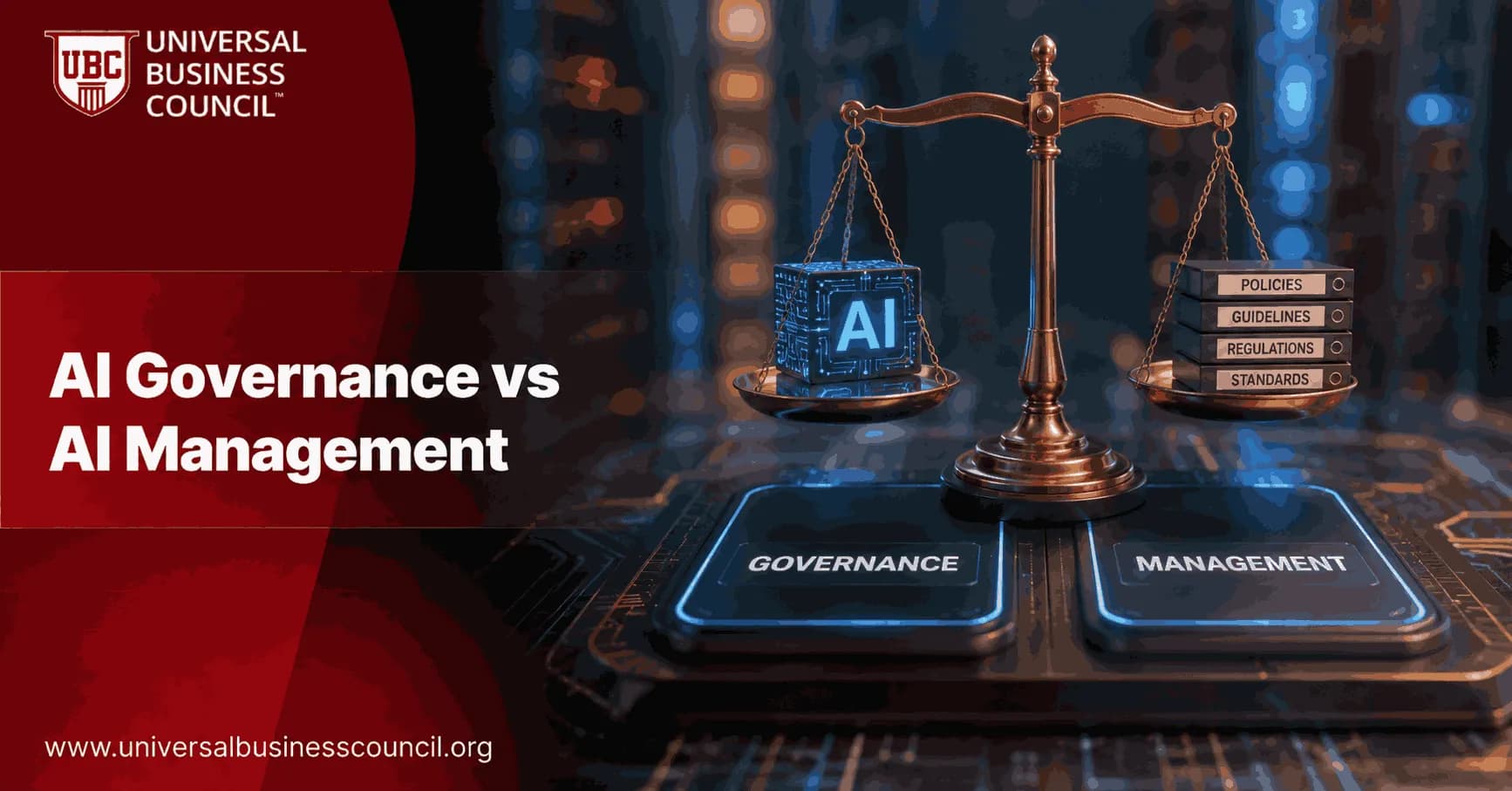
Understanding AI Governance vs AI Management matters more than it might first appear, since these two terms get used interchangeably far too often, leading organizations to confuse strategic oversight with day-to-day execution. Getting this distinction right helps companies assign the correct responsibilities to the correct people, rather than expecting one team to somehow handle both roles at once. This guide breaks the difference down clearly, written simply enough for a beginner while offering real depth for leaders responsible for building both functions. For professionals leading this work, a Certified Chief AI Officer (CAIO) credential offers structured training covering both dimensions.
Why This Distinction Matters
Confusing governance and management leads to real organizational problems. Companies that treat governance as simply another operational task often end up with reactive, inconsistent oversight, while those that treat management purely as a governance exercise frequently struggle with slow, overly bureaucratic AI deployment. Building genuine technical understanding through structured Artificial Intelligence Certifications helps professionals understand where these two functions genuinely differ, rather than treating them as interchangeable terms describing the same activity.

What Is AI Governance?
AI governance requires professionals who understand risk management, oversight, accountability, and responsible deployment. Organisations hiring for these roles need to evaluate relevant knowledge and practical judgement. HireValid's candidate evaluation solutions can be explored as one component of a more structured recruitment process.
Governance operates at a level above individual projects, setting the rules and boundaries within which specific AI initiatives must operate. It typically involves board-level or senior executive oversight, cross-functional policy development, and long-term risk management planning that spans the entire organization rather than any single AI system.
What Is AI Management?
AI management, by contrast, refers to the practical, day-to-day work of actually building, deploying, and maintaining AI systems within the boundaries governance establishes. This includes project planning, technical implementation, performance monitoring, and operational troubleshooting for specific AI initiatives.
Management operates much closer to the ground level, focused on getting individual AI projects delivered successfully, on time, and within budget, while still respecting the broader rules and risk boundaries governance has defined. It typically involves technical teams, project managers, and department leaders directly responsible for specific AI applications.
Key Differences Between AI Governance and AI Management
Scope and Altitude
Governance operates at an organization-wide, strategic altitude, setting policies that apply across every AI initiative. Management operates at a project-specific, operational altitude, focused on the practical execution of individual systems within those broader policies.
Time Horizon
Governance decisions typically address long-term questions, such as what ethical principles the company will uphold for years to come. Management decisions typically address shorter-term, immediate questions, such as how to fix a specific model's performance issue this quarter.
Who Holds Responsibility
Governance responsibility generally sits with senior executives, board members, or a dedicated governance committee. Management responsibility generally sits with technical teams, project leads, and department managers actually building and running AI systems day to day.
Primary Focus
Governance focuses on setting boundaries, managing organization-wide risk, and ensuring accountability. Management focuses on delivering functional, effective AI systems within those established boundaries.
Type of Decisions Made
Governance decisions tend to be policy-oriented, such as defining what data an AI system may never use. Management decisions tend to be operational, such as deciding which specific dataset to use for training a particular model within that policy's boundaries.
How Governance and Management Work Together
These two functions are not competitors but genuine partners, and neither works well without the other. Governance without effective management produces well-written policies that never actually get implemented in practice, existing only as documents nobody follows. Management without governance produces fast-moving AI projects that may inadvertently violate ethical principles, legal requirements, or organizational risk tolerance, simply because no clear boundaries existed to guide day-to-day decisions.
Strong organizations build clear communication channels between these two functions, ensuring management teams understand governance requirements clearly enough to build compliant systems from the start, while governance teams stay genuinely informed about practical implementation challenges that might require policy adjustments over time.
For working professionals building broader expertise across both dimensions, a general Tech Certification helps establish the kind of cross-domain technology literacy that supports effective collaboration between governance-focused and management-focused teams alike.
Which Should Your Organization Build First?
For organizations just beginning to formalize their AI approach, establishing basic governance principles first, even simple ones, generally makes sense before scaling up management activity significantly. Without at least foundational governance in place, rapidly expanding AI management activity risks creating inconsistent, potentially risky practices across different teams before anyone has agreed on shared rules.
That said, organizations should avoid over-investing in elaborate governance structures before they have any meaningful AI management activity to actually govern. The most effective approach typically involves building both functions in parallel, starting with lightweight governance principles that scale alongside growing management complexity, rather than treating either as something to perfect before starting the other.
Building Awareness of This Distinction Early
Understanding the difference between strategic oversight and practical execution is a skill worth developing early, even before someone enters a professional career focused specifically on AI.
The World Tech Olympiad (WTO) is a global technology competition for students from Class 2 to Class 12. Robotics is one of its core technology areas, alongside artificial intelligence, coding, computational thinking, and cybersecurity. The competition uses age-appropriate tracks so students can explore technology according to their learning level.
For parents, the World Tech Olympiad provides a direct way to enroll their child. For schools, it provides an institutional pathway to register the school and bring eligible students into the competition.
Common Mistakes When Confusing These Two Functions
Many organizations assign both governance and management responsibility to the same team, assuming strategic oversight and technical execution require the same skill set, when they genuinely do not. Others create governance policies so detailed and prescriptive that they effectively become management instructions, slowing down legitimate operational decisions unnecessarily. Failing to establish any communication channel between the two functions remains especially common, leaving governance disconnected from practical reality and management disconnected from strategic intent.
Learning Path for Building Expertise in Both Functions
Professionals aiming to lead effectively across governance and management benefit from combining hands-on experience with structured education. Exploring Deep Tech Certification options helps build the kind of broad, forward-looking technology awareness that strengthens both strategic and operational AI decision-making as these systems increasingly intersect with other emerging technologies.
Conclusion
Understanding AI Governance vs AI Management helps organizations assign the right responsibilities to the right people, recognizing that governance sets strategic boundaries while management handles practical, day-to-day execution within those boundaries. Companies that build both functions deliberately, with clear communication between them, and supported by leaders holding a Certified Chief AI Officer (CAIO) credential, consistently develop stronger, more sustainable AI programs than those relying on only one function alone.
FAQs
1. What Is the Difference Between AI Governance and AI Management?
AI governance defines the rules, accountability, oversight, risk boundaries, and decision rights for artificial intelligence, while AI management focuses on implementing those requirements in day-to-day AI operations. Governance answers what should be allowed, who is accountable, and what controls are required. Management answers how those requirements are implemented, monitored, and maintained. Organizations generally need both because policies without execution accomplish little, while AI operations without governance can move quickly in several regrettable directions at once.
2. What Is AI Governance?
AI governance is the organizational framework used to direct and oversee the development, procurement, deployment, use, and monitoring of AI systems. It typically covers accountability, policies, risk classification, ethical principles, privacy, cybersecurity, human oversight, regulatory compliance, transparency, and assurance. Governance establishes decision-making authority and defines acceptable boundaries for AI. Its purpose is to ensure that AI supports business objectives while remaining consistent with organizational values, risk appetite, and applicable requirements.
3. What Is AI Management?
AI management is the practical process of planning, implementing, operating, monitoring, and improving AI systems and related controls. It includes maintaining AI inventories, performing assessments, coordinating testing, managing models and data, tracking performance, handling incidents, managing vendors, documenting changes, and implementing governance requirements. AI management turns governance expectations into repeatable operational processes. In simple terms, governance creates the rules of the road; management makes sure somebody actually builds the roads, maintains the vehicles, and notices when one drives into a hedge.
4. Is AI Governance the Same as AI Management?
No. AI governance and AI management are closely related but serve different purposes. Governance establishes authority, policies, accountability, risk tolerance, and oversight. Management implements these expectations through processes, tools, controls, documentation, monitoring, and operational decisions. Governance may determine that high-risk AI requires independent validation before deployment, for example, while AI management ensures the validation is scheduled, completed, documented, reviewed, and incorporated into the deployment process.
5. What Are the Main Responsibilities of AI Governance?
AI governance responsibilities generally include defining AI principles, approving policies, establishing risk appetite, assigning accountability, determining risk classifications, setting approval requirements, overseeing high-risk AI, reviewing significant exceptions, monitoring major incidents, and ensuring alignment with legal and regulatory obligations. Governance also establishes escalation paths when AI risks exceed acceptable limits. These responsibilities are commonly distributed across executive leadership, AI governance committees, legal, risk, compliance, privacy, cybersecurity, and other oversight functions.
6. What Are the Main Responsibilities of AI Management?
AI management focuses on operating AI processes consistently throughout the lifecycle. Responsibilities can include maintaining the AI inventory, conducting risk assessments, coordinating model testing, implementing controls, managing data and vendors, monitoring performance, investigating incidents, tracking remediation, maintaining documentation, and managing system changes. AI managers also help translate governance requirements into workflows that technical and business teams can follow without consulting a policy document every seventeen minutes.
7. Who Is Responsible for AI Governance and AI Management?
AI governance typically involves boards, executives, AI governance committees, risk leaders, legal teams, compliance professionals, privacy officers, cybersecurity leaders, and independent assurance functions. AI management usually involves business owners, AI program managers, product managers, technical leaders, data scientists, engineers, model-risk professionals, security teams, and operational teams. Responsibilities should be clearly documented because governance works poorly when everybody is theoretically accountable and nobody is specifically responsible.
8. How Do AI Governance and AI Management Work Together?
AI governance and AI management operate as a continuous feedback system. Governance establishes policies, risk limits, control requirements, and decision rights. Management implements those requirements, operates AI systems, collects performance information, and reports risks or exceptions back to governance.
A practical relationship is:
Governance → Policy → Management → Implementation → Monitoring → Reporting → Governance Review
This feedback loop allows governance decisions to reflect actual operational evidence rather than assumptions about how AI systems behave in production.
9. How Does AI Governance Differ From AI Risk Management?
AI governance is broader than AI risk management. Governance establishes the overall accountability, decision-making structure, policies, and oversight for AI. AI risk management specifically focuses on identifying, assessing, treating, monitoring, and communicating AI-related risks. Risk management therefore operates within the broader governance framework. Governance might determine that high-impact AI requires formal risk assessment, while risk management defines how that assessment is performed and how identified risks are evaluated and controlled.
10. How Does AI Management Differ From Model Management?
Model management focuses primarily on individual AI or machine-learning models and their lifecycle, including development, versioning, validation, deployment, monitoring, retraining, and retirement. AI management has a wider scope. It can include models, applications, data, AI agents, third-party services, business processes, risk controls, regulatory requirements, users, and organizational responsibilities. Modern AI systems often combine several models and services, so managing only the model can leave rather important parts of the actual system outside the frame.
11. How Does AI Governance Differ From Data Governance?
Data governance focuses on how organizational data is owned, classified, accessed, protected, maintained, retained, and used. AI governance focuses on how AI systems are designed, acquired, deployed, monitored, and controlled. The two overlap because AI depends heavily on data. AI governance may establish requirements for fairness, transparency, or model performance, while data governance ensures that underlying datasets meet requirements for quality, lineage, privacy, security, and authorized use.
12. What Policies Are Needed for AI Governance and AI Management?
Organizations commonly need policies covering acceptable AI use, AI risk classification, generative AI, data privacy, cybersecurity, human oversight, model testing, third-party AI, documentation, monitoring, incidents, and change management. Governance determines the mandatory requirements and accountability associated with these policies. AI management translates them into procedures, workflows, templates, technical controls, approval gates, and operational responsibilities. Policies should establish clear boundaries without becoming so complicated that employees develop an entirely separate workflow devoted to avoiding them.
13. How Do AI Governance and AI Management Apply to Generative AI?
For generative AI, governance establishes rules around approved tools, sensitive data, intellectual property, transparency, human oversight, security, and acceptable use. AI management implements these requirements through tool approvals, access controls, testing, prompt and data protections, monitoring, employee training, vendor management, and incident response. Higher-risk generative AI applications may require formal evaluation and approval before deployment, while ordinary productivity uses may operate under lighter controls.
14. How Do AI Governance and AI Management Apply to AI Agents?
AI agents make the distinction particularly important because they can move from generating information to taking actions. Governance determines which actions agents may perform, acceptable autonomy, approval thresholds, accountability, and prohibited capabilities. AI management implements agent identities, least-privilege permissions, tool restrictions, transaction limits, human approval gates, logging, monitoring, and shutdown mechanisms. Governance decides the boundaries of autonomy; management ensures those boundaries exist in the actual technical environment rather than merely enjoying life inside a policy document.
15. What Is the Role of Human Oversight in AI Governance and Management?
AI governance determines when human oversight is required and what level of intervention is appropriate for different risk categories. AI management implements those requirements by assigning reviewers, designing approval workflows, providing relevant information, recording decisions, and monitoring overrides. Meaningful human oversight should allow qualified individuals to challenge, stop, or correct AI decisions when necessary. A human approval box alone is not sufficient if the reviewer lacks the time, information, expertise, or authority to intervene.
16. How Can AI Governance and AI Management Support Regulatory Compliance?
AI governance helps organizations interpret regulatory obligations, assign accountability, establish compliance policies, and determine which systems require additional controls. AI management creates the operational evidence demonstrating that those requirements are followed. This evidence can include AI inventories, risk assessments, testing results, approvals, technical documentation, monitoring records, incident reports, and change histories. Together, governance and management help transform regulatory requirements from legal language into repeatable business and technical processes.
17. What Is an AI Management System?
An AI management system is a structured set of organizational processes used to establish, implement, maintain, and continually improve how AI is managed. It can connect leadership responsibilities, policies, objectives, risk management, resources, operational controls, performance evaluation, and improvement activities. ISO/IEC 42001 provides an international AI management system standard that organizations can use as a reference. An AI management system can therefore provide the operational structure through which many AI governance objectives are implemented.
18. What Metrics Should Companies Use for AI Governance and AI Management?
AI governance metrics should help leadership understand risk, accountability, compliance, and control effectiveness. AI management metrics should provide more detailed information about operational performance. Relevant measures may include AI systems by risk tier, systems without assigned owners, assessments completed before deployment, unresolved high-risk findings, policy exceptions, AI incidents, model-performance breaches, human overrides, overdue reviews, vendor assessments, and remediation times. Metrics should help organizations make decisions rather than simply proving that somebody discovered how to create dashboards.
19. Do Companies Need Both AI Governance and AI Management?
Yes. Organizations deploying AI at meaningful scale generally need both governance and management capabilities. Governance without management can produce policies and committees without consistent execution. Management without governance can create technically efficient AI operations without clear accountability, risk boundaries, or strategic oversight. The two should therefore operate together as Direction + Execution. The exact structure should be proportionate to the organization's size, industry, AI maturity, regulatory exposure, and the potential impact of its AI systems.
20. How Can Companies Build an Integrated AI Governance and AI Management Model?
An integrated model starts by separating strategic oversight from operational execution while connecting them through clear accountability and reporting.
At the governance level, organizations establish:
AI Strategy → Principles → Policies → Risk Appetite → Decision Rights → Oversight
Governance determines which AI uses are acceptable, how systems should be classified, which risks require escalation, and who can approve higher-risk deployments.
The management layer then translates those requirements into:
Processes → Controls → Tools → Testing → Documentation → Monitoring → Improvement
For example, governance might establish that every high-risk AI system requires independent validation before production deployment.
AI management then determines how that requirement operates:
System Classified High Risk
↓
Validation Scheduled
↓
Testing Performed
↓
Findings Documented
↓
Issues Remediated
↓
Approval Recorded
↓
Deployment Authorized
↓
Performance Monitored
The complete lifecycle can operate as:
AI Idea
↓
Registration
↓
Risk Classification
↓
Assessment
↓
Development or Procurement
↓
Testing
↓
Governance Approval
↓
Deployment
↓
Operational Management
↓
Monitoring
↓
Reporting
↓
Governance Review
↓
Improvement or Retirement
The division of responsibility becomes clearer when expressed as questions.
AI Governance asks:
What AI should the organization use?
What risks are acceptable?
Who is accountable?
Which controls are mandatory?
Who has authority to approve exceptions?
When should leadership intervene?
AI Management asks:
How will AI systems be registered?
How will assessments be performed?
How will controls be implemented?
How will models and agents be monitored?
How will incidents be handled?
How will evidence be maintained?
A mature organization connects both layers through a feedback loop:
Governance Direction → Management Execution → Performance Data → Risk Reporting → Governance Decision → Operational Improvement
This prevents governance from becoming disconnected from technical reality and prevents operational AI teams from making major risk decisions without appropriate oversight.
The simplest distinction is:
AI Governance = Direction, Accountability, Rules, and Oversight
AI Management = Implementation, Operation, Monitoring, and Improvement
Companies should therefore avoid treating AI governance and AI management as competing approaches. They are complementary parts of the same operating model.
Governance determines where AI is allowed to go and under what conditions.
Management ensures AI actually stays within those boundaries while delivering useful results.
Without governance, AI management can become uncontrolled execution. Without management, AI governance can become an impressive collection of policies, committees, and diagrams describing a reality that exists nowhere outside PowerPoint.
Related Articles
View All
Chief Ai Officer
AI Strategy vs AI Governance
AI strategy and AI governance address different but interconnected aspects of enterprise AI. AI strategy defines where and how an organization will use AI to create business value, while AI governance establishes the policies, accountability, controls, and oversight needed to ensure those initiatives operate responsibly and within acceptable risk.
Chief Ai Officer
How to Build an AI Governance Framework
An AI governance framework establishes the policies, roles, controls, and processes organizations need to develop and use artificial intelligence responsibly. Learn how to define AI accountability, manage risks, set approval processes, monitor AI systems, and align governance with business and regulatory requirements.
Chief Ai Officer
Chief AI Officer Trends in 2026
Chief AI Officer trends in 2026 reflect the shift from experimental AI programs toward enterprise-wide execution. CAIOs are increasingly focused on agentic AI, measurable ROI, governance, security, workforce transformation, model and vendor strategy, and integrating AI into core business operations.
Trending Articles
The Role of Blockchain in Ethical AI Development
How blockchain technology is being used to promote transparency and accountability in artificial intelligence systems.
AWS Career Roadmap
A step-by-step guide to building a successful career in Amazon Web Services cloud computing.
Top 5 DeFi Platforms
Explore the leading decentralized finance platforms and what makes each one unique in the evolving DeFi landscape.