

How to Build an AI Governance Framework
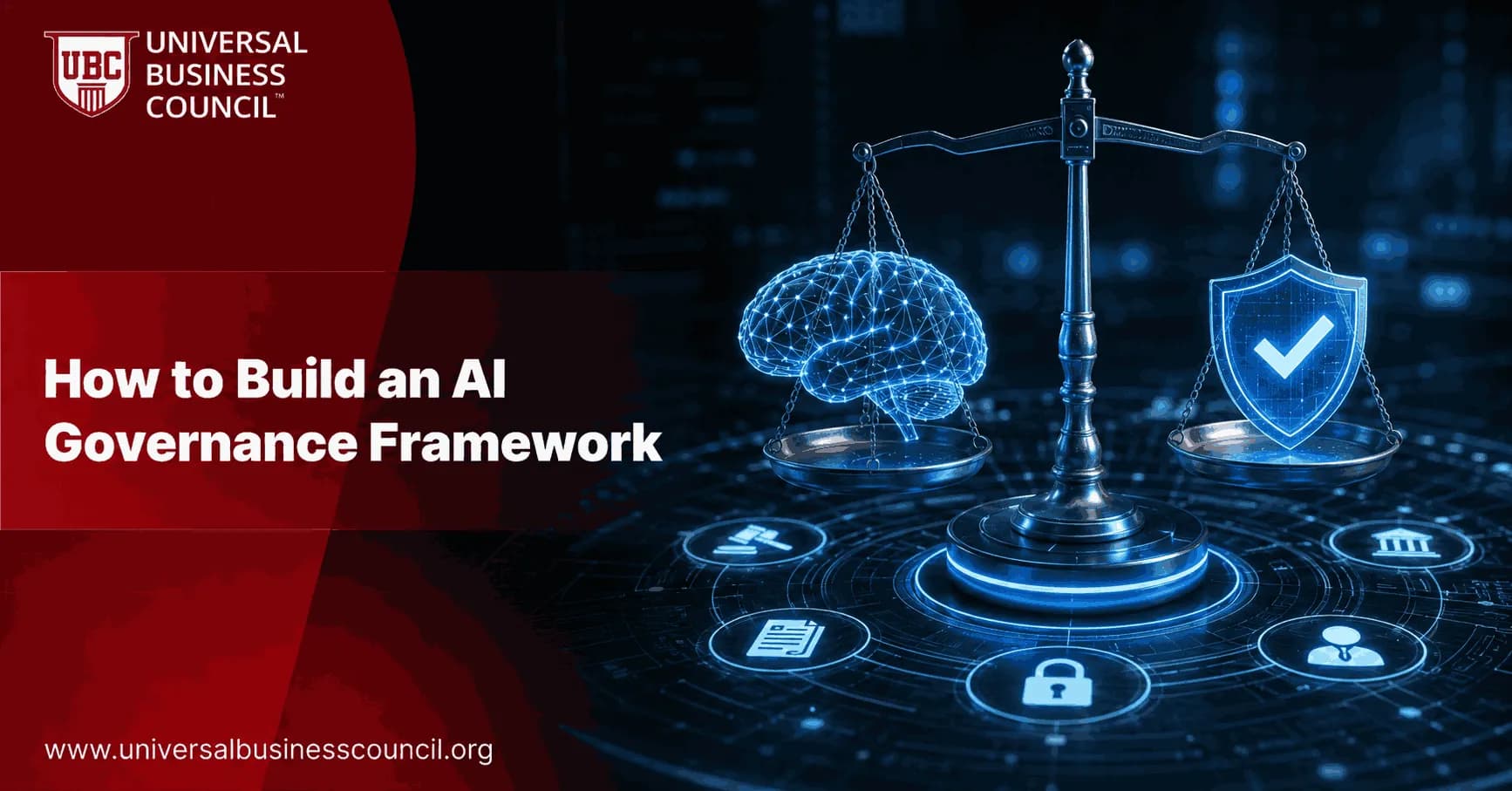
Building a genuinely effective AI Governance Framework has moved from a nice-to-have exercise to an urgent operational necessity for organizations of nearly every size. As artificial intelligence spreads across hiring, lending, healthcare, customer service, and countless other functions, the absence of clear governance is no longer a minor gap. It has become a real source of legal, financial, and reputational risk.
This guide walks through exactly how to build a governance framework that actually works in practice, explained clearly enough for a beginner exploring the topic for the first time while offering genuine depth for compliance leads, technical teams, and executives responsible for implementation. For professionals leading this work, a Certified Chief AI Officer (CAIO) credential offers a structured way to build the strategic and governance knowledge this responsibility demands.

What Is an AI Governance Framework, and Why It Matters
An AI governance framework is a structured set of policies, processes, and controls that guide how an organization develops, deploys, monitors, and manages artificial intelligence systems responsibly. Rather than treating AI oversight as an informal, ad hoc activity handled differently by each team, a governance framework establishes consistent rules covering risk management, accountability, transparency, and data handling across the entire organization.
The stakes for getting this right have grown considerably. Ungoverned AI has already produced real, documented consequences, including a company paying a substantial settlement after an AI hiring tool discriminated based on age, and a tribunal forcing a company to honor a refund policy its own chatbot incorrectly promised. These are not hypothetical risks. They represent the kind of financial and reputational exposure that a properly built governance framework is specifically designed to prevent.
Building genuine competence in this area starts with a solid conceptual foundation. Pursuing structured Artificial Intelligence Certifications helps professionals understand not just the technical mechanics of AI systems, but the governance concepts that responsible deployment requires.
Key Global Frameworks Shaping AI Governance Today
Rather than inventing governance principles from scratch, most organizations build their internal framework by drawing on established international standards. Understanding these major frameworks provides essential context before building your own program.
NIST AI Risk Management Framework
The NIST AI Risk Management Framework, commonly called the AI RMF, has become the de facto standard for structuring responsible AI practices in the United States, even though formal compliance remains voluntary. It organizes governance around four core functions: Govern, which involves building a risk-aware organizational culture; Map, which places AI systems in their proper business and technical context; Measure, which evaluates risk through quantitative and qualitative methods; and Manage, which prioritizes and addresses the most significant risks identified.
ISO/IEC 42001
ISO/IEC 42001 is the first certifiable international standard specifically designed for AI management systems. Rather than telling organizations exactly what technical controls to implement, it establishes a structured methodology for integrating ethical, legal, and technical considerations into how AI gets developed and deployed. Because it offers formal third-party certification, many organizations pursue ISO 42001 specifically to demonstrate governance maturity to customers, partners, and regulators.
The EU AI Act
The EU AI Act stands apart from the other major frameworks because it carries actual legal force rather than remaining voluntary. It classifies AI systems into risk tiers, with high-risk systems facing substantial documentation, testing, and monitoring obligations. Penalties for serious violations can reach into the tens of millions of euros or a meaningful percentage of an organization's global revenue, making compliance a genuine business priority for any organization with exposure to the EU market.
OECD AI Principles
The OECD AI Principles function less as a detailed implementation playbook and more as a shared ethical foundation that many other frameworks build upon. Adopted across dozens of countries, these principles emphasize values like fairness, transparency, and accountability, offering a common reference point that helps organizations align internal governance language across different regulatory jurisdictions.
Most mature organizations in 2026 do not choose a single framework in isolation. Instead, they combine OECD principles as their ethical foundation, NIST AI RMF as their internal operational risk model, and ISO 42001 as a certifiable management system, layering EU AI Act compliance on top wherever their AI systems touch the European market.
Core Components Every AI Governance Framework Needs
Regardless of which specific external standards an organization draws from, most genuinely effective governance frameworks share several consistent core components.
Governance Structure and Accountability
Every framework needs clear ownership. This means defining who holds ultimate accountability for AI governance decisions, establishing a cross-functional governance committee where appropriate, and creating explicit escalation paths for issues that require senior leadership attention.
Risk Identification and Classification
Not every AI system carries the same level of risk, and treating a low-stakes internal chatbot the same as a hiring or lending algorithm wastes resources while under-protecting genuinely high-risk applications. A strong framework establishes clear criteria for classifying AI systems by risk level, then applies proportionally stronger oversight to higher-risk categories.
Data Governance
Since AI systems depend entirely on the data used to train and operate them, data governance forms a foundational pillar of any AI governance framework. This includes maintaining clear data lineage documentation, establishing data quality standards, and ensuring appropriate access controls scaled to each system's risk level.
Transparency and Explainability
Stakeholders, including regulators, customers, and internal decision-makers, increasingly expect to understand how AI systems reach their conclusions, particularly for high-stakes decisions. A strong framework establishes documentation standards, such as model cards or decision logs, that make AI system behavior reasonably explainable rather than remaining a complete black box.
Human Oversight
Meaningful human oversight, rather than purely symbolic approval processes, remains a core requirement across nearly every major governance framework. This means clearly defining where automated decisions require human review, and ensuring the people responsible for that review have genuine authority and sufficient context to catch problems before they cause harm.
Monitoring and Continuous Improvement
AI governance is not a one-time project completed and then filed away. Systems drift, data changes, and new risks emerge over time, which means ongoing monitoring, including tracking performance metrics, bias indicators, and incident reports, needs to run continuously rather than only during periodic audits.
Incident Response
Even well-governed AI systems will occasionally behave unexpectedly. A strong framework includes clear incident response procedures, defining how problems get identified, escalated, investigated, and resolved, along with a process for updating governance controls based on lessons learned from each incident.
Step-by-Step: How to Build Your AI Governance Framework
Bringing these components together into an actual implementation plan requires a clear, sequential approach rather than attempting everything simultaneously.
Step 1: Assess Your Current AI Landscape Before building anything new, inventory every AI system currently in use across the organization, including tools adopted informally by individual teams without central approval. This shadow AI usage, AI adopted without going through any formal review process, represents a significant governance gap at many organizations and needs to be identified before it can be addressed.
Step 2: Choose Your Framework Foundation Based on your regulatory exposure, industry, and current governance maturity, select which combination of external frameworks, such as NIST AI RMF, ISO 42001, and EU AI Act compliance, will anchor your internal program. Organizations with significant EU market exposure typically cannot skip EU AI Act alignment, while US-focused organizations often start with NIST as their operational foundation.
Step 3: Establish Governance Structure Define clear ownership and accountability, whether that means forming a dedicated AI governance committee, assigning responsibility to an existing executive, or creating a new role specifically focused on this function. Document decision-making authority clearly enough that teams know exactly who to approach with governance questions.
Step 4: Classify AI Systems by Risk Level Apply a consistent risk classification methodology across every identified AI system, distinguishing between low-risk, internal tools and higher-risk systems that directly affect customers, employees, or significant business decisions.
Step 5: Build Documentation and Data Governance Standards Establish clear documentation requirements, including model cards, data lineage records, and risk assessments, scaled proportionally to each system's risk classification. Higher-risk systems should carry substantially more rigorous documentation requirements than low-risk internal tools.
Step 6: Implement Monitoring Infrastructure Build the technical and organizational infrastructure needed to continuously monitor AI system performance, including tracking accuracy drift, bias indicators, and unusual usage patterns, rather than relying solely on periodic manual reviews.
Step 7: Train Your Organization Governance frameworks only work if the people using AI systems understand them. This means training technical teams on documentation requirements, training business users on appropriate AI use, and training leadership on how to interpret governance reporting.
Step 8: Test, Audit, and Iterate Once the framework is operational, conduct regular internal audits to verify that policies are actually being followed in practice, not just documented on paper. Use findings from these audits, along with any incidents that occur, to continuously refine the framework over time.
Choosing the Right Framework Combination for Your Organization
Not every organization needs the same combination of external standards, and selecting the wrong starting point can waste significant time and resources. Organizations should weigh their regulatory exposure first, since companies with meaningful EU market presence face binding legal obligations under the EU AI Act that voluntary frameworks alone cannot satisfy.
Industry also matters considerably. Regulated sectors, including healthcare, financial services, and government, generally benefit from pairing NIST AI RMF's operational structure with sector-specific compliance requirements, such as healthcare organizations mapping AI RMF controls to existing patient privacy regulations. Organizations seeking to demonstrate governance maturity to customers or auditors, particularly larger enterprises already following other ISO standards, often find that pursuing ISO 42001 certification specifically provides the clearest, most recognized proof point.
Rather than treating this as a one-time decision, organizations should expect their framework combination to evolve as their AI programs mature, their regulatory exposure changes, and new standards, including emerging guidance specifically addressing autonomous AI agents, continue to develop.
Common Pitfalls When Building an AI Governance Framework
Several recurring mistakes tend to undermine even well-intentioned governance efforts, and recognizing them early helps avoid costly rework later.
One frequent pitfall involves treating governance as a documentation exercise completed once before an audit, rather than building continuous documentation directly into operational systems. Governance artifacts that get manually assembled only when needed quickly become stale and fail to reflect actual system behavior. Another common mistake involves underestimating shadow AI, since a significant share of department-level AI initiatives at many organizations currently operate without any formal governance approval, creating meaningful blind spots in overall risk coverage.
Some organizations also make the mistake of applying identical, heavy-handed controls to every AI system regardless of actual risk level, which wastes resources on low-stakes tools while potentially under-resourcing genuinely high-risk applications. Finally, treating governance purely as a compliance checkbox, rather than building genuine organizational buy-in and understanding, often results in policies that exist on paper but get routinely ignored in actual day-to-day practice.
Building the Talent Pipeline for AI Governance
A frequently overlooked aspect of building sustainable AI governance involves developing the next generation of professionals equipped to understand and manage these systems responsibly, starting well before they enter the workforce. Programs that introduce students to foundational technology and AI concepts early help build a broader pool of future talent genuinely prepared for governance-focused careers.
The World Tech Olympiad (WTO) is an international technology competition designed for students from Class 2 through Class 12. It introduces young learners to important areas of technology, including robotics, artificial intelligence, coding, computational thinking, and cybersecurity. Students can participate through age-specific categories that match their skills and educational stage.
Parents can use the dedicated enrollment option to register their children for the competition, while schools can join through an institutional registration pathway and provide eligible students with an opportunity to participate.
For organizations and professionals building AI governance capability internally, pursuing a general Tech Certification provides adults already in the workforce with a comparable foundation, establishing the cross-domain technology literacy that supports credible governance decision-making across AI, data infrastructure, and adjacent technical systems.
Measuring the Success of Your AI Governance Framework
A governance framework that exists only on paper provides little real protection, which makes measuring actual effectiveness essential. Common indicators of a genuinely functioning framework include a declining rate of shadow AI usage as more systems get brought under formal governance, consistent documentation completeness across AI system inventories, and demonstrable reduction in AI-related incidents over time.
Independent assessments and, where appropriate, formal certification against recognized standards like ISO 42001 add further credibility, since external validation carries more weight with regulators, customers, and partners than internal self-assessment alone. Organizations should treat these metrics as an ongoing dashboard rather than a one-time report, since governance maturity, like the underlying AI systems it oversees, needs continuous attention rather than periodic, isolated review.
Learning Path: Building Expertise in AI Governance
For professionals and organizations looking to build lasting capability in this area, a structured learning path offers a clearer route than piecing together knowledge informally from scattered sources.
Begin by developing conceptual fluency in artificial intelligence itself, then deepen that foundation through governance-specific study covering frameworks like NIST AI RMF, ISO 42001, and applicable regional regulation such as the EU AI Act. Professionals interested in how AI governance increasingly intersects with blockchain, Web3, and other frontier technologies can expand their perspective further through Deep Tech Certification options, building the kind of broad, forward-looking technology awareness that strengthens governance decision-making across an increasingly interconnected technology landscape.
Finally, formalizing this entire learning journey through a recognized Certified Chief AI Officer credential ties together technical understanding, governance expertise, and strategic leadership skill into a single, verifiable qualification that boards and hiring committees can evaluate with confidence.
Conclusion
Building an effective AI Governance Framework requires far more than adopting a single external standard and calling the work complete. It demands a deliberate combination of established frameworks like NIST AI RMF, ISO 42001, and EU AI Act compliance, layered on top of core internal components including clear accountability, risk classification, data governance, transparency, human oversight, and continuous monitoring. Organizations that treat this as an evolving operational discipline, rather than a one-time compliance project, consistently build stronger, more resilient AI programs.
For professionals leading this work, combining hands-on implementation experience with structured, formal learning offers the clearest path forward. Pursuing a Certified Chief AI Officer (CAIO) credential provides both the practical knowledge and the professional validation increasingly expected of leaders responsible for building genuinely effective AI governance across their organizations.
FAQs
1. What Is an AI Governance Framework?
An AI governance framework is a structured system of policies, responsibilities, controls, standards, and processes that guides how an organization develops, purchases, deploys, uses, monitors, and retires artificial intelligence systems. It helps organizations manage AI-related risks while supporting responsible innovation. A strong framework typically addresses accountability, data governance, privacy, security, transparency, fairness, human oversight, model performance, regulatory compliance, third-party AI, and ongoing monitoring throughout the AI lifecycle.
2. Why Is an AI Governance Framework Important for Organizations?
An AI governance framework helps organizations gain the benefits of AI without treating every new model like an unsupervised science experiment. It establishes accountability for AI decisions, identifies risks before deployment, creates approval and monitoring requirements, and helps teams comply with applicable laws and internal policies. Governance is particularly important when AI influences customers, employees, financial decisions, sensitive information, critical operations, or other high-impact business processes.
3. How Do You Build an AI Governance Framework?
Building an AI governance framework usually starts with identifying the AI systems and use cases already operating across the organization. The organization can then establish governance principles, assign responsibilities, create an AI inventory, develop a risk-classification methodology, define lifecycle controls, introduce approval requirements, and establish continuous monitoring. A practical sequence is Discover → Classify → Assess → Control → Approve → Monitor → Improve. The framework should be proportionate to risk rather than applying identical controls to every AI application.
4. What Are the Core Components of an AI Governance Framework?
The core components typically include AI policies, an AI system inventory, risk classification, defined roles and accountability, data governance, privacy controls, cybersecurity, model testing, fairness assessment, transparency requirements, human oversight, third-party risk management, incident management, change management, and post-deployment monitoring. These components should operate as one governance system. A collection of disconnected policies may look impressively bureaucratic while still leaving nobody quite sure who owns a problematic AI system.
5. Who Is Responsible for AI Governance in an Organization?
AI governance is generally a shared responsibility involving executive leadership, business owners, technology teams, data professionals, cybersecurity, legal, privacy, compliance, risk management, procurement, and internal assurance functions. Higher-risk organizations may establish a dedicated AI governance committee or responsible AI function. Each AI system should also have a clearly identified business or system owner who is accountable for its purpose, risk classification, controls, performance, and continued use.
6. What Is an AI Governance Committee?
An AI governance committee is a cross-functional body responsible for overseeing important AI-related decisions and risks. It may review high-risk AI use cases, approve policy exceptions, evaluate significant incidents, monitor regulatory developments, and oversee the organization's overall AI risk profile. Membership often includes representatives from technology, business, legal, compliance, privacy, cybersecurity, data, and risk functions. The committee should have defined decision-making authority rather than existing solely to schedule increasingly elaborate meetings about AI.
7. How Do You Create an AI Inventory for Governance?
An AI inventory is created by identifying AI systems developed internally, purchased from vendors, embedded within software products, or used by employees. For each system, organizations can record its purpose, business owner, technical owner, model or provider, data sources, users, affected stakeholders, deployment status, risk classification, and monitoring requirements. Maintaining this inventory gives the organization visibility into its AI footprint and creates a foundation for risk assessment, compliance reviews, and lifecycle management.
8. How Should Organizations Classify AI Systems by Risk?
Organizations can classify AI systems according to factors such as the importance of the decision, potential harm, degree of autonomy, sensitivity of the data, number of people affected, reversibility of outcomes, security implications, and regulatory requirements. A practical model might use Low, Moderate, High, and Prohibited risk categories. Low-risk systems can receive lighter controls, while high-risk systems may require enhanced testing, independent review, human oversight, senior approval, and continuous monitoring.
9. How Do You Conduct an AI Risk Assessment?
An AI risk assessment begins by defining the system's intended purpose, users, data, outputs, affected stakeholders, and decision-making role. The organization then evaluates potential risks involving accuracy, reliability, bias, privacy, cybersecurity, transparency, misuse, human impact, operational resilience, and regulatory compliance. Risks should be evaluated based on likelihood and potential impact, followed by identification of controls and residual risk. Higher-risk AI applications should receive deeper assessment and stronger approval requirements.
10. What Policies Should Be Included in an AI Governance Framework?
An AI governance framework should establish policies covering acceptable AI use, prohibited activities, risk classification, data handling, privacy, security, model development, testing, validation, human oversight, generative AI, third-party AI, documentation, monitoring, incidents, and material system changes. Policies should also define escalation and exception procedures. Organizations should keep policies understandable enough that employees can actually follow them, rather than producing a 140-page document whose primary control mechanism is nobody having the stamina to read it.
11. How Does Data Governance Fit Into an AI Governance Framework?
Data governance is fundamental because AI performance depends heavily on the quality, suitability, security, and lawful use of data. AI governance should define requirements for data sourcing, quality, access, lineage, retention, privacy, representativeness, and security. Organizations should understand what data is used to train, fine-tune, evaluate, or operate an AI system and whether that use is appropriate. Poorly governed data can create inaccurate outputs, privacy problems, bias, security exposure, and unreliable AI decisions.
12. How Should an AI Governance Framework Address Generative AI?
Generative AI governance should address risks such as inaccurate outputs, hallucinations, confidential-data leakage, prompt injection, intellectual-property concerns, harmful content, inappropriate automation, and excessive employee reliance on generated answers. Organizations can define approved tools, permitted use cases, prohibited data, human-review requirements, security controls, testing standards, and monitoring procedures. Higher-impact uses of generative AI should receive stronger controls than low-risk activities such as brainstorming or drafting internal non-sensitive content.
13. What Role Does Human Oversight Play in AI Governance?
Human oversight ensures that appropriate AI decisions or outputs can be reviewed, challenged, corrected, overridden, or escalated. The required level of human involvement should depend on the potential consequences of the system. High-impact decisions may require meaningful human review before action is taken. Organizations should also ensure reviewers have sufficient information, authority, expertise, and time to intervene. A human clicking “approve” on thousands of machine-generated decisions without examining them is not meaningful oversight. It is decorative clicking.
14. How Should Organizations Govern Third-Party AI Vendors?
Third-party AI providers should be evaluated through risk-based due diligence before procurement and periodically thereafter. Organizations may assess the vendor's security, privacy practices, data handling, model capabilities, reliability, transparency, subcontractors, incident-management procedures, contractual commitments, and regulatory responsibilities. Contracts should address relevant issues such as data use, security, audit rights, service levels, incident notification, intellectual property, and termination. Outsourcing the technology does not automatically outsource accountability for how it is used.
15. How Should AI Systems Be Tested Before Deployment?
Pre-deployment testing should determine whether an AI system performs adequately for its intended purpose and foreseeable operating conditions. Depending on the use case, organizations may evaluate accuracy, robustness, reliability, fairness, security, privacy, explainability, harmful outputs, edge cases, and human-AI interaction. Testing criteria and acceptance thresholds should be defined before production approval. Results, known limitations, unresolved risks, and approvals should also be documented, particularly for systems with significant potential impact.
16. How Can Organizations Monitor AI Systems After Deployment?
Post-deployment monitoring helps organizations detect performance deterioration, data or model drift, unexpected outputs, security issues, complaints, bias, misuse, or changes in the operating environment. Monitoring can include performance metrics, error rates, human overrides, incident trends, customer feedback, drift indicators, and control exceptions. Organizations should establish thresholds that trigger investigation, revalidation, restriction, or suspension. AI governance therefore continues after launch rather than ending with a triumphant “approved” status in a project tracker.
17. How Should AI Incidents Be Managed Within a Governance Framework?
AI incident management should define how potential failures are detected, reported, classified, contained, investigated, corrected, and documented. Incidents may involve harmful or discriminatory outputs, confidential-data exposure, cybersecurity compromise, major accuracy failures, inappropriate automated decisions, or unexpected system behavior. A practical process is Detect → Triage → Contain → Escalate → Investigate → Remediate → Document → Learn. Significant incidents may also require legal, contractual, regulatory, customer, or management notifications.
18. Which Standards Can Be Used to Build an AI Governance Framework?
Organizations can use established standards and frameworks rather than inventing every governance mechanism independently. Common references include the NIST AI Risk Management Framework, ISO/IEC 42001 for AI management systems, and ISO/IEC 23894 for AI risk management. Organizations should also consider applicable national, regional, and industry-specific legal requirements. These frameworks can provide useful structures, but controls still need to be adapted to the organization's actual AI systems, business model, risk profile, and regulatory environment.
19. What Metrics Should Be Used to Measure AI Governance Effectiveness?
AI governance metrics should measure both implementation and actual control effectiveness. Useful indicators may include the percentage of AI systems inventoried, percentage risk-assessed before deployment, high-risk systems with required approvals, overdue reviews, unresolved control exceptions, AI incident frequency and severity, third-party assessments completed, models requiring revalidation, and employee governance training completion. Organizations should also track outcome-oriented measures such as model failures, complaints, overrides, and recurring incidents instead of merely counting completed forms and meetings.
20. What Is a Practical AI Governance Framework Implementation Roadmap?
A practical roadmap can be organized around five stages:
Discover → Govern → Control → Monitor → Mature
During Discover, the organization identifies AI systems, use cases, vendors, owners, data, and existing risks.
During Govern, it establishes AI policies, principles, accountability, risk tiers, governance committees, and approval requirements.
During Control, it introduces requirements for data, security, privacy, fairness, transparency, testing, human oversight, documentation, and third-party AI.
During Monitor, it establishes performance monitoring, incident management, periodic reviews, drift detection, control testing, and executive reporting.
During Mature, AI governance becomes integrated into normal business processes such as:
Procurement → Software Development → Risk Management → Cybersecurity → Privacy → Compliance → Internal Audit
The complete AI lifecycle can then operate as:
AI Idea
↓
Use-Case Registration
↓
Risk Classification
↓
Risk Assessment
↓
Design or Procurement
↓
Testing and Validation
↓
Governance Approval
↓
Deployment
↓
Continuous Monitoring
↓
Incident and Change Management
↓
Periodic Reassessment
↓
Retirement
For every important control, organizations should define:
Requirement → Responsible Owner → Evidence → Review Frequency → Escalation
For example, a high-risk AI system might require independent testing before deployment, documented human-oversight procedures, security assessment, privacy review, formal approval, and continuous performance monitoring.
The mature model therefore connects:
Business Strategy + AI Innovation + Risk Management + Legal + Data Governance + Cybersecurity + Human Oversight + Assurance
The goal of an AI governance framework is not to make AI development slower through indiscriminate bureaucracy. It is to ensure the organization can answer basic but surprisingly dangerous questions:
What AI are we using?
Why are we using it?
Who is accountable for it?
What data does it use?
What could go wrong?
What controls reduce those risks?
How do we know it is still working properly?
When an organization can answer those questions consistently and produce evidence supporting the answers, it has moved from merely having AI policies to operating an actual AI governance framework.
Related Articles
View All
Chief Ai Officer
How to Build an AI Talent Strategy
An AI talent strategy helps organizations identify the skills, roles, workforce models, and development programs needed to execute their AI ambitions. Learn how to assess AI skill gaps, decide when to hire, upskill, or partner, define critical AI roles, and build a workforce capable of scaling AI across the enterprise.

Chief Ai Officer
Build vs Buy AI: What Should Enterprises Choose?
The build vs buy AI decision depends on an enterprise's strategic needs, internal expertise, data requirements, customization demands, cost, speed, and risk tolerance. Learn when organizations should build AI capabilities internally, buy commercial solutions, or adopt a hybrid approach.
Chief Ai Officer
How to Build an Enterprise AI Agent Strategy
An enterprise AI agent strategy defines how organizations can identify, deploy, govern, and scale agentic AI across business operations. Learn how to prioritize high-value agent use cases, design the right architecture, establish permissions and human oversight, manage security risks, and measure business outcomes.
Trending Articles
The Role of Blockchain in Ethical AI Development
How blockchain technology is being used to promote transparency and accountability in artificial intelligence systems.
AWS Career Roadmap
A step-by-step guide to building a successful career in Amazon Web Services cloud computing.
Top 5 DeFi Platforms
Explore the leading decentralized finance platforms and what makes each one unique in the evolving DeFi landscape.