

Build vs Buy AI: What Should Enterprises Choose?
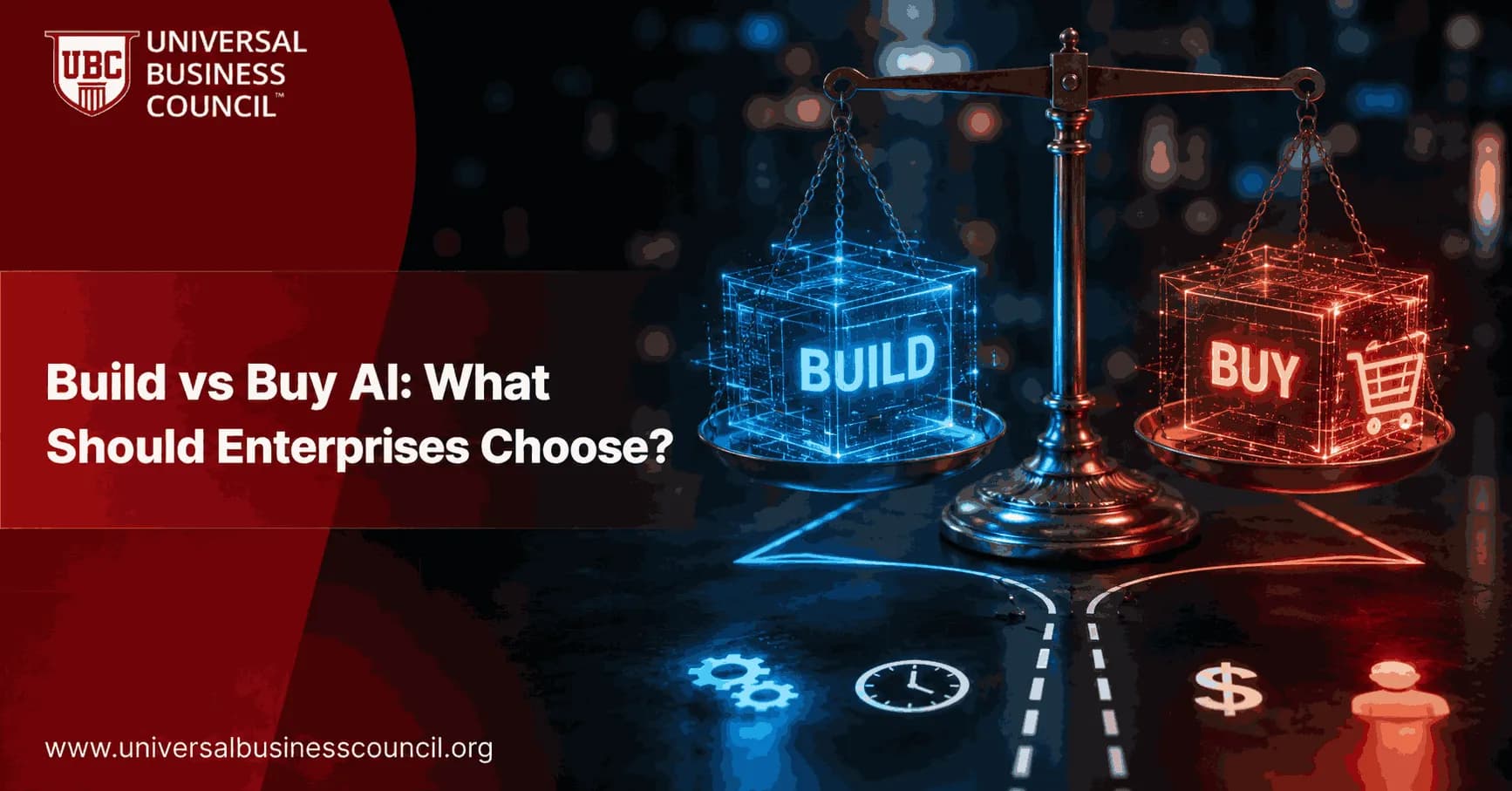
Artificial intelligence has moved from experimental initiative to business-critical infrastructure. Enterprises across every sector are making significant investments in AI capabilities. However, one question consistently sits at the center of every AI strategy discussion: should the organization build its own AI solution or buy a ready-made one?
The build vs buy AI decision is not purely a technology question. It is a strategic business decision that touches budget, talent, time, competitive positioning, and long-term operational risk. Getting it right can define an organization's AI trajectory for years. Getting it wrong results in wasted resources, delayed outcomes, and difficult course corrections.

This guide examines both sides of the build vs buy AI decision in depth. It covers the real trade-offs, the factors that should drive the choice, and the scenarios where each path makes the most sense. For enterprise leaders who want the strategic knowledge to guide this decision confidently, the Certified Chief AI Officer (CAIO) program provides the frameworks, governance knowledge, and leadership tools required to navigate high-stakes AI decisions at the executive level.
Why the Build vs Buy AI Decision Is More Complex Today
A few years ago, most enterprises had no realistic option to build sophisticated AI systems from scratch. The compute costs were prohibitive, the talent was scarce, and the foundational research was still maturing. Therefore, buying was the default for all but the largest technology organizations.
Today, the landscape is different. Open-source models, cloud-based training infrastructure, and a growing pool of AI-trained professionals have made building more accessible. At the same time, the commercial AI market has matured rapidly. Off-the-shelf solutions now cover a wide range of enterprise use cases with strong performance and fast deployment timelines.
This expanded set of options makes the build vs buy AI decision more nuanced than ever. Enterprises must now evaluate not just whether to build or buy, but which combination of approaches best serves their specific objectives. Building internal AI literacy across the organization supports this evaluation significantly. Structured Artificial Intelligence Certifications equip technology and business professionals with the foundational knowledge needed to assess AI options accurately, compare vendor claims rigorously, and make informed recommendations that align with enterprise goals.
Understanding the Build Option
Building an AI solution means the enterprise designs, trains, and deploys its own model using internal or contracted resources. This path ranges from training a large model entirely from scratch to fine-tuning an open-source base model on proprietary data.
When Building Makes Strategic Sense
Building is the right choice when the enterprise's competitive advantage depends directly on AI capabilities that no vendor can replicate. For example, an organization with a unique dataset accumulated over decades may be able to train a model that outperforms any commercially available option in its specific domain.
Furthermore, building is appropriate when data sensitivity prevents the use of external AI providers. Some regulated industries prohibit sending certain categories of data outside the organization's own infrastructure. In these cases, an internally built and hosted solution may be the only compliant option.
Building also makes sense when the organization plans to use AI at a scale where per-unit API costs would significantly exceed the amortized cost of a purpose-built internal system over time.
The Real Costs of Building
The direct financial cost of building is only part of the total investment. Enterprises must account for the cost of skilled AI engineers, data scientists, and machine learning operations professionals. These roles are in high demand and carry significant salary premiums.
Additionally, building requires substantial time investment. Developing, testing, validating, and deploying a custom AI model typically takes months. During this period, the organization is not yet receiving value from the system while carrying the full cost of development. Therefore, time-to-value is a critical factor in any build decision.
Ongoing maintenance is another frequently underestimated cost. Models degrade as data distributions shift over time. Retraining, monitoring, and updating a custom system requires continuous investment well beyond the initial build phase.
Understanding the Buy Option
Buying an AI solution means the enterprise subscribes to or licenses a commercially built AI product or API. This ranges from enterprise software with embedded AI features to standalone AI platforms that integrate with existing business systems.
When Buying Makes Strategic Sense
Buying is the right choice when speed to value is a primary objective. Commercial AI solutions can be deployed in days or weeks rather than months. For organizations responding to competitive pressure or trying to capitalize on a time-sensitive market opportunity, this speed advantage is decisive.
Buying also makes sense when the use case is standard rather than unique. Many enterprise AI needs, including customer service automation, document summarization, translation, and basic predictive analytics, are well served by existing commercial products. In these situations, building a custom solution consumes resources without producing proportional competitive benefit.
Furthermore, buying transfers significant technical and operational risk to the vendor. The provider handles infrastructure management, model updates, security patching, and compliance with evolving technical standards. This allows the enterprise to focus its internal resources on applying AI rather than managing it.
The Real Costs of Buying
Commercial AI solutions carry their own cost structure. Subscription and usage fees scale with adoption, and at high volumes these costs can become substantial. Enterprises must model projected usage carefully to ensure commercial pricing remains favorable at scale.
Additionally, buying creates vendor dependency. If the provider changes its pricing, discontinues a product, or is acquired, the enterprise faces disruption. Therefore, organizations relying on commercial AI for mission-critical processes must assess vendor stability and build appropriate contractual protections.
Customization limits are another consideration. Most commercial products allow some configuration, but enterprises with highly specific requirements may find that off-the-shelf solutions deliver 80 percent of what they need while the remaining 20 percent requires significant workarounds or remains unaddressed.
Preparing the Next Generation for an AI-Driven World
The build vs buy AI debate reflects a broader reality: AI is now a fundamental business competency, and organizations need a continuous pipeline of AI-literate talent to sustain and advance their strategies. This pipeline begins earlier than most enterprises recognize.
The World Tech Olympiad (WTO) is a global technology competition for students from Class 2 to Class 12. Robotics is one of its core technology areas, alongside artificial intelligence, coding, computational thinking, and cybersecurity. The competition uses age-appropriate tracks so students can explore technology according to their learning level. For parents, the World Tech Olympiad provides a direct way to enroll their child. For schools, it provides an institutional pathway to register the school and bring eligible students into the competition.
Competitions like this develop the technical curiosity and problem-solving mindset that enterprises rely on when they build internal AI capabilities. Supporting early AI education is therefore a strategic investment in the talent pipeline that will power enterprise AI for decades to come.
The Hybrid Approach: Combining Build and Buy
For many enterprises, the build vs buy AI question does not have a binary answer. A hybrid approach, where the organization buys foundational capabilities and builds differentiated applications on top of them, often delivers the best balance of speed, control, and competitive advantage.
Fine-Tuning Commercial Models on Proprietary Data
One popular hybrid strategy involves starting with a commercially available base model and fine-tuning it using the organization's own proprietary data. This approach captures the speed and infrastructure advantages of buying while incorporating the domain specificity that custom building would otherwise require.
For example, a financial services enterprise might take a commercial language model and fine-tune it on thousands of internal research reports, regulatory filings, and client communications. The result is a model that understands the organization's specific language, terminology, and context far better than the unmodified commercial version.
Retrieval-Augmented Generation as a Hybrid Strategy
Another widely adopted hybrid approach is retrieval-augmented generation. In this architecture, the enterprise uses a commercial AI model for language generation but connects it to an internal retrieval system that pulls relevant documents from a private knowledge base before each response is generated.
This keeps model outputs grounded in the organization's actual data and policies without requiring full custom model training. Furthermore, the retrieval component can be updated continuously as internal documents change, ensuring that the system always reflects current information without retraining the underlying model.
Building Orchestration Layers Over Commercial Models
Some enterprises buy commercial AI capabilities and build proprietary orchestration layers that control how those capabilities are applied across business workflows. The orchestration layer encodes the organization's specific business logic, compliance requirements, and quality standards, creating a differentiated system even though the core AI engine is commercially sourced.
Technology professionals responsible for designing and implementing these hybrid architectures benefit from strong applied technical skills. A Tech Certification program builds the practical engineering knowledge needed to evaluate AI tools, design integration architectures, and manage the technical complexity of hybrid AI deployments effectively across diverse enterprise environments.
Key Factors That Should Drive Your Build vs Buy AI Decision
Several specific factors consistently determine which path delivers better outcomes for a given enterprise. Evaluating these factors honestly and thoroughly is the foundation of a sound build vs buy AI decision.
Uniqueness of the Use Case
If the use case is genuinely unique and central to competitive differentiation, building offers stronger strategic value. If the use case is common across many industries and well served by commercial products, buying delivers faster value at lower risk.
Internal AI Talent and Capacity
Building requires sustained internal capacity. If the organization cannot attract, retain, and manage a skilled AI team over the long term, the build path will consistently underperform its projections. An honest assessment of current and realistically acquirable talent is essential before committing to a custom build.
Data Availability and Proprietary Advantage
Proprietary data is the primary justification for building. If the enterprise holds unique data assets that could train a superior model, building captures that advantage. If the data is standard or limited, commercial models trained on far larger datasets will typically outperform anything the enterprise could build internally.
Time-to-Value Requirements
If the business requires AI capabilities within weeks, buying is almost always the right choice. Building rarely delivers production-ready systems in less than several months even with experienced teams and adequate resources.
Regulatory and Data Governance Constraints
Strict data residency requirements, sector-specific AI regulations, and internal data governance policies can eliminate external commercial options entirely. When compliance requirements mandate full internal control over data and model processing, building becomes necessary rather than optional.
Common Mistakes Enterprises Make in the Build vs Buy AI Decision
Underestimating the True Cost of Building
Many enterprises approve build decisions based on infrastructure costs alone. They systematically underestimate talent costs, data preparation expenses, time-to-production delays, and the ongoing maintenance investment that keeps a custom model performing reliably over time.
Overestimating Commercial Solution Fit
Conversely, organizations sometimes purchase commercial AI solutions based on vendor demonstrations that do not reflect real-world enterprise conditions. Pilot deployments on carefully selected datasets consistently outperform full production deployments on messy, complex organizational data. Therefore, rigorous proof-of-concept testing before purchase commitment is essential.
Ignoring the Integration Challenge
Whether building or buying, integration with existing enterprise systems is consistently the most underestimated challenge. Data pipelines, security controls, user interface integration, and change management all require substantial effort regardless of whether the AI model itself is built or bought.
Making the Decision: A Practical Framework
A practical build vs buy AI decision framework asks four questions in sequence. First, does the use case provide genuine competitive differentiation that commercial products cannot match? Second, does the organization have or can it realistically acquire the talent to build and sustain a custom system? Third, does the organization hold proprietary data that would give a custom model a meaningful performance advantage? Fourth, do compliance requirements mandate full internal control over data and model processing?
If the answer to all four questions is yes, building is likely the right path. If the answer to two or fewer is yes, buying or a hybrid approach will almost certainly deliver better outcomes. Most enterprises fall into the hybrid category, where a thoughtful combination of commercial and custom capabilities serves their needs most effectively.
Professionals who want to lead AI strategy at the deepest technical level benefit from understanding the architecture and capabilities of current and emerging AI systems. A Deep Tech Certification provides the advanced technical grounding required to evaluate cutting-edge AI models, understand their underlying architectures, and make authoritative build vs buy recommendations backed by rigorous technical understanding rather than vendor claims or surface-level familiarity.
Conclusion
The build vs buy AI decision is one of the defining strategic choices enterprises face in an AI-driven economy. Neither path is universally superior. Building delivers control, customization, and the ability to capture proprietary data advantages. Buying delivers speed, reduced technical risk, and access to continuously improving commercial capabilities.
The right answer depends on the specific intersection of the organization's use case uniqueness, internal talent capacity, data assets, time constraints, and compliance obligations. Most enterprises will find that a hybrid approach, combining commercial foundations with targeted custom development, delivers the best balance of these competing factors.
Furthermore, the build vs buy AI decision is not permanent. Organizations that start by buying can build incrementally as their capabilities mature. Those that build custom systems can supplement them with commercial components as the market evolves. Enterprises that approach this decision with clarity, rigor, and strategic intent consistently outperform those driven by trend or peer pressure. The investment in making this decision well is always worth it.
FAQs
1. What Does Build vs Buy AI Mean for Enterprises?
Build vs buy AI refers to the decision between developing an AI solution internally and purchasing or subscribing to an AI product, platform, model, or service from an external provider. Building can provide greater customization, control, and differentiation, while buying can reduce development time and operational complexity. In practice, many enterprises choose a hybrid approach, combining third-party AI models or platforms with proprietary data, integrations, workflows, and governance.
2. Should Enterprises Build or Buy AI?
Enterprises should build AI when the capability creates meaningful competitive differentiation, requires specialized workflows, depends heavily on proprietary assets, or needs controls that commercial products cannot provide. Buying is generally more attractive for standardized capabilities that vendors already deliver effectively. The decision should consider Strategic Value + Differentiation + Time to Market + Internal Capability + Risk + Total Cost of Ownership rather than assuming internally built technology is automatically superior because more engineers were inconvenienced by it.
3. When Should a Company Build Its Own AI Solution?
Building may be appropriate when AI is central to a company's product or competitive advantage, the workflow is highly specialized, proprietary data provides meaningful differentiation, or available commercial products cannot meet performance, security, integration, or regulatory requirements. Companies should also have the engineering, data, security, product, and operational capabilities required to maintain the solution after launch. Building the prototype is often considerably easier than owning the production system for the next several years.
4. When Should an Enterprise Buy an AI Solution?
Buying can be appropriate when the required capability is relatively standardized and established vendors can satisfy business, security, privacy, integration, and performance requirements. Common productivity, document processing, customer support, analytics, and developer-assistance capabilities may have viable commercial options. Buying can accelerate deployment and reduce infrastructure responsibilities. Enterprises should still conduct vendor due diligence because outsourcing the technology does not magically outsource accountability for how it is used.
5. What Are the Advantages of Building AI In-House?
Building AI internally can provide greater control over architecture, user experience, integrations, data flows, model selection, evaluation, security, and product evolution. It can also help organizations create differentiated capabilities based on proprietary processes or information. Internal development may reduce dependence on a single vendor and allow deeper customization. These benefits are strongest when the enterprise possesses meaningful AI engineering capabilities and the use case is strategically important enough to justify sustained investment.
6. What Are the Advantages of Buying Enterprise AI?
Buying AI can provide faster implementation, access to established capabilities, vendor support, managed infrastructure, and lower initial engineering requirements. Commercial platforms may also provide security, administration, integrations, monitoring, and model improvements that would otherwise need to be built internally. Buying is particularly attractive when the capability does not create meaningful competitive differentiation. There is little strategic glory in spending eighteen months rebuilding a commodity feature that could have been deployed responsibly in several weeks.
7. What Are the Risks of Building AI Internally?
Internal development creates risks involving engineering complexity, talent requirements, security, scalability, model operations, technical debt, maintenance, and uncertain costs. AI systems also require ongoing evaluation as models, data, user behavior, and dependencies change. Organizations may underestimate the work required to move from prototype to reliable production service. A successful internal demo demonstrates feasibility; it does not prove that the enterprise has suddenly acquired a mature AI platform organization.
8. What Are the Risks of Buying AI From a Vendor?
Buying introduces risks such as vendor lock-in, limited customization, data exposure, pricing changes, service dependency, model changes, integration constraints, and reduced architectural control. Enterprises should understand how providers handle data, which subprocessors are involved, what service commitments exist, and how customers can migrate away. Critical AI capabilities may require contingency plans. A vendor's attractive product roadmap is useful, but it should not be confused with a contractual obligation to solve every future enterprise requirement.
9. How Should Enterprises Calculate the Cost of Building vs Buying AI?
Enterprises should compare total cost of ownership rather than initial implementation cost. Building costs can include engineering, models, compute, data pipelines, integration, testing, security, monitoring, governance, support, and maintenance. Buying costs may include subscriptions, consumption charges, implementation, integration, customization, training, governance, and vendor management. A useful comparison is Total Cost per Successful Business Outcome, measured over a realistic period rather than whichever spreadsheet horizon makes one option look pleasantly inexpensive.
10. Is Building AI Cheaper Than Buying AI?
Neither option is inherently cheaper. Building may become economical at sufficient scale or when proprietary capabilities generate substantial business value, but internal systems require ongoing engineering and infrastructure investment. Buying may have lower initial costs and faster deployment but become expensive as usage grows or premium capabilities accumulate. Enterprises should model several scenarios covering adoption, transaction volumes, model usage, staffing, infrastructure, and vendor pricing before deciding.
11. How Does Time to Market Affect the Build vs Buy AI Decision?
Time to market can strongly favor buying when commercial products already meet most requirements. If a business opportunity is time-sensitive, spending months or years developing an internal alternative can reduce the economic value of greater customization. Building may still be justified for strategically differentiated capabilities. Enterprises should therefore consider Value of Customization vs Cost of Delay rather than treating technical elegance as the only measure of a successful architecture decision.
12. How Should Data Privacy Affect the Build vs Buy AI Decision?
Enterprises should evaluate what data the AI system processes, where that data travels, how long it is retained, who can access it, and whether providers use it for other purposes. Buying may be appropriate when vendors provide adequate contractual and technical protections. Highly sensitive workloads may justify more controlled architectures. Building internally does not automatically guarantee privacy, however, because poorly configured internal systems are perfectly capable of mishandling sensitive data without assistance from an external vendor.
13. How Should Security Affect the Build vs Buy AI Decision?
Security evaluation should compare the organization's internal capabilities with the vendor's security controls and the risks of each architecture. A commercial provider may offer mature infrastructure security, while internal development may provide tighter control over data flows and integrations. Enterprises should assess identity, encryption, access controls, secure development, vulnerability management, logging, incident response, and AI-specific threats. The relevant question is which option can meet the required security level reliably over the entire lifecycle.
14. How Should Intellectual Property Affect the Build vs Buy Decision?
Intellectual property can materially influence the decision when AI capabilities, models, workflows, data assets, or outputs contribute to competitive differentiation. Enterprises should understand ownership and licensing terms for vendor technologies, generated outputs, fine-tuned models, and proprietary data. Building may provide greater control over strategically important intellectual property, while buying can be appropriate where the AI capability itself is not differentiated. Legal review should occur before strategically valuable information becomes inseparable from a vendor platform.
15. Should Enterprises Build Their Own Foundation Models?
For most enterprises, training a general-purpose foundation model from scratch is unlikely to be necessary. The compute, data, research expertise, infrastructure, evaluation, security, and ongoing development requirements can be substantial. Organizations can often create differentiated value by using existing models and investing in proprietary data, RAG, workflows, integrations, fine-tuning, applications, and user experience. Building a foundation model makes more sense when the model itself provides strategic value and the organization has sufficient scale and specialized capability.
16. Should Enterprises Build or Buy AI Agents?
The answer depends on the complexity and strategic importance of the workflow. Commercial agent platforms may accelerate common automation scenarios, while custom agents can provide deeper integration with proprietary processes and systems. Many enterprises will likely buy agent infrastructure while building domain-specific workflows, tools, policies, and integrations. Agent decisions should also consider identity, permissions, observability, testing, security, and portability because an agent connected deeply to enterprise systems can become rather inconvenient to replace.
17. What Is a Hybrid Build-and-Buy AI Strategy?
A hybrid strategy combines purchased AI infrastructure with internally developed capabilities. An enterprise might use third-party foundation models, cloud infrastructure, and commercial AI platforms while building proprietary RAG systems, agent workflows, integrations, evaluation frameworks, and user experiences. This approach allows organizations to avoid recreating commodity infrastructure while retaining control over differentiated capabilities. For many enterprises, the real strategic decision is therefore not simply build or buy, but what should we own and where should we depend on partners?
18. How Can Enterprises Avoid AI Vendor Lock-In?
Enterprises can reduce vendor lock-in through modular architecture, abstraction layers, portable data formats, model gateways, standardized APIs, independent evaluation frameworks, and clear contractual exit provisions. Critical business logic should be separated from provider-specific features where practical. Organizations can also maintain alternative providers for important workloads. Complete portability may not be realistic, so the objective should be to understand switching costs and prevent unnecessary dependencies rather than pretending every component can be replaced by Friday afternoon.
19. What Metrics Should Enterprises Use to Compare Build vs Buy AI?
Enterprises should compare business value, time to market, implementation cost, total cost of ownership, performance, reliability, security, privacy, customization, integration effort, scalability, vendor dependency, and internal capability requirements. The comparison should use measurable thresholds rather than broad labels. A solution that costs more but reaches production a year earlier may create greater economic value, while a cheaper product that cannot meet critical security or integration requirements may provide little practical advantage.
20. What Is a Practical Build vs Buy AI Decision Framework?
A practical framework begins with the strategic importance of the capability.
The enterprise should first ask:
Is this AI capability a source of competitive differentiation?
If the answer is no, buying should generally receive serious consideration because recreating commodity technology consumes engineering capacity that could be invested elsewhere.
If the answer is yes, the organization should evaluate whether differentiation comes from the model itself or from surrounding assets such as proprietary data, workflows, integrations, customer experience, and domain knowledge.
This distinction matters because enterprises often do not need to own the foundation model to own the competitive advantage.
The decision can then evaluate:
Strategic Differentiation
Business Value
Available Commercial Solutions
Internal AI Capability
Time to Market
Data Sensitivity
Security Requirements
Customization Requirements
Integration Complexity
Scalability
Total Cost of Ownership
Vendor Dependency
The organization can then compare three options:
Build
The enterprise owns most of the application architecture, integrations, workflows, and potentially the model infrastructure.
Buy
The enterprise adopts a commercial product or managed service and configures it for business requirements.
Hybrid
The enterprise purchases commodity infrastructure or models while developing differentiated data, workflows, integrations, controls, and experiences internally.
A useful decision sequence is:
Business Need
↓
Is the Capability Differentiating?
↓
Does a Commercial Solution Meet Requirements?
↓
Can Internal Teams Build and Operate It Better?
↓
Compare Time, Cost, Risk, and Control
↓
Build / Buy / Hybrid Decision
For example, consider an internal employee writing assistant.
If several commercial solutions meet security, privacy, integration, and usability requirements, buying may be appropriate because the capability itself provides limited differentiation.
Now consider an AI system that automates a proprietary underwriting process built on unique company data and domain expertise.
The competitive advantage may reside in the workflow, data, evaluation methodology, and decision logic. A hybrid approach might therefore use third-party models while keeping proprietary orchestration and business logic internal.
Enterprises should also evaluate the decision over time.
A capability that should be bought today may become strategically important enough to build later.
Likewise, an internally developed capability may become commoditized, making commercial alternatives more economical.
The lifecycle becomes:
Initial Decision → Deploy → Measure → Market Changes → Reevaluate → Continue / Migrate / Replace
The central principle is:
Build what differentiates. Buy what is becoming a commodity. Use hybrid architecture when competitive value sits between the two.
The objective is not maximum ownership or maximum outsourcing.
It is to determine which parts of the AI stack the enterprise genuinely needs to control to create value, manage risk, and preserve strategic flexibility.
That tends to produce better decisions than the two traditional corporate instincts: “we must build everything ourselves” and, six quarters later, “why are we maintaining all of this ourselves?”
Related Articles
View All
Chief Ai Officer
How Should Enterprises Adopt Generative AI?
Enterprises should adopt generative AI through a structured approach that connects high-value business use cases with secure technology, reliable data, governance, and workforce readiness. Learn how organizations can move from GenAI pilots to scalable deployment while controlling costs, risks, and measuring business outcomes.
Chief Ai Officer
How Should a Chief AI Officer Build an AI Strategy?
A Chief AI Officer should build an AI strategy by aligning artificial intelligence initiatives with business goals, assessing AI readiness, prioritizing high-value use cases, establishing governance, and defining measurable outcomes. Learn how CAIOs can create a practical roadmap for responsible, scalable enterprise AI adoption.
Chief Ai Officer
What AI Metrics Should Executives Track?
Executives should track AI metrics that connect technology performance with business value, adoption, cost, risk, and operational impact. Useful measures include AI ROI, productivity gains, revenue contribution, user adoption, model quality, reliability, security incidents, compliance, and progress toward strategic objectives.
Trending Articles
The Role of Blockchain in Ethical AI Development
How blockchain technology is being used to promote transparency and accountability in artificial intelligence systems.
AWS Career Roadmap
A step-by-step guide to building a successful career in Amazon Web Services cloud computing.
Top 5 DeFi Platforms
Explore the leading decentralized finance platforms and what makes each one unique in the evolving DeFi landscape.