

How Should CEOs Work With a Chief AI Officer?
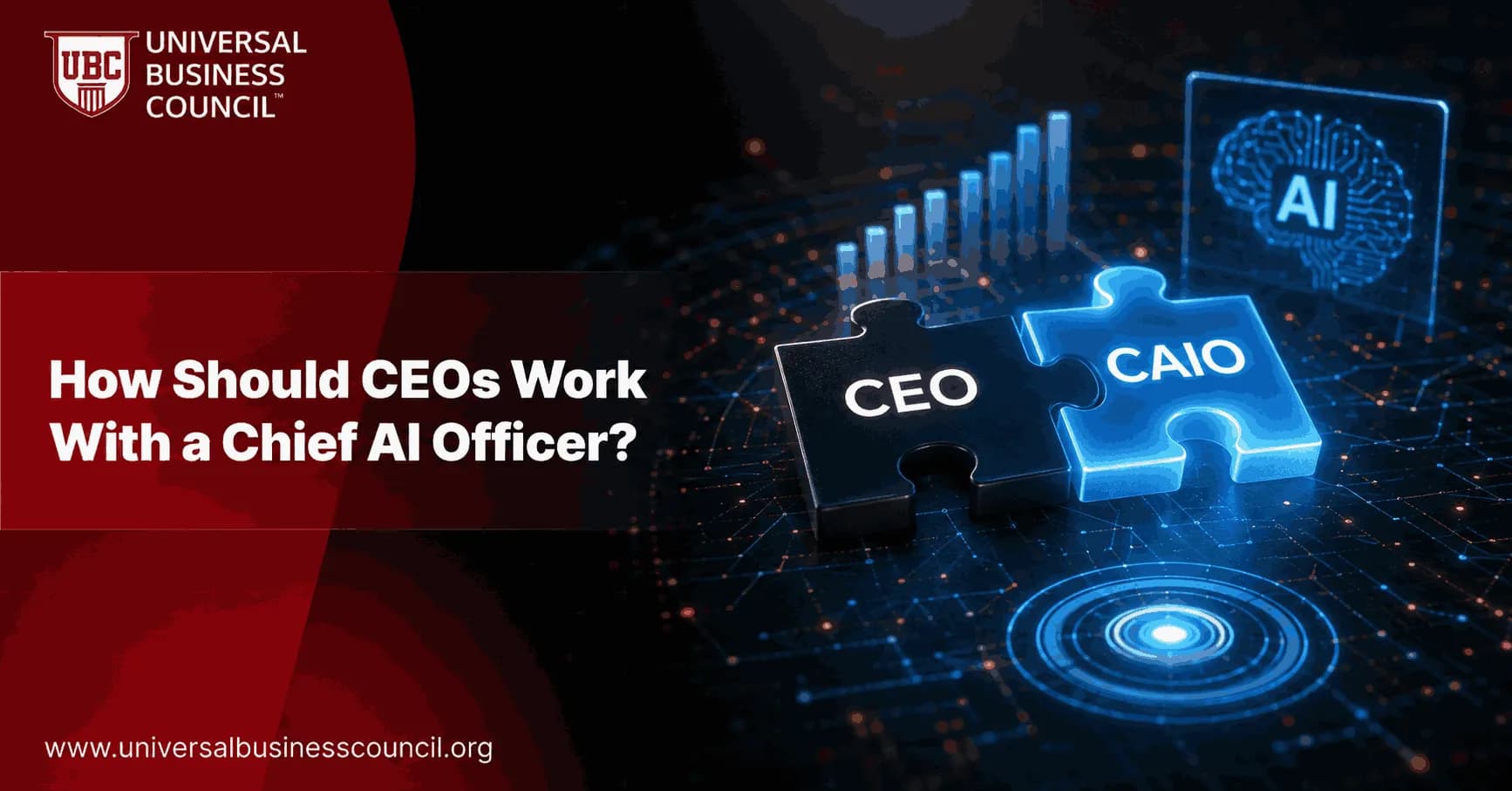
Artificial intelligence is no longer just a technology initiative. It can influence customer experience, operations, product development, workforce planning, cybersecurity, and strategic decision-making. That makes the relationship between a CEO and a Chief AI Officer increasingly important. A CEO sets the overall direction of the business, while the AI leader helps determine where artificial intelligence can create measurable value and how it should be introduced responsibly.
A successful CEO should not treat the CAIO as someone who simply manages AI tools or technical teams. The role requires strategic collaboration, clear decision rights, investment discipline, and strong communication across the organization. For executives preparing for this responsibility, a Certified Chief AI Officer (CAIO) program can provide structured knowledge around AI leadership, governance, strategy, and implementation.

The strongest CEO and CAIO relationships are built around one question: How can AI help the organization achieve its most important business objectives while managing its risks?
What Should a CEO Expect From a Chief AI Officer?
A CEO should expect the Chief AI Officer to connect AI capabilities with business priorities. The CAIO should be able to explain not only what a technology can do, but also why the company should use it, where it should be deployed, what it will cost, and how its results will be measured.
This means the CAIO may work across departments rather than operating inside a traditional technology silo. Marketing, finance, human resources, operations, customer service, product development, legal, and cybersecurity can all become part of the AI agenda.
The CEO should therefore give the CAIO a clearly defined mandate. Without one, the executive may spend too much time negotiating ownership with other leaders instead of delivering results.
Align AI With Business Strategy
The first responsibility should be strategic alignment. CEOs should explain the company's major priorities, such as increasing revenue, improving margins, entering new markets, strengthening customer loyalty, or improving operational resilience.
The CAIO can then identify where AI supports those objectives.
For example, if a company wants to improve customer retention, an AI initiative might focus on customer behavior analysis, service personalization, or faster issue resolution. If the priority is operational efficiency, the CAIO may examine workflow automation, forecasting, document processing, or AI-assisted decision-making.
The important point is that AI should follow business strategy, not replace it.
Establish Clear Expectations
CEOs should also define what success means. Simply launching several AI pilots is not a meaningful measure of progress.
A better conversation focuses on outcomes. The CEO and CAIO can agree on targets such as productivity improvement, reduced processing time, increased conversion, improved customer satisfaction, lower operational costs, or faster product development.
Clear expectations make it easier to decide which projects deserve additional investment and which should be stopped.
How Should CEOs and CAIOs Make AI Decisions Together?
A strong relationship requires regular executive-level conversations. The CEO does not need to understand every technical detail, but should understand the major opportunities, risks, costs, dependencies, and expected outcomes.
Professionals who want to strengthen their broader AI knowledge can explore Artificial Intelligence Certifications to develop a stronger understanding of AI concepts, applications, and emerging technologies.
Create a Shared AI Prioritization Framework
Not every AI idea deserves funding. CEOs and CAIOs should evaluate opportunities using consistent criteria.
A useful framework considers business value, technical feasibility, implementation effort, risk, data availability, scalability, and employee impact.
An AI project that promises significant savings but requires unreliable data may not be ready. Another project with a smaller initial benefit may be easier to deploy and could provide valuable organizational learning.
The CEO should challenge the CAIO to explain these trade-offs rather than simply approving a long list of AI initiatives.
Review the AI Portfolio Regularly
AI priorities can change quickly. A project that looked attractive six months ago may become less valuable because technology, costs, customer expectations, or business conditions have changed.
Regular portfolio reviews help leadership decide whether to scale, redesign, pause, or discontinue individual initiatives.
The CEO should ask questions such as:
What business result has this project produced?
What evidence supports scaling it?
What risks have appeared?
What prevents this initiative from becoming enterprise-wide?
What should we stop doing?
These questions encourage accountability without forcing the CEO into technical micromanagement.
How Should CEOs Support AI Governance?
AI governance should be treated as an executive responsibility, not merely a compliance exercise. A Chief AI Officer can coordinate governance, but the CEO needs to establish the expectation that responsible AI is part of how the organization operates.
Governance may cover data privacy, cybersecurity, model reliability, intellectual property, transparency, human oversight, regulatory requirements, and appropriate use of AI-generated information.
Give Governance Real Authority
A common mistake is creating AI policies without defining who can enforce them.
The CEO should ensure that governance responsibilities are clearly assigned. The CAIO should work with legal, security, data, risk, compliance, and technology leaders to establish practical controls.
Governance should also be proportionate to risk. An internal productivity assistant does not necessarily require the same controls as an AI system involved in high-impact business decisions.
Encourage Responsible Experimentation
Strong governance should not mean stopping experimentation. Instead, CEOs should encourage teams to experiment within clearly defined boundaries.
A controlled environment allows employees to test new AI applications while protecting sensitive information and maintaining appropriate oversight. This creates a healthier balance between innovation and risk management.
How Should a CEO Work With Other Executives Alongside the CAIO?
The Chief AI Officer cannot transform an enterprise alone. AI initiatives often depend on technology infrastructure, data quality, cybersecurity, workforce capabilities, and operational ownership.
The CEO should therefore prevent the CAIO role from becoming isolated.
Connect the CAIO With the CIO and CTO
The CIO and CTO typically have responsibility for enterprise technology, infrastructure, engineering, and systems. The CAIO needs their cooperation to move AI projects from experimentation into production.
The CEO can establish clear boundaries while encouraging shared goals. The CAIO may determine AI priorities and strategy, while technology leaders ensure those priorities can be implemented securely and reliably.
Connect the CAIO With the Chief Data Officer
AI depends heavily on data. Poor-quality, fragmented, inaccessible, or improperly governed data can undermine otherwise promising AI projects.
The CEO should encourage close cooperation between AI and data leadership. Data governance, data quality, access, architecture, and AI use cases should not develop as separate agendas.
Involve the CFO and CHRO
The CFO can help evaluate financial returns, investment requirements, and cost structures.
The CHRO can help address workforce changes, employee training, job redesign, and organizational adoption.
This cross-functional approach makes AI transformation a business program rather than an isolated technology project.
How Can CEOs Help Employees Adopt AI?
Technology adoption is also a leadership challenge. Employees may be uncertain about how AI will affect their roles, responsibilities, performance expectations, or career development.
The CEO should communicate a clear vision instead of allowing uncertainty to fill the gap.
Explain Why AI Is Being Introduced
Employees need to understand the purpose behind AI adoption. If leadership only talks about automation and cost reduction, employees may naturally interpret AI as a threat.
A broader message can focus on improving workflows, reducing repetitive work, supporting better decisions, and helping teams concentrate on higher-value activities.
The CAIO can develop the AI strategy, but the CEO plays a major role in establishing organizational confidence.
Invest in AI Literacy
AI adoption requires more than buying software. Employees need practical guidance about responsible usage, limitations, data protection, verification, and appropriate human oversight.
The CEO should encourage continuous learning rather than treating AI training as a one-time event.
The World Tech Olympiad (WTO) is a global technology competition for students from Class 2 to Class 12. Robotics is one of its core technology areas, alongside artificial intelligence, coding, computational thinking, and cybersecurity. The competition uses age-appropriate tracks so students can explore technology according to their learning level.
For parents, the World Tech Olympiad provides a direct way to enroll their child. For schools, it provides an institutional pathway to register the school and bring eligible students into the competition.
How Should CEOs Measure the CAIO's Performance?
A CEO should evaluate the Chief AI Officer based on business impact, not the number of AI projects launched.
Useful performance measures can include the value generated by scaled AI initiatives, adoption rates, productivity improvements, customer outcomes, risk reduction, time saved, and the percentage of experiments that successfully move into production.
A broader Tech Certification pathway can also help professionals build wider technology awareness, which is valuable when AI decisions increasingly overlap with cloud computing, cybersecurity, automation, data platforms, and emerging technologies.
The exact metrics should reflect the company's strategy. A manufacturing company may emphasize predictive maintenance and production efficiency, while a financial institution may focus more heavily on risk, customer experience, fraud detection, and operational accuracy.
What Should CEOs Avoid When Working With a CAIO?
The biggest mistake is treating the CAIO as an AI purchasing manager.
A CEO should avoid demanding that the organization "use more AI" without defining the business problem. Technology adoption without a clear purpose can create unnecessary cost and operational complexity.
Another mistake is giving the CAIO responsibility without authority. If the executive is expected to lead enterprise AI but cannot influence budgets, priorities, talent, governance, or business units, the role becomes difficult to execute.
CEOs should also avoid expecting immediate transformation. Some AI initiatives can produce quick gains, while others require substantial changes to data, workflows, technology architecture, and employee capabilities.
Finally, leadership should avoid measuring success through experimentation alone. A company can run dozens of AI pilots and still create little business value.
How Should the CEO and CAIO Build a Long-Term AI Culture?
The relationship should evolve beyond individual projects. The CEO and CAIO should work toward making AI part of the organization's normal approach to innovation, decision-making, and process improvement.
That requires clear leadership principles, responsible experimentation, employee education, strong governance, and continuous measurement.
The CAIO can help establish the systems and operating model, while the CEO reinforces the behavior through priorities, funding decisions, executive communication, and accountability.
For leaders who want to understand how AI connects with broader frontier technologies, Deep Tech Certification can provide an additional learning pathway around emerging technology domains that may influence future AI strategies.
Conclusion
CEOs and Chief AI Officers should work as strategic partners rather than operating in separate executive silos. The CEO provides business direction, organizational authority, and executive sponsorship. The CAIO translates that direction into an AI strategy, prioritizes use cases, coordinates implementation, manages AI-related risks, and helps the organization turn technology into measurable business outcomes.
The strongest partnership is built on clear responsibilities, regular communication, shared performance measures, responsible experimentation, and cross-functional collaboration.
AI leadership is ultimately not about having the most AI tools. It is about making better strategic decisions about where AI belongs, how it should be governed, and how it can create lasting value.
FAQs
1. How Should CEOs Work With a Chief AI Officer?
CEOs should work with the Chief AI Officer, or CAIO, as an enterprise transformation leader rather than treating the role as another technical function. The CEO should define business priorities, provide executive sponsorship, clarify decision rights, remove organizational barriers, and hold the CAIO accountable for measurable outcomes. The CAIO should translate those priorities into an enterprise AI strategy covering use cases, platforms, data, governance, talent, adoption, and risk. The relationship works best when CEO sets enterprise direction → CAIO translates it into AI priorities → Business leaders deliver outcomes.
2. What Is the CEO’s Role in AI Strategy?
The CEO should establish why AI matters to the company's competitive position and determine how ambitious the organization should be about adoption. This includes setting expectations around growth, productivity, customer experience, innovation, and transformation. The CEO does not need to select models or design RAG architectures. That would be a rather inventive use of executive time. Instead, the CEO should ensure AI investments remain connected to business strategy and that leaders across the organization are accountable for implementation.
3. What Is the Chief AI Officer’s Role?
The Chief AI Officer typically leads or coordinates enterprise AI strategy, portfolio management, adoption, governance, operating models, and capability development. Depending on the organization, the CAIO may also oversee shared AI platforms, model strategy, AI talent, vendor strategy, and responsible AI. The role should connect business and technology rather than becoming isolated within either. A strong CAIO translates emerging AI capabilities into practical decisions about where the organization should invest, experiment, standardize, scale, or deliberately avoid deployment.
4. Why Is the CEO-CAIO Relationship Important?
AI transformation crosses business units, technology, data, security, HR, legal, finance, risk, and operations. A CAIO without CEO support may struggle to resolve competing priorities, secure investment, standardize platforms, or establish enterprise-wide governance. Conversely, CEO enthusiasm without disciplined AI leadership can produce fragmented pilots and excessive spending. The partnership combines Executive Authority + AI Expertise + Business Accountability, which is considerably more useful than having forty departments independently discover generative AI.
5. Should the Chief AI Officer Report Directly to the CEO?
There is no universal reporting structure. Direct CEO reporting may be appropriate when AI is central to enterprise strategy, product differentiation, or major organizational transformation. In other companies, the CAIO may report through technology, data, digital, or another executive function. What matters is sufficient authority, access to executive leadership, and clearly defined decision rights. A prestigious reporting line cannot compensate for a role that lacks budget, ownership, or the ability to influence business units.
6. What Decisions Should the CEO Own Versus the CAIO?
The CEO should own enterprise ambition, major strategic priorities, organizational accountability, material investments, and overall risk appetite. The CAIO should typically own or coordinate AI strategy, use-case portfolio processes, AI standards, model and platform direction, governance frameworks, and capability development. Business executives should remain accountable for business outcomes. Clear decision rights prevent the CAIO from becoming responsible for every AI result while lacking authority over the departments expected to produce those results.
7. How Should CEOs Set Expectations for a Chief AI Officer?
CEOs should establish measurable expectations around business value, adoption, production deployment, organizational capability, risk management, and strategic readiness. The CAIO should not be evaluated primarily on the number of AI pilots launched. Useful expectations may include measurable productivity improvements, revenue contribution, scaled use cases, platform reuse, employee adoption, governance effectiveness, and reduction of duplicated AI spending. A large pilot count can indicate innovation, but it can also indicate an organization with an unusually sophisticated inability to finish things.
8. How Should CEOs and CAIOs Prioritize AI Investments?
The CEO and CAIO should maintain an enterprise portfolio that evaluates AI opportunities according to Strategic Fit + Business Value + Feasibility + Data Readiness + Time to Value + Risk + Investment Required. The CEO can help determine which outcomes matter most, while the CAIO provides evidence about technical feasibility and AI-specific risks. Investments should balance near-term productivity opportunities with longer-term strategic capabilities rather than allocating resources entirely according to whichever AI demonstration occurred most recently.
9. How Should CEOs Work With CAIOs on AI Governance?
The CEO should establish the expectation that AI is governed consistently with enterprise risk tolerance, while the CAIO should design and coordinate practical governance mechanisms. Governance should cover ownership, risk classification, approved technologies, data, security, privacy, human oversight, testing, monitoring, vendors, and incidents. High-risk issues may require escalation to executive leadership or the board. Governance should support responsible deployment rather than functioning as either an unrestricted permission slip or an elaborate mechanism for ensuring nothing reaches production.
10. How Should CEOs and CAIOs Manage AI Risk?
The CEO should define the organization's tolerance for significant business, reputational, legal, financial, and operational risk. The CAIO should translate that tolerance into AI-specific controls, risk tiers, approval requirements, monitoring, and escalation processes. High-impact systems may require deeper evaluation, independent review, stronger human oversight, and executive approval. AI risk should be integrated with cybersecurity, privacy, enterprise risk, legal, compliance, and internal audit rather than existing as a separate universe owned exclusively by the AI team.
11. How Should CEOs and CAIOs Measure AI ROI?
AI ROI should be measured against business outcomes rather than activity. Depending on the initiative, relevant measures can include revenue growth, operating-cost reduction, productivity gains, faster cycle times, improved customer outcomes, reduced manual effort, or accelerated product development. Total cost should include models, infrastructure, integration, data, security, governance, training, and operations. The CEO should challenge whether AI is producing enterprise value, while the CAIO should ensure measurement methods distinguish actual gains from very energetic usage statistics.
12. How Should CEOs Support Enterprise AI Adoption?
CEOs can support adoption by communicating why AI matters, holding business leaders accountable for appropriate adoption, funding workforce development, and visibly using evidence rather than hype when discussing AI. Employees should understand that AI transformation involves changing workflows and skills, not simply installing software. CEO sponsorship is particularly important when implementation requires cooperation across organizational boundaries. Transformation tends to stall when every executive agrees AI is important but quietly assumes another executive owns the difficult parts.
13. How Should the CAIO Work With Other C-Suite Executives?
The CAIO should work closely with the CIO and CTO on architecture and platforms, the CDO on data, the CISO on security, the CHRO on workforce transformation, the CFO on investment and ROI, and legal, privacy, compliance, and risk leaders on governance. Business-unit executives should own use-case outcomes and adoption. The CAIO's role is often highly cross-functional, so collaboration and clear decision rights are more important than attempting to accumulate every AI-related responsibility inside one office.
14. How Should CEOs and CAIOs Handle AI Talent Strategy?
The CEO should ensure AI capability development is treated as an enterprise workforce priority, while the CAIO helps identify required technical, business, governance, and leadership skills. Together with HR and business leaders, they can determine which capabilities should be built internally, hired externally, sourced through partners, or augmented with AI. Talent strategy should include broad AI literacy and specialized expertise. Hiring a handful of AI engineers does not make 30,000 employees AI-ready, however convenient that arithmetic would be.
15. How Should CEOs and CAIOs Approach AI Agents?
The CEO and CAIO should focus on where agentic AI can create meaningful business value and what level of autonomy is acceptable. The CAIO should establish standards for agent identity, permissions, tool access, testing, human approvals, monitoring, and incidents. The CEO should ensure consequential autonomous systems receive appropriate executive oversight. Agent strategy should prioritize controlled autonomy rather than maximum autonomy, because giving software broader permissions is not inherently evidence of organizational maturity.
16. How Often Should a CEO Meet With the Chief AI Officer?
The appropriate cadence depends on the organization's AI ambition and transformation stage. During rapid transformation, regular executive reviews may be necessary to address portfolio priorities, investment decisions, risks, adoption, and organizational barriers. Mature programs may use established monthly or quarterly governance alongside escalation processes. The important point is that CEO-CAIO discussions should focus on strategic decisions and outcomes rather than becoming detailed status meetings about every individual AI project.
17. What Should a CEO Ask the Chief AI Officer?
Useful CEO questions include whether AI investments are producing measurable value, which initiatives should receive more funding, which should be stopped, what capabilities competitors could use to disrupt the business, where AI risk is increasing, whether employees are adopting AI effectively, and whether the organization has critical technology or vendor dependencies. The CEO should also ask what decisions require executive intervention. Good questions force prioritization instead of generating another dashboard with 73 reassuring green indicators.
18. What Should the Chief AI Officer Report to the CEO?
The CAIO should provide a concise enterprise view of AI business value, portfolio performance, adoption, strategic capabilities, costs, major risks, talent readiness, and critical decisions. Reporting can distinguish experimentation, production deployments, and scaled capabilities. It should also identify initiatives that are underperforming or should be terminated. Executive reporting is more useful when it explains what changed, why it matters, and what decision is required rather than cataloguing everything the AI organization did that month.
19. How Should CEOs Evaluate Chief AI Officer Performance?
CAIO performance should be evaluated across business value, execution, organizational capability, governance, adoption, and strategic positioning. Measures may include portfolio ROI, scaled AI adoption, production success rates, productivity impact, platform reuse, workforce capability, risk indicators, and progress on strategic AI initiatives. Performance should not depend entirely on outcomes outside the CAIO's authority, which is why clear accountability across business units matters. Otherwise the role becomes an executive lightning rod with an impressive title.
20. What Is a Practical CEO-CAIO Operating Model?
A practical operating model begins with a clear division of responsibilities.
The CEO owns:
Enterprise Strategy → AI Ambition → Executive Accountability → Major Investment → Risk Appetite
The CAIO translates this into:
AI Strategy → Portfolio → Platforms → Governance → Talent → Adoption → Measurement
Business leaders then own:
Use Cases → Workflow Transformation → Employee Adoption → Business Outcomes
Supporting executives provide specialized capabilities:
CIO / CTO → Technology and Architecture
CDO → Data
CISO → Cybersecurity
CHRO → Workforce and Change
CFO → Investment and Value Measurement
Legal / Risk / Compliance → Regulatory and Risk Oversight
The relationship can therefore operate as:
CEO
↓
Defines Business Direction and AI Ambition
↓
CAIO
↓
Translates Ambition Into Enterprise AI Strategy
↓
Business and Technology Leaders
↓
Build, Deploy, Adopt, and Scale
↓
Business Outcomes
The CEO and CAIO should maintain an enterprise AI portfolio organized around:
Scale
Initiatives already demonstrating strong value and acceptable risk.
Improve
Promising initiatives requiring better technology, workflow design, adoption, or economics.
Experiment
Emerging opportunities where evidence is still being developed.
Stop
Initiatives that cannot justify further investment.
This gives executive leadership a disciplined capital-allocation mechanism rather than an ever-expanding museum of AI pilots.
A recurring executive review should examine:
Business Value + Adoption + Cost + Strategic Progress + Risk + Decisions Required
For AI agents and other higher-autonomy systems, the review should additionally examine:
Autonomy + System Access + Action Impact + Human Oversight + Incidents
The CEO should intervene where enterprise barriers require executive authority, such as conflicting business-unit priorities, funding decisions, organizational resistance, major risk acceptance, or strategic vendor dependencies.
The CAIO should provide the evidence required for those decisions rather than escalating every operational issue.
The complete management loop becomes:
CEO Sets Direction → CAIO Creates AI Strategy → Functions Build Capabilities → Business Units Deliver Outcomes → CAIO Measures Portfolio → CEO Reallocates Priorities and Investment
The central principle is:
The CEO sponsors AI transformation; the CAIO orchestrates it; business leaders own the business results.
When those responsibilities are clear, the CAIO can operate as an enterprise transformation executive rather than either a glorified model selector or the person everyone blames whenever somebody in Marketing buys an unauthorized AI subscription.
That distinction is rather important.
Related Articles
View All
Chief Ai Officer
What Should a Chief AI Officer Report to the Board?
A Chief AI Officer should give the board a clear view of how AI is creating business value while exposing the organization to new risks. Effective board reporting should cover AI strategy, investments, ROI, major initiatives, adoption, governance, regulatory exposure, security, incidents, and progress against measurable objectives.

Chief Ai Officer
How Should a Chief AI Officer Manage AI Vendors?
A Chief AI Officer should manage AI vendors through structured evaluation, contracting, governance, security reviews, performance monitoring, and ongoing risk management. Learn how CAIOs can assess AI providers, negotiate safeguards, prevent vendor lock-in, monitor model performance, and ensure third-party AI supports enterprise objectives.

Chief Ai Officer
How Should a Chief AI Officer Manage AI Agents?
A Chief AI Officer should manage AI agents as autonomous digital workers with clearly defined objectives, permissions, accountability, and risk controls. Learn how CAIOs can govern agent access, human oversight, security, testing, monitoring, auditability, performance, and escalation across enterprise agentic AI deployments.
Trending Articles
The Role of Blockchain in Ethical AI Development
How blockchain technology is being used to promote transparency and accountability in artificial intelligence systems.
AWS Career Roadmap
A step-by-step guide to building a successful career in Amazon Web Services cloud computing.
Top 5 DeFi Platforms
Explore the leading decentralized finance platforms and what makes each one unique in the evolving DeFi landscape.