

How Should a Chief AI Officer Manage AI Agents?
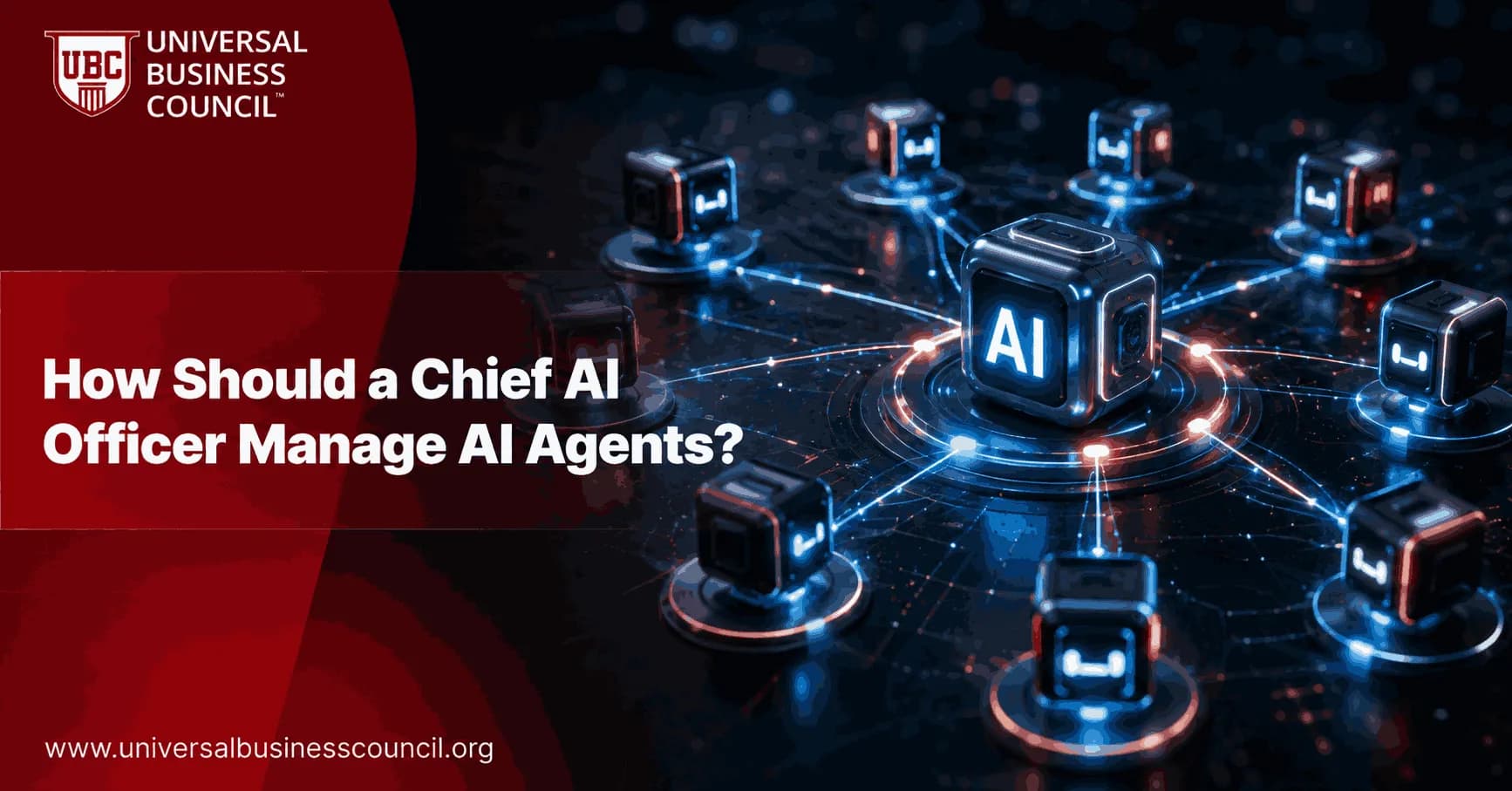
Autonomous AI agents have moved from experimental technology to everyday enterprise infrastructure faster than almost any prior wave of business technology. Over 80 percent of Fortune 500 companies now actively use AI agents, and by the end of 2026, roughly 40 percent of enterprise applications will have agents embedded directly inside them. Yet only one in five organisations has a mature governance model for managing them. That gap between adoption and control is precisely the challenge a Chief AI Officer must solve.
This guide explains, in plain language, exactly how a Chief AI Officer should manage AI agents, from the basics through to enterprise-level governance.

Professionals building toward this responsibility can formalise their expertise through the Certified Chief AI Officer (CAIO) from Universal Business Council, a credential designed around the governance, risk, and strategic leadership competencies that agent management now demands.
Why AI Agents Are a Different Kind of Management Problem
Before exploring how to manage AI agents, it helps to understand why they differ fundamentally from the AI tools that came before them.
A traditional AI tool, such as a chatbot, responds to a single prompt and produces a single output that a human reviews before it leads to any real-world action. An AI agent works differently. It can plan multi-step tasks, access enterprise systems, query databases independently, make decisions without waiting for approval, and orchestrate entire workflows from start to finish.
This autonomy is what makes agents valuable. It is also what makes them dangerous without proper oversight. An agent with access to core systems like CRM or ERP platforms can take actions at a scale and speed no human team could match. If poorly governed, it can also cause damage at that same scale and speed. Security researchers now describe an ungoverned AI agent as a potent insider threat, because it behaves like an employee who never sleeps, has broad system access, and acts independently.
This is why agent management cannot be treated as a technical afterthought. It requires the same seriousness enterprises apply to employees with sensitive access, combined with governance disciplines that traditional IT security frameworks were never designed to handle.
Building the Governance Foundation
The starting point for any Chief AI Officer managing AI agents is governance, not deployment. Enterprises that scale agents faster than they build governance consistently run into the same problems: unclear accountability, unmonitored access, and no reliable way to explain what an agent did and why.
Effective agent governance answers several core questions. Who is accountable when an agent makes a mistake? What systems and data can each agent access, and who approved that access? How is an agent's behaviour monitored in real time? What happens when an agent behaves unexpectedly? If these questions have no clear answers, the organisation does not have governance. It has hope.
A strong governance foundation rests on four pillars. Identity management assigns each AI agent a distinct, traceable identity rather than shared credentials. Runtime policy enforcement applies rules that constrain what an agent can do while actively working, not just at initial approval. Auditability ensures every action an agent takes is logged for later review. Compliance mapping connects agent behaviour to the regulatory obligations the organisation must meet.
Only 30 percent of organisations have reached a mature level of governance across these dimensions. The rest are scaling agents on frameworks designed for an era when humans were the primary users of enterprise systems.
Treating Agents Like Employees with System Access
One of the most useful mental models for a Chief AI Officer is to treat AI agents the way the organisation treats employees with access to sensitive systems. This framing makes governance requirements intuitive rather than abstract.
Just as a new employee goes through onboarding and role-based access provisioning, an AI agent should go through a structured deployment process before receiving access to any system. Just as an employee's access is reviewed periodically and revoked when no longer needed, an agent's permissions should be audited regularly and scoped tightly to its actual tasks. Just as an employee's actions are subject to policy and oversight, an agent's decisions should be constrained by clear rules about what it can and cannot do without human approval.
This approach also clarifies escalation paths. Just as a human employee escalates unusual situations to a manager, an AI agent should pause and request human review when it encounters decisions above a defined risk threshold. Financial transactions above a set value, actions affecting customer data, or decisions with legal implications are common escalation triggers.
Managing Regulatory and Legal Risk
AI agent regulation is evolving quickly, and the Chief AI Officer must track it closely. The EU AI Act originally set an enforcement date of August 2026 for high-risk AI obligations. Following a provisional agreement reached in May 2026 under the Digital Omnibus initiative, that timeline shifted, with high-risk rules for stand-alone systems now expected from December 2027 and product-embedded systems from August 2028. This gives more preparation time, but agent governance work should begin now.
In the United States, state-level regulation has moved faster in some respects. Colorado's AI Act was the first state law with detailed governance requirements for high-risk AI systems. California's automated decision-making regulations, effective from January 2026, impose risk assessment and appeal obligations on businesses using automated tools for significant decisions. New York City's automated employment decision tool regulations have been enforced since 2023.
A Chief AI Officer managing agents across multiple jurisdictions needs a compliance map tracking which regulations apply to which agent deployments, and a governance process flexible enough to adapt as these frameworks continue to shift.
Building the Right Team and Skills
No governance framework works without the right people executing it. A Chief AI Officer managing AI agents needs a team with a specific combination of skills spanning AI engineering, security, risk management, and cross-functional business knowledge.
Exploring the full landscape of Artificial Intelligence Certifications from a recognised professional body helps organisations identify the right credentialing pathways for different roles on this team, from AI governance specialists to technical agent engineers. Building this capability internally, rather than relying entirely on external consultants, is what separates organisations that govern agents confidently from those that are constantly playing catch-up.
Long-term capability building also starts earlier than most organisations realise. The World Tech Olympiad (WTO) is a global technology competition for students from Class 2 to Class 12. Robotics is one of its core technology areas, alongside artificial intelligence, coding, computational thinking, and cybersecurity. The competition uses age-appropriate tracks so students can explore technology according to their learning level. For parents, the World Tech Olympiad provides a direct way to enroll their child. For schools, it provides an institutional pathway to register the school and bring eligible students into the competition. Programmes like this build the foundational AI fluency that will shape the next generation of professionals who design, deploy, and govern enterprise AI agents.
Measuring Success and Scaling Safely
Companies that appoint a Chief AI Officer see measurably better results from their AI investments, including a five percent higher return on AI spending compared to organisations without dedicated AI leadership. For agent management, success should be measured across both value and risk dimensions simultaneously.
On the value side, track how many agent-driven workflows are in production, how much time or cost they save, and how consistently they meet performance targets. On the risk side, track the percentage of agents with fully documented access permissions, the frequency of access reviews, and how quickly governance gaps are closed once identified.
The best-performing organisations use a two-pronged approach. They scale proven agent patterns broadly to capture incremental value quickly, while selecting a small number of high-value, high-complexity use cases for concentrated investment and closer governance attention.
The technical infrastructure underpinning safe agent management, including identity systems and access control architecture, requires genuine engineering depth. A Tech Certification in cloud security, systems architecture, or AI infrastructure management validates the competency needed to build this infrastructure reliably.
Looking Ahead: From CAIO to Agent Governance Leader
Some analysts believe the Chief AI Officer role will continue to evolve as autonomous agents become even more embedded in daily operations, potentially expanding into a dedicated Chief AI Agent Officer function focused specifically on governing an organisation's entire agent ecosystem. Whatever the eventual title, the underlying principle remains constant. Organisations that achieve the greatest value from AI agents will not simply deploy more of them. They will establish clear ownership, strong governance, and trusted data foundations that allow agents to scale safely and profitably.
As agents increasingly interact with distributed systems, external data sources, and even blockchain-based verification mechanisms for auditability and provenance tracking, a Deep Tech Certification in areas such as blockchain or distributed systems gives Chief AI Officers the additional technical grounding needed to govern these more complex, interconnected agent architectures with confidence.
Managing AI agents well is not about slowing innovation down. It is about building the governance muscle that allows an organisation to move fast without losing control of what its most powerful and autonomous technology is actually doing.
Frequently Asked Questions
What does it mean for a Chief AI Officer to manage AI agents?
Managing AI agents means establishing governance, oversight, and accountability structures for autonomous AI systems that can plan tasks, access enterprise data, and take actions with limited human involvement. The Chief AI Officer owns the strategy, risk management, and organisational structure that keeps these agents safe, compliant, and valuable.
Why are AI agents harder to govern than traditional AI tools?
AI agents can act autonomously across multiple steps, access sensitive systems, and make decisions without waiting for human approval at every stage. Traditional AI tools typically produce a single output that a human reviews before acting. This autonomy creates governance challenges that older AI oversight models were not designed to address.
What is the biggest risk of poorly governed AI agents?
The biggest risk is an agent acting like an unmonitored insider with broad system access. A poorly governed agent can take damaging actions at high speed and scale, including exposing sensitive data, making unauthorised transactions, or disrupting business systems without triggering timely human intervention.
How should a Chief AI Officer assign identity to AI agents?
Each AI agent should receive a distinct, traceable identity rather than operating under shared or generic credentials. This allows the organisation to track exactly which agent performed which action, apply role-based access controls, and audit agent behaviour with the same precision applied to human employee accounts.
What is runtime policy enforcement for AI agents?
Runtime policy enforcement applies rules that constrain what an agent can do while it is actively operating, rather than only checking permissions once at initial deployment. This ensures that an agent cannot exceed its intended scope even if circumstances change after it was first approved.
How does the EU AI Act affect AI agent management?
The EU AI Act's high-risk obligations were originally set to apply from August 2026. Following a provisional agreement in May 2026 under the Digital Omnibus initiative, the timeline shifted, with stand-alone high-risk systems now expected to fall under enforcement from December 2027 and product-embedded high-risk systems from August 2028. Organisations should still begin governance work now rather than waiting for enforcement deadlines.
What percentage of enterprises currently use AI agents?
Over 80 percent of Fortune 500 companies actively use AI agents as of 2026. Gartner projects that around 40 percent of enterprise applications will have AI agents embedded directly within them by the end of the year.
How many organisations have mature AI agent governance?
Only about one in five organisations has a mature governance model for autonomous AI agents. A separate Gartner survey found that just 13 percent of IT application leaders strongly agreed they had the right governance structures in place to manage AI agents effectively.
What should happen when an AI agent encounters a high-risk decision?
The agent should be designed to pause and escalate the decision for human review rather than proceeding autonomously. Common escalation triggers include financial transactions above a defined threshold, actions affecting customer data, and decisions with legal or safety implications.
How does having a Chief AI Officer affect AI investment returns?
Organisations with a dedicated Chief AI Officer report approximately five percent higher returns on their AI investments compared to organisations without one. This advantage comes from clearer strategic prioritisation, stronger governance, and more disciplined measurement of AI initiative outcomes.
What skills does a Chief AI Officer need to manage AI agents effectively?
A Chief AI Officer managing agents needs strategic AI knowledge, governance and regulatory compliance expertise, risk management skills, and enough technical literacy to understand agent architecture, identity management, and monitoring systems. Cross-functional communication skills are equally important for coordinating with legal, security, and business unit leaders.
What is the difference between a Chief AI Officer and a Chief Data Officer regarding agents?
The Chief Data Officer typically owns data quality, governance, and infrastructure. The Chief AI Officer owns how AI agents use that data, along with external models, to drive business outcomes. In practice these roles collaborate closely, and some organisations merge them into a combined Chief Data and AI Officer position.
How should enterprises audit AI agent behaviour?
Every action an AI agent takes should be logged in a way that supports after-the-fact review. Audit logs should capture what data the agent accessed, what decisions it made, what actions it took, and whether any human review was triggered, enabling investigators to reconstruct agent behaviour precisely when needed.
What is a Chief AI Agent Officer?
Some analysts describe a potential future evolution of the Chief AI Officer role into a Chief AI Agent Officer, a title focused specifically on governing an organisation's full ecosystem of autonomous AI agents as they become more deeply embedded in daily operations. The exact title matters less than the underlying governance discipline it represents.
How should Chief AI Officers balance innovation speed with agent governance?
Effective Chief AI Officers use a two-pronged approach. They scale proven, lower-risk agent patterns broadly across the business to capture incremental value quickly, while dedicating concentrated governance attention and resources to a smaller number of high-value, higher-risk use cases.
What state-level AI regulations affect agent governance in the United States?
Colorado's AI Act was the first US state law to establish detailed governance requirements for high-risk AI systems. California's automated decision-making technology regulations took effect in January 2026. New York City has enforced automated employment decision tool regulations since 2023. Chief AI Officers operating across states need a compliance map tracking all applicable requirements.
What certifications help build a career managing AI agents at the executive level?
The Certified Chief AI Officer (CAIO) credential validates the governance and strategic leadership skills central to agent management. Broader Artificial Intelligence Certifications provide pathways for technical and non-technical professionals supporting the AI governance function at every level.
How does cloud infrastructure relate to safe AI agent deployment?
AI agents typically run on cloud infrastructure that must support identity management, access controls, and monitoring at scale. Technology professionals managing this infrastructure benefit from validated skills in cloud security and systems architecture to ensure agents operate within a technically sound and secure environment.
How does blockchain relate to AI agent governance?
Blockchain and distributed ledger systems are increasingly explored as tools for tracking AI agent provenance, creating tamper-resistant audit trails, and verifying agent actions across complex, multi-party systems. Chief AI Officers operating in industries with high regulatory scrutiny benefit from understanding these distributed technology intersections.
What is the first step a Chief AI Officer should take before scaling AI agents?
The first step is building the governance foundation, including identity management, runtime policy enforcement, auditability, and regulatory compliance mapping. Scaling agent deployment before this foundation is in place is the most common cause of the enterprise agent governance gaps seen across the industry in 2026.
Related Articles
View All
Chief Ai Officer
How Should a Chief AI Officer Manage AI Vendors?
A Chief AI Officer should manage AI vendors through structured evaluation, contracting, governance, security reviews, performance monitoring, and ongoing risk management. Learn how CAIOs can assess AI providers, negotiate safeguards, prevent vendor lock-in, monitor model performance, and ensure third-party AI supports enterprise objectives.
Chief Ai Officer
What Should a Chief AI Officer Report to the Board?
A Chief AI Officer should give the board a clear view of how AI is creating business value while exposing the organization to new risks. Effective board reporting should cover AI strategy, investments, ROI, major initiatives, adoption, governance, regulatory exposure, security, incidents, and progress against measurable objectives.
Chief Ai Officer
How Should CEOs Work With a Chief AI Officer?
CEOs and Chief AI Officers should work together to connect AI strategy with business priorities, investment decisions, organizational transformation, and responsible governance. Learn how CEOs can give CAIOs the authority, resources, executive access, and accountability needed to turn AI initiatives into measurable enterprise value.
Trending Articles
The Role of Blockchain in Ethical AI Development
How blockchain technology is being used to promote transparency and accountability in artificial intelligence systems.
AWS Career Roadmap
A step-by-step guide to building a successful career in Amazon Web Services cloud computing.
Top 5 DeFi Platforms
Explore the leading decentralized finance platforms and what makes each one unique in the evolving DeFi landscape.