

How Should a Chief AI Officer Build an AI Strategy?
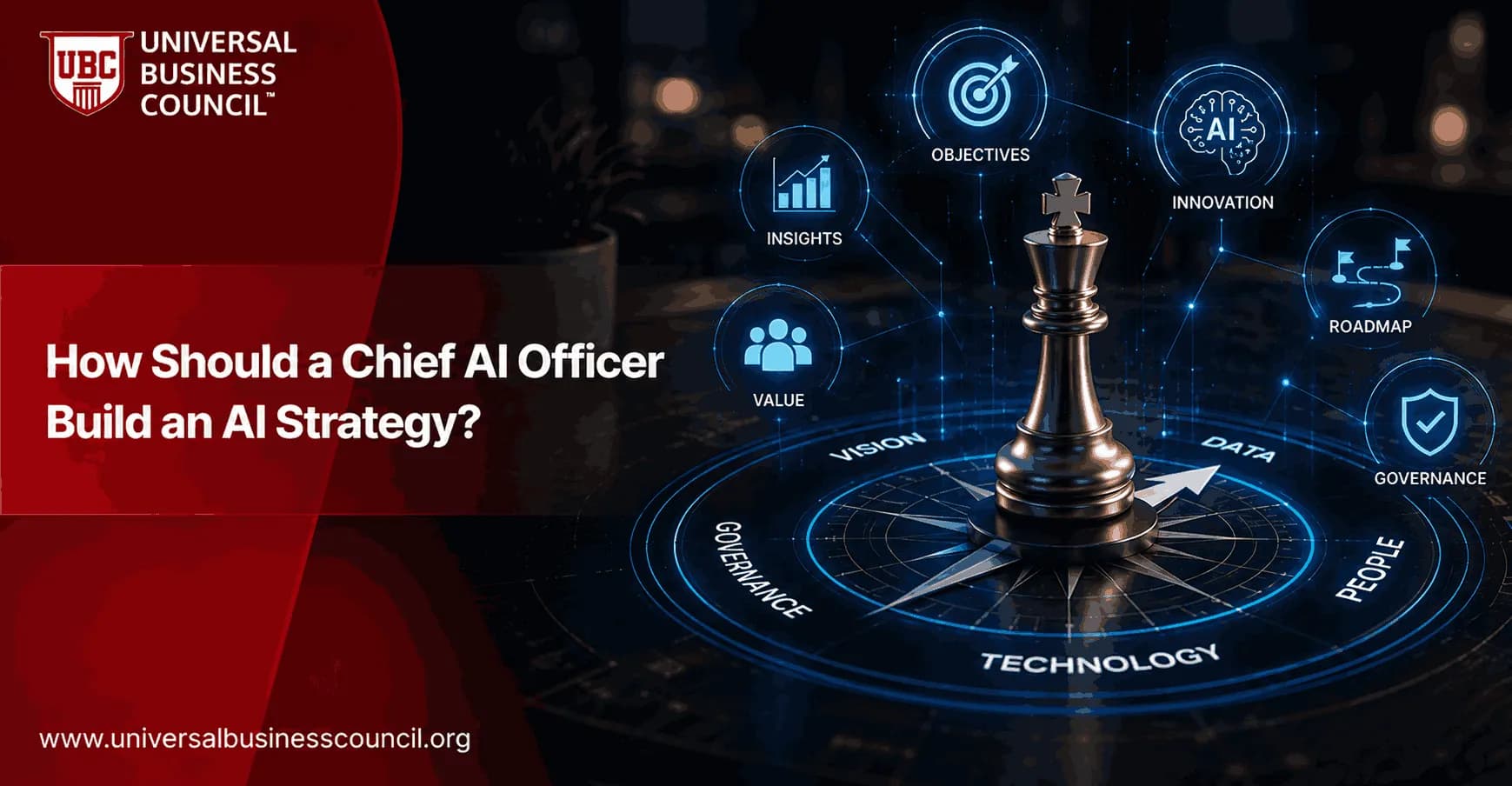
Artificial intelligence has moved from an experimental technology handled by specialist teams to a business priority discussed by CEOs, boards, product leaders, and operations executives. As organizations move from isolated AI experiments toward broader adoption, one question becomes increasingly important: who is responsible for turning AI opportunities into a coherent business strategy? That is where the Certified Chief AI Officer (CAIO) role becomes increasingly relevant.
A Chief AI Officer should not build an AI strategy by simply listing the newest models, AI agents, or automation tools available. The real responsibility is to connect artificial intelligence with business objectives, customer needs, data, technology, people, governance, investment, and measurable outcomes.

This guide explains how a Chief AI Officer can build an AI strategy from the ground up. It covers the fundamentals for beginners while also addressing the governance, operating model, investment, and leadership considerations that experienced professionals need to understand.
What Is an AI Strategy?
An AI strategy is a structured plan for using artificial intelligence to achieve specific organizational objectives. It explains where AI should be used, why it should be used, what capabilities are required, how risks will be managed, and how results will be measured.
A practical AI strategy connects several areas:
Business objectives
Customer requirements
AI use cases
Data availability and quality
Technology infrastructure
Talent and skills
Governance and responsible AI
Investment priorities
Change management
Performance measurement
The strategy should answer a simple executive question: How will AI create meaningful value for this organization?
That value could come from reducing operational costs, improving customer experiences, increasing productivity, developing new products, improving decision-making, reducing risk, or creating entirely new revenue opportunities.
A weak strategy starts with technology. A strong strategy starts with business problems.
For professionals building the expertise required for this leadership position, Certified Chief AI Officer (CAIO) training can provide a structured way to develop knowledge across AI strategy, leadership, governance, and implementation.
Why the Chief AI Officer Needs an AI Strategy
AI adoption can become fragmented surprisingly quickly.
One department may purchase an AI writing tool. Another may develop a machine learning model. A customer service team may introduce an AI chatbot, while the technology department experiments with AI agents. None of these projects are necessarily wrong, but without a common strategy, the organization can end up with duplicated spending, inconsistent governance, disconnected data, and projects that never move beyond experimentation.
The Chief AI Officer provides a central strategic perspective.
The objective is not necessarily to control every AI decision. Instead, the CAIO should create a framework that allows business units to innovate while maintaining common standards for investment, security, governance, data, and measurement.
A well-designed strategy should therefore establish:
Where AI fits into the corporate strategy
Which opportunities deserve priority
What risks require executive attention
Which capabilities should be centralized
Which responsibilities belong to business units
How successful pilots will reach production
How the organization will measure value
The need for this discipline is especially important as organizations move from experimentation toward broader AI deployment.
Core Responsibilities of a Chief AI Officer When Building an AI Strategy
While responsibilities differ between organizations, several areas consistently form the foundation of strategic AI leadership.
Business Alignment and AI Vision
The first responsibility is establishing a clear AI vision.
The CAIO should understand the organization's business model, competitive position, customer expectations, operating challenges, and long-term objectives before recommending major AI investments.
For example, a company focused on reducing operating costs may prioritize intelligent automation and employee productivity. A product-led organization may focus on AI-enabled products and personalization. A financial institution may place greater emphasis on fraud detection, risk analysis, customer service, and responsible AI governance.
The AI vision should answer:
What should AI enable this organization to do better, faster, safer, or differently?
AI Use Case Identification
Once the business priorities are understood, the CAIO identifies opportunities where AI could make a measurable difference.
Potential use cases can include:
Customer service automation
Predictive forecasting
Intelligent document processing
Employee knowledge assistants
Fraud detection
Recommendation systems
Software development assistance
Marketing personalization
Supply chain optimization
AI-enabled products
Enterprise search
Workflow automation
The key is not to select the largest number of use cases. It is to identify the use cases with the strongest combination of value, feasibility, risk, and organizational readiness.
AI Portfolio Prioritization
A long list of AI ideas needs to become a manageable portfolio.
The CAIO can evaluate each opportunity according to:
Expected business value
Implementation complexity
Data readiness
Technical feasibility
Risk
Customer impact
Employee impact
Time to value
Required investment
Scalability
A simple prioritization model can divide projects into quick wins, strategic initiatives, foundational capabilities, experiments, and projects that should be stopped.
This prevents the organization from treating every AI idea as equally important.
Data and AI Readiness
AI strategy cannot be separated from data strategy.
The CAIO should work with data and technology leaders to understand whether the organization has the information required to support its AI ambitions.
Important questions include:
Is the required data available?
Is it accurate?
Can authorized teams access it?
Is sensitive information properly protected?
Are data definitions consistent?
Can data move between required systems?
Who owns important datasets?
Can data quality be monitored?
An organization may have an impressive AI vision but still lack the data foundation required to execute it.
AI Governance and Responsible AI
Governance should be built into the strategy from the beginning.
The Chief AI Officer should establish principles for responsible AI covering areas such as privacy, security, fairness, transparency, accountability, human oversight, model performance, and acceptable use.
A useful governance model should clarify:
Which AI applications require formal review
Who approves higher-risk systems
How AI systems are tested
How incidents are reported
How models are monitored
When humans must review AI decisions
How AI vendors are evaluated
When an AI system should be modified or retired
A recognized risk-management approach can help organizations organize these responsibilities. The NIST AI Risk Management Framework, for example, structures AI risk activities around Govern, Map, Measure, and Manage. The framework is designed to support risk management throughout the AI lifecycle rather than treating governance as a one-time approval step.
Technology and Vendor Strategy
The CAIO also needs to determine how the organization will acquire AI capabilities.
The major choices usually include:
Build internally
Buy an existing solution
Partner with a specialist
Use cloud AI services
Combine several approaches
The decision should consider cost, security, performance, intellectual property, scalability, vendor dependency, integration requirements, and strategic importance.
Building everything internally is rarely practical. Buying everything can create long-term dependency. A balanced strategy evaluates each decision according to the organization's needs.
Chief AI Officer vs. Other Technology Leaders
The CAIO rarely operates independently. AI strategy intersects with several established executive roles.
Chief AI Officer vs. CTO
The CTO generally has broad responsibility for technology, engineering, architecture, and technical innovation.
The CAIO focuses specifically on artificial intelligence strategy, AI value creation, governance, adoption, and AI-related transformation.
The two roles should work closely rather than compete.
Chief AI Officer vs. CIO
The CIO typically focuses on enterprise information technology, internal systems, infrastructure, technology operations, and digital services.
The CAIO concentrates more specifically on AI capabilities and how they can transform business processes and products.
Depending on organizational size, one executive may sometimes hold overlapping responsibilities.
Chief AI Officer vs. Chief Data Officer
The Chief Data Officer typically focuses on data governance, data quality, data management, and data strategy.
The CAIO focuses on applying AI to business problems and building AI capabilities.
The relationship is important because effective AI requires reliable data.
Who Should Own the AI Strategy?
The Chief AI Officer may lead the strategy, but AI strategy should not belong to one person alone.
A strong operating model creates shared accountability.
The CEO or executive committee provides strategic direction.
The CAIO establishes the AI vision, portfolio, governance approach, and transformation roadmap.
The CTO and CIO support architecture, infrastructure, security, and technology delivery.
The CDO supports data governance and data readiness.
Business leaders own specific AI use cases and their business outcomes.
Legal, compliance, security, HR, and risk teams contribute specialized oversight.
This model prevents the CAIO from becoming the only person responsible for AI while still giving the role sufficient authority to coordinate the enterprise.
Skills Needed to Build an AI Strategy
A Chief AI Officer needs a combination of technical understanding and executive leadership.
AI and Technical Literacy
The CAIO does not need to personally build every model. However, the executive should understand machine learning, generative AI, AI agents, model evaluation, data pipelines, AI infrastructure, and the limitations of AI systems.
Business Strategy
AI decisions must connect to revenue, cost, customer experience, competitive advantage, and risk.
A technically impressive project that produces no meaningful business outcome should not automatically receive additional investment.
Financial Understanding
The CAIO should understand business cases, investment requirements, operating costs, return on investment, and opportunity cost.
AI spending can include model usage, infrastructure, software, talent, integration, training, security, governance, and ongoing monitoring.
Change Leadership
AI changes how people work.
Employees may need new tools, new workflows, new responsibilities, and new performance expectations. The CAIO must therefore understand organizational change, communication, training, and adoption.
Governance and Risk Management
AI leadership requires the ability to recognize and manage risks involving privacy, security, fairness, intellectual property, compliance, reliability, and customer impact.
Measuring the Success of an AI Strategy
An AI strategy needs measurable outcomes.
Useful metrics may include:
Revenue generated through AI-enabled products
Cost savings
Productivity improvement
Processing time reduction
Error reduction
Customer satisfaction
Employee adoption
AI system performance
Number of successful deployments
Pilot-to-production rate
AI-related incidents
Governance compliance
Return on AI investment
Avoid measuring success only by the number of AI projects launched.
Ten pilots do not necessarily represent more progress than two production systems generating measurable value.
The better question is:
What changed because of AI?
That question keeps the strategy connected to business performance.
Challenges Chief AI Officers Face
Building an AI strategy is not simply a technical exercise.
Too Many AI Experiments
Organizations may launch numerous pilots without deciding which ones deserve investment.
The CAIO needs a clear portfolio review process.
Unclear Executive Ownership
If several executives believe they own AI, decisions can become slow and political.
Roles and decision rights should be documented.
Poor Data Foundations
AI initiatives can stall when data is fragmented, inaccessible, inconsistent, or poorly governed.
Employee Resistance
Employees may worry about job changes or may not trust AI outputs.
Communication, training, and human oversight are therefore important.
Rapid Technology Change
AI capabilities evolve quickly. A strategy that depends too heavily on a particular model or vendor can become outdated.
The strategy should establish principles rather than locking the organization into one technology prematurely.
Building the Path Toward Becoming a Chief AI Officer
Professionals interested in AI leadership should develop their skills progressively.
A strong foundation includes AI concepts, data, analytics, business strategy, technology management, governance, project leadership, and organizational transformation.
Specialized Artificial Intelligence Certifications can help professionals develop structured knowledge of AI concepts and applications while building the technical vocabulary needed to work with engineering and data teams.
However, technical knowledge alone is not enough. Future CAIOs also need to understand financial decision-making, executive communication, risk management, and business transformation.
Introducing Technology Learning From an Early Age
Technology learning can begin well before students enter higher education or professional careers. Designed to encourage technology learning among school students, the World Tech Olympiad (WTO) brings together participants from Class 2 to Class 12 through different technology-focused challenges. Its areas include robotics, AI, programming, computational thinking, and cybersecurity, with competition levels structured to suit different age groups and abilities.
The Olympiad supports participation through separate routes for families and educational institutions. Parents can enroll their children directly, while schools can register as institutions and facilitate participation for students who meet the eligibility requirements. Early exposure to these areas can help students develop problem-solving, computational thinking, and technology skills that may provide a useful foundation for advanced education and future careers in AI, engineering, cybersecurity, and other technology fields.
Is Every Company Ready for a Chief AI Officer?
Not every company needs a dedicated CAIO immediately.
A smaller organization may initially assign AI responsibilities to a CTO, CIO, product executive, or another senior leader.
A dedicated Chief AI Officer becomes more valuable when AI activity becomes large enough to require enterprise coordination.
Signals may include:
Multiple AI initiatives across departments
Significant AI investment
AI-enabled products
Complex governance requirements
Increasing employee adoption
AI-related regulatory exposure
Need for organization-wide AI transformation
Difficulty moving pilots into production
The important point is that the underlying responsibilities still exist even when the CAIO title does not.
The Future of AI Strategy
AI strategy is likely to become increasingly focused on transformation rather than experimentation.
Organizations are moving beyond basic productivity tools toward AI-enabled workflows, intelligent automation, AI agents, personalized products, enterprise knowledge systems, and new operating models.
This means future CAIOs will need to think about more than individual AI applications.
They will need to consider how humans and AI work together, how organizations redesign workflows, how AI affects competitive advantage, and how autonomous systems should be governed.
AI strategy will therefore become increasingly connected to corporate strategy itself.
Learning Path for Future Chief AI Officers
Professionals preparing for AI leadership should build knowledge in stages.
Start with broad technology literacy, then develop specialized AI expertise. From there, strengthen skills in strategy, governance, data, business transformation, and executive leadership.
Broader Tech Certification options can support technology awareness across areas that intersect with AI, including emerging technologies, digital systems, and technical innovation.
The next stage should be practical application. Work on real AI use cases, evaluate business cases, participate in governance decisions, and learn how technology projects move from concept to production.
Professionals who want to understand AI alongside other emerging technologies can also explore Deep Tech Certification pathways to develop a broader perspective on the technology landscape.
Conclusion
A Chief AI Officer should build an AI strategy by starting with business objectives rather than technology trends. The process involves understanding corporate priorities, assessing AI maturity, identifying valuable use cases, prioritizing investments, strengthening data and technology foundations, establishing responsible AI governance, preparing employees, and creating measurable roadmaps.
The strongest AI strategy is not the one containing the largest number of models, pilots, or AI tools. It is the one that clearly explains why AI matters, where it should be applied, what risks must be managed, who owns the outcomes, and how business value will be measured.
As AI becomes more deeply integrated into products, operations, and decision-making, the Chief AI Officer will increasingly need to operate as a business strategist as much as a technology leader.
For professionals pursuing this path, structured executive development can help connect AI knowledge with leadership and organizational transformation. A Certified Chief AI Officer (CAIO) pathway can be part of that broader professional development journey.
FAQs
1. How should a Chief AI Officer build an AI strategy?
A Chief AI Officer should build an AI strategy by connecting business priorities with specific AI capabilities, investments, governance requirements, and measurable outcomes. The strategy should explain where AI can create value, which opportunities deserve investment, what capabilities the company must build, and how risks will be controlled.
A strong AI strategy starts with business problems rather than technology. Beginning with “we need more AI” usually produces plenty of activity and remarkably little strategy.
2. What is an enterprise AI strategy?
An enterprise AI strategy is a coordinated plan for using artificial intelligence to achieve organizational objectives. It connects AI investments with revenue growth, productivity, customer experience, innovation, operational efficiency, and risk management.
The strategy should cover AI use cases, data, technology, talent, governance, operating models, funding, adoption, and performance measurement.
It should also define what the company will not pursue. Strategy requires choices. A document containing every conceivable AI opportunity is a catalog, not a strategy.
3. What should a Chief AI Officer do before developing an AI strategy?
Before creating the strategy, the CAIO should understand the organization's business strategy, competitive position, existing AI capabilities, data environment, technology architecture, talent, governance, and current AI investments.
An AI maturity assessment can reveal gaps between current capabilities and future ambitions.
The CAIO should also inventory existing AI systems, vendors, pilots, and production applications. This prevents the slightly embarrassing discovery that three departments have independently purchased solutions for essentially the same problem.
4. How should a CAIO align AI strategy with business strategy?
The CAIO should begin with the organization's major strategic priorities and determine where AI can materially improve them.
For example, if the company wants to increase customer retention, AI opportunities might include personalization, churn prediction, intelligent support, or next-best-action recommendations. If cost efficiency is the priority, workflow automation and employee copilots may deserve greater attention.
Every major AI initiative should therefore connect to a business objective, accountable owner, measurable KPI, and expected economic outcome.
5. How should a Chief AI Officer identify AI use cases?
The CAIO should work with business leaders, employees, customers where appropriate, and technical teams to identify problems that AI could solve.
Potential opportunities can emerge from repetitive knowledge work, slow decisions, customer friction, manual processes, forecasting problems, fraud, document-heavy workflows, software development, or product innovation.
The useful question is not simply “Where can we use AI?”
It is “Which valuable problems can AI solve better than existing alternatives?”
That distinction prevents technology from becoming the objective rather than the means.
6. How should AI use cases be prioritized?
AI opportunities should be evaluated using consistent criteria such as business value, strategic alignment, technical feasibility, data readiness, implementation cost, risk, scalability, and time to value.
A simple prioritization framework might be:
AI Priority = Business Value × Feasibility × Strategic Fit ÷ Cost and Risk
The formula does not need to become mathematical theater. Its purpose is to make assumptions explicit and help leaders compare competing investments consistently.
The highest-priority project is not necessarily the most technologically impressive one.
7. How should a CAIO create an AI use-case portfolio?
A balanced AI portfolio should contain different types of initiatives rather than concentrating entirely on either quick wins or speculative innovation.
Some projects should deliver near-term productivity or efficiency gains. Others may improve existing products and customer experiences. A smaller number can explore strategically important capabilities with longer time horizons.
The CAIO should regularly review the portfolio and accelerate, redesign, consolidate, pause, or terminate projects according to evidence.
AI projects should not receive lifetime tenure merely because they survived the pilot stage.
8. What role should data play in AI strategy?
Data should be treated as a core enabler of AI rather than a separate technical issue.
The CAIO should work with the Chief Data Officer and other data leaders to identify the data required by priority AI use cases and assess its quality, accessibility, permissions, lineage, and governance.
Importantly, organizations do not necessarily need to perfect every dataset before beginning AI adoption.
Data investments should be prioritized according to business value. Fix the data that matters for important AI use cases instead of attempting to clean the entire corporate universe.
9. How should a Chief AI Officer develop an AI technology strategy?
The technology strategy should define how the organization will access models, build applications, integrate AI with enterprise systems, evaluate outputs, monitor performance, and operate AI securely at scale.
Important decisions may involve foundation models, cloud platforms, APIs, RAG, vector databases, AI agents, orchestration, MLOps, evaluation platforms, observability, and security controls.
The architecture should support flexibility because AI technologies and vendors evolve quickly.
Today's strategic platform can become tomorrow's migration project with impressive speed.
10. How should a CAIO decide whether to build, buy, or partner for AI?
The decision should depend on strategic differentiation, internal capability, cost, speed, risk, and long-term control.
Companies may buy commodity capabilities, build AI systems where proprietary data or workflows create competitive advantage, and partner when specialized expertise can accelerate implementation.
The CAIO should also evaluate switching costs and vendor dependency.
Building everything internally is expensive. Buying everything externally can eliminate differentiation. A sensible strategy usually uses all three approaches selectively.
11. How should generative AI fit into an enterprise AI strategy?
Generative AI should be treated as one important component of the broader AI portfolio rather than the entire strategy.
Potential applications include enterprise search, knowledge management, customer support, document processing, software development, content workflows, analytics, and employee copilots.
The CAIO should establish standards for model selection, grounding, evaluation, data protection, hallucination management, security, cost, and human oversight.
A generative AI strategy consisting entirely of purchasing chatbot licenses is more accurately described as procurement.
12. How should AI agents fit into a Chief AI Officer's strategy?
AI agents can support workflows requiring multiple steps, tools, systems, or decisions. They may be useful for customer operations, research, software development, finance processes, IT support, and other structured workflows.
The CAIO should define appropriate levels of autonomy based on risk.
Agent strategy should address tool permissions, authentication, evaluation, observability, escalation, human approval, security, and rollback mechanisms.
The more authority an agent receives to act, the stronger the controls should become. Autonomous software and vague accountability are an unpromising combination.
13. How should a Chief AI Officer build AI governance into the strategy?
AI governance should be designed into the strategy rather than attached after deployment.
The framework should address AI inventories, risk classification, use-case approval, model evaluation, documentation, human oversight, privacy, security, monitoring, vendor management, and incident response.
Controls should be proportional to risk.
A low-risk internal assistant does not necessarily require the same oversight as AI influencing employment, healthcare, credit, safety, or other consequential decisions.
Good governance enables responsible scaling rather than merely creating additional paperwork.
14. How should a CAIO develop an AI talent strategy?
The CAIO should determine which capabilities the organization needs internally and which can be obtained through vendors or partners.
Relevant capabilities may include AI engineering, machine learning, data science, AI architecture, MLOps, AI product management, evaluation, governance, security, and change management.
The strategy should also address broader workforce AI literacy.
Enterprise AI adoption cannot depend entirely on specialist teams. Employees and managers need enough knowledge to use AI appropriately, redesign workflows, evaluate outputs, and recognize limitations.
15. How should a Chief AI Officer plan for AI adoption and change management?
Adoption should be treated as part of the AI strategy from the beginning.
Employees need to understand how AI changes their workflows, what tools they should use, which tasks remain human responsibilities, and how performance expectations may change.
The CAIO should work closely with HR, learning teams, business leaders, and communications functions on training and workflow redesign.
A technically excellent AI system with weak adoption creates approximately the same business value as an expensive chair nobody sits in.
16. How should a CAIO measure AI ROI?
Each significant AI initiative should have measurable outcomes linked to a baseline.
Potential measures include revenue growth, cost reduction, productivity improvement, cycle-time reduction, conversion, customer satisfaction, error reduction, capacity gains, or risk reduction.
A basic financial calculation is:
AI ROI = (Financial Benefits − Total AI Costs) ÷ Total AI Costs × 100
Total costs should include models, infrastructure, integration, data work, employees, vendors, governance, maintenance, and change management.
Otherwise, ROI becomes unusually impressive for reasons accounting departments eventually discover.
17. What KPIs should be included in an AI strategy?
AI strategy should include both technical and business KPIs.
Technical measures might include accuracy, latency, reliability, evaluation scores, incidents, and cost per transaction. Adoption metrics can track active users, utilization, workflow penetration, and repeat usage.
Business metrics should measure the actual objective, such as revenue, cost, productivity, customer outcomes, or cycle time.
Portfolio-level metrics should also show how much AI investment has reached production and how much measurable value the overall portfolio generates.
18. How should a CAIO create an AI roadmap?
The roadmap should translate strategic priorities into sequenced initiatives, investments, capabilities, and milestones.
Near-term work may focus on governance, high-value quick wins, platform foundations, and employee adoption. Medium-term priorities may include scaling successful applications and redesigning workflows. Longer-term initiatives may involve AI-native products, agents, or business-model innovation.
Every major roadmap initiative should identify ownership, investment, dependencies, milestones, risks, and expected outcomes.
A roadmap without those elements is mostly a timeline with aspirations attached.
19. How often should a Chief AI Officer update the AI strategy?
AI strategy should be treated as a living strategy rather than an annual document that enjoys eleven peaceful months in cloud storage.
The CAIO should monitor technology changes, business priorities, regulations, vendor economics, competitive developments, and portfolio performance continuously.
Formal portfolio reviews may occur quarterly, while the broader strategy can be reassessed at least annually or whenever major changes justify it.
The organization's strategic direction should remain relatively stable while implementation choices adapt as evidence and technology change.
20. What does a strong Chief AI Officer AI strategy framework look like?
A practical Chief AI Officer AI strategy framework connects business objectives to execution and measurable outcomes.
Strategy Area | Core Question |
|---|---|
Business Alignment | What outcomes must AI improve? |
Use Cases | Where can AI create the most value? |
Portfolio | Which initiatives deserve investment? |
Data | What data capabilities are required? |
Technology | What models, platforms, and architecture are needed? |
Governance | How will AI risks be controlled? |
Talent | What skills must be built or acquired? |
Operating Model | Who owns decisions and execution? |
Adoption | How will workflows and behaviors change? |
Measurement | How will value and risk be measured? |
The strategy can then move through a clear sequence:
1. BUSINESS STRATEGY
Identify the company's most important growth, efficiency, customer, innovation, and risk objectives.
↓
2. AI OPPORTUNITY
Determine where machine learning, generative AI, agents, or other AI capabilities can materially improve those outcomes.
↓
3. PRIORITIZATION
Evaluate opportunities according to value, feasibility, strategic alignment, cost, data readiness, and risk.
↓
4. DATA AND TECHNOLOGY
Build only the data, platforms, integrations, models, and infrastructure required to support priority opportunities and reusable capabilities.
↓
5. GOVERNANCE
Establish risk-based controls for development, procurement, evaluation, deployment, monitoring, and human oversight.
↓
6. OPERATING MODEL
Define decision rights across the CAIO, CTO, CIO, CDO, CISO, legal, HR, finance, risk, and business units.
↓
7. TALENT AND ADOPTION
Build specialist capabilities while training employees and redesigning workflows around effective human-AI collaboration.
↓
8. EXECUTION
Move selected use cases from:
Problem → Business Case → Pilot → Production → Adoption → Scale
↓
9. MEASUREMENT
Track technical performance, adoption, financial outcomes, operational improvements, risk, and ROI.
↓
10. PORTFOLIO OPTIMIZATION
Scale successful initiatives, improve promising ones, consolidate duplication, and terminate projects that fail to demonstrate sufficient value.
A strong strategy ultimately connects:
Business Goals → AI Opportunities → Prioritized Investments → Data + Technology → Governance → People + Adoption → Production → Measurable Value
The CAIO's job is not to maximize how much AI the organization uses.
It is to determine where AI deserves investment, how it should be implemented, what risks need controlling, and whether it produces better business outcomes than the alternatives.
That distinction separates an actual AI strategy from a very expensive enthusiasm program.
Related Articles
View All
Chief Ai Officer
What Should a Chief AI Officer Report to the Board?
A Chief AI Officer should give the board a clear view of how AI is creating business value while exposing the organization to new risks. Effective board reporting should cover AI strategy, investments, ROI, major initiatives, adoption, governance, regulatory exposure, security, incidents, and progress against measurable objectives.
Chief Ai Officer
How Should CEOs Work With a Chief AI Officer?
CEOs and Chief AI Officers should work together to connect AI strategy with business priorities, investment decisions, organizational transformation, and responsible governance. Learn how CEOs can give CAIOs the authority, resources, executive access, and accountability needed to turn AI initiatives into measurable enterprise value.

Chief Ai Officer
How Should a Chief AI Officer Manage AI Vendors?
A Chief AI Officer should manage AI vendors through structured evaluation, contracting, governance, security reviews, performance monitoring, and ongoing risk management. Learn how CAIOs can assess AI providers, negotiate safeguards, prevent vendor lock-in, monitor model performance, and ensure third-party AI supports enterprise objectives.
Trending Articles
The Role of Blockchain in Ethical AI Development
How blockchain technology is being used to promote transparency and accountability in artificial intelligence systems.
AWS Career Roadmap
A step-by-step guide to building a successful career in Amazon Web Services cloud computing.
Top 5 DeFi Platforms
Explore the leading decentralized finance platforms and what makes each one unique in the evolving DeFi landscape.