

Search Campaigns in Google Ads: How to Capture High-Intent Customers
Search campaigns in Google Ads work best when you stop chasing search volume and start buying intent. The people who type "emergency plumber near me," "CRM software pricing," or "buy Nike Air Zoom Pegasus size 10" are not casually browsing. They are raising a hand.
That does not mean every search click is worth paying for. I have watched service-area campaigns burn a quiet 25 percent of spend because Google was set to target people who showed "interest" in a city, not people actually located there. The keyword looked right. The lead quality was wrong. That is the kind of detail that separates profitable Google Search campaigns from expensive traffic reports.

Why Search Campaigns Capture High-Intent Customers
Search is still the cleanest paid channel for bottom-of-funnel demand because the user tells you what they want in plain language. A query with "buy," "quote," "hire," "pricing," "book," "near me," or "same day" usually carries more commercial intent than a passive impression on social or display.
Search campaigns are text ads that appear on Google search results and search partner sites when people search for relevant terms. Timing is the advantage. You are not interrupting a user. You are responding to a need they already expressed.
Start With Intent, Not Keyword Volume
High-volume keywords are seductive. They also waste money fast. A keyword such as "software" or "contractor" tells you almost nothing about the user's stage of purchase. A query such as "field service management software pricing" or "licensed roofing contractor quote Dallas" tells you much more.
High-intent keyword patterns to prioritize
- Transactional terms: buy, order, book, quote, schedule, pricing, cost, demo, hire.
- Local terms: near me, city names, ZIP codes, service area phrases, open now.
- Urgency terms: emergency, 24 hour, same day, today, immediate, tonight.
- Product-specific terms: brand plus model, SKU, size, version, plan name, competitor alternative.
- B2B buying terms: request a demo, implementation partner, consultant, agency, platform pricing.
Use Google Keyword Planner to build the first list. Then filter ruthlessly. Top-of-page bid ranges can be useful because advertisers often bid more on terms that convert, but do not treat CPC as proof. Validate with your own conversion data.
Build Campaigns Around Intent Tiers
A practical account structure separates keywords by intent level. Do not put "what is CRM" and "CRM software pricing" in the same campaign. They need different budgets, ads, bids, and landing pages.
A simple intent-tier structure
- High intent: pricing, quote, buy, demo, near me, emergency, brand plus product. Give this tier the largest budget and closest review.
- Mid intent: comparison, best, reviews, alternatives, solution category. Use dedicated landing pages and remarketing.
- Low intent: how to, guide, definition, tutorial. Usually better for SEO, YouTube, or remarketing nurture than expensive Search clicks.
Many practitioner frameworks allocate about 60 to 70 percent of paid search budget to high-intent campaigns, 20 to 30 percent to mid-intent, and 10 percent or less to informational campaigns. That split is not a law. It is a starting point. If your sales cycle is long, mid-intent may deserve more support. If you run emergency HVAC, informational clicks should probably get very little budget.
Use Match Types and Negative Keywords to Protect Intent
Broad match has its place, especially in mature accounts with strong conversion tracking and Smart Bidding. But for a new high-intent campaign, phrase match and exact match usually give you better control.
- Exact match: Use it for your clearest money terms, such as "emergency plumber near me" or "salesforce consultant pricing."
- Phrase match: Use it to catch close variations while keeping the query anchored to the intent.
- Broad match: Use carefully, and only when conversion tracking is clean enough for Google to learn from the right signals.
Negative keywords are not admin work. They are profit protection. Add negatives before launch, then expand them weekly from the search terms report.
Common negative keyword themes
- jobs, careers, salary, resume
- free, template, sample, PDF
- how to, tutorial, DIY, course, definition
- used, cheap, wholesale, if those do not fit your offer
- competitor names, if competitor bidding is not part of your strategy
Here is the blunt version: if you do not read the search terms report, Google Search campaigns slowly become something else. You may think you are buying "commercial cleaning quote." You may actually be paying for "commercial cleaning jobs near me." Same words. Completely different user.
Tighten Geo-Targeting and Ad Scheduling
For local services, location settings can make or break performance. In Google Ads, change location options from "Presence or interest" to "Presence: People in or regularly in your targeted locations" when you only serve a defined area. Agencies commonly report that this removes roughly 20 to 30 percent of wasted geographic traffic in service-area accounts.
Map the actual service boundary. Use radius targeting, ZIP codes, cities, or exclusions where needed. Then review cost per lead by location. Some ZIP codes will look cheap but produce weak leads. Others will be expensive and worth every click.
Do the same by hour and day. A law firm may find weekday business hours convert best. A locksmith may need nights and weekends. Do not copy another account's schedule. Pull the data.
Write Ads That Match the Buying Moment
High-intent users do not need vague brand poetry. They need a clear answer: can you solve this now, at a price and quality level that fits?
Strong high-intent ad copy includes:
- Query match: Repeat the user's core phrase where it reads naturally.
- Specific offer: Free estimate, same-day booking, 2-day shipping, demo available, transparent pricing.
- Qualification: Service area, minimum project size, premium or budget positioning, business type served.
- Direct CTA: Get a Quote, Book Today, Request a Demo, Call Now, Buy Online.
Responsive search ads are now the standard format. Google rotates headline and description assets to find combinations that perform. Advertisers often see more conversions when they improve responsive search ad strength from "Poor" to "Excellent," sometimes in the region of 10 percent. Treat any single figure as practitioner evidence, not a universal guarantee. Still, the lesson is sound: weak assets limit the system.
Feed the ad system useful material. Include price language, service benefits, proof points, and clear CTAs. Do not add fifteen bland headlines just to fill slots.
Send Clicks to Landing Pages That Finish the Job
The ad earns the click. The landing page earns the conversion. If your ad says "same day AC repair in Phoenix," the landing page should not dump users on a generic homepage with six navigation choices and no phone number above the fold.
High-intent landing page checklist
- Match the keyword and ad promise in the headline.
- Put the CTA above the fold on desktop and mobile.
- Reduce form fields to what sales actually needs.
- Show trust signals: reviews, certifications, guarantees, security badges, case studies.
- Make phone numbers tap-to-call on mobile.
- Keep load time tight. A slow page taxes every paid click.
For B2B, do not hide pricing context if price filters lead quality. Even a phrase such as "plans for teams of 25+" or "projects from $10,000" can save sales from bad-fit leads.
Use Smart Bidding After Measurement Is Solid
Smart Bidding can improve high-intent campaigns, but it is not magic. It needs clean conversion signals. Before you use Target CPA, Target ROAS, or Maximize conversion value, confirm that tracking is working for purchases, forms, calls, demo requests, and other key actions.
Smart Bidding uses auction-time signals to optimize for conversions or conversion value. That is powerful when the conversion data reflects business value. It is dangerous when every newsletter signup, accidental call, and low-quality form counts the same as a sales-ready lead.
Use the right bidding strategy for the goal
- Maximize conversions: Good for early learning when you need volume and have a set budget.
- Target CPA: Best when you know the acceptable cost per lead or sale.
- Maximize conversion value: Useful when revenue values are tracked and order values vary.
- Target ROAS: Best for mature accounts with reliable purchase or revenue data.
To be blunt, do not move to Target ROAS if your revenue import is unreliable. Fix the data first.
Layer Audiences Without Replacing Keywords
Audience layering adds context to keyword intent. Combining keyword targeting with remarketing lists, in-market segments, and similar audience signals gives the system more to work with. The keyword still carries the user's stated need. The audience layer tells you more about who is searching.
Useful layers include:
- Past website visitors who did not convert
- Customer Match lists from CRM data
- In-market audiences relevant to your category
- Cart abandoners or demo-page visitors
- High-LTV customer segments, where value data is available
This is where high-intent and high-value become different ideas. Someone may search "buy laptop stand" and convert quickly, but your margin may be thin. Another person searching "enterprise cybersecurity platform demo" may cost more per click and produce a much higher lifetime value. Your bidding model should know the difference.
What to Measure Every Week
Do not optimize only on CTR. High-intent campaigns should be judged by business outcomes.
- Conversion rate by keyword and search term
- Cost per acquisition or cost per qualified lead
- ROAS or conversion value per cost
- Lead quality by campaign, ad group, location, and device
- Search term waste, especially informational and job-seeker queries
- Impression share on proven high-intent terms
- Landing page conversion rate
A simple weekly rule works well: add negatives, move budget toward profitable intent, pause weak ad assets, and test one landing page improvement. Boring? Maybe. Profitable search management often is.
The Next Step for Google Ads Professionals
If you want to capture high-intent customers, build your next Search campaign around intent tiers before you write a single ad. Start with exact and phrase match keywords, set presence-only locations where relevant, create a serious negative keyword list, and connect conversion tracking before Smart Bidding takes over.
For deeper professional development, treat this article as a study path alongside the relevant Universal Business Council certification and course programmes covering Google Ads, digital marketing strategy, analytics, and campaign performance management. Then audit one live account this week. The search terms report will tell you where the money is leaking.
Related Articles
View All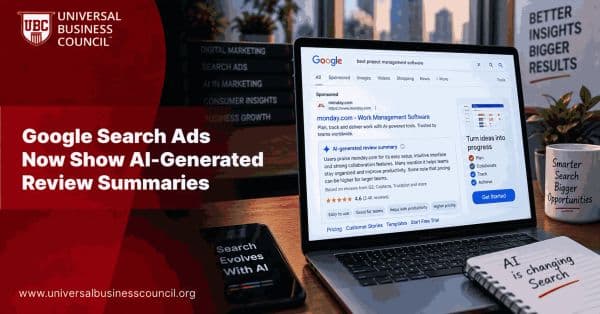
Google Ads
Google Search Ads Now Show AI-Generated Review Summaries
Google Search ads are beginning to show AI-generated review summaries that highlight what customers like about businesses, adding another layer of AI-generated content to sponsored results.
Google Ads
Google Ads Best Practices for Beginners: How to Build Profitable Campaigns
Learn Google Ads best practices for beginners, from keyword targeting and conversion tracking to Smart Bidding, landing pages, and weekly optimization.
Google Ads
Audience Targeting in Google Ads: How to Reach the Right Customers
Learn how audience targeting in Google Ads works in 2026, from Customer Match and custom segments to Performance Max signals, exclusions, and first-party data.
Trending Articles
The Role of Blockchain in Ethical AI Development
How blockchain technology is being used to promote transparency and accountability in artificial intelligence systems.
AWS Career Roadmap
A step-by-step guide to building a successful career in Amazon Web Services cloud computing.
Top 5 DeFi Platforms
Explore the leading decentralized finance platforms and what makes each one unique in the evolving DeFi landscape.