

Six Sigma CTQ Explained: Critical-to-Quality Metrics and Examples
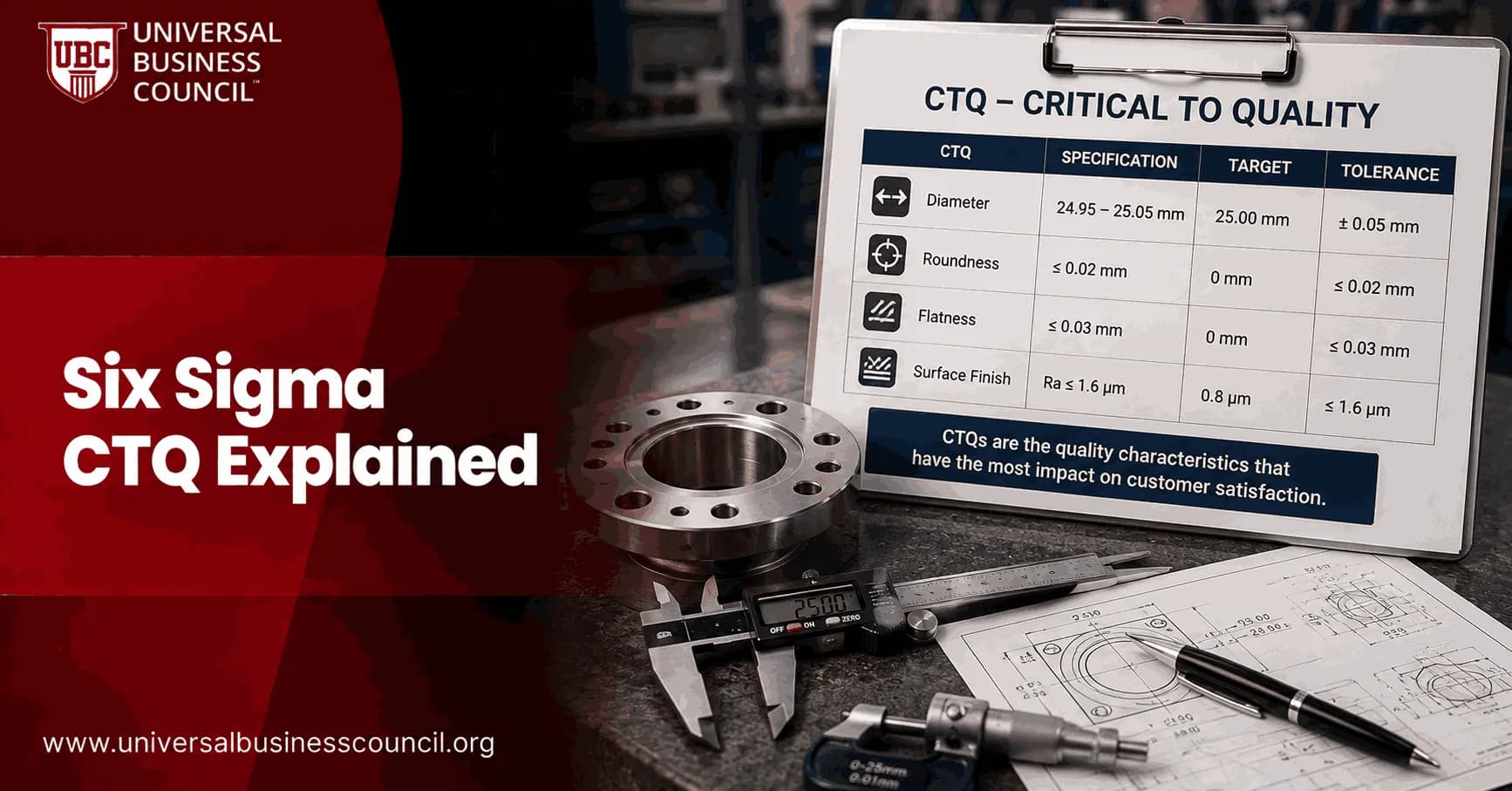
Six Sigma CTQ means Critical-to-Quality: the measurable product, service, or process characteristics that decide whether a customer requirement has truly been met. Not vaguely met. Measurably met. In Six Sigma and Lean Six Sigma work, CTQs turn the voice of the customer into clear targets such as defect rate, waiting time, order accuracy, uptime, or compliance performance. For professionals building structured expertise in quality improvement and customer-focused process management, a Certified Six Sigma Expert pathway can provide a practical foundation for applying CTQ analysis within DMAIC projects.
That translation matters because teams often improve what is easy to measure, not what customers actually care about. A warehouse may celebrate picking speed while customers complain about damaged shipments. A support center may cut call time while first-contact resolution gets worse. CTQ analysis prevents that kind of false win.

What Is a CTQ in Six Sigma?
A CTQ is a customer-critical requirement expressed as a measurable standard. It starts with a customer need, then becomes an operational metric with a threshold. For professionals who want to connect quality improvement with broader organizational and leadership capabilities, Management Certifications can complement Six Sigma learning by strengthening the skills needed to manage improvement teams and turn analysis into action.
For example:
Customer need: fast delivery
Driver: delivery timeliness
CTQ metric: 95 percent of orders delivered within 2 business days
Quality practitioners describe CTQs as measurable characteristics derived from customer requirements and voice of customer work. The key word is measurable. If your team cannot define how the data will be captured, the CTQ is not ready.
How CTQs Fit Into DMAIC
In DMAIC, CTQs stop the project from drifting into internal preference. They anchor the work to customer value.
Define: Identify CTQs from surveys, complaints, interviews, service tickets, returns data, regulatory expectations, and customer contracts.
Measure: Convert the CTQ into an operational measure. Baseline the current performance. Check the measurement system before trusting the number.
Analyze: Study which process inputs influence the CTQ. Look for causes, not opinions.
Improve: Test changes that move the CTQ without harming related measures.
Control: Add the CTQ to dashboards, control plans, audits, or daily management routines.
To be blunt, a Six Sigma project without a CTQ is usually just a cost-cutting project wearing a quality label.
CTQ Trees: Turning Customer Needs Into Metrics
A CTQ tree is the practical tool most teams use to break broad customer language into measurable requirements. It usually has three levels.
1. Customer Need
This is the broad expectation, often stated in plain customer language. Examples include accurate invoices, safe medication, reliable delivery, or easy checkout.
2. Quality Drivers
Drivers are the major factors that shape the customer experience. For reliable delivery, drivers might include on-time arrival, correct address handling, damage prevention, and tracking accuracy.
3. CTQ Metrics
Each driver becomes one or more quantified metrics. A good CTQ includes the unit of measure, target, defect definition, and data source.
A practitioner detail that matters: define the clock. For a turnaround-time CTQ, does timing start when the customer submits the request, when the ticket is assigned, or when the analyst first opens it? I have seen teams argue for days over performance variance that was really a timestamp definition problem. Fix that before analysis.
Six Sigma CTQ Examples by Industry
Manufacturing CTQ Examples
Dimensional accuracy: part diameter within plus or minus 0.1 mm
Defect rate: fewer than 3 defects per 1,000 units for a critical component
Cycle time: assembly step completed within 12 minutes to protect delivery commitments
Reliability: mean time between failures above the required service threshold
In regulated manufacturing, CTQs often connect directly to safety, labeling, sterility, fit, or material specifications. These are not negotiable preferences. They are pass or fail requirements.
Healthcare CTQ Examples
Patient waiting time: registration completed within a defined number of minutes
Diagnostic accuracy: error rate monitored by case type or review process
Readmission rate: tracked for specific procedures or conditions
Medication safety: zero tolerance for wrong-patient or wrong-dose events
Healthcare CTQs must be handled carefully because customer satisfaction and clinical safety are not always the same thing. Faster discharge is not a quality win if complications rise.
Service and Digital CTQ Examples
Call center: average speed of answer, abandonment rate, and first-contact resolution
Order fulfillment: order accuracy, on-time delivery, and damage-free delivery
Software: page load time, transaction success rate, uptime, and error rate
Billing: invoice accuracy and dispute resolution time
For digital services, avoid vanity metrics. A team may report high page views while the CTQ, successful checkout completion, is poor. Customers do not care about your traffic if payment fails.
Primary Metrics, Secondary Metrics, and CTQs
Six Sigma teams often separate CTQs into primary and secondary measures. The primary metric is the main project success measure, such as reducing order entry errors. Secondary metrics guard against side effects, such as employee overtime, rework, complaints, or delivery delay.
This distinction matters. If you reduce support handling time but first-contact resolution drops, you have probably optimized the wrong metric. Candidates preparing for Six Sigma exams often miss this point. The exam question may ask for the best project metric, but the safer answer is the one tied directly to the customer CTQ, not the easiest operational count.
How to Write a Strong CTQ Statement
Use this format:
Customer requirement + measurable metric + target + defect definition + data source.
Example:
Customers require accurate invoices. Invoice accuracy will be measured as the percentage of invoices issued without pricing, tax, quantity, or customer details errors. Target: 99.5 percent accurate monthly. Any invoice requiring correction after release counts as a defect. Data source: billing correction log and ERP invoice records.
That is usable. Everyone can see what counts, where the data lives, and what target is expected.
Common CTQ Mistakes
Using vague words: Better service is not a CTQ. First-contact resolution above 85 percent is.
Skipping VOC: Internal assumptions are not customer requirements.
Measuring what is convenient: Easy data can still be irrelevant.
Ignoring trade-offs: Speed improvements can damage accuracy, safety, or compliance.
Setting no threshold: A metric without an acceptable limit cannot define a defect.
Technology can add another layer to CTQ analysis when customer requirements depend on software performance, data accuracy, system availability, or automated workflows. In such environments, understanding the technical context can help quality professionals distinguish a genuine process cause from a symptom created by the underlying system. Deep Tech Certification can complement this perspective with broader technology-focused learning.
Building CTQ Skills Through Six Sigma Training
If you work in operations, quality, service delivery, software, healthcare, or compliance, CTQ analysis is one of the first Six Sigma skills to master. It supports problem definition, measurement planning, root-cause analysis, control plans, and executive reporting.
Professionals preparing through Universal Business Council can connect this topic with related Six Sigma and Lean Six Sigma certification training, especially modules covering DMAIC, voice of customer analysis, process capability, control charts, and continuous improvement.
Your next step: take one active process, select a real customer complaint, and build a CTQ tree. Keep it small. One need, three drivers, and two measurable CTQs under each driver is enough to expose whether your team is measuring customer quality or just internal activity.
As digital systems, analytics, automation, and technology-enabled workflows become more closely connected to customer outcomes, broader technical knowledge can also support professionals working across quality and technology teams. A Tech Certification pathway can complement Six Sigma expertise with additional technology-focused learning.
FAQs
1. What does CTQ mean in Six Sigma?
CTQ stands for Critical to Quality. A CTQ is a measurable product, service, or process characteristic that is essential to meeting customer needs or other important requirements.
CTQs translate broad expectations into measurable performance requirements.
For example:
Customer Need: “Fast delivery”
↓
CTQ: Order-to-delivery lead time
↓
Requirement: 95% of orders delivered within 2 business days
That translation is essential because “make delivery faster” is an aspiration. “95% within two days” is something a Six Sigma team can actually measure.
2. Why are CTQs important in Six Sigma?
CTQs help Six Sigma teams focus improvement efforts on characteristics that genuinely matter to customers and business performance.
They provide a basis for:
Project objectives
Data collection
Process measurements
Specification limits
Capability analysis
Improvement targets
Control plans
Without clearly defined CTQs, teams can improve metrics that are easy to measure but have little connection to customer value. Organizations are remarkably capable of optimizing whatever happens to be on the dashboard.
3. How are CTQs identified in Six Sigma?
CTQs are usually derived from Voice of the Customer (VOC) information and other critical requirements.
A typical process is:
Collect VOC → Identify Customer Needs → Identify Quality Drivers → Define CTQs → Establish Specifications → Measure Performance
VOC sources can include:
Customer interviews
Surveys
Complaints
Reviews
Support tickets
Warranty data
Returns
Market research
Contract requirements
The goal is to convert customer language into operational definitions that can be measured consistently.
4. What is a CTQ example in Six Sigma?
Suppose customers say:
“I want my online order delivered quickly.”
That statement is too broad for statistical analysis.
The team could translate it into:
Need: Fast delivery
Quality Driver: Delivery speed
CTQ: Order-to-delivery lead time
Target: ≤ 2 business days
Requirement: At least 95% of orders meet the target
Now the team can collect data, analyze variation, determine baseline performance, identify causes of delays, and measure whether improvements work.
5. What is a CTQ Tree?
A CTQ Tree is a tool for translating broad customer needs into specific measurable requirements.
Its basic structure is:
Customer Need
↓
Quality Drivers
↓
CTQ Requirements
For example:
Need: Reliable delivery
↓
Drivers: Speed + Accuracy + Damage-Free Delivery
↓
CTQs:
Delivery time ≤ 2 days
Order accuracy ≥ 99.5%
Damage rate ≤ 0.2%
A CTQ Tree prevents broad customer language from floating indefinitely through presentations without ever becoming measurable.
6. What is the relationship between Voice of the Customer and CTQ?
Voice of the Customer (VOC) describes what customers need, expect, value, dislike, or require.
CTQs convert those needs into measurable characteristics.
For example:
VOC: “Your customer support takes too long.”
↓
Need: Faster support
↓
CTQ: First-response time
↓
Specification: 90% of inquiries answered within 30 minutes
Therefore:
VOC tells you what matters.
CTQ defines how that requirement will be measured.
7. What makes a good CTQ metric?
A useful CTQ should be:
Specific
Measurable
Operationally defined
Relevant to customer needs
Connected to process performance
Time-bound where appropriate
Capable of having a target or specification
Weak CTQ:
“Improve customer service.”
Better CTQ:
“Resolve at least 90% of customer cases within 24 hours.”
If two employees can interpret the metric differently, its operational definition probably needs work.
8. What is the difference between a CTQ and a KPI?
A CTQ represents a characteristic that is critical to satisfying an important customer or quality requirement.
A KPI (Key Performance Indicator) is a broader performance measure used to monitor business, functional, or process performance.
For example:
CTQ: Product defect rate ≤ 0.5%
KPI: Monthly manufacturing cost
Some CTQs can also be KPIs, but not every KPI is a CTQ.
The distinction depends largely on whether the metric directly represents a critical quality requirement.
9. What is the difference between CTQ and specification limits?
A CTQ defines what characteristic is important.
A specification limit defines the acceptable boundary for that characteristic.
For example:
CTQ: Shaft diameter
Target: 20.00 mm
LSL: 19.95 mm
USL: 20.05 mm
The CTQ tells the team what to measure.
The specifications tell the team what values are acceptable.
Those limits should come from legitimate customer, engineering, regulatory, or functional requirements rather than whatever numbers make the capability study look friendlier.
10. What are CTQs in manufacturing?
Manufacturing CTQs commonly involve measurable product or process characteristics such as:
Diameter
Thickness
Weight
Strength
Torque
Surface finish
Temperature
Fill volume
Defect rate
Leakage
Assembly accuracy
For example:
Customer Requirement: Bottle must contain the advertised quantity.
CTQ: Fill volume
The filling process can then be measured, analyzed for capability, improved, and monitored using SPC.
11. What are CTQs in service processes?
Service CTQs can measure customer-important characteristics even when no physical product exists.
Examples include:
Call Center: First-response time, resolution time, first-contact resolution.
Banking: Transaction accuracy, loan-processing time.
Healthcare: Waiting time, medication accuracy.
Logistics: On-time delivery, shipment accuracy.
IT Support: System availability, incident-resolution time.
Six Sigma is not restricted to measuring pieces of metal. Humans have thoughtfully invented plenty of variation in offices too.
12. What are CTQs in transactional processes?
Transactional CTQs commonly focus on accuracy, completeness, timeliness, and reliability.
Examples include:
Invoice accuracy
Payment-processing time
Data-entry error rate
Application-processing time
Percentage of complete forms
Approval turnaround time
Billing accuracy
For example:
Need: Accurate invoices
↓
CTQ: Invoice accuracy
↓
Requirement: ≥ 99.8% invoices issued without errors
This creates a measurable outcome that can be tracked through DMAIC.
13. How are CTQs used in the Define phase of DMAIC?
During Define, CTQs help translate customer requirements into clear project objectives.
A typical sequence is:
Voice of Customer
↓
Customer Need
↓
CTQ
↓
Baseline Metric
↓
Project Goal
For example:
VOC: Deliveries are unreliable.
CTQ: On-time delivery percentage.
Baseline: 82%.
Goal: Increase to ≥ 97%.
This keeps the DMAIC project focused on measurable customer-relevant outcomes from the beginning.
14. How are CTQs used in the Measure phase?
During Measure, teams establish how CTQs will be measured and determine current process performance.
Activities may include:
Creating operational definitions
Validating measurement systems
Developing data-collection plans
Collecting baseline data
Measuring defects
Evaluating process capability
For a dimensional CTQ, this might involve Gauge R&R before capability analysis.
The principle is straightforward: if a CTQ is critical enough to drive improvement decisions, its measurement system should probably be trustworthy.
15. How are CTQs connected to process capability?
Process capability analysis determines whether a stable process can consistently meet the specifications associated with a CTQ.
For a continuous CTQ, teams may use:
Cp
Cpk
Pp
Ppk
For example:
CTQ: Component diameter
LSL = 9.90 mm
USL = 10.10 mm
Capability analysis compares actual process variation and centering with these requirements.
This helps answer:
Can the process consistently produce acceptable CTQ performance?
16. What is the difference between CTQ and CTP?
CTQ means Critical to Quality and generally describes an important output characteristic or customer requirement.
CTP, commonly meaning Critical to Process, refers to an important process input or operating condition that influences CTQ performance.
For example:
CTQ: Product strength
Potential CTPs:
Temperature + Pressure + Cure Time
This reflects the Six Sigma relationship:
Y = f(X)
where the CTQ is often the output Y, while critical process variables are important Xs that influence it.
17. How do CTQs relate to defects and DPMO?
A defect occurs when a defined requirement is not met.
If the CTQ requirement is:
Response time ≤ 30 minutes
then a response taking 45 minutes may constitute a defect according to the operational definition.
Teams can then measure:
Defect rate
Yield
Defects per unit
DPMO
Sigma level
Clear CTQ requirements are therefore necessary for meaningful defect measurement. Without defining acceptable performance, “defect” becomes a surprisingly philosophical concept.
18. How are CTQs used in a Six Sigma Control Plan?
After improvements are implemented, important CTQs are often incorporated into the Control Plan.
For example:
Control Element | Example |
|---|---|
CTQ | Fill weight |
Target | 500 g |
Specification | 495-505 g |
Measurement | Calibrated scale |
Frequency | Every 30 minutes |
Owner | Line operator |
Control Method | SPC chart |
Reaction | Stop, investigate and correct |
This ensures that improved CTQ performance is monitored after the DMAIC project closes.
19. What are common mistakes when defining CTQs?
Common mistakes include:
Using vague metrics: “High quality” cannot be measured consistently.
Confusing customer needs with CTQs: “Reliable service” still requires translation.
Selecting too many CTQs: Everything becomes critical, rendering the word “critical” somewhat unemployed.
Using internal metrics customers do not value: Teams optimize operational convenience rather than customer outcomes.
Missing operational definitions: Different people measure the CTQ differently.
Setting arbitrary specifications: Capability results become meaningless.
Ignoring measurement-system quality: Decisions rely on unreliable data.
Good CTQs require both customer relevance and measurement discipline.
20. How should Six Sigma teams develop and use CTQs effectively?
An effective CTQ development process connects customer expectations directly to measurable process management:
Collect Voice of Customer
↓
Identify Customer Needs
↓
Prioritize Important Needs
↓
Identify Quality Drivers
↓
Build CTQ Tree
↓
Define Measurable CTQs
↓
Establish Operational Definitions
↓
Set Targets and Specification Limits
↓
Validate Measurement Systems
↓
Measure Baseline Performance
↓
Analyze Drivers of CTQ Performance
↓
Improve Critical Process Inputs
↓
Verify CTQ Improvement
↓
Add CTQs to Control Plan
↓
Monitor Long-Term Performance
For example:
Customer says: “I need dependable deliveries.”
That becomes:
Need → Reliable delivery
↓
Driver → Delivery timeliness
↓
CTQ → Percentage delivered by promised date
↓
Requirement → ≥ 98%
↓
Measurement → Weekly on-time delivery rate
↓
Improvement → Reduce scheduling and fulfillment delays
↓
Control → Monitor KPI/control chart and trigger reaction plan
The central Six Sigma principle is that customer language must eventually become measurable process requirements.
Customers rarely arrive carrying control charts and specification limits. They say things like “make it faster,” “stop sending damaged products,” or “I need this to work every time.”
CTQs translate those expectations into numbers that teams can measure, analyze, improve, and control.
Without that translation, Six Sigma risks becoming extremely sophisticated mathematics applied to metrics nobody particularly cares about.
Related Articles
View AllSix Sigma
Six Sigma 8 Wastes Explained with Real Business Examples
Learn the Six Sigma 8 wastes with practical examples from healthcare, banking, software, retail, and operations, plus steps to find waste in your own process.
Six Sigma
Six Sigma Pp and Ppk Explained: Performance Metrics and Interpretation
Learn how Six Sigma Pp and Ppk measure long term process performance, how to interpret values, and when to compare them with Cp and Cpk.
Six Sigma
Six Sigma Cp and Cpk Explained: Capability Metrics Made Simple
Six Sigma Cp and Cpk explained in plain language, with formulas, benchmarks, examples, pitfalls, and practical guidance for process capability analysis.
Trending Articles
The Role of Blockchain in Ethical AI Development
How blockchain technology is being used to promote transparency and accountability in artificial intelligence systems.
AWS Career Roadmap
A step-by-step guide to building a successful career in Amazon Web Services cloud computing.
Top 5 DeFi Platforms
Explore the leading decentralized finance platforms and what makes each one unique in the evolving DeFi landscape.