

Six Sigma in Food Manufacturing: Improving Safety, Consistency, and Yield
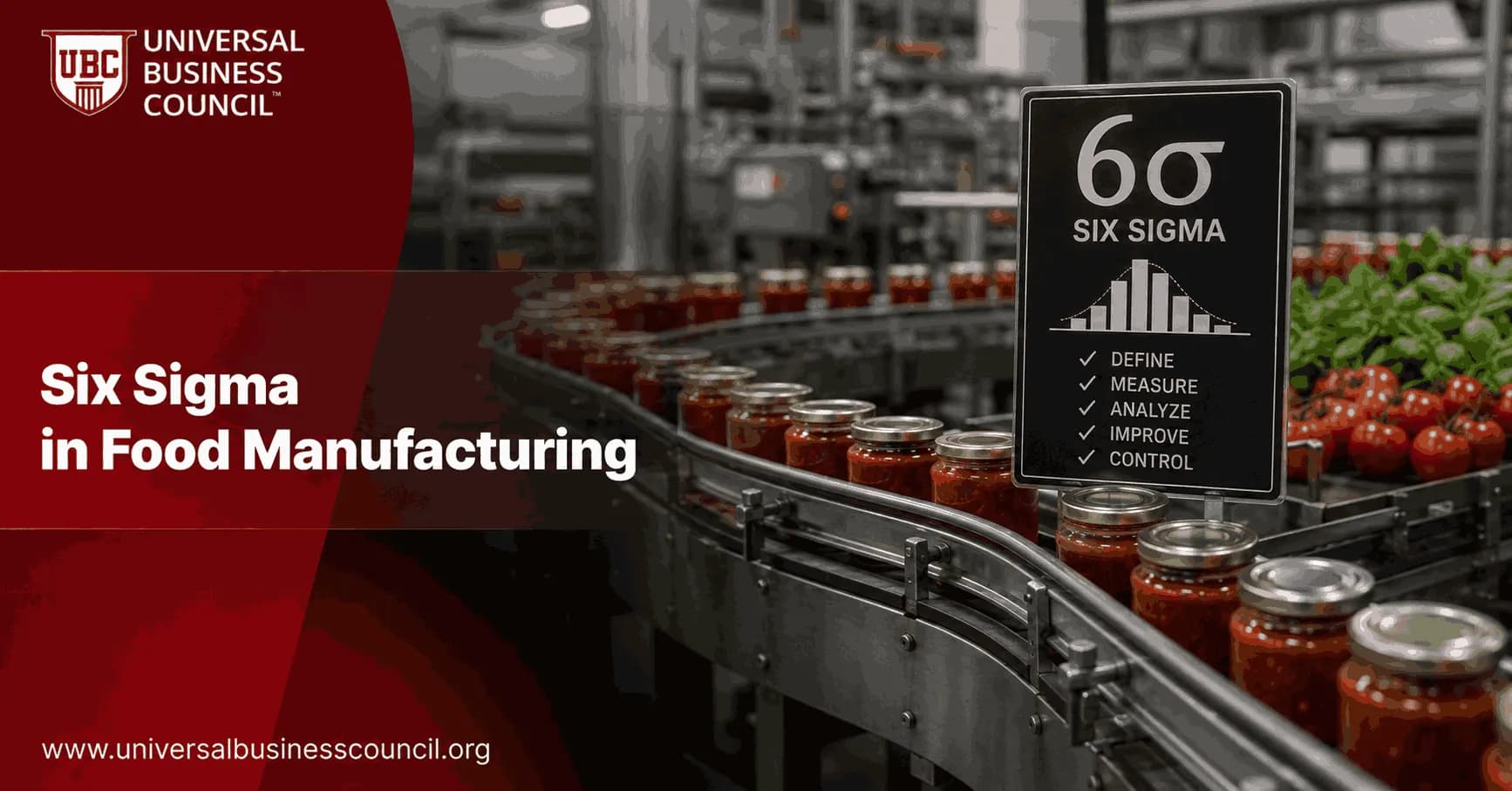
Six Sigma in food manufacturing works best when you treat it as a plant operating system, not a statistics project. You use DMAIC, statistical process control, and disciplined corrective action to reduce food safety risk, hold product quality steady, and stop yield loss from becoming accepted background noise. Plant quality and operations professionals building this capability often start with a focused credential like the Certified Six Sigma Expert program, since DMAIC fluency is what turns floor observations into a defensible improvement case.
The food sector is a natural fit. A defect is not just a scratch on a part. It may be an allergen label error, a cooking temperature deviation, an underweight pack, a weak seal, or a trim loss that quietly drains margin every shift.

Why Six Sigma Fits Food Manufacturing
Six Sigma aims for very low defect rates, often expressed as 3.4 defects per million opportunities. In practice, most food plants start far from that benchmark. That is fine. The value is in the method: define the problem, measure the process, analyze root causes, improve the process, and control the gains.
In a food plant, the usual Six Sigma toolkit includes:
DMAIC for structured improvement projects.
SPC control charts for temperature, pH, brix, viscosity, fill weight, seal width, and cap torque.
FMEA to rank failure modes before they become complaints or incidents.
Fishbone diagrams to separate raw material, machine, method, people, and environment causes.
Capability analysis to test whether the line can meet specification consistently.
The practical point is simple. Do not inspect quality into the product at the end. Control the variables that create quality and safety while the process is running. Getting shift supervisors, quality leads, and plant managers aligned on that discipline is a leadership challenge as much as a statistical one, which is why plant leaders often pair Six Sigma training with broader Management Certifications, covering the team-leadership and change-management skills that keep a control plan from quietly slipping back into old habits.
Using Six Sigma With HACCP, FSMA, and SQF
Six Sigma does not replace HACCP. It strengthens it. Codex Alimentarius HACCP guidance, FDA preventive controls under FSMA, and Global Food Safety Initiative recognized schemes such as SQF all rely on hazard identification, defined limits, monitoring, corrective action, and verification. Those ideas match Six Sigma thinking closely.
Here is where many plants get it wrong. They treat a critical control point as pass-fail paperwork. A cooking step is checked, the form is signed, and everyone moves on. SPC gives you a better view. It shows whether the process is stable, drifting toward a critical limit, or reacting to a special cause.
What SPC Adds to Food Safety
A control chart can flag a trend before a HACCP limit is breached. That matters for chilled foods, thermal processing, high-care packaging, and cold chain operations, where a late reaction can mean hold orders, rework, or disposal.
Take a retort. If temperature stays inside the legal limit but shows seven points trending downward, you have a signal. Do not wait for a failure. Check steam pressure, venting, load pattern, sensor calibration, and operator setup while product is still under control.
Improving Consistency: The Consumer Notices Variation
Customers may not know your process capability index, but they notice watery yogurt, pale sauce, broken seals, and packs that feel light. Six Sigma in food manufacturing gives teams a way to connect those complaints to measurable process inputs.
Common consistency projects include:
Reducing batch-to-batch variation in color, texture, or viscosity.
Stabilizing fill weight without creating excess giveaway.
Reducing seal defects by controlling jaw temperature, dwell time, and film tension.
Improving label accuracy, especially allergen and date-code controls.
Reducing foreign material risk through better process checks and failure analysis.
A small fill-weight example shows the money involved. If a 250 g product is overfilled by just 2 g on average, and the line runs 80,000 packs per day, that is 160 kg given away daily. At a production cost of 1.80 per kg, the line loses 288 per day before anyone sees a complaint. The fix may not be a new filler. It may be nozzle maintenance, product temperature control, or a better checkweigher reaction plan. When these losses trace back to checkweigher, SCADA, and lab systems that will not reconcile cleanly against each other, a Deep Tech Certification from Blockchain Council can help engineering and quality teams understand how reliable, traceable plant data systems are actually built, since a fill-weight investigation is only as good as the data behind it.
Improving Yield Without Weakening Safety
Yield is where Six Sigma often earns attention from senior leaders. Meat, dairy, bakery, beverage, and ready-meal plants all lose margin through overtrimming, overfill, rework, start-up waste, changeover loss, and rejected packs.
Published case work in meat processing has used DMAIC to reduce variation in boning and trimming, improving yield by standardizing cut practices and measuring capability. Dairy case studies have reported better cheese and butter yield through Kaizen events, designed experiments, process standardization, and mistake proofing.
Be careful, though. Yield improvement is the wrong target if the plant has weak sanitation, poor allergen segregation, or unreliable CCP monitoring. Fix the food safety foundation first. A few points of yield are not worth a recall.
How to Start a Six Sigma Food Manufacturing Project
Pick one painful process. Good first projects include fill-weight giveaway, seal failures, cooking temperature variation, label defects, or trim loss.
Define the defect clearly. "Off spec" is too vague. State the exact limit, product, line, shift, and customer impact.
Check the measurement system. If scales, probes, or lab methods are unreliable, your analysis will be noise.
Use real process data. Pull data from checkweighers, SCADA, laboratory systems, metal detector logs, and nonconformance records.
Analyze before adjusting. Operators often chase normal variation. SPC helps you decide when to act and when to leave the process alone.
Lock the control plan. Update SOPs, training, reaction plans, maintenance checks, and audit questions.
Skills Professionals Need
If you manage production, quality, engineering, or continuous improvement, build competence in DMAIC, HACCP alignment, SPC, FMEA, and capability analysis. These are not abstract exam topics. They are the tools you reach for when a line is drifting, an auditor asks for evidence, or leadership wants a defensible yield number.
For professional development, connect this topic with Universal Business Council learning paths in Six Sigma, quality management, operations management, and food safety training. If you are preparing a team, start with practical Green Belt level capability for supervisors and quality leads, then reserve deeper statistical work for specialists leading cross-functional projects.
Next Step: Choose One Line and Measure It Properly
Start with one product family and one measurable defect. Build a DMAIC charter, verify the measurement system, and put the key variable on a control chart for at least several production runs. You will learn quickly whether the issue is common-cause variation, a special-cause failure, or a standard that was never realistic. That is where Six Sigma in food manufacturing becomes useful. It turns opinion into evidence you can act on. If your measurement system keeps failing because plant sensors, SCADA, and lab records will not talk to each other reliably, a Tech Certification from Global Tech Council is worth adding to your plan, since some plant data problems need better systems integration, not another control chart.
FAQs
1. How is Six Sigma used in food manufacturing?
Six Sigma is used in food manufacturing to reduce process variation, improve product consistency, increase yield, control defects, reduce waste, and strengthen quality performance. Teams can apply DMAIC, process capability analysis, Pareto charts, FMEA, control charts, and root-cause analysis to areas such as mixing, filling, cooking, packaging, sanitation, temperature control, and supplier quality.
2. How can Six Sigma improve food safety?
Six Sigma can support food safety by helping teams identify, measure, and reduce variation in critical process conditions such as temperature, time, sanitation, contamination control, and ingredient handling. It should complement established food safety systems such as HACCP and applicable regulatory requirements rather than replace them.
The value of Six Sigma is its ability to make process instability visible before it becomes a larger quality or safety issue.
3. What food manufacturing problems can Six Sigma solve?
Six Sigma can help address problems such as underweight or overweight packages, inconsistent texture, incorrect moisture levels, excessive cooking variation, seal failures, labeling errors, contamination risks, high scrap, low yield, excessive giveaway, and recurring customer complaints.
It is particularly useful when the problem is measurable, recurring, and influenced by several process variables.
4. How does DMAIC apply to food manufacturing?
DMAIC provides a structured improvement process:
Define: Identify the food quality, yield, or safety problem.
Measure: Establish current process performance.
Analyze: Determine root causes.
Improve: Test and implement process changes.
Control: Sustain the improved process.
For example, a team could use DMAIC to reduce package-weight variation while maintaining legal and customer requirements.
5. How can Six Sigma improve product consistency?
Product consistency depends on controlling process inputs and conditions.
Teams can measure variables such as:
Temperature + Mixing Time + Ingredient Ratios + Moisture + Pressure + Fill Weight + Line Speed
Statistical analysis can then determine which factors influence variation in taste, texture, appearance, weight, or other Critical-to-Quality characteristics.
Reducing variation helps customers receive a more consistent product from batch to batch.
6. How can Six Sigma improve production yield?
Yield measures how much usable product is produced relative to the amount of input material.
Six Sigma can identify losses caused by:
Overprocessing + Trim Loss + Defects + Downtime + Giveaway + Rework + Packaging Failures
By measuring these losses and validating root causes, food manufacturers can increase usable output without simply increasing raw-material consumption.
7. What is giveaway in food manufacturing?
Giveaway occurs when a manufacturer provides more product than the declared or target amount, often to avoid underweight packages.
For example, if a package labeled 500 grams is filled to an average of 520 grams because the process has high variation, the extra 20 grams may represent significant annual cost.
Six Sigma can reduce variation so the process can operate closer to target while still meeting legal requirements.
8. How can Six Sigma reduce food waste?
Six Sigma can reduce waste by identifying where losses occur and why.
Common sources include:
Overfilling
Trimming
Spoilage
Rejected batches
Packaging defects
Setup losses
Changeovers
Rework
Ingredient variation
Teams can quantify the cost of each waste category and prioritize high-impact improvement opportunities.
9. How can control charts be used in food manufacturing?
Control charts help teams monitor process performance over time and distinguish normal variation from unusual changes that may require investigation.
They can be applied to measures such as:
Fill Weight
Temperature
Moisture
pH
Seal Strength
Cycle Time
Defect Rate
A stable process is easier to control and improve than one that changes unpredictably.
10. What is process capability in food manufacturing?
Process capability measures how consistently a stable process performs relative to specified limits.
Metrics such as Cp and Cpk may be used where appropriate to evaluate whether process output reliably meets requirements.
For example, capability analysis can help assess whether package weights, moisture levels, or dimensional characteristics remain within specification.
Capability should only be interpreted after confirming that the process is sufficiently stable and the measurement system is reliable.
11. How can FMEA improve food manufacturing processes?
Failure Mode and Effects Analysis helps teams identify potential failures before they occur.
Food manufacturing examples may include:
Seal Failure
Incorrect Label
Temperature Deviation
Foreign-Material Risk
Ingredient Error
Cleaning Failure
Teams can assess severity, likelihood, and existing controls to prioritize preventive actions.
FMEA should complement formal food safety risk systems where required.
12. How does Six Sigma work with HACCP?
Six Sigma and HACCP can complement each other.
HACCP focuses on identifying and controlling food safety hazards through Critical Control Points.
Six Sigma focuses on reducing process variation and improving measurable performance.
A manufacturer might use HACCP to define required temperature controls and Six Sigma tools to reduce variation in the heating process so those limits are met more consistently.
13. How can Six Sigma improve packaging quality?
Packaging problems may involve weak seals, incorrect labels, damaged containers, underweight packs, misalignment, or poor coding.
Teams can measure defect frequency by:
Machine + Shift + Material + Product + Supplier + Time
Pareto and root-cause analysis can identify the largest contributors.
Improvements may involve equipment settings, maintenance, operator procedures, material specifications, or supplier quality.
14. How can Six Sigma reduce changeover losses?
Changeovers can create downtime, startup waste, incorrect settings, and unstable early production.
Teams can measure:
Changeover Time + Startup Scrap + Adjustment Time + First-Pass Yield
Lean methods such as SMED can reduce changeover time, while Six Sigma can analyze variation and recurring quality problems during startup.
The combination can improve both speed and process stability.
15. How can Six Sigma improve sanitation processes?
Sanitation processes can be analyzed for consistency, timing, chemical concentration, coverage, verification, and downtime.
Six Sigma can help identify variation in cleaning performance and standardize procedures.
However, sanitation improvements must remain aligned with food safety regulations, validated cleaning requirements, allergen controls, and microbiological standards.
Efficiency should never come at the expense of safety.
16. How can Six Sigma improve supplier quality in food manufacturing?
Food manufacturers depend heavily on consistent raw materials, ingredients, packaging, and agricultural inputs.
Six Sigma can track supplier performance using metrics such as:
Defect Rate + Specification Compliance + Delivery Reliability + Contamination Incidents + Moisture Variation
Supplier development projects can then address recurring causes of poor incoming quality.
17. How can Six Sigma reduce customer complaints in food manufacturing?
Customer complaints can be categorized by product, defect type, batch, region, supplier, or production line.
Pareto analysis may reveal that a small number of issues account for most complaints.
Examples include:
Taste Variation
Packaging Damage
Incorrect Weight
Foreign Material
Labeling Errors
Root-cause analysis can then identify process changes that reduce recurrence.
18. What KPIs should Six Sigma teams track in food manufacturing?
Useful KPIs can include:
Yield
Scrap rate
Rework rate
Giveaway
First-pass yield
Defect rate
Customer complaints
Downtime
OEE
Package-weight variation
Process capability
Sanitation compliance
Supplier defect rate
The correct KPI set should reflect food safety, quality, cost, and customer requirements.
19. What skills do Six Sigma professionals need in food manufacturing?
Useful skills include DMAIC, process mapping, root-cause analysis, statistics, process capability, FMEA, control charts, Cost of Poor Quality, and change management.
Professionals should also understand food manufacturing processes, food safety systems, HACCP principles, sanitation, supplier quality, traceability, and applicable regulatory requirements.
Six Sigma expertise without food-process knowledge can produce technically elegant recommendations that should never get anywhere near an actual production line.
20. What is the best Six Sigma framework for improving food manufacturing performance?
A practical approach begins with the areas that matter most:
Safety → Quality → Yield → Cost → Delivery
Start with a process such as:
Raw Material Receiving
↓
Preparation
↓
Mixing
↓
Cooking
↓
Filling
↓
Packaging
↓
Finished Product
Then establish measurable Critical-to-Quality and Critical-to-Safety requirements.
Suppose a packaged food line has:
Average Yield: 89%
Target Yield: 94%
Giveaway: 3.8%
Packaging Defects: 4.5%
Customer Complaints: 2.1 per 10,000 units
The team can apply DMAIC.
Define
Create a problem statement.
Example:
“Current line yield averages 89% against a target of 94%, while package giveaway and seal defects create approximately $750,000 in annual Cost of Poor Quality.”
Measure
Collect data on:
Raw Material Loss
Fill Weight
Temperature
Line Speed
Seal Strength
Downtime
Scrap
Rework
Validate the measurement system before drawing conclusions.
Analyze
Use:
Pareto Analysis → Fishbone → 5 Whys → Process Capability → Statistical Analysis
Suppose the analysis shows that:
52% of giveaway comes from fill-weight variation
and
60% of packaging defects occur during two specific machine settings
Now the improvement effort has a much clearer target.
Improve
Potential actions might include:
Equipment Calibration
Revised Machine Settings
Improved Preventive Maintenance
Standardized Work
Supplier Material Controls
Automated Weight Feedback
Operator Training
Pilot important changes and verify that food safety and regulatory requirements remain fully satisfied.
Suppose the pilot achieves:
Yield: 89% → 94.2%
Giveaway: 3.8% → 1.4%
Packaging Defects: 4.5% → 1.6%
Annualized Savings: $420,000
Now the organization has evidence of both operational and financial improvement.
Control
Create a control plan.
Monitor:
Fill Weight | Temperature | Yield | Seal Defects | Scrap | Complaints
Use control charts where appropriate.
Define ownership and reaction plans.
For example:
Fill-Weight Trend Outside Control Limits → Immediate Investigation
Seal Defect Rate > 2% → Maintenance Review
Critical Food Safety Deviation → Follow Established Food Safety Escalation Procedures
The broader improvement model becomes:
HACCP/Food Safety Controls
Quality Management System
Six Sigma
Lean
Data Analytics
HACCP protects against food safety hazards.
Quality systems establish governance.
Six Sigma reduces variation and defects.
Lean removes waste and improves flow.
Analytics makes performance visible.
The strongest principle is:
Never trade food safety for efficiency.
Six Sigma should improve process control so safety requirements are achieved more consistently, not weaken those requirements in pursuit of yield or speed.
For professionals, a strong skill stack can include:
Food Safety + Quality Management + Six Sigma + Lean + Statistical Process Control + Supplier Quality
At leadership level, add:
Operational Excellence + Financial Analysis + Change Management + Regulatory Awareness
Six Sigma is particularly valuable in food manufacturing because small improvements multiply across enormous production volumes.
Reducing giveaway by a fraction of a gram, preventing a small percentage of packaging defects, or improving yield by one percentage point can create substantial annual value.
The objective is straightforward:
Produce safe food, consistently, with less waste and less variation.
Which sounds simple until one remembers that ingredients, machines, temperatures, people, packaging, suppliers, and microbiology have all declined to behave identically every day.
Related Articles
View All
Six Sigma
Six Sigma in Healthcare: Improving Patient Safety and Care Quality
Learn how Six Sigma in healthcare reduces errors, improves patient safety, strengthens care quality, and supports measurable clinical outcomes.

Six Sigma
Six Sigma in Procurement: Improving Supplier Quality and Cost Control
Learn how Six Sigma in procurement improves supplier quality, reduces defects, controls cost, and strengthens purchase-to-pay performance with DMAIC.
Six Sigma
Six Sigma in Pharmaceutical Manufacturing: Quality, Compliance, and Validation
Learn how Six Sigma in pharmaceutical manufacturing improves GMP compliance, validation evidence, defect reduction, capability, and process control.
Trending Articles
The Role of Blockchain in Ethical AI Development
How blockchain technology is being used to promote transparency and accountability in artificial intelligence systems.
AWS Career Roadmap
A step-by-step guide to building a successful career in Amazon Web Services cloud computing.
Top 5 DeFi Platforms
Explore the leading decentralized finance platforms and what makes each one unique in the evolving DeFi landscape.