

Data-Driven Product Management: How to Use Metrics, Analytics, and User Feedback Effectively
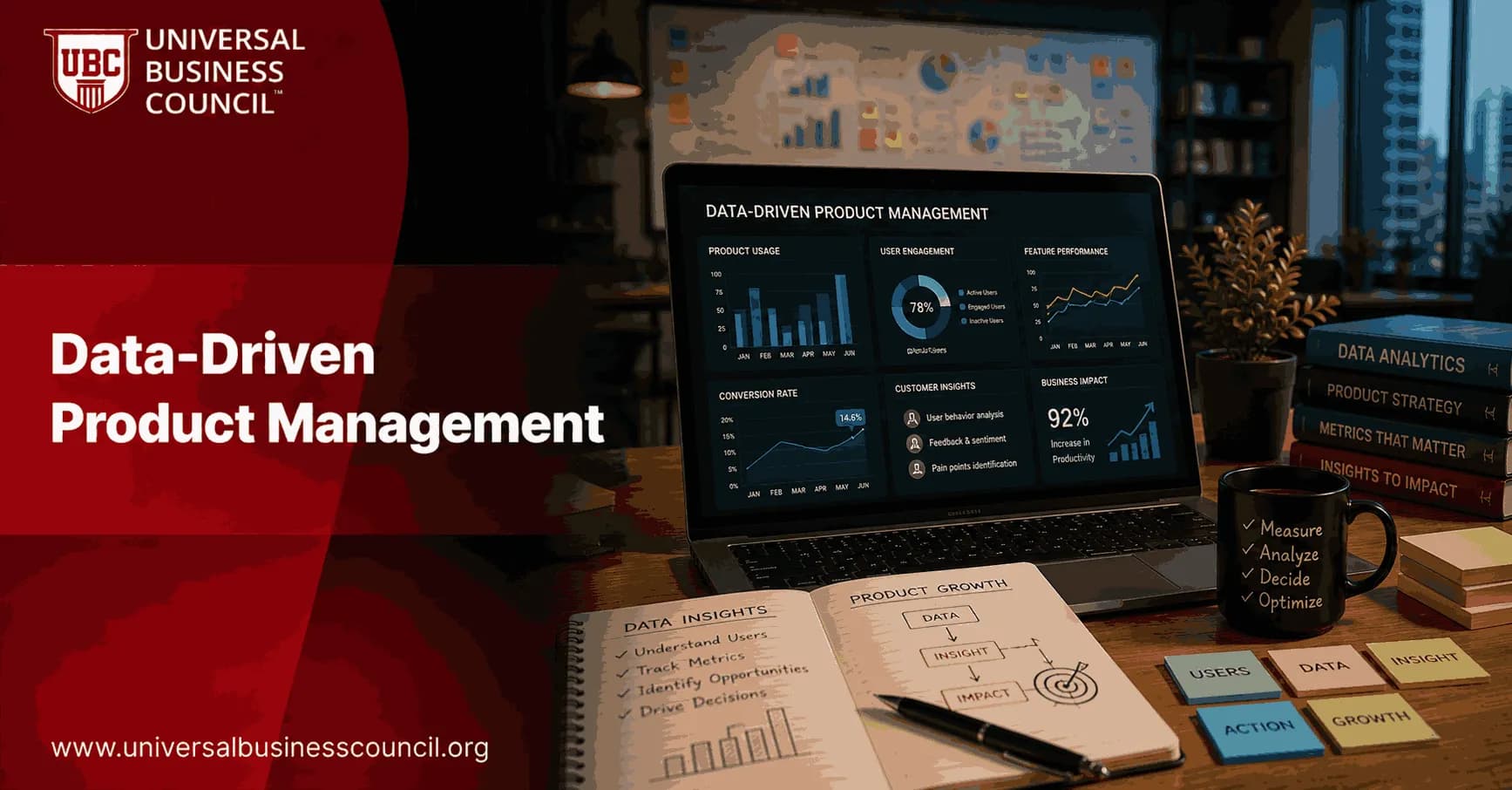
Data-driven product management works when you use evidence to sharpen judgment, not when you outsource judgment to a dashboard. Good product leaders combine metrics, analytics, experiments, and user feedback to decide what to build, what to stop, and what to improve next.
The hard part is not getting more data. Most teams already have too much of it. The hard part is choosing the few signals that explain whether users are getting value and whether the product is moving the business in the right direction.

What Data-Driven Product Management Really Means
Data-driven product management is the discipline of using quantitative and qualitative evidence to guide product strategy, prioritization, and iteration. It connects user behavior to business outcomes such as retention, revenue, customer value, and satisfaction.
That last point matters. Shipping features is not a product outcome. A full roadmap can still produce a weak product if users do not activate, return, pay, or recommend it. Mature product teams now define success through outcomes such as cohort retention, activation rate, conversion to paid, customer effort score, and churn reduction.
To be blunt, a feature count is often a comfort metric. It tells leadership the team is busy. It does not prove the product is better.
Building this mindset is a key characteristic of a Product Management Professional, combining strategic thinking, customer insight, analytics, and business judgment to make evidence-based product decisions that create measurable value.
Start With the Decision, Not the Dashboard
Before you add another chart to Mixpanel, Amplitude, Google Analytics 4, Tableau, or Looker Studio, write the decision you need to make. Then define the question behind it.
For example:
Decision: Should we redesign onboarding?
Question: Where do new users fail to reach first value?
Metric: Activation rate by acquisition channel and user segment.
Qualitative input: Five to ten interviews with users who abandoned onboarding.
This sounds basic. It is where many teams go wrong. I have seen event plans with both signup_completed and sign_up_completed used by different engineers. The dashboard looked official, but the funnel was wrong. If your tracking taxonomy is messy, every prioritization meeting turns into a debate about whose number is real.
The Product Metrics That Actually Matter
Use a small set of metrics that map to the customer journey. A useful structure is acquisition, activation, engagement, retention, revenue, and satisfaction. Do not treat all of them as equal at every stage.
Acquisition Metrics
Acquisition metrics show how users arrive. Track sign-ups, source, campaign, landing page conversion, and cost per acquisition where paid media is involved. These metrics help product teams work with marketing, but they are not enough on their own.
A channel that brings cheap sign-ups can still be poor if those users never activate. This is common in free trials. Volume feels good until you split retention by source.
Activation Metrics
Activation measures whether a new user reaches an initial value moment. For a project management tool, that may be creating a first project and inviting a teammate. For a fintech app, it might be linking a bank account and completing a first transaction.
Define activation carefully. Product certification candidates often miss this distinction: activation is not simply account creation. It is evidence that the user has experienced meaningful value.
Engagement Metrics
Engagement includes DAU, MAU, session frequency, feature usage, and workflow completion. Use these with care. Time spent can be positive in a media product, but negative in a tax filing product. Context wins.
Segment engagement by persona, plan type, lifecycle stage, and device. Averages hide pain. If enterprise admins are highly engaged but end users are inactive, expansion risk is building quietly.
Retention and Churn Metrics
Retention is the clearest sign that users keep finding value. Use cohort retention curves, repeat usage, renewal rate, and churn by segment. For subscription products, retention usually deserves more attention than top-line sign-ups.
Look at both logo churn and revenue churn. A few small accounts leaving may not hurt revenue much, but if power users in large accounts stop using a core workflow, renewal risk is real.
Revenue and Unit Economics
Track ARPU, LTV, conversion to paid, expansion revenue, gross margin impact, and payback period. Product decisions affect unit economics more than teams admit. Packaging, usage limits, onboarding friction, and feature gating all change revenue behavior.
User Satisfaction Metrics
NPS, CSAT, and CES give useful signals, but none should run the roadmap alone. NPS can tell you whether users would recommend the product. CES can show friction in support or setup. CSAT can validate a specific interaction. Pair them with behavioral data.
Build an Analytics System You Can Trust
Good analytics begins before the feature is built. Define the hypothesis, events, user properties, and success criteria during planning. If tracking is added after launch, teams often miss the baseline and then argue from weak evidence.
Use this practical sequence:
Map the journey: Identify the key steps in onboarding, search, checkout, collaboration, renewal, or another critical flow.
Define events: Track meaningful actions, not every click. Name events consistently.
Add properties: Include plan type, device, country, user role, and acquisition source where relevant.
Create funnels: Measure drop-off between steps.
Run cohort analysis: Check whether behavior persists after the first day, week, or month.
Review weekly: Tie the review to roadmap trade-offs, not passive reporting.
North star metrics can help, but only if they reflect recurring user value. Examples include completed rides for a mobility platform, nights booked for a travel marketplace, or active teams completing shared projects for a collaboration tool. Avoid vague north stars that sound impressive but do not guide action.
Use Experiments to Reduce Product Risk
Leading digital companies use controlled experiments because opinions are expensive. Netflix is known for testing recommendation systems, artwork, copy, and interface variations. Airbnb has invested heavily in experimentation across search, pricing tools, host onboarding, and trust features. Amazon and Spotify also use behavioral data to personalize experiences and test changes before broad release.
You do not need Netflix scale to apply the principle. Start small.
Write a clear hypothesis: if we simplify plan comparison, trial-to-paid conversion will increase.
Choose one primary metric and a few guardrail metrics.
Decide the minimum detectable effect before launch.
Use feature flags for controlled rollout.
Read support tickets and session recordings after the test.
Do not worship statistical significance. A test can be statistically clean and strategically useless. If a new button color raises clicks but lowers completed purchases, the product got worse.
User Feedback Explains the Why Behind the Numbers
Analytics tells you what happened. Feedback helps explain why. You need both.
Useful feedback channels include:
In-product surveys after key actions.
Customer interviews with new users, power users, and churned users.
Usability tests on unfinished prototypes.
Support tickets and helpdesk tags.
Community forums and advisory groups.
Feedback portals such as UserVoice, Productboard, or similar systems.
The trap is chasing loud voices. A strategic customer can dominate the conversation, especially in B2B. Listen carefully, but do not let one account become the roadmap. Tag requests by segment, account size, revenue impact, product area, and frequency. Then compare the pattern against usage and retention data.
A Simple Feedback Prioritization Workflow
Use a consistent process so feedback becomes evidence, not noise.
Normalize: Group comments into bugs, usability issues, feature requests, and product ideas.
Tag: Add segment, role, lifecycle stage, plan type, and product area.
Score: Consider frequency, business value, strategic fit, customer impact, and effort.
Connect: Link themes to roadmap epics, OKRs, and product outcomes.
Close the loop: Tell users when their feedback influenced a change.
Closing the loop is underrated. A short note saying, we changed this based on your feedback, can build more trust than a polished release announcement.
Common Mistakes in Data-Driven Product Management
Tracking vanity metrics: Downloads, page views, and raw sign-ups are weak unless they connect to value.
Using averages only: Segment data before you make a decision.
Measuring too late: Instrument during planning, not after launch.
Ignoring qualitative evidence: Metrics show scale. Interviews reveal context.
Changing too many things at once: If everything changes, you cannot explain the result.
Optimizing locally: A faster onboarding step is not a win if users retain less after week two.
Where AI Fits Next
AI is making product analytics faster and more predictive. Teams are using machine learning for churn prediction, anomaly detection, automated segmentation, recommendation systems, and feedback classification. That is useful. It also raises the bar for governance.
You need clear consent, privacy-aware instrumentation, and responsible data handling. Product teams should know what data they collect, why they collect it, where it is stored, and who can access it. Trust is now part of product quality.
As AI and other emerging technologies become central to product strategy, a Deep Tech Certification can help professionals develop a broader understanding of artificial intelligence, automation, blockchain, and advanced digital technologies that are shaping the future of product management.
Building the Skill Set
If you want to strengthen your product decision-making, study metrics, experimentation, customer research, business strategy, and data governance together. They are connected in real work.
Professionals can use Universal Business Council certification pathways in business, marketing, analytics, and management as structured learning routes to build the commercial and analytical judgment behind stronger product decisions. Check the current Universal Business Council certification catalog and choose the programme that matches your role, whether you manage product strategy, lead growth, run analytics, or work with cross-functional teams.
Next Step
Pick one active product initiative this week. Write the hypothesis, primary metric, guardrail metrics, and feedback source before the next sprint planning meeting. If you cannot define those four items, the work is not ready for prioritization.
A Tech Certification can further strengthen this foundation by expanding your knowledge of digital technologies, software ecosystems, cloud platforms, and innovation trends that support modern product strategy, analytics, and business growth.
FAQs
1. What Is Data-Driven Product Management?
Data-driven product management is the practice of using customer data, product analytics, and business metrics to guide product decisions, prioritize features, improve user experiences, and achieve business goals.
2. Why Is Data-Driven Product Management Important?
It helps product teams make objective decisions, reduce assumptions, understand customer behavior, improve product performance, and deliver solutions that create measurable business value.
3. How Does Data-Driven Product Management Work?
Product managers collect data from users, analytics platforms, customer feedback, and market research, analyze trends, identify opportunities, prioritize initiatives, and measure the impact of product decisions.
4. What Types of Data Should Product Managers Analyze?
Common data includes user behavior, product usage, customer feedback, conversion rates, retention, churn, feature adoption, revenue, support tickets, and market trends.
5. What Are the Benefits of Data-Driven Product Management?
Benefits include better decision-making, faster product improvements, increased customer satisfaction, improved feature prioritization, higher product adoption, reduced risk, and stronger business outcomes.
6. Which Product Metrics Should Every Product Manager Track?
Key metrics include Monthly Active Users (MAU), Daily Active Users (DAU), customer retention, churn rate, feature adoption, conversion rate, Customer Lifetime Value (CLV), Net Promoter Score (NPS), and revenue growth.
7. How Does Customer Data Improve Product Decisions?
Customer data reveals how users interact with products, identifies pain points, validates feature requests, and helps teams build solutions that better meet customer needs.
8. What Is Product Analytics?
Product analytics is the process of collecting and analyzing user interactions with a product to understand behavior, optimize experiences, measure feature performance, and support product strategy.
9. How Does A/B Testing Support Data-Driven Product Management?
A/B testing compares different versions of a feature or experience to determine which performs better based on measurable user behavior and business metrics.
10. Why Is Customer Feedback Important in Data-Driven Product Management?
Customer feedback provides qualitative insights that complement analytics, helping product teams understand user expectations, identify problems, and improve future product releases.
11. How Does Artificial Intelligence Support Product Management?
AI helps analyze customer feedback, detect usage patterns, forecast demand, prioritize product features, automate reporting, and generate actionable insights for faster decision-making.
12. What Role Does Market Research Play?
Market research helps product managers understand customer needs, industry trends, competitor strategies, pricing opportunities, and emerging market demands before making product decisions.
13. Which Tools Support Data-Driven Product Management?
Popular tools include Google Analytics, Mixpanel, Amplitude, Heap, Power BI, Tableau, Jira, Productboard, Aha!, Hotjar, FullStory, and Looker Studio.
14. How Can Product Managers Prioritize Features Using Data?
Product managers evaluate customer demand, business value, technical feasibility, product usage metrics, revenue impact, and strategic goals to prioritize the most valuable features.
15. How Can Businesses Build a Data-Driven Product Culture?
Organizations should encourage evidence-based decision-making, define clear KPIs, improve data accessibility, invest in analytics tools, and promote collaboration across product, engineering, marketing, and sales teams.
16. What Challenges Do Product Managers Face with Data?
Common challenges include poor data quality, disconnected systems, information overload, conflicting metrics, privacy concerns, and balancing quantitative data with customer feedback.
17. How Can Product Teams Measure Product Success?
Success can be measured through customer satisfaction, feature adoption, user engagement, retention, conversion rates, revenue growth, product quality, and achievement of strategic business goals.
18. How Can Beginners Learn Data-Driven Product Management?
Start by learning product analytics, understanding key product metrics, practicing with analytics tools, studying customer behavior, conducting A/B tests, and working on real-world product case studies.
19. What Common Mistakes Should Product Managers Avoid When Using Data?
Avoid relying only on metrics without understanding customer context, tracking too many KPIs, ignoring qualitative feedback, making decisions based on incomplete data, and confusing correlation with causation. Effective product management combines analytics with customer empathy and business strategy.
20. How Will Data-Driven Product Management Shape the Future of Product Development?
Data-driven product management will continue to evolve with AI, predictive analytics, and real-time customer insights. Organizations that use data responsibly to guide product strategy, validate decisions, personalize user experiences, and continuously optimize products will be better positioned to innovate faster, improve customer satisfaction, and achieve sustainable business growth in an increasingly competitive market.
Related Articles
View All
Artificial Intelligence
NVIDIA Nemotron 3.5 Lightning vs NVIDIA Cosmos 3: Key Differences and Use Cases
Compare NVIDIA Nemotron 3.5 Lightning and NVIDIA Cosmos 3, including their architectures, capabilities, AI workloads, and use cases across agentic AI and Physical AI.

Artificial Intelligence
Gemini 4 Argon: Features, Pricing, and Availability
Gemini 4 Argon is Google’s new flagship AI model for coding, science, finance, law and security. See its main features, API and subscription pricing, and where you can access it today.

Artificial Intelligence
What Is Meta Muse Wonder? Features and How It Works
Meta Muse Wonder is a new frontier AI model built for agents with Active Memory and Active Focus. Learn what it is, how it works, its features, pricing and how to access it.
Trending Articles
The Role of Blockchain in Ethical AI Development
How blockchain technology is being used to promote transparency and accountability in artificial intelligence systems.
AWS Career Roadmap
A step-by-step guide to building a successful career in Amazon Web Services cloud computing.
Top 5 DeFi Platforms
Explore the leading decentralized finance platforms and what makes each one unique in the evolving DeFi landscape.