

Gemma 4 vs Claude

The Fundamental Divide
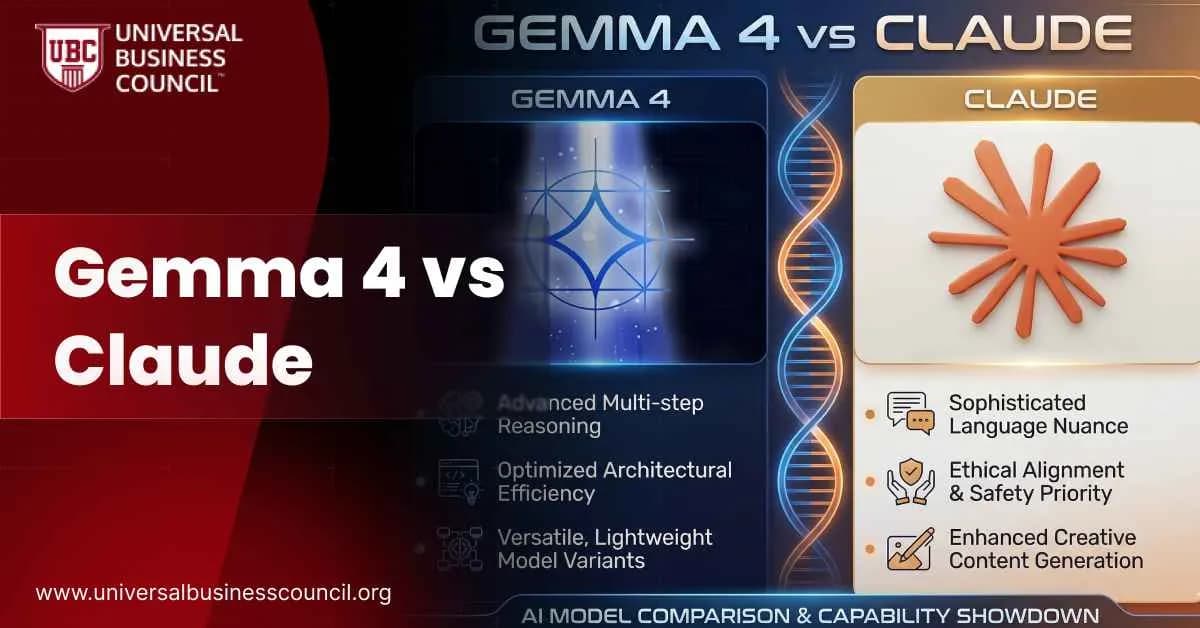
The Gemma 4 vs Claude comparison begins with a single defining contrast: ownership versus access. Gemma 4 operates as a fully open-weight model released under the Apache 2.0 license. Professionals download it, run it on their own hardware, and deploy it inside commercial products without paying ongoing fees, accepting usage restrictions, or sending data to external servers. Claude functions as a proprietary, cloud-hosted AI model. Users access it through a subscription plan or API, benefiting from a continuously updated, highly polished assistant — but without control over infrastructure, data handling, or deployment conditions. This distinction shapes every downstream decision a professional makes about which model to adopt and how deeply to integrate it into their workflow.Performance Across Core Tasks
Raw performance matters most when AI drives business outcomes. In the Gemma 4 vs Claude contest, both models deliver impressive results but across different strengths. Gemma 4’s 31B Dense model scores 85.2% on MMLU Pro, achieves a Codeforces ELO of 2,150 for code generation, and ranks third globally among open models on the Arena AI leaderboard. Its configurable thinking modes allow professionals to switch between rapid response generation and deep multi-step analytical reasoning based on task demands. Claude consistently earns recognition for long-form writing quality, conversational coherence, and nuanced instruction-following. Editorial professionals and communication-focused teams frequently cite its output sophistication as a decisive advantage for polished, high-stakes written deliverables. An AI Powered Marketing Expert evaluating both models for campaign workflows will find Gemma 4 superior for high-volume, cost-sensitive content automation, while Claude serves better for premium editorial content requiring exceptional tonal refinement and stylistic consistency.Multimodal Capabilities and Context Handling
Gemma 4 processes text, images with variable resolution support, video up to 60 seconds, and audio natively across all model sizes. The E2B and E4B edge variants add speech recognition and translation, making the model a complete media processing platform deployable on a single device. Claude handles image and text input effectively, delivering strong visual understanding for document analysis and image-based queries but its native audio and video processing capabilities remain more limited compared to Gemma 4’s full-stack multimodal architecture. On context window capacity, Gemma 4’s larger models support up to 256,000 tokens, enabling professionals to process entire code repositories, lengthy research documents, or comprehensive campaign briefs in a single prompt.Cost Structure and Commercial Flexibility
Cost separates these two models most decisively in the Gemma 4 vs Claude comparison. Gemma 4 runs entirely free on local hardware. No per-token charges, no monthly subscription tiers, and no escalating API costs as usage scales. Claude operates on a subscription or consumption-based pricing model. Premium tiers unlock higher context windows, faster response speeds, and priority access — but monthly costs accumulate significantly for professionals running high-volume workflows. Professionals holding a Marketing and Business Certification recognize this cost dynamic immediately. Deploying Gemma 4 locally for content pipelines, customer engagement automation, and campaign asset generation eliminates a recurring operational expense that compounds over time, delivering a measurable improvement in AI-driven marketing ROI.Deployment Control and Data Privacy
Gemma 4 gives professionals complete infrastructure ownership. Every inference runs locally no data leaves the device or network, no third party processes user inputs, and no external dependency creates operational risk. This makes Gemma 4 the clear choice for freelancers handling sensitive client work, healthcare professionals managing confidential records, legal teams processing privileged documents, and any professional operating under strict data governance requirements. Claude’s cloud-based architecture delivers convenience and consistent updates but requires data transmission to external servers for every query a trade-off that organizations with strict compliance requirements cannot always accept. Professionals with a Deep Tech Certification understand the architectural implications of this distinction deeply. Infrastructure ownership, data sovereignty, and inference security represent core considerations in enterprise AI deployment and Gemma 4’s open architecture provides full transparency across all three dimensions.Ease of Use and Accessibility
Claude maintains a clear advantage for immediate usability. Its interface requires no technical setup, no model management, and no hardware configuration a professional creates an account and begins generating output within minutes. Gemma 4 demands slightly more initial effort for local deployment, though modern inference tools have reduced that barrier substantially. Graphical interfaces allow non-technical users to run the model locally without command-line interaction, and cloud-hosted access points eliminate local setup entirely for those who prefer it. Professionals pursuing a Tech Certification find the Gemma 4 setup process genuinely educational. Configuring inference parameters, managing model weights, and optimizing system prompts builds practical AI deployment skills that translate directly into professional credibility and expanded service offerings.The Decisive Verdict on Gemma 4 vs Claude
Gemma 4 vs Claude does not produce a universal winner — it produces a context-dependent recommendation. Gemma 4 wins decisively on cost, deployment control, data privacy, multimodal breadth, fine-tuning flexibility, and commercial licensing freedom. It suits developers, high-volume marketers, privacy-conscious freelancers, and entrepreneurs building AI-powered products. Claude wins on conversational polish, editorial sophistication, and frictionless accessibility. It suits communication professionals, editorial teams, and users who prioritize output refinement over deployment control. The professional who understands both models and deploys each where it performs best holds the strongest competitive position in an AI-driven market.FAQs
-
What is the core difference between Gemma 4 and Claude?
Gemma 4 is an open-weight model running locally under Apache 2.0, while Claude is a proprietary cloud-hosted model requiring a subscription or API access. -
Which model costs less to use professionally?
Gemma 4 is completely free to download and deploy, while Claude requires a subscription or per-token API payment. -
How does an AI Powered Marketing Expert use these models differently?
They use Gemma 4 for high-volume, cost-free content automation and Claude for premium editorial deliverables requiring exceptional tonal sophistication. -
Which model handles multimodal tasks more comprehensively?
Gemma 4 supports text, images, video, and audio natively across all sizes, giving it a broader multimodal scope than Claude’s current capabilities. -
Does Gemma 4 protect data privacy better than Claude?
Yes. Gemma 4 runs entirely locally with no data transmitted to external servers, delivering superior data privacy and compliance flexibility. -
Which model suits freelancers handling confidential client work?
Gemma 4 suits them better due to its fully offline operation, ensuring no client data leaves the user’s device during inference. -
How does a Marketing and Business Certification apply to this comparison?
It equips professionals to evaluate AI cost structures, ROI potential, and strategic deployment decisions when choosing between open and proprietary models. -
Which model offers better fine-tuning capabilities?
Gemma 4 supports full fine-tuning on custom datasets using open-source tools, while Claude does not offer fine-tuning access to external users. -
Can beginners use Gemma 4 without technical skills?
Yes. Graphical local inference tools allow non-technical users to run Gemma 4 without any command-line or coding knowledge. -
Which model ranks higher on global AI benchmarks?
Gemma 4’s 31B Dense ranks third globally among open models on the Arena AI leaderboard with an MMLU Pro score of 85.2%. -
How does a Deep Tech Certification enhance evaluation of these models?
It provides the architectural knowledge to assess MoE efficiency, attention mechanisms, inference optimization, and fine-tuning feasibility across both model families. -
Which model suits entrepreneurs building commercial products?
Gemma 4 suits entrepreneurs better due to its Apache 2.0 license granting unrestricted commercial use without royalty fees or user caps. -
Does Claude support on-device deployment?
No. Claude operates exclusively through cloud-based servers and requires an active internet connection for every interaction. -
Which model generates better code?
Gemma 4 achieves a Codeforces ELO of 2,150, placing it at expert competitive programmer level making it exceptionally strong for code generation tasks. -
How does a Tech Certification complement hands-on experience with these models?
It validates the technical skills needed to deploy, configure, and optimize AI models like Gemma 4 across diverse professional and enterprise environments. -
Which model handles longer documents more effectively?
Gemma 4’s larger models support up to 256,000 tokens, enabling processing of entire code repositories or lengthy documents in a single prompt. -
Which model suits marketing teams running automated content pipelines?
Gemma 4 suits high-volume marketing automation better due to its zero per-token cost and local deployment capability. -
Does Gemma 4 support agentic workflows like Claude?
Yes. Gemma 4 includes native function calling, structured JSON output, and multi-step planning for building fully autonomous agentic systems. -
Which model delivers better conversational quality?
Claude maintains an edge in conversational nuance and long-form editorial sophistication for communication-heavy professional tasks. -
What is the final recommendation in the Gemma 4 vs Claude comparison?
Choose Gemma 4 for cost control, deployment ownership, multimodal depth, and commercial flexibility. Choose Claude for conversational excellence and frictionless accessibility. Deploy both strategically where each performs best.
Related Articles
View All
Artificial Intelligence
Gemini 4 Argon: Features, Pricing, and Availability
Gemini 4 Argon is Google’s new flagship AI model for coding, science, finance, law and security. See its main features, API and subscription pricing, and where you can access it today.

Artificial Intelligence
What Is Meta Muse Wonder? Features and How It Works
Meta Muse Wonder is a new frontier AI model built for agents with Active Memory and Active Focus. Learn what it is, how it works, its features, pricing and how to access it.

Artificial Intelligence
What Is Google Playground? Features and How It Works
What is Google Playground? Learn how Google's new AI platform turns text prompts into playable browser games, which models power it, its features, pricing and access, Unity Spark plans, rival tools, and limits.
Trending Articles
The Role of Blockchain in Ethical AI Development
How blockchain technology is being used to promote transparency and accountability in artificial intelligence systems.
AWS Career Roadmap
A step-by-step guide to building a successful career in Amazon Web Services cloud computing.
Top 5 DeFi Platforms
Explore the leading decentralized finance platforms and what makes each one unique in the evolving DeFi landscape.