

GPT-Live-1 and GPT-Live-1 Mini: What Global ChatGPT Users Need to Know
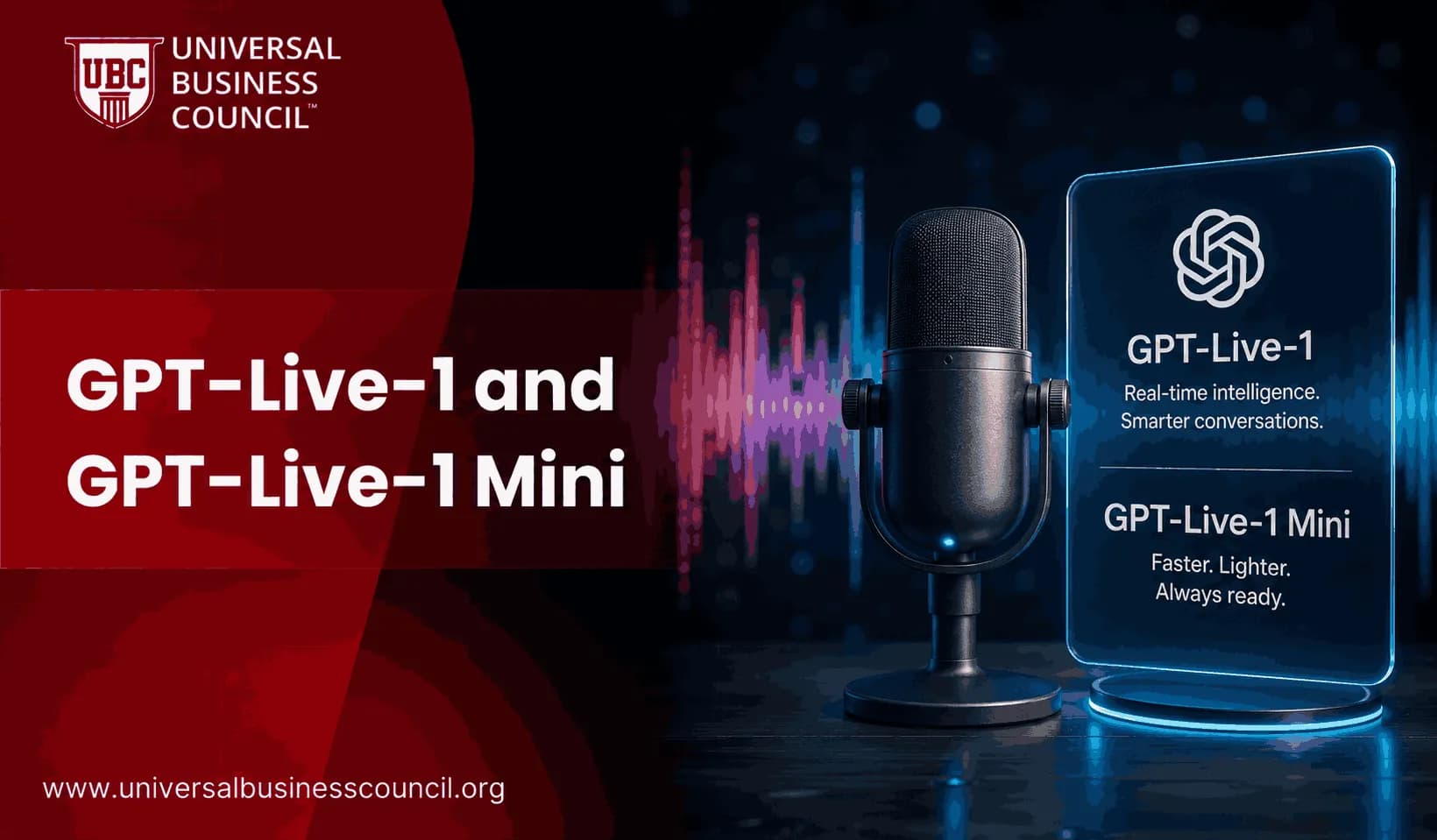
GPT-Live-1 and GPT-Live-1 Mini are OpenAI's voice models for ChatGPT Voice, built to make spoken AI conversations feel less like command prompts and more like real dialogue. The change is simple. You can interrupt, correct yourself, and keep talking while the system listens and responds in real time.
For professionals, developers, and business leaders, this is more than a nicer voice interface. It changes how people use ChatGPT for translation, research, field work, customer support, training, and daily productivity. It also raises harder questions about safety, governance, and when voice AI is the wrong tool.

As conversational AI becomes a regular part of business communication and productivity, many professionals are also strengthening their practical skills through a Certified ChatGPT Expert program to better understand voice AI, prompt design, and responsible enterprise adoption.
What GPT-Live-1 and GPT-Live-1 Mini are
GPT-Live is OpenAI's family of voice models designed for natural, real-time conversation. According to OpenAI's launch materials, the models use a full-duplex architecture, which means they can receive audio and generate speech at the same time.
That sounds technical. In practice, it means you do not have to wait for the assistant to finish before you correct it. You can say No, make that Spanish, not French while it is speaking, and the model should adjust without the awkward stop-start behaviour common in older voice assistants.
There are two versions:
GPT-Live-1: the higher-capacity model, used by default for ChatGPT Go, Plus, and Pro users.
GPT-Live-1 Mini: the lighter model, used by default for free ChatGPT users.
OpenAI describes GPT-Live-1 as its most capable voice model to date. Independent coverage from CNET and TechRadar has focused on the same two points: more natural speech timing and better handling of interruptions.
Availability for global ChatGPT users
OpenAI is rolling GPT-Live-1 and GPT-Live-1 Mini out across iOS, Android, and ChatGPT.com in supported regions. Reporting from CNET and TechRadar indicates the new voice experience is reaching both paid and free users, though individual accounts may see it at different times during rollout.
Plan access at launch
Free users: GPT-Live-1 Mini is the default ChatGPT Voice model.
Go, Plus, and Pro users: GPT-Live-1 is the default ChatGPT Voice model.
Business, Enterprise, and Edu workspaces: GPT-Live-1 is not available at launch, based on OpenAI's release notes. These users can continue with Advanced Voice Mode where available.
This segmentation matters. If you are testing voice AI for work, do not assume the free and paid experiences behave the same. The Mini model can be fast and useful, but GPT-Live-1 is positioned as the stronger option, especially when deeper reasoning is needed.
Voice AI is also creating new opportunities for customer engagement, personalized communication, and brand interactions. Professionals who combine these technical capabilities with a Marketing Certification are often better prepared to apply conversational AI across customer-facing business functions.
How full-duplex voice changes the experience
Older voice assistants follow a turn-taking pattern. You speak, the system processes, then it speaks. That rhythm is tolerable for short commands. It falls apart in coaching, negotiation practice, language learning, and support simulations.
GPT-Live's full-duplex design allows overlapping speech. CNET described OpenAI's approach as continuous interaction, where the model can take in information and produce output at the same time. That is the core difference.
Here is a useful test. Interrupt mid-answer with a constraint: Keep going, but make it suitable for a CFO. In many older voice systems, that kind of barge-in either gets ignored or resets the whole conversation. In real deployments, barge-in handling is one of the first things contact-centre teams check, because customers interrupt constantly. They do not wait politely for a bot to finish a paragraph.
Where GPT-5.5 fits in
GPT-Live-1 and GPT-Live-1 Mini are voice models, but they are not carrying every hard task alone. OpenAI says GPT-Live can hand complex reasoning, web search, and expert-level work to GPT-5.5 in the background, then bring the answer back into the spoken conversation.
This split matters. Voice interaction needs speed. Deep research needs time. If the voice model tried to solve every difficult problem directly while speaking, answers would turn slow or shallow. Delegation keeps the conversation active while a stronger text and reasoning model works behind the scenes.
Paid users may also see intelligence options such as high, medium, and instant, as reported by reviewers and CNET. The trade-off is familiar. Faster answers suit lightweight tasks. Higher intelligence settings are better for research, analysis, or questions where accuracy matters more than speed.
What is better than Advanced Voice Mode?
OpenAI reports that GPT-Live-1 and GPT-Live-1 Mini were preferred over Advanced Voice Mode in matched 5 to 10 minute conversations. The comparisons looked at overall preference, turn-taking, interruption handling, conversational flow, and naturalness.
OpenAI also pointed to gains on two evaluation areas:
GPQA: a graduate-level science question-answering benchmark covering fields such as biology, chemistry, and physics.
BrowseComp: a benchmark focused on agent-style web search behaviour.
OpenAI has not published full public numeric tables for these tests, so treat the claims as directional rather than a complete benchmark package. The pattern is still clear. GPT-Live is meant to improve both the feel of conversation and the substance behind more complex answers.
Current limitations you should know
Do not overstate what GPT-Live can do today. It is better voice AI, not a finished enterprise voice agent for every workflow.
No video or screen sharing at launch: use Advanced Voice Mode where those features are needed.
No general API access yet: OpenAI says API access for GPT-Live-1 and GPT-Live-1 Mini is planned, with a notification sign-up for developers and enterprises.
Not available in Business, Enterprise, or Edu workspaces at launch: this limits immediate organisational deployment.
Voice output still needs oversight: spoken answers can feel more persuasive than text, even when they are incomplete.
That last point is not academic. In a team setting, a confident voice assistant can push a meeting in the wrong direction faster than a shaky paragraph on screen. For high-stakes use, keep transcripts, require source checks, and define which tasks need human approval.
Safety and risk management
OpenAI says GPT-Live includes safety improvements from its latest models plus dedicated safety training for voice use cases. CNET reported that OpenAI's internal testing showed better performance than previous models in areas such as self-harm, psychosis, violence, and sexual content.
Voice safety is different from text safety. Tone, timing, and interruption behaviour all matter. A model that gives a poor written answer is a problem. A model that gives the same answer in a calm, authoritative voice during a distressed conversation is a bigger one.
If you manage AI use in an organisation, write a simple voice AI policy before any pilot starts:
Define approved use cases, such as internal training, drafting, translation, or research assistance.
Block or escalate sensitive topics, especially health, legal, financial, and safety-critical advice.
Require logging where privacy rules allow it.
Measure errors, not just user satisfaction.
Train staff to verify spoken answers before acting on them.
Best use cases right now
GPT-Live-1 and GPT-Live-1 Mini are strongest where conversation speed and hands-free use matter.
For individual users
Language practice: hold back-and-forth conversations and ask for corrections.
Live translation: use speech-to-speech support for travel or bilingual discussions.
Research while moving: ask questions while commuting, walking, or working away from a desk.
Dictation and drafting: speak notes, outlines, or email drafts and refine them by voice.
For professionals and teams
Sales role-play: practise objections and interruptions, which text chat rarely simulates well.
Customer support training: test how agents handle angry, confused, or talkative customers.
Field operations: get procedural guidance when hands are occupied.
Executive briefings: ask for a short spoken summary, then request sources or assumptions in text.
For contact-centre leaders, the key metrics will not be novelty. Watch containment rate, escalation rate, average handle time, customer satisfaction, and compliance exceptions. If a voice agent lowers handle time but raises escalations, it is not ready.
What developers and enterprises should watch next
The API is the next major milestone. Once GPT-Live models reach developers, expect experiments in interactive tutoring, meeting assistants, voicebots, guided troubleshooting, and vertical support tools.
Wait for the details, though. Pricing, latency, data retention, regional availability, safety controls, and integration options will decide whether GPT-Live is practical for regulated industries. A healthcare triage assistant and a language tutor do not carry the same risk.
If you are preparing a team for this shift, build capability in three areas: AI product management, analytics, and governance. Universal Business Council readers can connect this topic with certification courses in artificial intelligence, digital transformation, business analytics, project management, and management strategy. Those pathways go beyond product awareness.
What you should do now
If you use ChatGPT Voice casually, test GPT-Live-1 Mini or GPT-Live-1 with interruptions, corrections, translation, and follow-up questions. That is where the difference shows.
If you use AI at work, run a controlled pilot. Pick one low-risk workflow, write success metrics before testing, and compare voice output against typed ChatGPT responses. To be blunt, do not approve a tool just because it sounds human.
For your next step, document three voice use cases in your role, rank them by risk, then choose one to test this week. If you are building broader AI capability, pair the experiment with formal training through Universal Business Council's AI, analytics, and management education pathways.
As real-time AI continues to reshape how people work, communicate, and solve problems, earning a Tech Certification can help professionals build the practical knowledge needed to evaluate, implement, and manage emerging AI technologies with greater confidence.
FAQs
1. What are GPT-Live-1 and GPT-Live-1 Mini?
GPT-Live-1 and GPT-Live-1 Mini are OpenAI models optimized for real-time AI conversations. They are designed to deliver low-latency responses for voice assistants, live chat, customer support, and AI agents that require fast, natural interactions. GPT-Live-1 focuses on higher performance, while GPT-Live-1 Mini emphasizes speed and cost efficiency.
2. What is the difference between GPT-Live-1 and GPT-Live-1 Mini?
GPT-Live-1 offers stronger reasoning, richer responses, and better performance for complex tasks. GPT-Live-1 Mini is a lightweight alternative that provides faster response times and lower operating costs, making it ideal for high-volume conversational applications.
3. What are GPT-Live-1 and GPT-Live-1 Mini used for?
These models are built for real-time conversational AI applications, including voice assistants, customer support chatbots, virtual agents, live translation, educational platforms, and interactive business tools that require immediate responses.
4. How do GPT-Live-1 and GPT-Live-1 Mini improve real-time AI conversations?
Both models are optimized to minimize response latency while maintaining conversational quality. This enables smoother interactions, faster replies, and a more natural user experience across voice and text-based AI applications.
5. Why are GPT-Live-1 and GPT-Live-1 Mini important for AI developers?
Developers can use these models to build responsive AI applications that deliver real-time conversations. Their optimization for speed and efficiency makes them suitable for scalable customer-facing products and enterprise solutions.
6. Which model should businesses choose: GPT-Live-1 or GPT-Live-1 Mini?
Businesses that require advanced reasoning and higher-quality responses may prefer GPT-Live-1. Those prioritizing lower costs, faster inference, and handling large volumes of conversations may find GPT-Live-1 Mini to be the better option.
7. Can GPT-Live-1 support voice assistants?
Yes. GPT-Live-1 is designed for natural, real-time conversations, making it suitable for AI voice assistants, smart devices, virtual receptionists, and voice-enabled customer support systems.
8. Is GPT-Live-1 Mini suitable for customer service automation?
Yes. GPT-Live-1 Mini can efficiently answer common customer questions, provide product information, assist with troubleshooting, and automate routine conversations while helping businesses reduce operating costs.
9. How do GPT-Live-1 models reduce response latency?
The models are optimized for faster inference and real-time processing, enabling AI systems to generate responses quickly. Lower latency creates a more seamless conversational experience for users interacting with AI.
10. Can GPT-Live-1 and GPT-Live-1 Mini handle multilingual conversations?
Yes. These models support multiple languages, allowing businesses to build AI assistants that communicate with customers across different countries and regions while improving global accessibility.
11. What industries can benefit from GPT-Live-1 and GPT-Live-1 Mini?
Industries such as healthcare, finance, education, retail, travel, telecommunications, software development, e-commerce, and hospitality can use these models to improve customer engagement, automate workflows, and enhance digital experiences.
12. Are GPT-Live-1 and GPT-Live-1 Mini suitable for enterprise applications?
Yes. Enterprises can use these models for internal knowledge assistants, employee support, customer service automation, workflow management, and AI-powered communication tools that require reliable, real-time interactions.
13. Can developers integrate GPT-Live-1 into existing applications?
Yes. Developers can integrate GPT-Live-1 and GPT-Live-1 Mini into websites, mobile apps, customer support platforms, CRM systems, and enterprise software using OpenAI's APIs and development tools.
14. How do GPT-Live-1 models improve user experience?
By providing faster, context-aware, and more natural responses, these models reduce waiting times and create engaging conversations. This leads to higher user satisfaction across AI-powered applications.
15. Can GPT-Live-1 be used in AI-powered call centers?
Yes. GPT-Live-1 can assist live agents, automate routine inquiries, summarize customer conversations, provide real-time information, and improve the overall efficiency of AI-powered contact centers.
16. What are the advantages of GPT-Live-1 Mini for startups?
Startups benefit from GPT-Live-1 Mini because it offers lower infrastructure costs, quick deployment, scalable AI interactions, and reliable conversational performance without requiring significant computing resources.
17. How secure are GPT-Live-1 and GPT-Live-1 Mini?
OpenAI provides security features and administrative controls that help organizations deploy AI responsibly. Businesses can implement access management, privacy protections, and governance policies according to their operational requirements.
18. Can GPT-Live-1 replace traditional chatbots?
GPT-Live-1 offers significant improvements over rule-based chatbots by understanding context, generating dynamic responses, and maintaining more natural conversations. However, it serves as an advanced conversational AI solution rather than a direct replacement for every chatbot implementation.
19. What are the biggest benefits of GPT-Live-1 and GPT-Live-1 Mini?
The key benefits include low-latency conversations, improved customer experiences, faster AI responses, scalable deployment, multilingual support, enterprise integration, and cost-effective performance for a wide range of conversational applications.
20. Why are GPT-Live-1 and GPT-Live-1 Mini significant for the future of conversational AI?
GPT-Live-1 and GPT-Live-1 Mini represent an important advancement in real-time AI communication. Their combination of speed, conversational intelligence, and scalability enables businesses and developers to build next-generation AI assistants that deliver faster, more natural, and highly interactive experiences across industries.
Related Articles
View All
Artificial Intelligence
Can ChatGPT Improve Its Own Capabilities Through Recursive Self-Improvement?
Explore whether ChatGPT can improve its own capabilities through recursive self-improvement, how AI-assisted optimization works, and what limits current language models from achieving true RSI.
Artificial Intelligence
Gemini 4 Argon: Features, Pricing, and Availability
Gemini 4 Argon is Google’s new flagship AI model for coding, science, finance, law and security. See its main features, API and subscription pricing, and where you can access it today.

Artificial Intelligence
What Is Meta Muse Wonder? Features and How It Works
Meta Muse Wonder is a new frontier AI model built for agents with Active Memory and Active Focus. Learn what it is, how it works, its features, pricing and how to access it.
Trending Articles
The Role of Blockchain in Ethical AI Development
How blockchain technology is being used to promote transparency and accountability in artificial intelligence systems.
AWS Career Roadmap
A step-by-step guide to building a successful career in Amazon Web Services cloud computing.
Top 5 DeFi Platforms
Explore the leading decentralized finance platforms and what makes each one unique in the evolving DeFi landscape.