

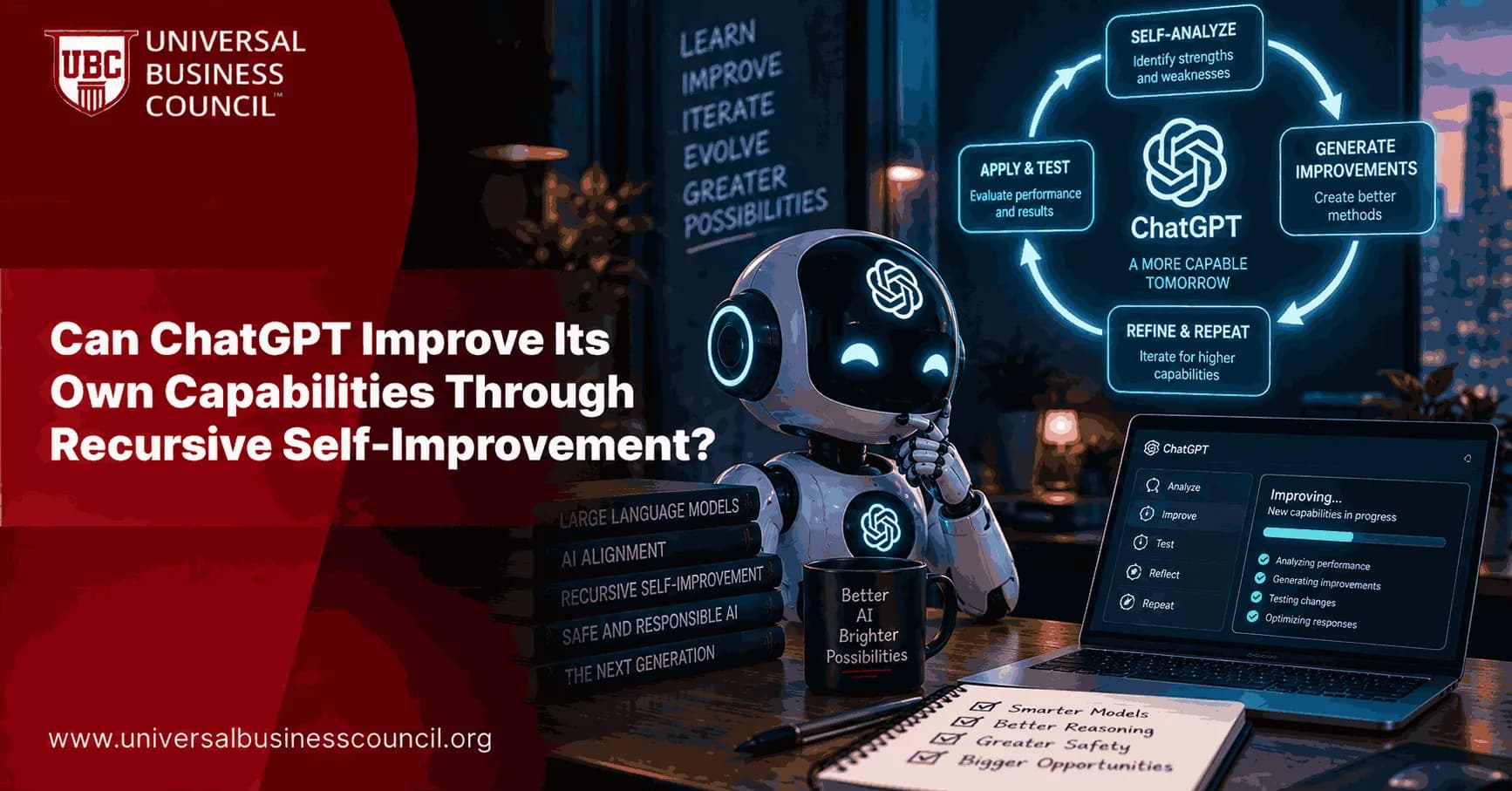
Can ChatGPT Improve Its Own Capabilities Through Recursive Self-Improvement?
Introduction: Two Very Different Kinds of "Getting Smarter"
Millions of people interact with ChatGPT daily and notice something that feels like the product genuinely improving over time. It remembers details from past conversations, adapts its tone to individual preferences, and seems to understand context better with each passing update. Whether any of this constitutes recursive self-improvement in the technical sense depends entirely on separating two very different phenomena that often get confused with one another. For professionals trying to make sense of this distinction accurately, a Marketing Certification helps build the communication skills needed to explain nuanced AI product changes clearly to audiences who may otherwise conflate personalization with genuine capability growth.
Answering whether ChatGPT can improve itself through recursive self-improvement requires looking separately at what happens inside a single user's experience versus what happens inside OpenAI's actual model training pipeline, since these two processes work in fundamentally different ways.

What Is Actually Improving: Memory, Not the Underlying Model
The feature most responsible for ChatGPT feeling smarter over time is its memory system, and understanding exactly how that system works reveals why it does not represent recursive self-improvement in the technical sense:
ChatGPT's memory system, most recently rebuilt under an architecture OpenAI calls Dreaming V3, generates a readable memory summary that captures a user's stated preferences, ongoing projects, and recurring context across conversations.
The system automatically revises outdated information over time, updating something like a future trip reference to reflect that the trip has already happened once enough time has passed.
OpenAI has published internal evaluation figures showing clear year-over-year gains in this system: factual recall task success rose from 41.5 percent in 2024 to 67.9 percent in 2025 and 82.8 percent in 2026, while preference adherence climbed from 31.4 percent to 55.3 percent and then 71.3 percent over the same period.
Time-sensitive context updates, testing whether the system correctly recognizes that previously mentioned plans have already concluded, improved even more sharply, from 9.4 percent success in 2024 to 75.1 percent in 2026.
These are genuinely meaningful improvements, but they represent better retrieval, summarization, and personalization logic layered around a fixed underlying model, not a change to the model's core reasoning weights or trained capabilities.
Why Memory Improvements Are Not the Same as Model-Level RSI
The distinction matters because recursive self-improvement, in the sense researchers use the term, refers specifically to a system altering its own trained parameters, training data, or architecture to become more capable across the board:
Memory and personalization changes affect what context ChatGPT has access to for a given conversation, not how capable the underlying model is at reasoning, coding, or math once that context is stripped away.
A user with rich, well-organized memory data will get noticeably better, more relevant responses than a user without it, but both users are interacting with the exact same underlying model weights.
This means the improvement users experience through memory is real and valuable, but it is best understood as smarter context management rather than the model teaching itself to become more intelligent.
Professionals who want to understand this distinction at a deeper technical level, including how personalization systems differ from genuine model training, often pursue Artificial Intelligence Certifications, which cover both the practical AI product features people interact with daily and the underlying training processes that determine a model's actual capabilities.
Where Genuine Self-Improvement Research Does Show Up
Separately from ChatGPT's consumer-facing memory features, academic researchers have explored techniques that let a system like ChatGPT genuinely improve its reasoning performance without requiring any change to its trained parameters:
One notable research framework, called Memory-of-Thought, lets ChatGPT improve its own reasoning abilities in arithmetic, commonsense reasoning, and factual inference tasks purely by storing and recalling its own previously successful reasoning paths, without updating any model weights or requiring newly annotated training data.
This approach works by having the model save high-quality chains of reasoning it generated for earlier problems, then retrieving and adapting those saved reasoning paths when facing similar new problems later.
Researchers describe this as a genuinely self-improving mechanism precisely because it lets a fixed, already-deployed model perform measurably better over time using its own accumulated reasoning history, distinct from OpenAI's separate work training entirely new model versions from scratch.
Building the practical skills needed to design and evaluate this kind of prompt-level self-improvement technique, alongside understanding the broader technology landscape it fits into, benefits from a well-rounded Tech Certification, which covers the software architecture and evaluation methods relevant to both consumer AI products and more experimental research techniques like these.
AI Microdrama and Emerging Creative Applications
One emerging application is AI microdrama, where generative AI helps bring serialized stories, characters, and fictional worlds to life. Platforms built around this kind of storytelling benefit from the same underlying tension discussed throughout this article, since a system's ability to remember character details and narrative continuity across episodes reflects sophisticated memory management rather than the underlying generative model teaching itself new creative capabilities from scratch.
What Actually Changes ChatGPT's Real Capabilities
Genuine improvements to ChatGPT's core reasoning, coding, and knowledge capabilities happen through an entirely separate process from anything an individual user experiences directly:
New ChatGPT model versions are trained through OpenAI's internal research and engineering pipeline, involving updated training data, refined reinforcement learning techniques, and architectural changes decided by human researchers and engineers.
OpenAI has disclosed that its own coding models increasingly assist in this development process, contributing to debugging training runs and authoring a substantial share of code merged into production systems, representing bounded, human-supervised self-improvement at the organizational level rather than something happening inside an individual ChatGPT conversation.
When a new model version is released, every user gains access to the same improved capabilities simultaneously, in sharp contrast to memory improvements, which remain personalized and specific to each individual user's accumulated conversation history.
Why This Distinction Matters for How People Talk About AI Progress
Confusing personalization gains with genuine model-level self-improvement leads to inaccurate claims in both directions:
Overstating memory features as evidence of runaway AI self-improvement misrepresents what is actually a sophisticated but conventional software engineering achievement in context management.
Dismissing genuine capability gains between model versions as mere marketing ignores real, measurable underlying improvements in reasoning and coding ability that OpenAI's research teams have achieved through deliberate training decisions.
Users evaluating whether ChatGPT is "getting smarter" should distinguish between their own personalized experience improving through memory and the underlying model's actual reasoning capability, which only changes when OpenAI releases a genuinely new model version.
Developing a well-rounded technical foundation for making these distinctions confidently, across memory systems, model training pipelines, and emerging research techniques, benefits from a Deep Tech Certification, which equips professionals to evaluate AI product claims with the technical precision this kind of nuanced question genuinely requires.
Whether ChatGPT can improve its own capabilities through recursive self-improvement depends entirely on which layer of the system is being discussed. Its memory and personalization features have measurably improved through disclosed engineering work, but that improvement reflects better context management around a fixed model rather than the model teaching itself new underlying capabilities. Genuine capability growth still happens through OpenAI's separate, human-supervised training pipeline, released periodically as new model versions rather than continuously evolving within any single user's ongoing conversation history.
FAQs
1. Can ChatGPT improve its own capabilities through recursive self-improvement?
ChatGPT can assist with tasks that contribute to AI improvement, such as coding, debugging, research, and analysis. However, ChatGPT does not independently control an unrestricted cycle in which it redesigns, retrains, evaluates, and deploys increasingly capable versions of itself. OpenAI currently distinguishes these AI-assisted development capabilities from fully autonomous recursive self-improvement.
2. What is recursive self-improvement in AI?
Recursive self-improvement (RSI) is the theoretical process in which an AI system improves its own capabilities or contributes to creating an improved successor, which can then participate in another improvement cycle. A complete RSI loop could involve research, coding, training, evaluation, and deployment. The key feature is repeated improvement rather than a single model update.
3. Does ChatGPT learn from every conversation?
Not in the sense of immediately changing its underlying model after every conversation. OpenAI explains that foundation models are trained through processes such as pre-training, post-training, evaluation, and ongoing improvement. Depending on a user's settings, conversations with ChatGPT may also be used later as data to help train and improve future models, which is different from ChatGPT autonomously modifying itself during a conversation.
4. Can ChatGPT change its own model weights?
ChatGPT does not ordinarily have direct control over its underlying model weights. Model weights are learned parameters that are adjusted during training. OpenAI's documentation describes model development as a separate training and evaluation process rather than ChatGPT independently rewriting its own parameters during normal use.
5. Can ChatGPT rewrite its own code?
ChatGPT can generate, analyze, debug, and modify code when given appropriate tools or instructions. However, generating code is different from independently modifying the production systems that run ChatGPT. Autonomous RSI would require much broader access to the software, training infrastructure, evaluation systems, and deployment pipeline.
6. Can ChatGPT create a better version of itself?
ChatGPT can help researchers and developers with activities involved in building improved AI systems, including coding, analysis, experimentation, and research. It could therefore contribute to the development of a more capable successor. However, that does not mean ChatGPT independently designs, trains, validates, and deploys a better version of itself.
7. Is ChatGPT currently capable of recursive self-improvement?
There is no evidence that ChatGPT has unrestricted autonomous RSI. OpenAI stated in September 2026 that fully autonomous recursive self-improvement, in which AI systems independently drive successive generations of increasingly capable AI, is not happening today. OpenAI does say that AI is already accelerating parts of the research used to develop and align future models.
8. How can ChatGPT contribute to AI improvement without improving itself?
ChatGPT can assist with programming, research, debugging, data analysis, experiment design, and other technical tasks. These capabilities can help human researchers and automated systems improve AI models. The distinction is that the broader development process remains controlled through training pipelines, evaluation procedures, infrastructure, and human oversight.
9. Is ChatGPT's memory the same as recursive self-improvement?
No. Memory can allow ChatGPT to use information from previous interactions in future responses, depending on the product's features and settings. This is different from changing the underlying model's parameters or redesigning the model. Memory improves contextual usefulness, not necessarily the core intelligence of the model through RSI.
10. Can ChatGPT train itself using its own responses?
ChatGPT can generate responses that may potentially become part of datasets used in later model-development processes, depending on OpenAI's data-use policies and settings. OpenAI also describes the use of synthetic data in some training processes. However, this does not mean ChatGPT autonomously decides to collect its responses, retrain itself, evaluate the new model, and deploy it.
11. What is the difference between ChatGPT learning and ChatGPT improving itself?
“Learning” can refer to several different mechanisms, including model training, post-training, contextual adaptation, memory, or use of external information. Recursive self-improvement specifically refers to an iterative process in which an AI contributes to improving its own capabilities or successors. Therefore, not every form of learning qualifies as RSI.
12. Could ChatGPT help create a better AI model?
Yes. ChatGPT can assist with many components of AI development, such as writing training code, analyzing experiments, generating test cases, debugging software, and researching technical approaches. If these capabilities are integrated into a controlled AI-development pipeline, they can contribute to building improved models.
13. Could ChatGPT eventually participate in an RSI loop?
In principle, an AI system with sufficient capabilities and access to development tools could participate in a recursive improvement loop. Such a system would need mechanisms for identifying improvements, implementing them, training or modifying candidate systems, evaluating results, and repeating successful improvements. Whether ChatGPT or future systems will operate with this degree of autonomy depends on future technical development and deployment choices.
14. What would ChatGPT need to perform autonomous RSI?
A highly autonomous RSI system would need access to substantial computing resources, model-development infrastructure, source code or other mechanisms for modifying the system, training pipelines, reliable evaluation tools, and deployment capabilities. It would also require well-defined objectives and safeguards. Having access to a coding interface alone would not be sufficient.
15. Could ChatGPT improve its reasoning through recursive self-improvement?
A future AI development system could potentially improve reasoning capabilities by experimenting with training methods, architectures, inference strategies, or evaluation techniques. ChatGPT can assist with some of these research activities. However, ChatGPT does not independently run an unrestricted process of modifying and retraining its own underlying model to improve its reasoning.
16. Could ChatGPT improve itself faster than humans?
If future AI systems become capable of performing substantial portions of AI research and engineering autonomously, they could potentially accelerate some development activities. OpenAI says current AI agents can already perform some research tasks that would take skilled researchers several days. However, OpenAI explicitly distinguishes this kind of research acceleration from fully autonomous RSI.
17. What prevents ChatGPT from recursively improving itself?
Several factors separate ChatGPT from a fully autonomous RSI system, including controlled access to model weights and training infrastructure, the need for external evaluation, computing requirements, deployment controls, and safety mechanisms. A model being capable of reasoning about its own improvement does not automatically give it the authority or infrastructure to implement those improvements.
18. Could ChatGPT's future versions be developed with help from AI?
Yes. AI can contribute to the development of future AI systems by assisting with research, coding, experimentation, evaluation, and optimization. OpenAI says it is working toward automated AI researchers that operate under human supervision. This represents increasing AI involvement in AI development, but it should not be confused with unrestricted autonomous RSI.
19. Could ChatGPT eventually become recursively self-improving?
It is a possible area of future AI research, but it is not an established capability of current ChatGPT. Achieving reliable RSI would require solving substantial technical and safety challenges, including trustworthy self-evaluation, controlled modification, resource management, and verification of improvements. Future systems may automate more of the AI development process, but the extent of autonomy remains uncertain.
20. Is ChatGPT already an example of recursive self-improvement?
No, not in the strong sense of the term. ChatGPT can contribute to AI research and its interactions may, depending on applicable settings and policies, help provide data for future model improvements. But fully autonomous RSI requires an AI system to independently drive successive cycles of increasingly capable AI development, which OpenAI says is not happening today.
Related Articles
View All
Artificial Intelligence
Can LLMs Improve Their Own Capabilities Through Recursive Self-Improvement?
Explore whether large language models can improve their own capabilities through recursive self-improvement, how iterative self-optimization might work, and the technical and safety limits involved.

Artificial Intelligence
Can Google Gemini Improve Itself Through Recursive Self-Improvement?
Explore whether Google Gemini can improve itself through recursive self-improvement, how Gemini-powered systems already support iterative learning and optimization, and what still separates them from true autonomous RSI.

Artificial Intelligence
Can AI Rewrite and Improve Its Own Code for Recursive Self-Improvement?
Explore whether AI can rewrite and improve its own code, how code-generating systems support self-optimization, and what role this could play in recursive self-improvement.
Trending Articles
The Role of Blockchain in Ethical AI Development
How blockchain technology is being used to promote transparency and accountability in artificial intelligence systems.
AWS Career Roadmap
A step-by-step guide to building a successful career in Amazon Web Services cloud computing.
Top 5 DeFi Platforms
Explore the leading decentralized finance platforms and what makes each one unique in the evolving DeFi landscape.