

GPT-Live-1 vs GPT-Live-1 Mini: Key Features, Use Cases, and Benefits for Professionals
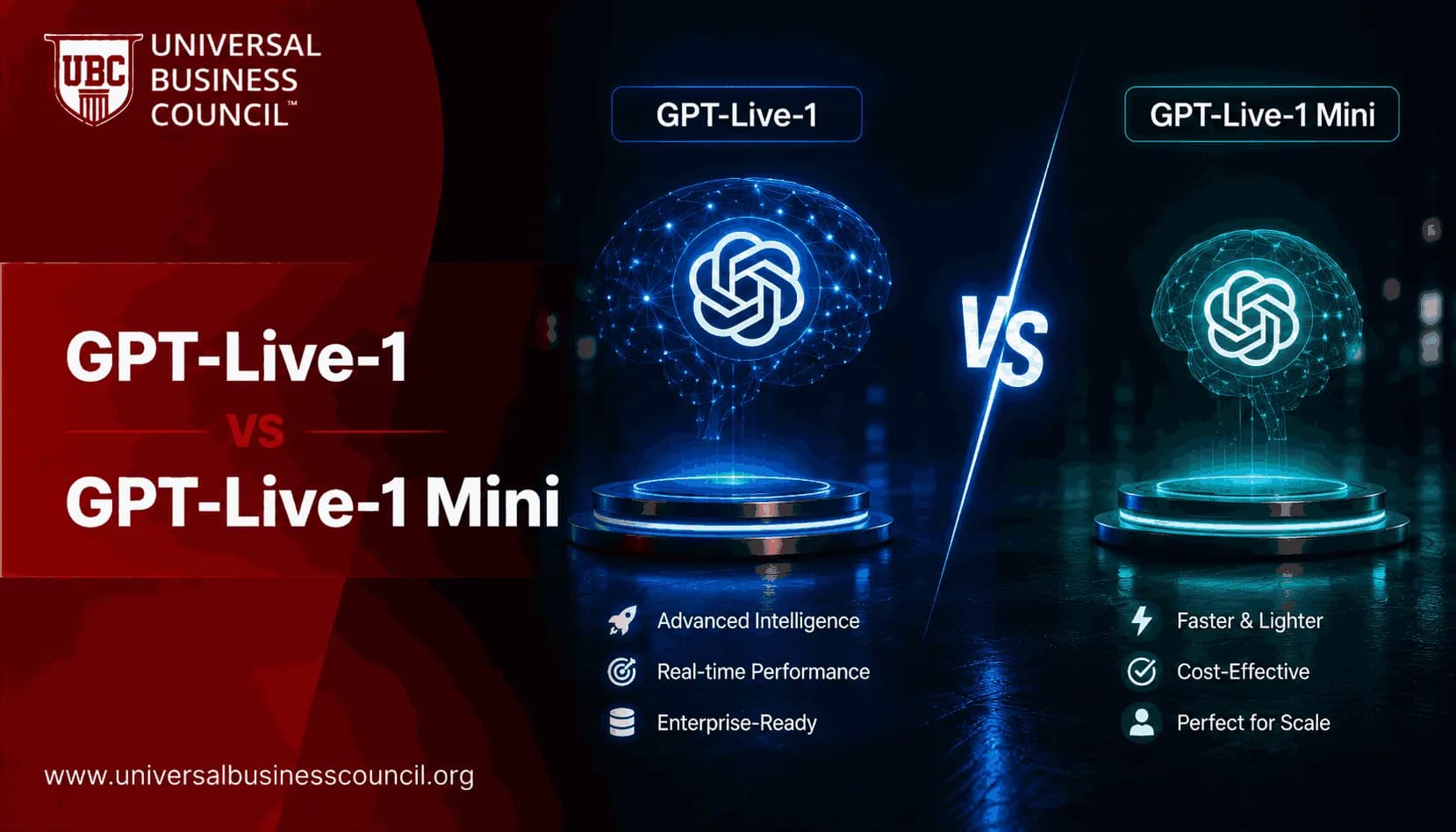
GPT-Live-1 vs GPT-Live-1 Mini comes down to a trade-off between capability and scale. GPT-Live-1 is the higher-capability, configurable full-duplex voice model for paid ChatGPT tiers. GPT-Live-1 Mini is the lighter, cost-optimized model that brings the same voice architecture to Free users. If you use AI for research, support, training, or enterprise workflows, that difference matters.
The short answer: pick GPT-Live-1 when accuracy, deeper reasoning, and control over response depth are worth the extra cost. Use GPT-Live-1 Mini for quick conversations, everyday help, language practice, and early experiments with voice-first workflows.

As voice AI becomes part of everyday business communication, many professionals are building practical skills through a Certified ChatGPT Expert program to better understand conversational AI, prompt engineering, and enterprise-ready AI workflows.
What GPT-Live Changes in Voice AI
OpenAI introduced the GPT-Live family as the new voice model layer behind ChatGPT Voice across iOS, Android, and the web. The important technical shift is full-duplex conversation. The model can listen and speak at the same time instead of waiting for tidy turn-by-turn exchanges.
This sounds minor until you use it in a real workflow. Old voice bots often break when a user interrupts. The classic support example is painful. The customer says, I already rebooted the router, but the bot keeps reading step two from the script. Full-duplex design is meant to reduce that failure. It lets the assistant hear the interruption, pause, adjust, or keep listening.
OpenAI also says GPT-Live can handle pauses, changes of pace, and short back-channel responses such as mhmm or yeah. That makes conversations feel less like dictation and more like working with a colleague who can follow your train of thought.
GPT-Live-1 vs GPT-Live-1 Mini: The Core Differences
OpenAI has not published a full technical spec sheet comparing both models line by line. Still, its product materials, system card, and early-access demonstrations make the positioning clear.
GPT-Live-1
Default voice model for paid Go, Plus, and Pro users.
Positioned as the higher-intelligence model in the GPT-Live family.
Built for complex reasoning, research, support, and professional workflows.
Offers configurable reasoning levels such as Instant, Medium, and High in demonstrations.
High mode is described as using more background reasoning through OpenAI's frontier model, GPT-5.5.
GPT-Live-1 Mini
Default voice model for Free users.
Shares the same full-duplex conversational architecture.
Optimized for cost, speed, and broad access.
Best suited to lightweight tasks, quick questions, practice conversations, and daily planning.
Does not appear to expose the same advanced reasoning controls in early demonstrations.
To be blunt, Mini is not the model I would choose for a board briefing, a regulatory research task, or a complex customer escalation. It is very useful, but its job is access at scale. GPT-Live-1 is the better fit when the conversation has business consequences.
Beyond technical capabilities, organizations are increasingly using voice AI to improve customer engagement, campaign interactions, and personalized experiences. Professionals who complement these skills with a Marketing Certification are often better equipped to align AI adoption with measurable business outcomes.
Feature Comparison Table
Aspect | GPT-Live-1 | GPT-Live-1 Mini |
|---|---|---|
Default access | Paid Go, Plus, and Pro users | Free users |
Architecture | Full-duplex voice | Full-duplex voice |
Reasoning depth | Higher, with configurable levels | Baseline voice intelligence |
Best use | Research, enterprise workflows, complex support | Everyday questions, practice, light assistance |
Cost profile | Higher resource footprint | Cost-optimized for broad use |
Professional fit | High-value or high-stakes work | Low-risk and exploratory work |
Shared Capabilities Professionals Should Know
Both GPT-Live-1 and GPT-Live-1 Mini are built on the same interaction model, so they share several capabilities that matter for business users.
Natural interruption handling
You can interrupt, correct yourself, pause, and change direction. The model is designed to keep listening during speech output. This matters in coaching, support calls, negotiation practice, and live research sessions where clean turns are rare.
Delegated reasoning and search
OpenAI says GPT-Live can delegate deeper reasoning, web search, and complex tasks to GPT-5.5 in the background, then return the answer inside the voice conversation. That keeps the exchange moving while heavier work runs behind the scenes.
Multimodal context
ChatGPT Voice with GPT-Live can retain access to search, memory, images, and file uploads. It can also show visual cards for topics such as weather, stocks, and sports. For professionals, this points to a more useful workflow. Talk through a spreadsheet, ask about a report, or review a chart without switching fully back to text.
Voice-specific safety controls
OpenAI's GPT-Live system card describes safety checks that run continuously during conversation, not only after each user turn. It also discusses safeguards for sensitive topics, impersonation risks, and misuse of realistic synthetic voices. That is not just a compliance footnote. If you plan to use voice AI in customer-facing settings, governance needs to be designed from day one.
Performance Signals and Benchmarks
The public data is useful but incomplete. OpenAI reports that GPT-Live-1 substantially outperforms the previous Advanced Voice Mode on GPQA, an expert-level science reasoning benchmark spanning biology, chemistry, and physics. It also reports strong gains on BrowseComp, which tests difficult information retrieval and agentic web search.
For operations teams, the most interesting benchmark may be a multi-turn telecom support task OpenAI ran internally. GPT-Live-1 outperforms the previous voice model there as well. That fits the practical need. Voice assistants have to handle messy, branching conversations, not just answer isolated questions.
OpenAI has also reported matched five-to-ten-minute user preference studies in which both GPT-Live-1 and GPT-Live-1 Mini were strongly preferred over Advanced Voice Mode across turn-taking, interruptions, flow, and naturalness. TechRadar has described GPT-Live as ChatGPT's smartest voice model to date, and Investing.com has highlighted its full-duplex design and delegated reasoning.
One caveat. OpenAI has not published exact numerical scores for every benchmark or a direct GPT-Live-1 versus GPT-Live-1 Mini table. So do not overread the marketing language. The safer reading is simple: GPT-Live-1 is the stronger model, Mini is the scale model.
Best Use Cases for GPT-Live-1
Research and executive briefings
Use GPT-Live-1 when you need a spoken research partner. Ask it to compare market shifts, summarize uploaded documents, or walk through regulatory changes. The adjustable reasoning level pays off here. Instant is handy for quick checks. High is better when you need a more careful answer and can tolerate a little more latency.
Customer support and contact centers
GPT-Live-1 is a stronger fit for support flows where users interrupt, skip steps, or describe problems out of order. Start with agent-assist before full automation. Let the model listen, summarize, suggest next actions, and draft notes inside your CRM. Only move to customer-facing automation after you have tested edge cases, escalation rules, and audit logging.
Professional training and role-play
For training providers and enterprises, GPT-Live-1 can run role-play simulations for sales calls, service recovery, performance reviews, and negotiations. The real value is not that it talks. It adapts mid-conversation when the learner hesitates, pushes back, or gives an incomplete answer.
If you are building this skill set, connect the topic with related Universal Business Council certification pathways in artificial intelligence, business analytics, digital transformation, and business management. Voice AI is no longer only a technical issue. It touches process design, risk management, customer experience, and workforce training.
Best Use Cases for GPT-Live-1 Mini
Everyday productivity
GPT-Live-1 Mini suits quick planning, reminders, informal brainstorming, and short explanations. Use it for low-risk tasks where speed and access matter more than deep analysis.
Language practice
Mini is a good entry point for language learners and professionals sharpening business communication. Full-duplex voice makes practice less rigid. You can interrupt, ask for a correction, repeat a phrase, or shift the scenario from a job interview to a client call.
Voice UX prototyping
Developers and product teams can use Mini to test whether users actually want a voice layer before committing budget to a more advanced build. When OpenAI makes GPT-Live API access available, expect teams to prototype with lower-cost models first, then move critical workflows to GPT-Live-1.
Enterprise Adoption: What to Watch Next
API access is the next major milestone. OpenAI has said GPT-Live API access is planned, which could bring these models into CRM systems, help desks, learning platforms, business intelligence tools, and internal knowledge bases.
Voice with video and screen sharing is another development to watch. OpenAI has said these features are not available at launch but are being worked on. Once they arrive, the professional use cases expand quickly: live presentation coaching, screen-based troubleshooting, meeting companions, and guided training inside enterprise software.
Do not start with the model choice. Start with the workflow. Ask:
Is the task low-risk or high-stakes?
Does the user need fast answers or deeper reasoning?
Will the assistant access private files, customer data, or regulated information?
What should trigger escalation to a human?
How will you measure success: resolution rate, handle time, NPS, training score, or error reduction?
Which Model Should You Choose?
Choose GPT-Live-1 if you need complex reasoning, professional research, customer support depth, configurable intelligence levels, or enterprise-grade workflow design. It is the better choice for paid professional use.
Choose GPT-Live-1 Mini if you need broad access, quick conversations, learning support, light productivity, or early product experiments. It is the sensible starting point when cost and reach matter most.
Your next step: map one real workflow before you test either model. Pick a support call, research briefing, training simulation, or language practice scenario. Define the success metric, test GPT-Live-1 Mini for the baseline experience, then move to GPT-Live-1 when the task demands deeper reasoning and tighter control.
As conversational AI continues to evolve across enterprise software, customer service, and productivity platforms, earning a Tech Certification can help professionals build the broader technical foundation needed to evaluate, implement, and manage emerging AI technologies with confidence.
FAQs
1. What is the difference between GPT-Live-1 and GPT-Live-1 Mini?
GPT-Live-1 is designed for higher-quality reasoning, richer conversational capabilities, and more advanced real-time interactions. GPT-Live-1 Mini is a lightweight alternative that prioritizes lower latency, reduced costs, and faster performance for high-volume conversational applications.
2. Which is better: GPT-Live-1 or GPT-Live-1 Mini?
The better model depends on your use case. GPT-Live-1 is ideal for complex conversations, enterprise AI assistants, and advanced customer interactions, while GPT-Live-1 Mini is better suited for applications requiring speed, scalability, and cost efficiency.
3. What are GPT-Live-1 and GPT-Live-1 Mini used for?
Both models are built for real-time AI experiences such as voice assistants, live customer support, AI chatbots, virtual agents, business automation, educational tools, and interactive applications that require quick, natural conversations.
4. Is GPT-Live-1 more powerful than GPT-Live-1 Mini?
Yes. GPT-Live-1 generally offers stronger reasoning, better contextual understanding, and higher-quality responses for demanding tasks. GPT-Live-1 Mini focuses on efficiency, making it suitable for simpler or large-scale conversational workloads.
5. Why would businesses choose GPT-Live-1 Mini?
Businesses may choose GPT-Live-1 Mini because it offers lower operating costs, faster inference, and the ability to support large numbers of simultaneous users. It is well suited for FAQs, customer support, and routine business interactions.
6. When should developers use GPT-Live-1 instead of GPT-Live-1 Mini?
Developers should consider GPT-Live-1 for applications that require advanced reasoning, detailed responses, complex workflows, or high-quality conversational experiences where response quality is a higher priority than cost.
7. How do GPT-Live-1 and GPT-Live-1 Mini compare in response speed?
Both models are optimized for real-time interactions, but GPT-Live-1 Mini is generally designed for faster response times and lower computational requirements. GPT-Live-1 balances speed with deeper reasoning and more comprehensive responses.
8. Which model is more cost-effective for businesses?
GPT-Live-1 Mini is typically the more cost-effective option because it requires fewer computing resources. Organizations handling high volumes of customer conversations may find it more economical while maintaining good conversational performance.
9. Can both GPT-Live-1 and GPT-Live-1 Mini support voice assistants?
Yes. Both models are designed for conversational AI applications and can power voice assistants, virtual receptionists, smart devices, and AI-powered call center solutions that require natural, low-latency interactions.
10. Which model is better for customer support automation?
GPT-Live-1 is better for handling complex customer inquiries that require detailed reasoning, while GPT-Live-1 Mini is highly effective for managing routine questions, FAQs, and large-scale support operations where speed is essential.
11. Are GPT-Live-1 and GPT-Live-1 Mini suitable for enterprise applications?
Yes. Both models can support enterprise use cases such as employee assistants, knowledge management, workflow automation, customer service, and AI-powered collaboration tools, depending on the organization's performance and budget requirements.
12. Can developers integrate both models into existing applications?
Yes. Developers can integrate GPT-Live-1 and GPT-Live-1 Mini into websites, mobile applications, CRM systems, customer support platforms, and enterprise software using OpenAI's APIs and supported development frameworks.
13. Which model is better for startups?
Startups often benefit from GPT-Live-1 Mini because it provides reliable conversational AI at a lower cost. As business needs become more advanced, organizations can evaluate whether GPT-Live-1 offers additional value for more sophisticated applications.
14. Do GPT-Live-1 and GPT-Live-1 Mini support multiple languages?
Yes. Both models are capable of supporting multilingual conversations, making them suitable for businesses serving international customers and creating AI applications for global audiences.
15. How do GPT-Live-1 and GPT-Live-1 Mini improve user experiences?
These models deliver faster, context-aware responses that create smoother conversations. Users experience shorter waiting times, more natural interactions, and improved engagement across voice and text-based applications.
16. Which model is better for AI-powered call centers?
GPT-Live-1 is often better for handling complex customer conversations and agent assistance, while GPT-Live-1 Mini is ideal for managing large volumes of standard inquiries efficiently and at a lower operational cost.
17. Can GPT-Live-1 Mini handle high traffic applications?
Yes. GPT-Live-1 Mini is specifically designed to scale efficiently, making it suitable for businesses that need to support thousands of simultaneous conversations without significantly increasing infrastructure costs.
18. How secure are GPT-Live-1 and GPT-Live-1 Mini?
Both models can be deployed with enterprise-grade security features, including authentication, administrative controls, access management, and privacy safeguards that help organizations use AI responsibly.
19. What factors should businesses consider when choosing between GPT-Live-1 and GPT-Live-1 Mini?
Organizations should evaluate conversation complexity, response quality, latency requirements, operating costs, expected traffic, scalability needs, and integration requirements before selecting the model that best fits their business goals.
20. Why is understanding the differences between GPT-Live-1 and GPT-Live-1 Mini important?
Comparing GPT-Live-1 and GPT-Live-1 Mini helps businesses and developers choose the right AI model for their needs. By balancing performance, speed, scalability, and cost, organizations can build conversational AI solutions that deliver better user experiences while optimizing operational efficiency.
Related Articles
View All
Artificial Intelligence
NVIDIA Nemotron 3.5 Lightning vs NVIDIA Cosmos 3: Key Differences and Use Cases
Compare NVIDIA Nemotron 3.5 Lightning and NVIDIA Cosmos 3, including their architectures, capabilities, AI workloads, and use cases across agentic AI and Physical AI.
Artificial Intelligence
Gemini 4 Argon: Features, Pricing, and Availability
Gemini 4 Argon is Google’s new flagship AI model for coding, science, finance, law and security. See its main features, API and subscription pricing, and where you can access it today.

Artificial Intelligence
What Is Meta Muse Wonder? Features and How It Works
Meta Muse Wonder is a new frontier AI model built for agents with Active Memory and Active Focus. Learn what it is, how it works, its features, pricing and how to access it.
Trending Articles
The Role of Blockchain in Ethical AI Development
How blockchain technology is being used to promote transparency and accountability in artificial intelligence systems.
AWS Career Roadmap
A step-by-step guide to building a successful career in Amazon Web Services cloud computing.
Top 5 DeFi Platforms
Explore the leading decentralized finance platforms and what makes each one unique in the evolving DeFi landscape.