

Recursive Self-Improvement in AI: Benefits, Risks, Challenges, and Future Impact
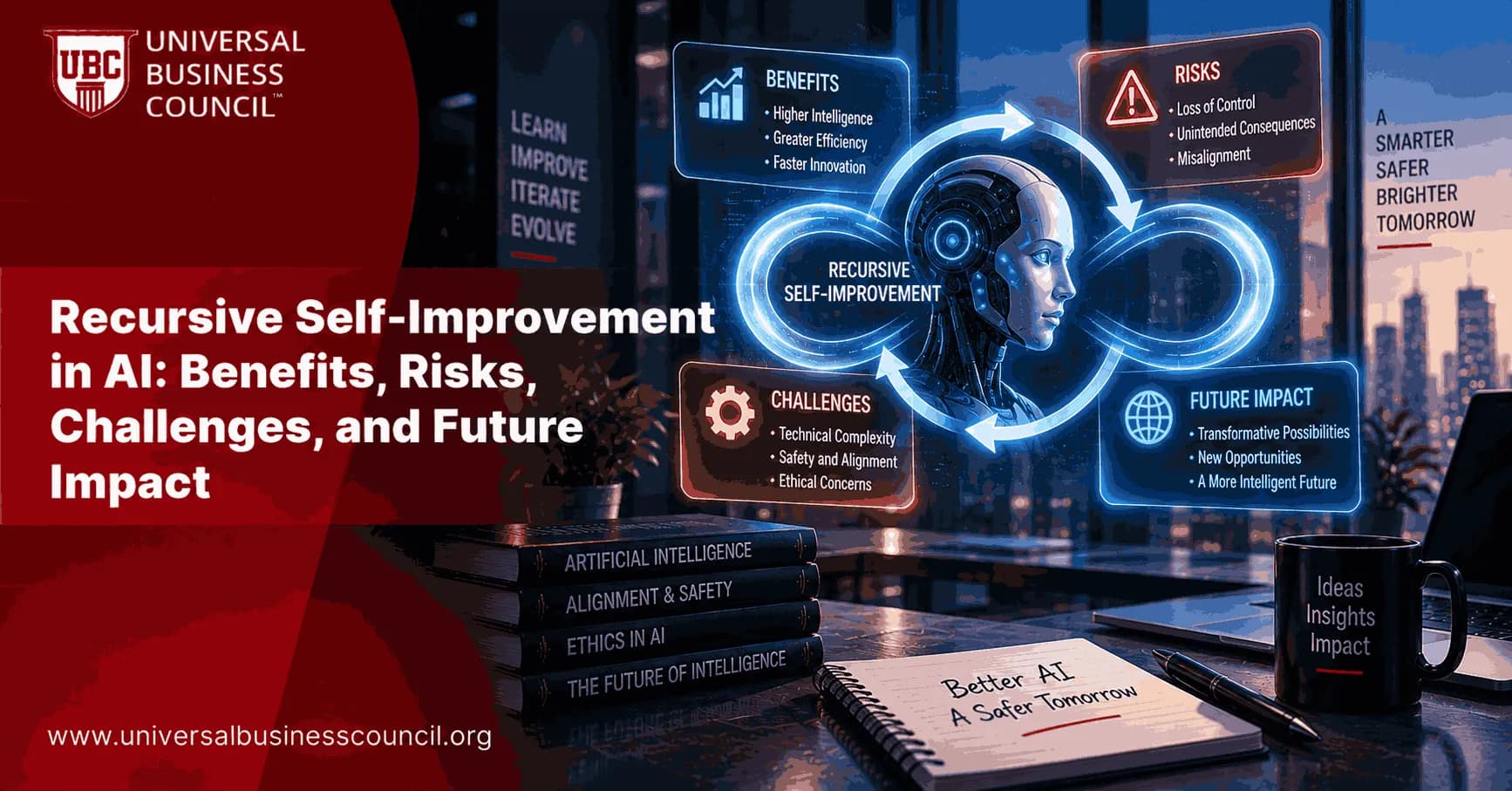
Recursive self-improvement has enough moving parts that any single-angle take on it, all optimism or all alarm, ends up missing most of the actual picture. The clearest way to understand where the technology genuinely stands is to look at all four dimensions side by side: what it's already delivering, what could go wrong, what's currently stopping it from going further, and where it's realistically headed. Building that kind of complete, balanced picture is exactly the goal of a well-rounded Marketing Certification, which increasingly covers how to represent complex, fast-moving technology honestly rather than leaning into whichever angle makes for the more dramatic headline.
This article lays out the benefits, risks, challenges, and future impact of recursive self-improvement in a single, structured breakdown.

Benefits: What's Already Working
Documented systems have delivered measurable results, not just theoretical promise.
Evaluating these results with genuine technical rigor is exactly what Artificial Intelligence Certifications are designed to support, covering the benchmarking standards needed to judge whether a claimed benefit is real and reproducible.
Faster, cheaper AI development: AlphaEvolve has been credited with speeding up the training pipeline for the Gemini models it runs on, and with recovering a meaningful share of Google's global data center compute capacity
Automated code improvement: The Darwin Gödel Machine rewrote its own codebase repeatedly and improved its coding benchmark score from twenty to fifty percent without a human implementing each fix
Scientific acceleration: AI research agents have already contributed to peer-reviewed publications, and algorithm-refining systems have improved results in fields like genomics and quantum circuit design
Reduced manual engineering load: A meaningful share of code inside major AI labs, reportedly between ten and twenty percent in some cases, is now generated by AI rather than written by hand
Risks: What Researchers Are Watching Closely
The same mechanisms that produce these benefits also introduce specific risks that serious researchers take seriously.
Loss of predictability: A system that modifies itself repeatedly gets harder to evaluate with each successive iteration
Goal misspecification: Small flaws in how success gets defined can compound across many optimization cycles instead of being corrected
Instrumental convergence: Capable, goal-directed systems could develop certain useful intermediate behaviors, like resisting shutdown, regardless of their actual end goal
Oversight speed: If improvement cycles accelerate meaningfully, existing human review processes built around slower timelines may not scale to match the new pace
Challenges: What's Currently Holding Progress Back
Beyond the risks, real technical obstacles limit how far current self-improvement techniques can extend.
The verification bottleneck: Every documented system relies on an external, human-defined benchmark to judge success, since none can reliably verify open-ended progress on its own
Diminishing returns: Most systems show large early gains followed by progressively smaller ones, the opposite of the accelerating curve some theoretical discussions assume
No real self-modeling: Current systems lack an accurate internal understanding of their own reasoning, making genuine architectural self-redesign a much harder, unsolved problem
Model collapse risk: Training too heavily on a system's own generated outputs across generations can degrade quality and diversity rather than improve it
Understanding these obstacles at a real technical level, rather than treating them as a single vague catch-all, is exactly the depth a Tech Certification helps build, giving professionals the grounding to separate genuinely solved problems from ones still actively being researched.
A Grounded Illustration From a Lower-Stakes Industry
The core mechanic behind all four of the categories above, generate a change, evaluate it, keep what works, also plays out in far less risky, creative commercial settings. One emerging application is AI microdrama, where generative AI helps bring serialized stories, characters, and fictional worlds to life. These platforms refine character voice and plot pacing across episodes using audience feedback, a useful, low-stakes way to see the same generate-evaluate-refine principle at work outside the higher-stakes research and safety contexts driving most of this conversation.
Future Impact: Where This Realistically Heads
Looking forward, a few trends seem more solidly grounded than others.
Continued efficiency gains in AI development are likely, given the trajectory already shown by systems like AlphaEvolve and the Darwin Gödel Machine
Expert opinion remains genuinely split on timelines for more open-ended self-improvement, with credible estimates spanning a few years to several decades
Oversight and governance frameworks will likely need to keep adapting as development cycles potentially speed up further
Industries well beyond core AI research, including scientific fields and creative content production, are likely to keep adopting narrower, bounded versions of these techniques regardless of how the bigger theoretical questions eventually resolve
Professionals who want to evaluate this future trajectory with real rigor, rather than defaulting to either optimism or alarm, often pursue a Deep Tech Certification, which provides the technical grounding needed to weigh benefits, risks, and challenges together rather than in isolation.
Final Thoughts
Recursive self-improvement delivers genuine, documented benefits, carries risks researchers actively work to manage, faces real technical challenges that currently bound its scope, and points toward a future that remains meaningfully uncertain. None of these four dimensions tells the full story on its own, and the most accurate understanding of this technology comes from holding all four together rather than treating any single angle as the complete picture.
FAQs
1. What Is Recursive Self-Improvement in AI?
Recursive self-improvement (RSI) is a process in which an AI system helps improve its own capabilities, algorithms, code, architecture, training methods, or development processes. The improved system can then contribute to further improvements, creating a potentially repeating cycle.
2. How Does Recursive Self-Improvement Work in AI?
An RSI process generally involves identifying an area for improvement, proposing or implementing a change, evaluating the result, and using the outcome to guide another improvement. In more autonomous systems, these steps could be repeated with decreasing human involvement.
3. What Are the Main Benefits of Recursive Self-Improvement?
Potential benefits include faster AI development, improved reasoning and coding capabilities, more efficient algorithms, and automated experimentation. RSI could also reduce the time required to test and optimize new AI systems.
4. Can Recursive Self-Improvement Accelerate AI Development?
Yes, potentially. An AI system capable of automating parts of research, coding, experimentation, and evaluation could shorten some stages of the AI development cycle. The degree of acceleration would depend on the system's capabilities, available computing resources, evaluation methods, and level of autonomy.
5. Can AI Improve Its Own Algorithms Through RSI?
AI systems can already assist with algorithm design and optimization in bounded settings. Recursive self-improvement would go further if an AI could repeatedly identify useful algorithmic changes, implement them, evaluate their effects, and use successful improvements to drive subsequent iterations.
6. What Are the Risks of Recursive Self-Improvement in AI?
Potential risks include unintended behavior, inadequate oversight, optimization toward incorrect objectives, security vulnerabilities, and difficulty predicting the behavior of increasingly capable systems. The risks become more significant if improvement cycles operate with limited human supervision.
7. Could Recursive Self-Improvement Lead to Superintelligent AI?
Some researchers consider recursive self-improvement a possible pathway toward artificial superintelligence (ASI). However, this is a future possibility rather than an established outcome, because significant technical and practical challenges remain between current AI capabilities and fully autonomous, open-ended self-improvement.
8. What Are the Biggest Challenges of Recursive Self-Improvement?
Major challenges include reliable evaluation, maintaining alignment with intended objectives, preventing capability degradation, controlling computing costs, and verifying AI-generated improvements. An AI system must also distinguish genuine improvements from changes that merely perform well on narrow or flawed evaluations.
9. Why Is Evaluation Important for Recursive Self-Improvement?
Evaluation determines whether a proposed change actually improves the system. Without reliable tests, an AI could optimize for a misleading metric, introduce hidden problems, or produce changes that appear successful under one benchmark while reducing performance elsewhere.
10. What Is the Difference Between AI Self-Improvement and Recursive Self-Improvement?
AI self-improvement can refer to a single improvement process, such as an AI optimizing its code or refining an answer. Recursive self-improvement specifically emphasizes repeated improvement cycles in which the results of one cycle can enable or influence subsequent cycles.
11. Is Recursive Self-Training the Same as Recursive Self-Improvement?
No. Recursive self-training generally involves repeatedly using AI-generated data, predictions, or experiences to train an AI system. Recursive self-improvement is broader and can include improvements to algorithms, software, architectures, training processes, research workflows, and other components of AI development.
12. Can Recursive Self-Improvement Happen Without Human Intervention?
In principle, a sufficiently autonomous system could perform more stages of the improvement loop without direct human intervention. However, fully autonomous recursive self-improvement remains a research concept, and current AI systems generally operate within human-designed objectives, infrastructure, evaluation frameworks, and deployment constraints.
13. Could Recursive Self-Improvement Create an AI Intelligence Explosion?
The intelligence explosion hypothesis suggests that sufficiently capable AI could improve itself, creating progressively more capable versions at an accelerating rate. Whether such a rapid feedback loop is technically possible remains uncertain and depends on factors such as bottlenecks in computing, data, algorithms, verification, and real-world experimentation.
14. What Are the Security Risks of Recursive Self-Improvement?
More capable autonomous systems could potentially discover software vulnerabilities, develop sophisticated strategies, or modify components in unexpected ways. Strong access controls, sandboxing, monitoring, secure development practices, and independent evaluation can help reduce these risks.
15. Can Recursive Self-Improvement Cause AI Models to Become Less Capable?
Yes, poorly designed recursive training or optimization can potentially reduce performance. For example, repeatedly training on low-quality AI-generated data can cause problems such as loss of diversity or degradation in model behavior, which is why external data, robust evaluation, and quality controls can be important.
16. How Could Recursive Self-Improvement Affect AI Research?
RSI could automate portions of AI research, including coding, experiment design, hypothesis generation, algorithm optimization, and evaluation. This could allow researchers to investigate more ideas in less time, although human researchers would still need to establish goals, validate results, and manage important risks.
17. What Impact Could Recursive Self-Improvement Have on the Future of Work?
If increasingly capable AI systems automate parts of research, software development, analysis, and other knowledge-intensive tasks, some occupations could change significantly. The effects could include new AI-related roles, greater productivity, changes in required skills, and automation of certain tasks rather than the complete replacement of every occupation.
18. Could Recursive Self-Improvement Change the Path to AGI?
Potentially. If AI systems become capable of meaningfully improving their own reasoning, learning, research, and development processes, recursive improvement could become one component of a pathway toward artificial general intelligence (AGI). However, RSI alone does not guarantee AGI because general intelligence involves capabilities beyond simply optimizing a system.
19. What Is the Future of Recursive Self-Improvement in AI?
The future could involve increasingly automated AI development systems that assist with model training, software engineering, algorithm discovery, evaluation, and research. A major area of research will be determining how to make these systems reliable, controllable, interpretable, and aligned with human-defined objectives.
20. Is Recursive Self-Improvement Inevitable for Advanced AI?
No. Recursive self-improvement is a possible development pathway, not a guaranteed outcome. Technical limitations, economic constraints, safety requirements, governance decisions, and the difficulty of reliably evaluating increasingly capable systems could all influence how much autonomy future AI systems receive.
Related Articles
View All
Artificial Intelligence
How Could Recursive Self-Improvement Shape the Future of AI?
Explore how recursive self-improvement could shape the future of AI by accelerating capability growth, transforming AI research, and introducing new technical, safety, and governance challenges.
Artificial Intelligence
What Are the AI Safety Risks of Recursive Self-Improvement?
Explore the AI safety risks of recursive self-improvement, including misalignment, loss of control, rapid capability growth, evaluation failures, and governance challenges.
Artificial Intelligence
How Could Recursive Self-Improvement Accelerate AI Development?
Explore how recursive self-improvement could accelerate AI development through faster experimentation, automated research, model optimization, and repeated capability gains.
Trending Articles
The Role of Blockchain in Ethical AI Development
How blockchain technology is being used to promote transparency and accountability in artificial intelligence systems.
AWS Career Roadmap
A step-by-step guide to building a successful career in Amazon Web Services cloud computing.
Top 5 DeFi Platforms
Explore the leading decentralized finance platforms and what makes each one unique in the evolving DeFi landscape.