

How to Create a Product Roadmap That Aligns Teams and Drives Business Growth
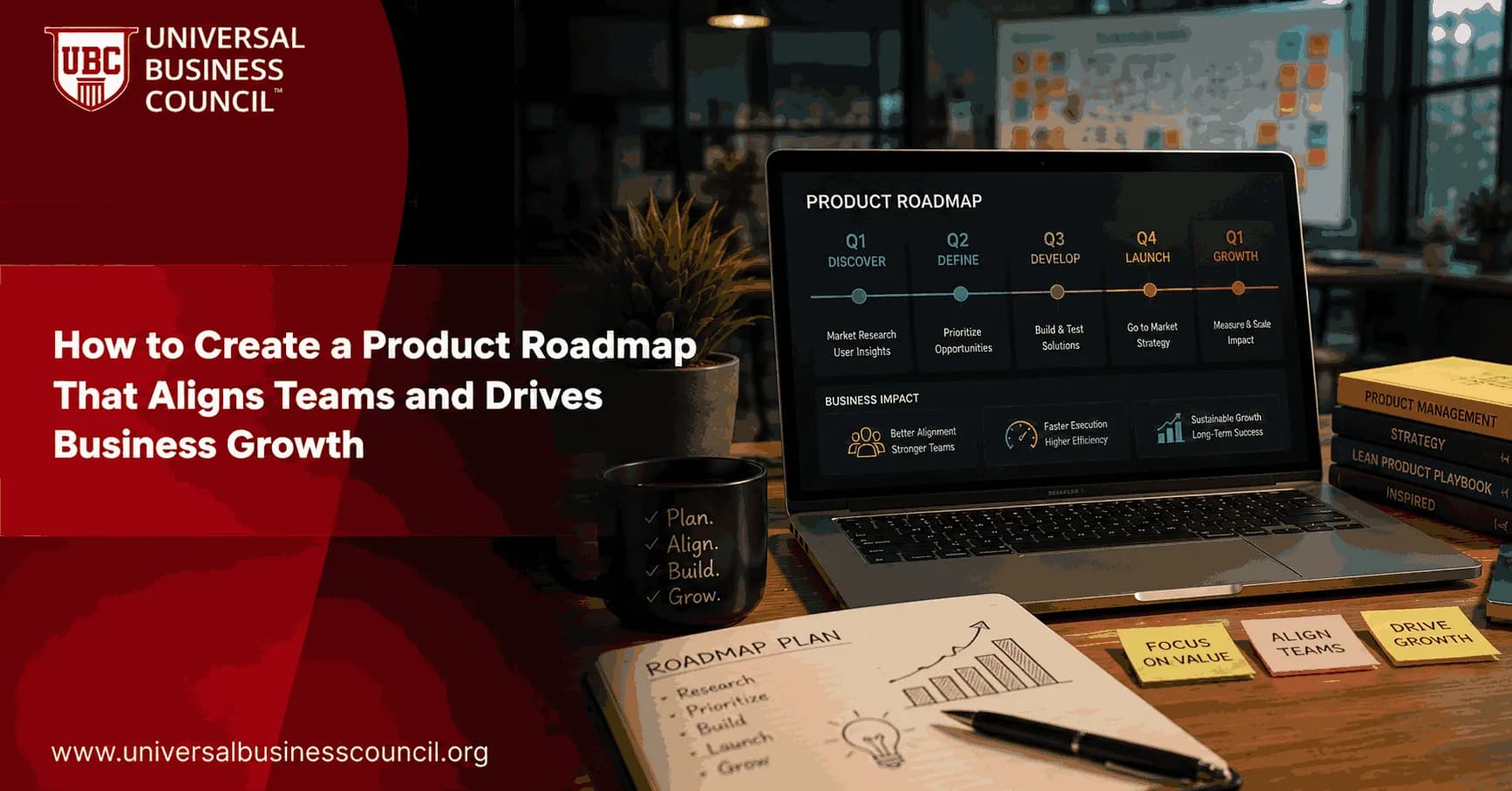
A product roadmap is not a delivery calendar. A strong roadmap links product decisions to business goals, shows teams what matters now, and gives leaders a practical way to judge whether product work is driving growth. Agile Alliance describes a roadmap as a visual strategic guide for direction and alignment, while Aha! and Productboard both stress the connection between product strategy, execution, and measurable outcomes.
That distinction matters. A feature list keeps engineers busy. A roadmap should help you decide what not to build.

What a Product Roadmap Should Actually Do
A useful product roadmap answers four questions:
Where are we going? The product vision and strategic direction.
Why does it matter? The business outcome, such as retention, revenue growth, activation, or market expansion.
What are we changing? Themes, capabilities, experiments, or initiatives.
How will we know it worked? Metrics, review dates, and learning loops.
The best roadmaps are living documents. Customer needs, market conditions, technical constraints, and company priorities change, so the roadmap has to change with them. Quarterly reviews are common. Fast-moving AI or SaaS teams may need monthly checks.
Developing these strategic planning skills is a hallmark of a Product Management Professional, helping teams align customer needs, business objectives, and product execution while adapting roadmaps as market conditions evolve.
To be blunt, a roadmap that has not changed in six months is usually either too vague to be useful or too disconnected from reality.
Start With Business Strategy, Not Features
Before you open Jira, Mural, Aha!, Productboard, Airtable, or a spreadsheet, get clear on the business strategy. If leadership is focused on reducing churn, your roadmap should not be dominated by new acquisition features unless you can prove the link.
Translate company objectives into product outcomes. For example:
Company goal: Increase net revenue retention.
Product objective: Improve expansion usage among admin users.
Roadmap theme: Self-service reporting and permission management.
Success metric: Expansion-qualified accounts using reports weekly.
OKRs work well here when they are written clearly. Avoid vague key results like "improve user experience". Use specific measures: reduce onboarding time from account creation to first completed workflow, increase trial activation, or cut support tickets tied to billing setup.
Define Outcomes Before You Define Work
Modern roadmapping is moving away from static feature schedules. Product School has noted a shift toward product principles and AI prototypes, while Airtable has highlighted the move from features to revenue. The direction is clear. Stakeholders care less about how many features ship and more about whether the product changes business performance.
Good outcome-based roadmap themes sound like this:
Increase activation for new teams.
Reduce enterprise implementation friction.
Improve model transparency for regulated AI customers.
Increase retention among high-value accounts.
Lower operational cost for support and success teams.
Weak roadmap items sound like this:
Add dashboard v2.
Build AI assistant.
Redesign settings page.
Create integrations page.
Those may become valid initiatives, but only after the outcome is clear. A practical test: if you cannot name the metric a roadmap item should move, it is not ready for prioritization.
Gather Input Without Turning the Roadmap Into a Wishlist
You need input from customers, sales, customer success, marketing, support, design, engineering, finance, and operations. You do not need to accept every request.
Use several sources:
Customer interviews: Ask what blocked adoption, renewal, or expansion.
Product analytics: Review activation, retention, funnel drop-off, usage frequency, and cohort behaviour in tools such as Google Analytics 4, Mixpanel, or Amplitude.
Sales and CRM data: Look at lost reasons, stalled opportunities, and expansion patterns in Salesforce or HubSpot.
Support tickets: Tag recurring issues by theme, not just volume.
Technical discovery: Ask engineering where reliability, architecture, or security work will affect delivery.
Here is a detail that separates clean roadmaps from noisy ones: count the same customer problem once, even when it shows up in five different channels. A single enterprise prospect, three support tickets, and a sales escalation may all point to the same permissions problem. Treat it as one problem with multiple signals, not five separate roadmap demands.
Prioritize With Transparent Criteria
Roadmap conflict is normal. Sales wants deal support. Engineering wants platform cleanup. Marketing wants launchable stories. Executives want growth. The answer is not louder debate. Use visible criteria.
RICE Scoring
RICE is useful when you need a simple, comparable score:
RICE score = Reach x Impact x Confidence / Effort
It works best when reach and effort estimates are grounded in data. It falls apart when teams inflate impact to justify a pet feature.
Value vs Effort
This one is faster and easier for workshops. Plot initiatives by expected business value and delivery effort. Do the high-value, lower-effort work first, but do not ignore strategic infrastructure. Some platform work looks low-value until it blocks every future release.
Risk vs Opportunity
This is especially useful for AI products, financial services, healthcare, and enterprise platforms. A model governance milestone, privacy review, security certification, or audit log capability may not impress a casual user, but it can decide whether the product can be sold at all.
My view: RICE is better for mid-sized product teams comparing many options. Value vs effort is better for executive alignment. Risk vs opportunity is better when compliance, reliability, or trust can make or break growth.
Use Themes and Time Horizons
A roadmap should not promise false precision. Unless dates are tied to a contractual, regulatory, or launch dependency, use time horizons such as Now, Next, and Later, or quarterly buckets.
Structure the roadmap around themes:
Now: Improve onboarding activation and reduce setup friction.
Next: Expand admin controls for enterprise accounts.
Later: Introduce AI-assisted workflow recommendations after validation and governance review.
This gives delivery teams room to learn while still giving stakeholders a clear direction. It also reduces the common mistake of treating the roadmap as a promise date for every feature.
Choose the Right Roadmap View for Each Audience
One roadmap does not mean one view. Executives, engineers, sales teams, and customers need different levels of detail.
Executive roadmap: Outcomes, investment themes, business metrics, risks, and trade-offs.
Delivery roadmap: Dependencies, epics, capacity, milestones, and sequencing.
Go-to-market roadmap: Customer value, launch timing, positioning, enablement, and commercial impact.
Customer-facing roadmap: Broad direction without overpromising dates or unvalidated features.
There is real value in two-way synchronisation between planning boards and delivery tools such as Jira. Stale roadmap slides create misalignment. If delivery status changes, the roadmap view should reflect it quickly.
Run a Cross-Functional Roadmap Workshop
Do not build the roadmap alone and reveal it like a finished sculpture. Co-create it.
A practical workshop agenda:
Restate company goals and product objectives.
Review customer evidence, usage data, revenue signals, and technical constraints.
Cluster problems into themes.
Score themes using agreed criteria.
Identify dependencies, compliance needs, and delivery risks.
Assign owners and define success metrics.
Confirm what is not being prioritized.
The last step is often the most valuable. Alignment is not only agreement on priorities. It is agreement on trade-offs.
Build Governance Into the Roadmap
Roadmap governance sounds dull. It prevents expensive mistakes.
For regulated products, include compliance, privacy, security, and risk work as first-class roadmap items. AI product teams should account for model validation, bias testing, explainability, data usage restrictions, human review workflows, and auditability. The European Union AI Act, privacy laws such as GDPR, and sector-specific rules can affect what ships and when.
If you bury governance work under engineering tasks, leaders will underestimate the timeline. Then the launch date slips, or worse, the team ships something that has to be reworked.
Use AI Carefully in Product Roadmapping
AI can help product teams synthesise feedback, cluster support tickets, draft scenarios, summarise research, and compare prioritization options. Trend reports from Product School and Airtable point to AI-powered product strategy becoming more common through 2026.
Use AI for analysis support, not final judgment. It can miss strategic context, overvalue noisy data, or treat a loud customer segment as representative. Always check AI-generated recommendations against revenue quality, customer fit, technical feasibility, and risk.
For professionals building these capabilities, Universal Business Council learning pathways in artificial intelligence, product strategy, business management, and project leadership are worth a look. The practical skill is not just using AI tools. It is knowing which product decision the tool is supposed to improve.
As AI and emerging technologies become increasingly central to product strategy, a Deep Tech Certification can help professionals develop a broader understanding of artificial intelligence, automation, blockchain, and other advanced technologies that influence long-term product decisions.
Measure Whether the Roadmap Drives Growth
A roadmap should be judged by outcomes, not presentation quality. Track leading and lagging indicators.
Leading Indicators
Activation rate.
Feature adoption among target segments.
Time to first value.
Trial-to-paid conversion.
Task completion rate.
Support ticket volume by theme.
Lagging Indicators
Revenue growth.
Gross and net retention.
Customer lifetime value.
Churn.
Expansion revenue.
NPS or customer satisfaction trends.
Review metrics at the same rhythm as the roadmap. If an onboarding theme ships but activation does not improve, do not celebrate the release and move on. Diagnose. Was the wrong user targeted? Was the feature hidden? Did marketing attract poor-fit trials? Did the sales promise differ from the product experience?
Common Roadmap Mistakes to Avoid
Listing too many features: Overcrowded roadmaps become wishlists, not strategy.
Committing to dates too early: Use dates only when there is a real dependency.
Ignoring technical debt: Reliability and scalability can be growth work.
Letting sales dictate priority alone: Revenue matters, but one deal should not distort the whole product direction.
Skipping post-launch measurement: Shipping is not success. Impact is success.
Hiding trade-offs: Teams align faster when they know what has been deprioritized and why.
Build the Roadmap as a Management System
The strongest product roadmap is a management system for growth. It connects business strategy, customer evidence, delivery capacity, and measurable outcomes. It tells a clear story, and it changes when the evidence changes.
Start this week with one move: take your current roadmap and rewrite each item as an outcome theme with one success metric. If an item cannot pass that test, put it back into discovery. Then review Universal Business Council resources in product strategy, artificial intelligence, business management, and project leadership to strengthen the skills needed to lead roadmap decisions across teams.
A Tech Certification can further strengthen this learning journey by building practical knowledge of digital technologies, cloud platforms, software ecosystems, and innovation trends that support modern product strategy and business growth.
FAQs
1. What Is a Product Roadmap?
A product roadmap is a strategic plan that outlines a product's vision, goals, priorities, and planned features over time. It helps teams understand what will be built, why it matters, and how it supports business objectives.
2. Why Is a Product Roadmap Important?
A product roadmap aligns product development with business goals, improves team collaboration, communicates priorities, and ensures everyone works toward a shared vision while delivering value to customers.
3. How Does a Product Roadmap Support Business Growth?
A well-defined roadmap helps organizations prioritize high-impact initiatives, allocate resources effectively, accelerate innovation, improve customer satisfaction, and achieve long-term business objectives.
4. What Are the Key Components of a Product Roadmap?
A product roadmap typically includes product vision, strategic goals, major initiatives, prioritized features, timelines, milestones, success metrics, dependencies, and target outcomes.
5. How Do You Create a Product Roadmap?
Start by defining your product vision, understanding customer needs, identifying business goals, prioritizing initiatives, gathering stakeholder input, establishing timelines, and reviewing the roadmap regularly.
6. How Should Product Managers Prioritize Roadmap Features?
Features should be prioritized based on customer value, business impact, market demand, technical feasibility, strategic alignment, available resources, and measurable outcomes.
7. Why Is Customer Feedback Important When Building a Product Roadmap?
Customer feedback helps product managers understand user needs, validate product ideas, identify pain points, and prioritize features that deliver meaningful value and improve user satisfaction.
8. How Does Market Research Improve Product Roadmaps?
Market research provides insights into customer behavior, industry trends, competitor strategies, and emerging opportunities, helping teams make informed roadmap decisions.
9. How Can Product Roadmaps Align Cross-Functional Teams?
Roadmaps provide shared visibility into priorities, timelines, and objectives, helping product, engineering, design, marketing, sales, and leadership teams collaborate more effectively.
10. What Is the Difference Between a Product Roadmap and a Product Backlog?
A product roadmap focuses on strategic direction and long-term priorities, while a product backlog contains detailed tasks, user stories, and development work planned for implementation.
11. How Often Should a Product Roadmap Be Updated?
Product roadmaps should be reviewed regularly, often quarterly or after major business, customer, or market changes, to ensure priorities remain aligned with organizational goals.
12. What Metrics Should Product Managers Track to Evaluate Roadmap Success?
Important metrics include customer satisfaction (CSAT), Net Promoter Score (NPS), feature adoption, user retention, revenue growth, product usage, customer feedback, and return on investment (ROI).
13. How Does Artificial Intelligence Improve Product Roadmap Planning?
AI helps analyze customer feedback, identify market trends, forecast demand, prioritize features, and generate insights that support faster and more data-driven roadmap decisions.
14. Which Tools Are Commonly Used for Product Roadmapping?
Popular tools include Jira, Productboard, Aha!, Roadmunk, Notion, Trello, Asana, Miro, Confluence, Microsoft Planner, and ClickUp.
15. What Challenges Do Product Managers Face When Creating Roadmaps?
Common challenges include balancing stakeholder expectations, changing customer needs, limited development resources, shifting market conditions, and managing competing business priorities.
16. How Can Businesses Align Product Roadmaps with Company Strategy?
Organizations should connect roadmap initiatives to strategic business goals, customer outcomes, market opportunities, measurable KPIs, and long-term product vision.
17. How Can Product Managers Communicate Roadmaps Effectively?
Use clear visuals, explain business priorities, focus on outcomes rather than detailed tasks, involve stakeholders early, and communicate updates regularly to maintain alignment.
18. How Can Businesses Measure the Success of a Product Roadmap?
Success can be measured through improved customer satisfaction, feature adoption, faster product delivery, stronger team alignment, increased revenue, market growth, and achievement of strategic objectives.
19. What Common Mistakes Should Product Managers Avoid When Building Roadmaps?
Avoid treating the roadmap as a fixed commitment, including too many priorities, ignoring customer feedback, failing to align with business goals, and communicating only timelines instead of desired outcomes. An effective roadmap should remain flexible, strategic, and customer-focused.
20. How Can a Product Roadmap Drive Long-Term Business Growth?
A strong product roadmap connects customer needs with business strategy, helping teams prioritize the right initiatives, adapt to changing market conditions, and deliver continuous value. By maintaining alignment across departments, using data-driven insights, and regularly refining priorities, organizations can accelerate innovation, strengthen collaboration, improve customer loyalty, and achieve sustainable business growth.
Related Articles
View All
Artificial Intelligence
How Tosheo Helps Create AI Microdramas
Discover how Tosheo helps creators develop AI microdramas, from story ideas and characters to vertical episodes, dialogue, visuals, editing, and final production.

Artificial Intelligence
Create Your Own Microdrama with AI: From Story Idea to Finished Video
Learn how to create a microdrama with AI, from developing the story and script to generating visuals, voiceovers, scenes, and a finished short-form video.

Artificial Intelligence
Can AI Create a More Capable Version of Itself?
Explore whether AI can create a more capable version of itself, how automated model design and optimization work, and what technical and safety challenges still remain.
Trending Articles
The Role of Blockchain in Ethical AI Development
How blockchain technology is being used to promote transparency and accountability in artificial intelligence systems.
AWS Career Roadmap
A step-by-step guide to building a successful career in Amazon Web Services cloud computing.
Top 5 DeFi Platforms
Explore the leading decentralized finance platforms and what makes each one unique in the evolving DeFi landscape.