

Product Manager Skills for Leading High-Performing Product Teams
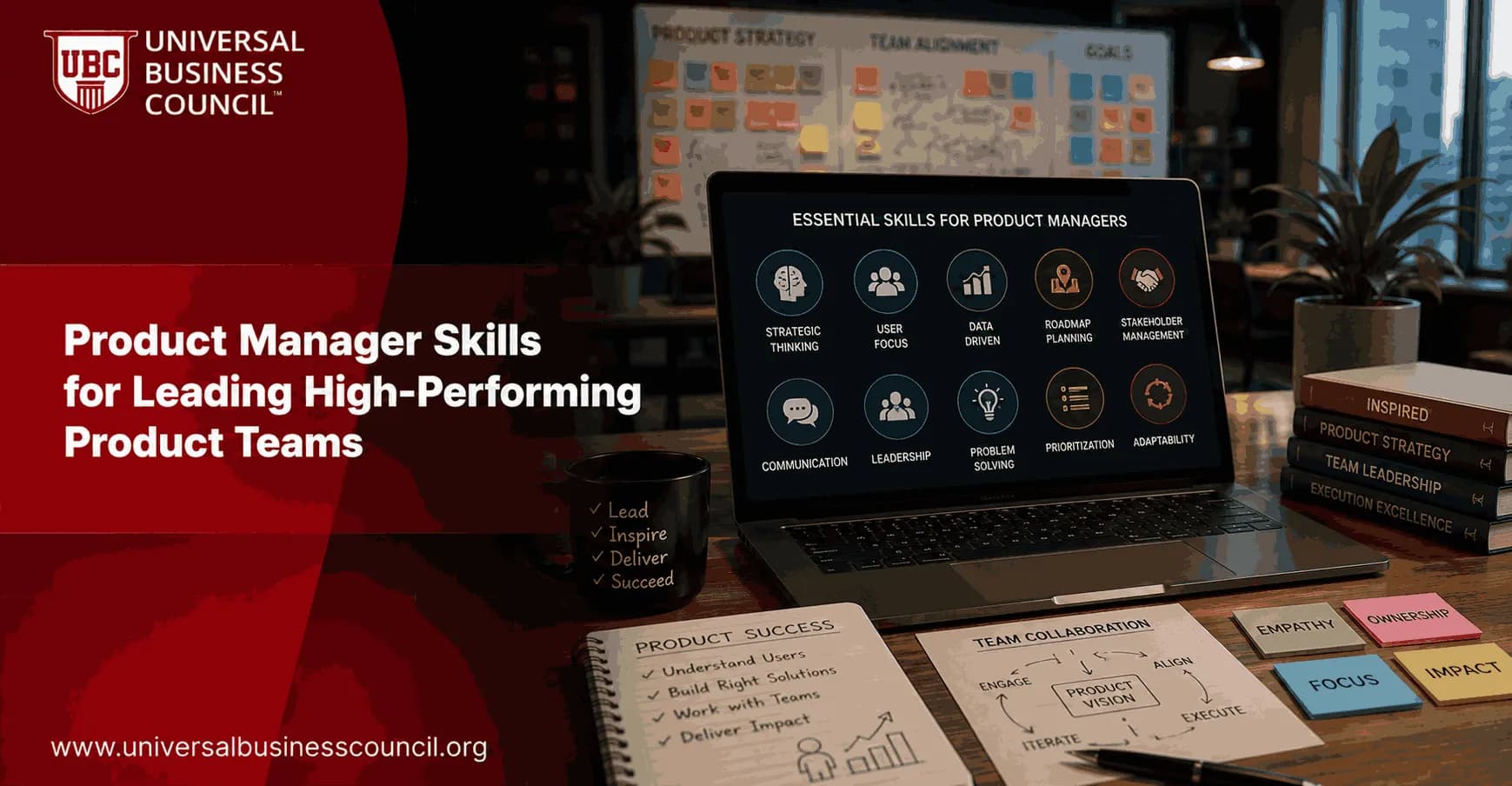
Product manager skills now cover far more than writing user stories and maintaining a roadmap. If you lead a product team, you need to connect strategy, customer insight, analytics, technical trade-offs, and stakeholder alignment into decisions your team can actually execute.
That is the hard part. Most product failures do not happen because a PM forgot a template. They happen because the team builds the wrong thing, measures the wrong signal, or avoids the difficult conversation with sales, engineering, finance, or leadership. High-performing product teams need product managers who can make those calls with evidence and clarity.

What the Modern Product Manager Actually Owns
A product manager identifies customer needs, aligns the product with business objectives, defines what success looks like, and rallies the team around a shared direction. The role sits at the intersection of business, technology, and user experience.
That intersection is not theoretical. On Monday, you may be discussing gross margin impact with finance. On Tuesday, you are reviewing funnel drop-off in Google Analytics 4 or Amplitude. By Wednesday, you are asking engineering whether a proposed feature requires a schema change, a new API endpoint, or a longer migration plan.
Strong product manager skills fall into seven practical clusters:
Strategic and business leadership
Customer and UX understanding
Data literacy and experimentation
Technical fluency
Communication and stakeholder management
Prioritization and roadmap execution
AI tool proficiency
Developing these capabilities is a defining characteristic of a Product Management Professional, combining strategic thinking, customer understanding, data-driven decision-making, and cross-functional leadership to deliver products that create measurable business value.
Strategic Thinking and Business Acumen
A product manager without strategy becomes a request handler. That is a bad place to be. Strategic product management means deciding where the product should compete, which user problem matters most, and which business outcome justifies the investment.
The core tension is balancing business objectives with user needs. In practice, you should be comfortable with:
Business models: subscriptions, usage-based pricing, marketplaces, services, and hybrid models
Financial metrics: CAC, LTV, gross margin, churn, expansion revenue, payback period
Market analysis: customer segments, competitive positioning, Porter's Five Forces, and category maturity
Goal setting: OKRs, North Star metrics, and quarterly product bets
Be careful with strategy theater. A polished slide deck with five pillars is not a strategy if every feature still gets approved. A useful strategy says no. It also explains why.
Customer Understanding and UX Judgment
The best PMs do not outsource customer understanding to research teams and then read the summary two weeks later. They listen to calls. They watch session recordings. They read support tickets. They sit with customer success when renewals are at risk.
Research, customer feedback, and prioritization built on real user problems sit at the heart of the role. Bring the product to market around real customer jobs, not internal assumptions.
Good customer work includes:
Interviewing users without leading them to the answer you want
Separating stated preference from observed behavior
Mapping jobs to be done, pain points, and switching triggers
Testing prototypes before the sprint commitment is locked
Working with design on usability, accessibility, and information architecture
Here is a practical detail that catches newer PMs: the biggest onboarding leak is often not account creation. It is the first value action. In a B2B product, that might be inviting a teammate, importing a CSV, connecting Salesforce, or publishing the first workflow. If your dashboard only reports sign-ups, you may be celebrating users who never reached value.
Data Literacy and Product Analytics
Data literacy is one of the most important product manager skills because it changes the conversation from opinion to evidence. Analysis, KPIs, and market research are core to the job.
You do not need to be a data scientist. You do need to know when the chart is lying.
Metrics product managers should understand
Acquisition: traffic source, conversion rate, CAC, ROAS
Activation: first value action, time to value, onboarding completion
Engagement: DAU, WAU, feature adoption, frequency of use
Retention: cohort retention, churn, renewal rate
Monetization: ARPU, expansion revenue, LTV, payback period
Customer sentiment: NPS, CSAT, support volume, complaint themes
Use data to form better questions, not just to defend a decision you already made. If activation is flat but feature usage is rising among existing customers, the roadmap problem may be different from the growth problem. That distinction matters.
Technical Fluency Without Pretending to Be an Engineer
PMs do not need to code, but they do need a solid handle on the technical side of product development. The standard is understanding APIs, architecture, and development methods well enough to bridge product and engineering.
That is the right bar. You should be able to ask sharp questions such as:
Does this require a frontend change, backend change, or both?
Are we adding technical debt or paying it down?
What happens to existing customers during migration?
Is this dependency inside our team or owned by another platform team?
What are the security, privacy, and compliance implications?
Agile and Scrum knowledge also matters, but do not confuse ceremony with delivery. A team can run perfect standups and still ship low-value work. Your job is to keep the backlog connected to outcomes, not just tickets.
Communication, Influence, and Stakeholder Alignment
Product managers rarely have formal authority over engineering, design, marketing, sales, support, or finance. Yet they must align all of them. Influence without authority is a central product leadership skill.
This is where many technically strong PMs struggle. They know the right answer but cannot get the organization to move.
Communication is not just presenting well. It includes:
Writing clear one-page product briefs
Explaining trade-offs in plain language
Facilitating tense prioritization meetings
Giving executives the decision they need, not a data dump
Helping engineers understand customer context
Telling sales why a requested feature is not on the roadmap yet
To be blunt, stakeholder alignment is often where roadmaps go to die. If sales hears commitment, engineering hears exploration, and leadership hears revenue forecast, you have not aligned anyone. Write down the decision, the owner, the success metric, and what is explicitly out of scope.
Prioritization and Roadmap Management
Prioritization is not a workshop exercise. It is the daily discipline of choosing what not to do.
Popular frameworks can help, but each has limits:
RICE: useful when you can estimate reach, impact, confidence, and effort with reasonable accuracy
MoSCoW: helpful for release scoping, but weak when every stakeholder labels their request as must-have
Kano: useful for understanding customer satisfaction, especially around basic needs and delight features
Opportunity Solution Tree: strong for discovery because it connects outcomes, opportunities, and experiments
My position: RICE is good for transparent debate, but it is overused when the inputs are guesses. If confidence is low, run discovery before assigning a fake score. A false sense of precision is worse than honest uncertainty.
AI Literacy for Product Managers
AI tool proficiency is becoming part of the modern product manager skill set, especially for research, data analysis, and day-to-day productivity.
Used well, AI can help you:
Cluster customer feedback from support tickets or interview notes
Draft first-pass product requirements for review
Summarize competitive messaging across public sources
Generate testable hypothesis lists
Speed up qualitative theme analysis
Used badly, AI creates confident nonsense. Do not paste sensitive customer data into tools without checking privacy rules. Do not treat AI-generated research themes as facts until you validate them against source material. For product teams working with AI features, PMs also need basic knowledge of model behavior, bias, evaluation metrics, and human review workflows.
As AI and emerging technologies become central to product strategy, a Deep Tech Certification can help professionals build a broader understanding of artificial intelligence, automation, blockchain, and other advanced technologies that increasingly influence product development and innovation.
How to Build These Product Manager Skills
If you want to become a stronger product leader, build skill in layers. Do not try to master everything at once.
Start with the customer: run five interviews, review ten support tickets, and map the first value action.
Clean up your metrics: define activation, retention, and revenue measures before your next roadmap review.
Improve one technical conversation: ask engineering to walk you through the architecture behind your next feature.
Practice prioritization: use RICE or an opportunity tree, then document what you rejected and why.
Strengthen communication: write a one-page product brief with problem, audience, evidence, trade-offs, and success metric.
Add AI carefully: use AI for synthesis and drafting, but keep human judgment in research, ethics, and final decisions.
For structured development, this topic connects naturally with Universal Business Council learning paths in business, management, marketing, and artificial intelligence. Teams can also link this guide to the Universal Business Council certifications catalog when designing product leadership training for PMs, founders, analysts, and technology managers.
What High-Performing Product Teams Expect From You
High-performing product teams do not need a PM who controls every detail. They need a PM who clarifies direction, sharpens trade-offs, protects focus, and keeps the work tied to customer and business outcomes.
Your next step is simple: choose one product outcome for the next quarter, such as activation, retention, or expansion revenue. Define the metric, identify the customer problem behind it, and build your roadmap around that evidence. Then strengthen the product manager skills that help you make the next decision faster and better.
A Tech Certification can further strengthen this learning journey by expanding your understanding of digital technologies, software ecosystems, cloud platforms, and innovation trends that support modern product management and long-term business growth.
FAQs
1. What Skills Does a Product Manager Need?
A successful Product Manager needs a combination of leadership, communication, strategic thinking, customer empathy, problem-solving, data analysis, stakeholder management, and product planning skills to guide products from idea to launch.
2. Why Are Product Manager Skills Important?
Strong product management skills help teams build products that solve customer problems, align with business goals, improve collaboration, reduce development risks, and increase product success.
3. What Leadership Skills Should Product Managers Develop?
Product Managers should develop decision-making, conflict resolution, team motivation, coaching, delegation, adaptability, and strategic leadership skills to guide cross-functional teams effectively.
4. How Important Is Communication for Product Managers?
Communication is one of the most important Product Manager skills. Clear communication helps align stakeholders, explain product vision, prioritize work, gather feedback, and ensure teams remain focused on shared objectives.
5. Why Is Customer Empathy Essential for Product Managers?
Customer empathy enables Product Managers to understand user needs, identify pain points, validate product ideas, and build solutions that deliver meaningful value and improve customer satisfaction.
6. How Do Product Managers Make Better Decisions?
Product Managers use customer research, product analytics, market trends, business goals, and stakeholder input to prioritize opportunities and make informed, data-driven decisions.
7. What Analytical Skills Should Product Managers Learn?
Key analytical skills include data interpretation, KPI tracking, A/B testing, market analysis, product metrics, forecasting, business analysis, and performance evaluation.
8. How Does Strategic Thinking Improve Product Management?
Strategic thinking helps Product Managers define long-term product vision, prioritize initiatives, identify growth opportunities, and align product decisions with business objectives.
9. Why Is Stakeholder Management Important?
Product Managers work with executives, engineers, designers, marketers, sales teams, and customers. Strong stakeholder management ensures alignment, manages expectations, and supports faster decision-making.
10. How Do Product Managers Build High-Performing Teams?
They establish clear goals, encourage collaboration, promote accountability, support continuous learning, communicate openly, remove obstacles, and create an environment where teams can perform at their best.
11. What Role Does Agile Play in Product Management?
Agile helps Product Managers deliver value faster through iterative development, continuous customer feedback, flexible planning, and close collaboration with cross-functional teams.
12. How Can Product Managers Improve Team Collaboration?
Product Managers improve collaboration by sharing a clear product vision, maintaining transparent communication, facilitating regular planning sessions, resolving conflicts, and encouraging cross-functional teamwork.
13. How Does Artificial Intelligence Support Product Managers?
AI helps analyze customer feedback, identify product trends, prioritize features, automate reporting, forecast demand, and provide insights that improve product strategy and decision-making.
14. Which Tools Should Product Managers Learn?
Popular tools include Jira, Productboard, Aha!, Trello, Asana, Notion, Confluence, Miro, Figma, Mixpanel, Google Analytics, Power BI, Tableau, and Slack.
15. What Metrics Should Product Managers Track?
Important metrics include customer satisfaction (CSAT), Net Promoter Score (NPS), customer retention, feature adoption, user engagement, churn rate, conversion rate, revenue growth, and customer lifetime value (CLV).
16. What Challenges Do Product Managers Face When Leading Teams?
Common challenges include balancing competing priorities, aligning stakeholders, managing limited resources, handling changing customer needs, resolving conflicts, and making decisions with incomplete information.
17. How Can Product Managers Continue Developing Their Skills?
Professionals should seek customer feedback, analyze successful products, practice strategic thinking, build leadership experience, earn certifications, learn AI tools, and stay informed about market trends.
18. What Certifications Can Help Product Managers Advance Their Careers?
Popular certifications include Certified Scrum Product Owner (CSPO), PMI certifications, Product School certifications, Pragmatic Institute programs, Google Project Management Certificate, and Agile certifications.
19. What Common Mistakes Should Product Managers Avoid?
Avoid prioritizing features without customer validation, failing to communicate product strategy, ignoring product metrics, making decisions based only on opinions, neglecting stakeholder alignment, and focusing solely on delivery instead of customer outcomes. High-performing Product Managers balance business goals, user needs, and team collaboration.
20. How Can Product Managers Lead High-Performing Product Teams?
Product Managers lead high-performing teams by combining strong leadership, customer focus, strategic thinking, and data-driven decision-making. By fostering collaboration, empowering cross-functional teams, embracing Agile practices, leveraging AI-powered insights, and continuously learning from customer feedback, Product Managers can build successful products while creating an environment where teams consistently deliver innovation, quality, and measurable business value.
Related Articles
View All
Artificial Intelligence
Gemini 4 Argon: Features, Pricing, and Availability
Gemini 4 Argon is Google’s new flagship AI model for coding, science, finance, law and security. See its main features, API and subscription pricing, and where you can access it today.

Artificial Intelligence
What Is Meta Muse Wonder? Features and How It Works
Meta Muse Wonder is a new frontier AI model built for agents with Active Memory and Active Focus. Learn what it is, how it works, its features, pricing and how to access it.

Artificial Intelligence
What Is Google Playground? Features and How It Works
What is Google Playground? Learn how Google's new AI platform turns text prompts into playable browser games, which models power it, its features, pricing and access, Unity Spark plans, rival tools, and limits.
Trending Articles
The Role of Blockchain in Ethical AI Development
How blockchain technology is being used to promote transparency and accountability in artificial intelligence systems.
AWS Career Roadmap
A step-by-step guide to building a successful career in Amazon Web Services cloud computing.
Top 5 DeFi Platforms
Explore the leading decentralized finance platforms and what makes each one unique in the evolving DeFi landscape.