

How to Become an AI Product Manager: Career Path, Skills, and Certifications
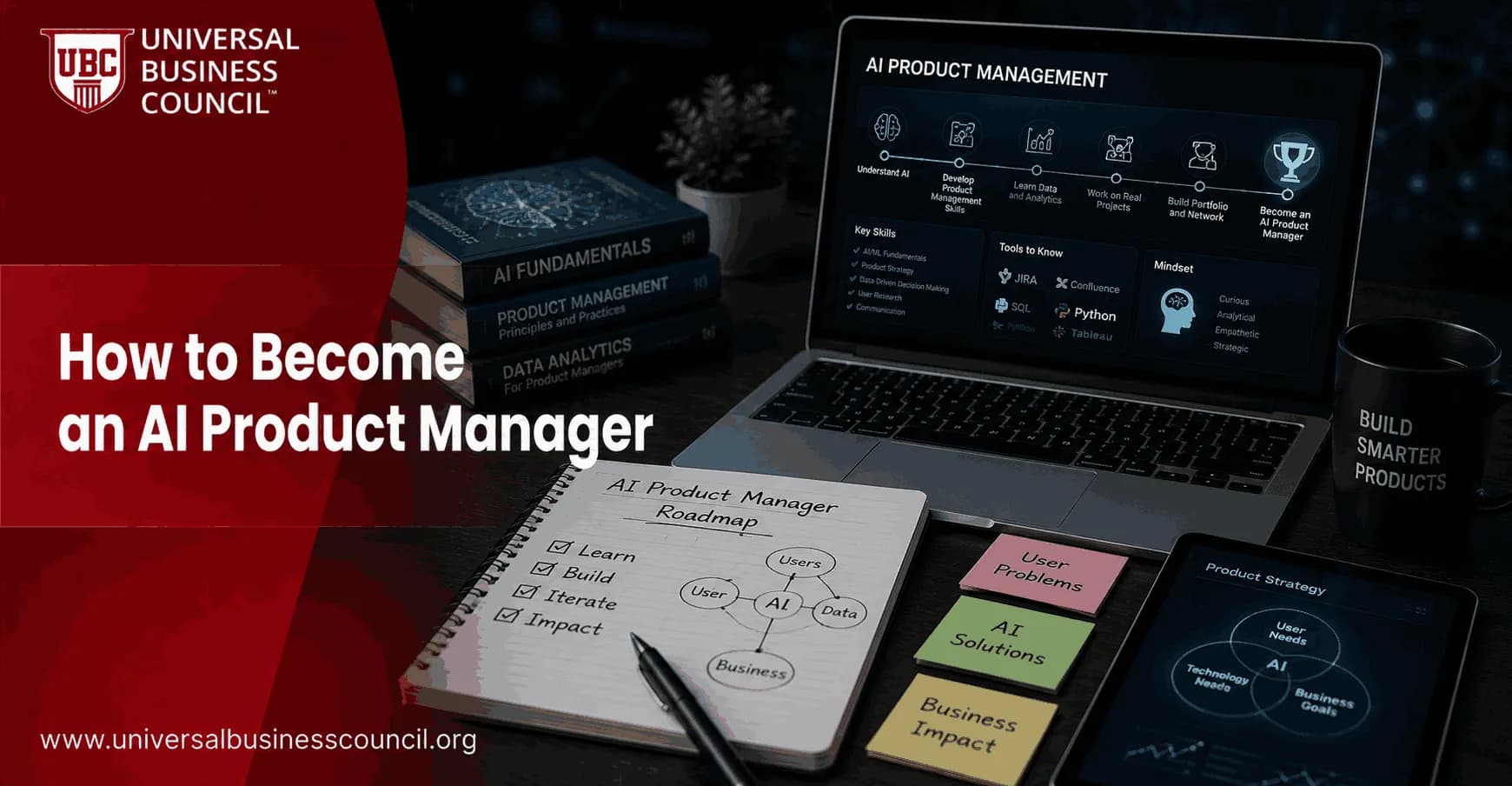
Becoming an AI Product Manager means learning two jobs at once: classic product management and the messy, probabilistic reality of AI systems. You still need discovery, prioritization, stakeholder management, pricing sense, and launch discipline. But you also need to understand data quality, model behavior, evaluation metrics, bias, human oversight, and the regulations now shaping AI products.
The role is not just a trend label. McKinsey's State of AI research has shown continued growth in AI adoption, especially generative AI, while also pointing to shortages in AI-specific talent. Salary data reflects that demand. Pay varies widely by market and company, but the premium for people who can connect product judgment with AI literacy is real.

For professionals entering this field, a Product Management Certification can help build a strong foundation in product strategy, customer discovery, prioritization, and product lifecycle management before tackling the additional complexity of AI-powered products.
What Does an AI Product Manager Do?
An AI Product Manager defines, builds, launches, and improves products or features that use machine learning, generative AI, natural language processing, recommendation systems, prediction models, or related AI techniques.
The job sits between business goals and technical execution. You translate a real customer problem into an AI use case, then work with data scientists, engineers, designers, legal teams, operations, sales, and executives to ship something that works in production.
Core responsibilities
Identify AI use cases: Find where AI can improve user experience, reduce cost, improve decision quality, or create a new product capability.
Write product requirements: Define users, workflows, success metrics, model constraints, failure modes, and release criteria.
Manage the data and model lifecycle: Work with teams on data availability, labeling, training, evaluation, deployment, monitoring, and iteration.
Design for uncertainty: AI outputs are probabilistic. You need fallback states, human review, confidence thresholds, and clear user messaging.
Own business outcomes: Track CAC, LTV, churn, ROAS, retention, activation, support deflection, productivity, or revenue impact, depending on the product.
Support responsible AI: Build in bias checks, transparency, privacy controls, documentation, human oversight, and post-launch monitoring.
Here is a practical example. In a customer support chatbot, leadership may care about ticket deflection. Your data science team may care about accuracy. Support managers will care about escalation rate and CSAT. The AI PM has to hold all three in the same dashboard. If deflection rises but CSAT drops, the product is not winning. That is the kind of trade-off that trips up first-time AI PMs.
AI Product Manager vs Traditional Product Manager
A traditional product manager can often define a feature, specify expected behavior, and test whether the team built it correctly. AI products are different. The system may give different outputs depending on data, prompts, context, user behavior, or model updates.
That changes the product operating model.
You define acceptable error, not just ideal behavior.
You measure model quality before and after launch.
You work with data pipelines, not only application code.
You plan for drift, edge cases, abuse, and regulatory review.
You explain uncertainty to executives who may expect deterministic software.
To be blunt, adding AI to a roadmap without a customer problem is usually waste. A weak AI feature with poor data will not become valuable because the model is fashionable. Strong AI Product Managers start with the workflow, the user pain, and the business metric. The model comes later.
Skills You Need to Become an AI Product Manager
1. Product management fundamentals
You need the basics first. Do not skip them.
User research and problem discovery
Product strategy and positioning
Roadmapping and prioritization
Experiment design and A/B testing
Go-to-market planning
Stakeholder communication
Commercial thinking, including pricing and unit economics
Frameworks such as OKRs, the 4Ps of marketing, Porter's Five Forces, RICE scoring, and jobs-to-be-done are still useful. AI does not replace product discipline. It punishes teams that lack it.
2. AI and data literacy
You do not need to become a machine learning engineer. You do need to know enough to ask better questions.
Build working knowledge of:
Supervised and unsupervised learning
Classification, regression, clustering, and ranking
Generative AI and large language models
Prompt design and retrieval augmented generation
Precision, recall, F1 score, latency, hallucination rate, and confidence thresholds
Training data, validation data, labeling, drift, and data quality
APIs, cloud services, analytics tools, and product instrumentation
For product analytics, get comfortable with Google Analytics 4, Amplitude, Mixpanel, SQL basics, and BI tools. For customer and revenue workflows, understand how platforms such as Salesforce, HubSpot, and Zendesk store the data your AI feature may depend on.
As AI becomes central to customer engagement, understanding AI Powered Digital Marketing can help product managers design more personalized user experiences, optimize customer journeys, and make better data-driven growth decisions.
3. Responsible AI and regulation
This skill is moving from optional to mandatory. The EU AI Act uses a risk-based framework for AI systems, with stricter obligations for high-risk uses. The Act can affect companies outside Europe if their AI products or services are used in the EU.
As an AI PM, you should understand:
Risk classification
Bias and fairness testing
Explainability and transparency
Human-in-the-loop design
Privacy and security controls
Model documentation
Post-deployment monitoring
In healthcare, finance, employment, education, and safety-related systems, the bar is higher. A clever prototype is not enough. You need evidence, audit trails, quality management, and clear escalation paths.
4. Communication across technical and non-technical teams
Your job is translation. Data scientists may discuss recall degradation. Sales may ask whether the feature will close enterprise deals. Legal may ask about consent and explainability. Executives may ask when revenue shows up.
Good AI PMs make those conversations concrete. Use decision memos. Define metric owners. Write down what the model will not do. Put risks in plain language.
Career Path: How to Become an AI Product Manager
There is no single route. Most AI Product Managers come from one of four backgrounds: product management, software engineering, data science, or business analysis. The transition is easiest when you can show shipped work, not just coursework.
Step 1: Build core product capability
If you are new to product, start with user research, prioritization, PRDs, roadmaps, and product analytics. Take ownership of a small feature. Learn how trade-offs are made when time, budget, and engineering capacity are limited.
Step 2: Learn AI fundamentals
Study machine learning concepts, generative AI architecture at a high level, model evaluation, and data workflows. You should be able to explain why a recommendation model needs feedback data, why a chatbot needs guardrails, and why accuracy alone is often a poor product metric.
Step 3: Work on AI-adjacent projects
Look for internal projects: search ranking, personalization, fraud detection, churn prediction, support automation, forecasting, or analytics. You do not need the AI PM title yet. You need the reps.
Step 4: Create portfolio artifacts
Build evidence. Write a short PRD for an AI feature. Create a model evaluation plan. Document a responsible AI risk review. Show how you would measure business impact. Hiring managers want proof that you can think through ambiguity.
Step 5: Apply for AI Product Manager roles
Target roles where your background gives you an edge. If you come from customer support operations, AI support automation may fit. If you worked in e-commerce, recommendation systems and merchandising AI may be a better entry point. If you worked in compliance, responsible AI product roles may be your strongest lane.
Best Certifications for AI Product Managers
Certifications help when they close a real skill gap. They do not replace product judgment or shipped experience. Choose based on your current weakness.
If you lack product fundamentals: start with product management training, strategy, user research, and go-to-market coursework.
If you lack AI literacy: choose a program covering machine learning basics, generative AI, prompt engineering, data workflows, and model evaluation.
If you work in enterprise delivery: consider training that includes agile delivery, governance, stakeholder management, and portfolio planning.
If you work in regulated sectors: prioritize responsible AI, compliance, documentation, privacy, and risk management.
Programs in the market include the IBM AI Product Manager Professional Certificate, Product School's AI product management courses, and Pragmatic Institute's AI Product Management training. Compare curriculum depth, project work, instructor quality, and assessment standards before you enroll.
Universal Business Council certification pathways in artificial intelligence, business management, strategic management, marketing, and digital transformation support the AI PM skill mix: technical fluency, business strategy, market analysis, and leadership. Pick the pathway that matches your weakest area, not the one with the most impressive name.
A Tech Certification can further strengthen these skills by providing broader knowledge of emerging technologies, cloud platforms, digital transformation, and software ecosystems that support modern AI product development.
Salary and Demand Outlook
The outlook is strong, but not immune to market cycles. General product management hiring has seen periodic slowdowns, while AI-related roles have continued to attract attention because companies are trying to move from pilots to production systems.
Compensation depends on geography, seniority, domain, company stage, and whether AI is central to the product or just an added feature. Several benchmarks place US AI Product Manager pay above typical PM roles, with startup figures running higher than the general average. Deep domain knowledge matters most. An AI PM who understands medical device regulation, supply chain forecasting, or enterprise security can command more than a generalist chasing AI headlines.
Is AI Product Management Right for You?
Choose this path if you like ambiguity, data, customer problems, and cross-functional decision-making. Avoid it if you only want to work on shiny prototypes. Production AI is full of unglamorous work: data cleanup, monitoring dashboards, failed experiments, documentation, and uncomfortable risk reviews.
A good next step is simple. Pick one AI use case in your current organization and write a one-page product brief: user problem, data needed, model approach, success metrics, risks, human oversight, and launch plan. Then pair that with structured training through a recognized AI, product management, or business certification pathway, including relevant Universal Business Council programs where they fit your career goal.
Professionals looking to stay ahead of the next wave of innovation may also consider a Deeptech Certification to build a broader understanding of AI, robotics, blockchain, and other advanced technologies that are shaping the future of product management and digital business.
FAQs
1. What Is an AI Product Manager?
An AI Product Manager is responsible for planning, developing, launching, and improving AI-powered products. They work with engineers, data scientists, designers, and business teams to ensure AI solutions solve real customer and business problems.
2. What Does an AI Product Manager Do?
An AI Product Manager defines product strategy, prioritizes features, gathers customer requirements, manages AI product roadmaps, collaborates with technical teams, and measures product success using business and user metrics.
3. Why Is AI Product Management a Growing Career?
As AI adoption accelerates across industries, organizations need professionals who can combine product management expertise with AI knowledge to build valuable, responsible, and scalable AI-powered products.
4. What Skills Are Required to Become an AI Product Manager?
Key skills include product management, AI fundamentals, data analysis, user research, market research, Agile methodologies, communication, leadership, business strategy, and problem-solving.
5. Do You Need a Technical Background to Become an AI Product Manager?
Not necessarily. While technical knowledge is valuable, many successful AI Product Managers come from business, product, marketing, or consulting backgrounds and develop a working understanding of AI technologies.
6. What AI Concepts Should an AI Product Manager Understand?
AI Product Managers should understand machine learning, generative AI, large language models (LLMs), natural language processing (NLP), computer vision, recommendation systems, and predictive analytics.
7. How Is an AI Product Manager Different from a Traditional Product Manager?
An AI Product Manager manages products that rely on AI capabilities, requiring additional knowledge of AI model behavior, data quality, model evaluation, AI ethics, and continuous model improvement.
8. What Programming Skills Should an AI Product Manager Learn?
Programming is not always required, but learning basic Python, SQL, APIs, and data analysis concepts helps AI Product Managers communicate more effectively with technical teams.
9. What Role Does Data Play in AI Product Management?
Data is the foundation of AI products. AI Product Managers help define data requirements, monitor data quality, understand user behavior, and ensure AI systems have the information needed to perform effectively.
10. How Can Someone Transition into AI Product Management?
Professionals can transition by building product management experience, learning AI fundamentals, completing AI certifications, working on AI projects, and gaining experience with data-driven product development.
11. What Certifications Can Help You Become an AI Product Manager?
Popular certifications include Google Project Management, Certified Scrum Product Owner (CSPO), PMI certifications, Microsoft AI certifications, AWS AI certifications, and executive AI product management programs.
12. Which Tools Should AI Product Managers Learn?
Common tools include Jira, Confluence, Figma, Notion, Miro, Power BI, Tableau, SQL, ChatGPT, GitHub, Google Analytics, Mixpanel, and product analytics platforms.
13. How Does an AI Product Manager Work with AI Engineers?
AI Product Managers define business requirements, prioritize features, clarify customer needs, review AI capabilities, and collaborate with engineers throughout product development and deployment.
14. What Metrics Should AI Product Managers Track?
Important metrics include user adoption, customer satisfaction, feature usage, retention, revenue growth, model accuracy, latency, operational efficiency, and return on investment (ROI).
15. What Industries Hire AI Product Managers?
AI Product Managers are employed in technology, healthcare, finance, retail, education, cybersecurity, manufacturing, logistics, marketing, and enterprise software companies.
16. What Challenges Do AI Product Managers Face?
Common challenges include managing AI limitations, ensuring high-quality data, balancing customer expectations, addressing ethical concerns, meeting regulatory requirements, and coordinating cross-functional teams.
17. How Can You Gain Practical Experience in AI Product Management?
Build AI product case studies, contribute to AI projects, work with AI-powered applications, practice writing product requirement documents (PRDs), and develop product roadmaps using real business scenarios.
18. What Career Path Can Lead to AI Product Manager Roles?
Many professionals move from Product Manager, Business Analyst, Software Engineer, UX Designer, Data Analyst, Technical Product Manager, or Project Manager roles into AI Product Management.
19. What Common Mistakes Should Aspiring AI Product Managers Avoid?
Avoid focusing only on AI technology, ignoring customer needs, overlooking data quality, neglecting AI governance, and measuring success only by model accuracy. Successful AI products solve real business problems and deliver measurable value, not just impressive technical capabilities.
20. What Is the Best Roadmap to Become an AI Product Manager?
Start by building strong product management fundamentals, learn AI and machine learning concepts, develop data literacy, understand user-centered design, master Agile methodologies, earn relevant certifications, and gain hands-on experience with AI products. Professionals who combine business strategy, technical awareness, customer focus, and leadership skills will be well positioned to build successful AI-powered products and advance in this rapidly growing career.
Related Articles
View All
Artificial Intelligence
Gemini 4 Argon: Features, Pricing, and Availability
Gemini 4 Argon is Google’s new flagship AI model for coding, science, finance, law and security. See its main features, API and subscription pricing, and where you can access it today.

Artificial Intelligence
What Is Meta Muse Wonder? Features and How It Works
Meta Muse Wonder is a new frontier AI model built for agents with Active Memory and Active Focus. Learn what it is, how it works, its features, pricing and how to access it.

Artificial Intelligence
What Is Google Playground? Features and How It Works
What is Google Playground? Learn how Google's new AI platform turns text prompts into playable browser games, which models power it, its features, pricing and access, Unity Spark plans, rival tools, and limits.
Trending Articles
The Role of Blockchain in Ethical AI Development
How blockchain technology is being used to promote transparency and accountability in artificial intelligence systems.
AWS Career Roadmap
A step-by-step guide to building a successful career in Amazon Web Services cloud computing.
Top 5 DeFi Platforms
Explore the leading decentralized finance platforms and what makes each one unique in the evolving DeFi landscape.