

LLM Safety and Alignment: How to Build More Reliable AI Systems
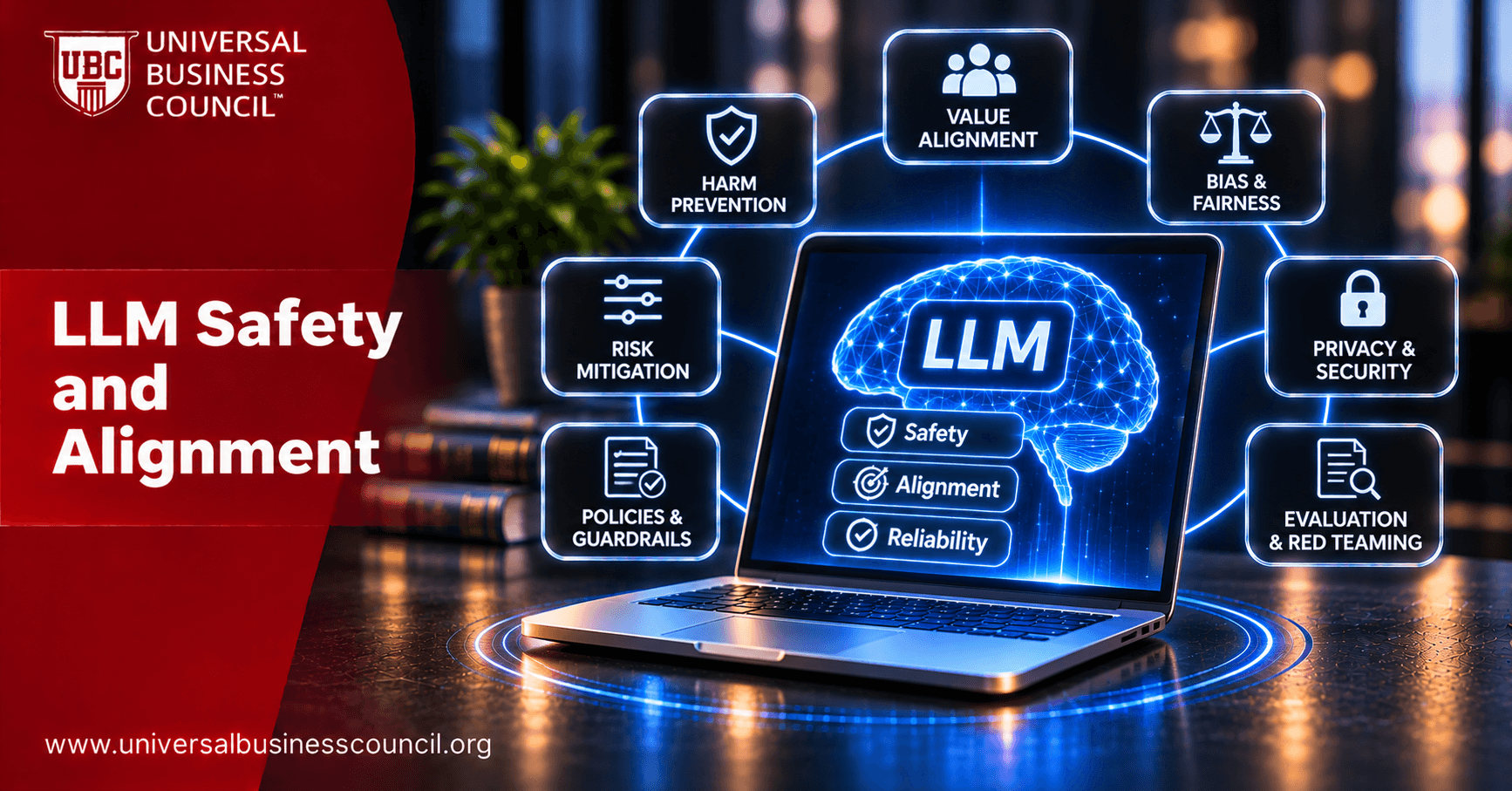
What does it mean for a language model to be safe? The honest answer is that it depends on who is asking, what the model is connected to and what it is allowed to do. LLM safety and alignment is the work of making large language models behave the way their builders and users actually intend, including under pressure. This post explains the key ideas, the techniques teams rely on and the habits that make AI systems more reliable in production. Readers who want a formal credential in this area can explore the Certified Responsible AI Expert program.
What is LLM safety and alignment?
LLM safety is about preventing harm from a model's outputs and actions, such as dangerous advice, leaked data, abusive content or misuse by bad actors. Alignment is about making the model's behavior match human intent and values, so it helps with what you actually asked for rather than what it merely guessed.

The two ideas overlap but are not identical. A model can be safe in narrow tests yet poorly aligned with what a user really needs. It can also be helpful and well aligned in ordinary use while still being open to attack. Reliable systems need both.
Why large language models are hard to make reliable
They generate text by predicting likely words, not by checking facts
Small changes in wording can produce very different answers
They can be pushed off course by cleverly written input
Their behavior in rare situations is hard to predict from average test results
Once connected to tools and data, mistakes can turn into actions
These traits explain why no single fix works. Reliability comes from layers.
The layers that make a system safer
Layer one: the model itself
Developers shape model behavior through careful data selection, fine-tuning on examples of good responses and training methods that use human feedback to prefer helpful, honest and harmless answers. If you use a model from a vendor, ask what testing was done and which known weaknesses remain.
Layer two: instructions and context
System prompts, clear task boundaries and well-chosen reference material steer the model within a deployment. These controls help, but they can be bypassed, so they should never be the only line of defense.
Layer three: checks around the model
Input and output filters, safety classifiers, format checks and policy rules catch problems before they reach users. Limiting the model's access to data and tools reduces the damage when something slips through.
Layer four: people and process
Human review for high-stakes outputs, clear escalation paths, monitoring and incident response complete the picture. Alignment is not a one-time setting. It is something you keep checking.
Evaluating safety and alignment
You cannot improve what you do not measure. A solid evaluation plan covers several angles:
Task quality: does the model do the job accurately?
Harmful content: does it refuse clearly unsafe requests?
Bias: does it treat different groups consistently?
Robustness: how does it respond to odd, adversarial or misleading inputs?
Honesty: does it admit uncertainty rather than inventing answers?
Keep your evaluation useful
Use test sets that reflect real users, refresh them as usage changes and keep a record of results over time. Run the same checks after every model, prompt or data change, because updates can quietly undo earlier fixes.
Red teaming and ongoing monitoring
Structured adversarial testing, often called red teaming, asks skilled people to try to break the system the way an attacker or careless user might. Their findings feed back into training, prompts and filters. After launch, monitor for unusual requests, rising complaint rates and drift in output quality, and set clear thresholds that trigger a review.
Safety when the model can take actions
Risk grows when a model can call tools, send messages or change records. Give it the least access it needs, require approval for irreversible steps, log every action and keep a fast way to switch it off. Treat text pulled from emails, web pages and documents as untrusted input, since it may contain hidden instructions.
Customer-facing assistants and brand risk
When an assistant speaks in a company's voice, a bad answer becomes a brand problem. Marketing and communications teams should help define tone, topics that are off limits and escalation rules. Marketers who want to understand the wider picture can look at the Certified Digital Marketing Expert program.
Skills, records and trusted people
Teams that build and test these systems benefit from strong technical grounding, which the programming and technology certifications from Global Tech Council can support. Evaluation results and incident logs deserve careful protection, and those curious about tamper-evident records can explore the deep tech certifications from Blockchain Council. When you hire safety engineers or engage outside evaluators, HireValid can help verify backgrounds and credentials.
Conclusion: building more reliable AI systems
LLM safety and alignment is the combined effort to prevent harm and to make model behavior match real human intent. Language models are hard to make reliable because they predict words rather than check facts, react to small changes in wording, can be pushed off course and become riskier once they use tools. No single control solves that, so reliable systems stack several: model training, careful instructions, filters and access limits, and human review with monitoring.
Measurement holds the stack together. Evaluate task quality, harmful content, bias, resilience to odd inputs and honesty, repeat the tests after every change and add red teaming before and after launch. When models can act, apply least privilege, approvals for irreversible steps, full logs and a kill switch. Start by picking one live system, listing the layers it has and the layers it lacks, and fill the biggest gap first. The Certified Responsible AI Expert program mentioned earlier can help your team build the skills behind LLM safety and alignment.
FAQs
1. What is LLM safety?
It is the work of preventing harm from a language model's outputs and actions.
2. What is AI alignment?
Making a model's behavior match human intent and values.
3. How are safety and alignment different?
Safety focuses on avoiding harm, while alignment focuses on doing what people actually want. Reliable systems need both.
4. Why do language models give wrong answers?
They predict likely text rather than verify facts, so they can produce confident mistakes.
5. Can prompts alone make a model safe?
No. Prompts help but can be bypassed, so use additional checks and limits.
6. What is fine-tuning?
Further training of a model on selected examples to shape its behavior for a task or policy.
7. What is reinforcement learning from human feedback?
A training approach where human ratings of outputs guide the model toward preferred responses.
8. What is red teaming?
Structured adversarial testing where people try to make the system fail or behave badly.
9. How often should we test a deployed model?
After every model, prompt or data change, and on a regular schedule as well.
10. What is prompt injection?
Input crafted to override the model's instructions or trigger unwanted actions.
11. What are guardrails?
Filters, rules and limits placed around a model to block or correct unsafe inputs and outputs.
12. Is human review still necessary?
For high-stakes outputs, yes. It remains one of the strongest safeguards.
13. How do we measure honesty in a model?
Test whether it admits uncertainty and avoids inventing facts, using questions with known answers.
14. How should we limit what an LLM can do?
Grant least privilege, require approval for irreversible actions and log everything.
15. What should we monitor after launch?
Unusual requests, complaint rates, output quality and signs of misuse or drift.
16. Can small teams do this work?
Yes. Start with a small test set, basic filters and a review process, then build up.
17. Do vendor models come with safety testing?
Many do, but you should ask for details and run tests for your own use case.
18. What is model drift?
A gradual change in performance as data and conditions shift over time.
19. Which frameworks help?
The NIST AI RMF, ISO/IEC 42001 and the OWASP Top 10 for LLM Applications are useful references.
20. Where can I learn more?
Training such as the Certified Responsible AI Expert program is a good start, along with hands-on testing.
Related Articles
View All
Artificial Intelligence
AI Audit Explained: How to Audit AI Systems for Safety, Fairness and Compliance
Learn what an AI audit is and how to evaluate AI systems for safety, fairness, transparency, and regulatory compliance. Explore key audit steps, risk assessment methods, bias detection techniques, and monitoring practices that help organizations build trustworthy and responsible AI systems.

Artificial Intelligence
How to Build Fair and Inclusive AI Systems
Learn how to build fair and inclusive AI systems by addressing bias, improving data quality, and applying ethical AI practices. Explore practical strategies such as diverse datasets, fairness testing, transparent algorithms, inclusive design, and continuous monitoring to create AI solutions that serve diverse users equitably.

Artificial Intelligence
AI Model Cards Explained: Documentation for Responsible AI Systems
Learn what AI model cards are and how they support responsible AI development through clear and structured documentation. Explore the key information they contain, including model purpose, performance, limitations, intended use, risks, and evaluation results, and how they improve transparency and accountability.
Trending Articles
The Role of Blockchain in Ethical AI Development
How blockchain technology is being used to promote transparency and accountability in artificial intelligence systems.
AWS Career Roadmap
A step-by-step guide to building a successful career in Amazon Web Services cloud computing.
Top 5 DeFi Platforms
Explore the leading decentralized finance platforms and what makes each one unique in the evolving DeFi landscape.