

How to Build Fair and Inclusive AI Systems
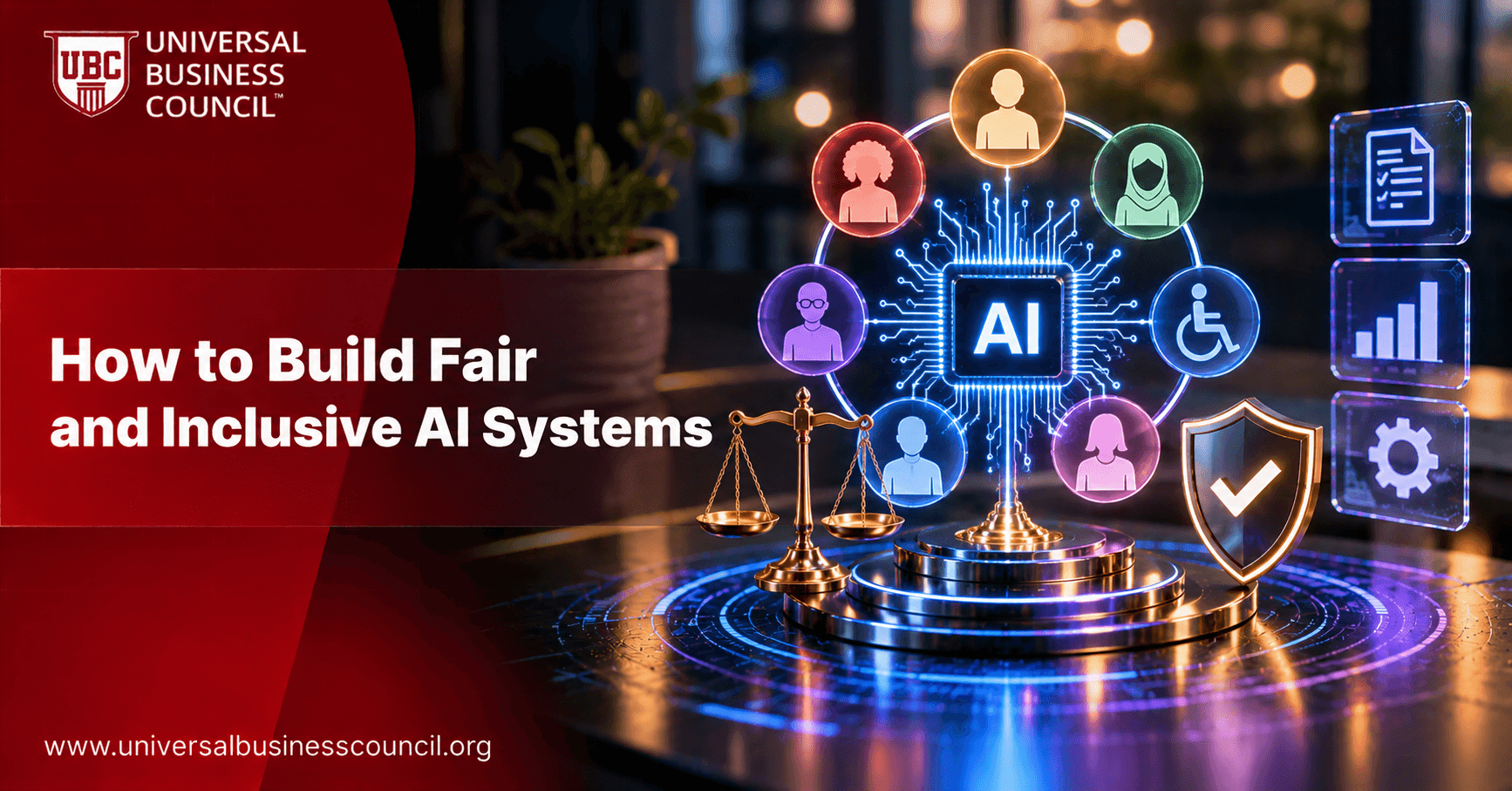
Building fair AI starts long before training, with the question of who is in the data and who is in the room. Systems designed by narrow teams, for narrow assumptions, tend to work well for some people and poorly for everyone else. Inclusion is how teams close that gap on purpose.
This guide explains how to build fair and inclusive AI systems across the full lifecycle, from planning and data to design, testing and governance. If you're developing skills in this field, the Certified Responsible AI Expert certification from Universal Business Council is a structured option to consider. The sections below move from definitions to a practical, stage-by-stage approach.

What are fair and inclusive AI systems?
A fair AI system avoids unjustified differences in outcomes or treatment across people and groups. An inclusive AI system goes a step further. It is designed so that people with different abilities, languages, ages, backgrounds and circumstances can use it and benefit from it. Fairness is often measured with metrics, while inclusion is about the experience, access and participation of real people.
The two ideas support each other. A fair model that people with disabilities cannot access isn't inclusive, and an accessible product that treats groups unequally isn't fair. Responsible AI work needs both.
Stage 1: Plan with the right people and purpose
Define the problem clearly and ask whether AI is the right tool at all
Identify everyone who could be affected, including people who will not be direct users
Build diverse project teams that include different disciplines, backgrounds and lived experience
Consult affected communities early, through interviews, advisory groups or co-design sessions
Set fairness and inclusion goals alongside performance targets
Diverse teams do not guarantee fair outcomes, but they make it more likely that someone spots a blind spot before launch.
Stage 2: Build inclusive data
Data shapes everything downstream. Check who is represented, who is missing and whether the data reflects the real population. Gaps matter in language, accent, skin tone, age, disability, region and device type.
Document data sources, collection methods and consent
Collect or source additional data for underrepresented groups where appropriate and lawful
Review labels for subjectivity, and use diverse annotators with clear guidelines
Look for proxies and for historical patterns that may encode past discrimination
Protect privacy through minimization, access controls and, where suitable, anonymization techniques
Stage 3: Design inclusively
Accessible and flexible interfaces
Follow accessibility guidelines such as WCAG for screens, support screen readers and offer alternatives to voice-only or touch-only interaction. Allow users to adjust text size, language and pace.
Language and cultural fit
Test across languages, dialects and cultural contexts. A system trained mainly on one dialect may misunderstand others, and a chatbot may respond inappropriately when cultural cues differ.
Human oversight and recourse
Provide plain-language explanations, a way to correct information and a route to human review. People who are wrongly flagged or excluded need a practical way to challenge a decision.
Stage 4: Train and test for fairness
Choose fairness metrics that match the decision and its harms.
Evaluate performance by group and by intersections of groups, with uncertainty estimates.
Apply mitigation, such as rebalancing data, adding constraints or adjusting thresholds, and test again.
Run red-team exercises and stress tests that look for failure under unusual inputs.
Test with real users from diverse groups, not only with internal staff.
Set release criteria so a system that fails fairness or accessibility checks does not ship.
Open-source tools such as Fairlearn and AI Fairness 360 help with analysis, and short tech certifications in programming and data science help teams use them effectively.
Stage 5: Deploy, monitor and improve
Inclusion work continues after launch. Track outcomes and user feedback by group, watch for drift and set alert thresholds. Offer easy ways to report problems and respond quickly. Some organizations run bias bounty programs or open feedback channels that reward people for finding issues.
Review the system when data, users or laws change, and retire models that can no longer be kept safe and fair.
Stage 6: Build governance and culture
Fair and inclusive AI needs structure. Assign owners, set approval gates for high-risk uses and document decisions in model cards and impact assessments. Provide training for engineers, product managers, designers and executives, and give employees a safe way to raise concerns.
People are central to this work. Organizations that add auditors, data scientists or compliance staff often verify credentials and work history, and services like HireValid can help with that step. Equally important is honest communication about what a system can and can't do. A Digital Marketing Course can help teams explain AI features clearly and avoid exaggerated claims, and Deep Tech Certifications offer a wider view of the technologies shaping AI today.
Common pitfalls to avoid
Treating inclusion as a final checklist instead of a design principle
Testing only on convenient or internal users
Relying on a single fairness metric without understanding trade-offs
Removing sensitive attributes and assuming bias is gone
Skipping documentation, which makes later audits and fixes harder
Conclusion
To build fair and inclusive AI systems, start with the people: diverse teams, consultation with affected communities and clear goals. Then build inclusive data, design for accessibility and language, test by group, give people recourse and monitor after launch. Governance and culture hold it all together.
No system is perfect, but a consistent, documented process makes fairness and inclusion a habit. Begin with one high-impact project, involve the people it affects and measure what you learn. The FAQs below answer common questions.
Frequently asked questions
What is inclusive AI?
AI designed so people with different abilities, languages and backgrounds can use it and benefit.
How is fair AI different from inclusive AI?
Fairness focuses on equitable outcomes, and inclusion focuses on access and participation.
Why do diverse teams matter?
They are more likely to spot blind spots and risks before launch.
How do you make AI data more inclusive?
Check representation, fill gaps lawfully, review labels and document sources.
What is participatory design?
Involving affected people in designing and reviewing a system.
What accessibility standards apply?
WCAG is widely used for digital accessibility, alongside local laws.
How do you test for fairness?
Evaluate performance and outcomes by group and by intersections of groups.
What is red teaming?
Deliberately probing a system to find failures and harmful behavior.
Should we test with real users?
Yes, especially people from groups likely to be affected.
What is a bias bounty?
A program that rewards people for finding bias or harm in a system.
How do you handle multiple languages?
Test across languages and dialects and include speakers in evaluation.
What is recourse?
A way for people to challenge or correct automated decisions.
Does removing sensitive attributes make AI fair?
No, because proxies can carry the same information.
What documentation helps?
Model cards, data sheets and impact assessments.
Who owns fairness in an organization?
Named product, data and risk owners, with executive sponsorship.
How often should we review systems?
Regularly and after any major change in data, users or regulations.
Can generative AI be inclusive?
Yes, with diverse data, testing for stereotypes and clear safeguards.
What is intersectional testing?
Checking performance for combined groups, such as older women.
How does inclusion affect business results?
It widens the user base and reduces failures, complaints and legal risk.
Where should teams start?
Pick one high-impact system, identify affected people and involve them early.
Related Articles
View All
Artificial Intelligence
ISO/IEC 42001 Explained: AI Management Systems and Certification Requirements
Understand what ISO/IEC 42001 is and how this international standard helps organizations establish, implement, and maintain an Artificial Intelligence Management System (AIMS). Explore its key requirements, benefits, certification process, and role in promoting responsible AI governance, risk management, transparency, and accountability.

Artificial Intelligence
AI Audit Explained: How to Audit AI Systems for Safety, Fairness and Compliance
Learn what an AI audit is and how to evaluate AI systems for safety, fairness, transparency, and regulatory compliance. Explore key audit steps, risk assessment methods, bias detection techniques, and monitoring practices that help organizations build trustworthy and responsible AI systems.
Artificial Intelligence
How to Build a Responsible AI Governance Framework
Learn how to build a responsible AI governance framework that supports ethical AI development and deployment. Explore key steps, including defining governance policies, assigning responsibilities, assessing risks, ensuring regulatory compliance, and establishing continuous monitoring and accountability.
Trending Articles
The Role of Blockchain in Ethical AI Development
How blockchain technology is being used to promote transparency and accountability in artificial intelligence systems.
AWS Career Roadmap
A step-by-step guide to building a successful career in Amazon Web Services cloud computing.
Top 5 DeFi Platforms
Explore the leading decentralized finance platforms and what makes each one unique in the evolving DeFi landscape.