

Prompt vs Loop vs Context Engineering
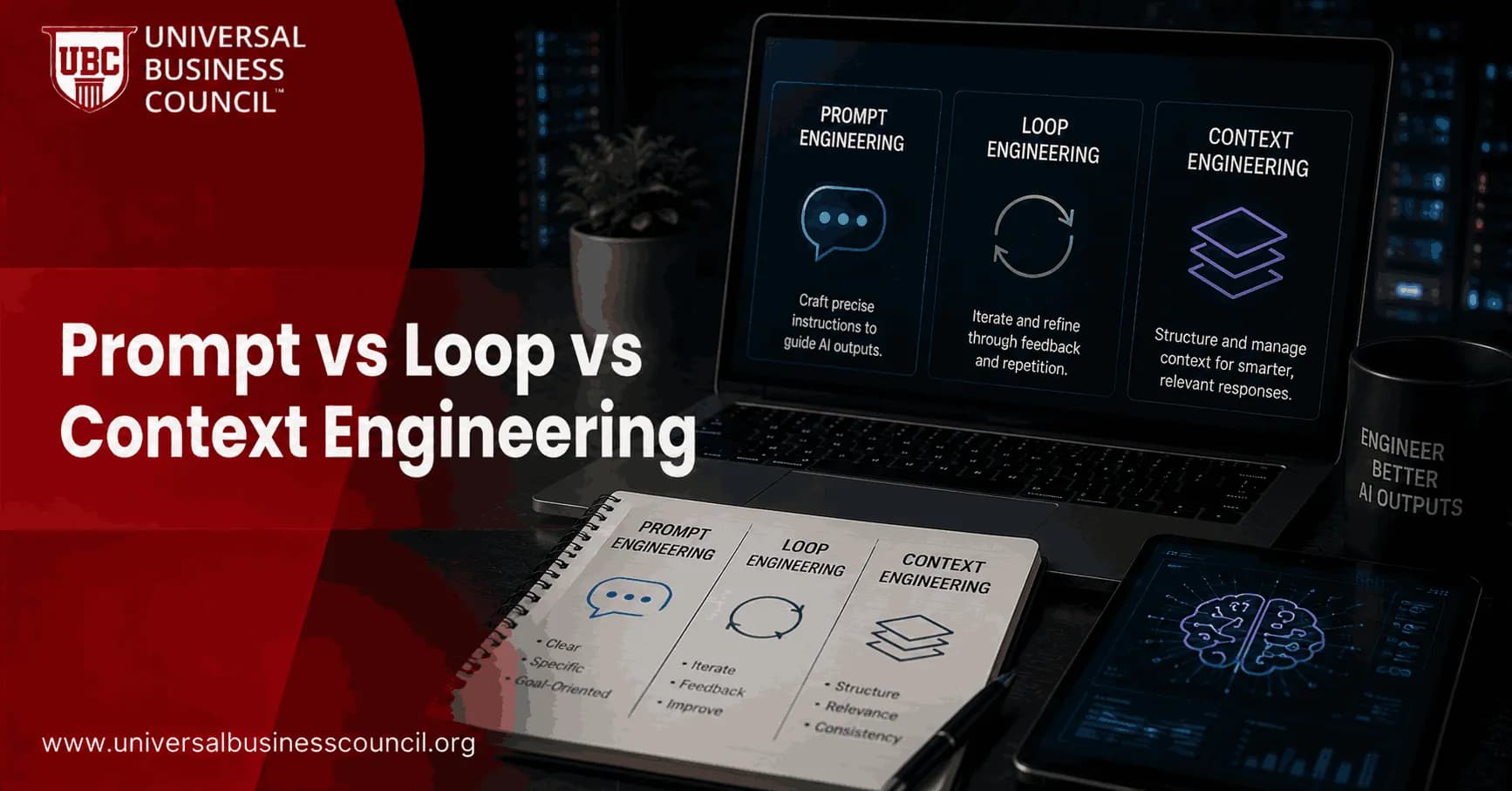
Artificial intelligence is evolving faster than ever. As AI systems become more capable, developers and professionals need new ways to improve their performance. This shift has introduced three important concepts: Prompt vs Loop vs Context engineering.
Although these approaches share a common goal, they solve different challenges. Prompt engineering focuses on writing effective instructions. Loop engineering improves reasoning through repeated workflows. Context engineering ensures AI receives the right information at the right time.

Understanding these concepts helps beginners, marketers, freelancers, entrepreneurs, and aspiring performance marketers build smarter AI-powered solutions. Moreover, learning when to use each approach can improve accuracy, efficiency, and user experience.
In this guide, you will learn the differences between prompt, loop, and context engineering. You will also discover when each method works best and how they complement one another.
What Is Prompt Engineering?
Prompt engineering is the process of creating clear instructions that guide an AI model toward the desired output. Every interaction begins with a prompt. Therefore, better prompts often produce better responses.
A well-written prompt reduces confusion and increases consistency. Instead of asking vague questions, users provide specific instructions, examples, constraints, and objectives.
For example, rather than requesting "Write an article," a better prompt explains the audience, tone, word count, structure, and desired outcome.
Why Prompt Engineering Matters
Prompt engineering offers several benefits:
Improves response quality
Reduces ambiguity
Saves editing time
Produces more consistent outputs
Enhances productivity
However, prompt engineering alone cannot solve every problem. As AI workflows become more advanced, they require continuous reasoning and memory.
Professionals who want to strengthen their prompting skills can explore the Prompt Engineer Certification.
What Is Loop Engineering?
Loop engineering is an emerging practice that enables AI systems to improve results through repeated execution cycles. Instead of producing one response, the AI evaluates its work, makes adjustments, and continues refining the output.
This iterative process resembles how humans revise their work before final submission.
Rather than relying on a single prompt, loop engineering creates a structured workflow consisting of planning, execution, verification, correction, and completion.
How Loop Engineering Works
A typical AI loop includes:
Planning
The AI identifies the objective.
Execution
The model completes the assigned task.
Evaluation
The output is reviewed against predefined criteria.
Refinement
Necessary improvements are made.
Completion
The final response meets the required quality standards.
Because of this continuous cycle, loop engineering performs well for complex projects that require multiple reasoning steps.
Professionals interested in advanced AI workflow techniques can further develop their expertise through the Claude AI Expert certification.
What Is Context Engineering?
Context engineering focuses on supplying AI with all relevant information before and during task execution. Instead of relying only on prompts, this approach manages memory, documents, conversation history, user preferences, retrieved knowledge, and external data sources.
In many modern AI systems, context engineering has become the foundation of reliable performance.
Without sufficient context, even an excellent prompt may produce incomplete or inaccurate answers.
Elements of Context Engineering
Context engineering typically includes:
User Memory
Previous conversations improve personalization.
Knowledge Retrieval
Relevant documents provide factual support.
Task History
Earlier actions prevent repeated mistakes.
System Instructions
Permanent rules maintain consistent behavior.
Together, these elements help AI deliver more accurate and relevant responses.
Professionals who want to specialize in this growing field can expand their knowledge through the AI Context Engineer certification.
Prompt vs Loop vs Context: Key Differences
Understanding Prompt vs Loop vs Context becomes easier by comparing their primary objectives.
Feature | Prompt Engineering | Loop Engineering | Context Engineering |
Primary Goal | Give instructions | Improve through repetition | Supply relevant information |
Focus | User input | Iterative reasoning | Information management |
Memory | Limited | Temporary | Persistent |
Complexity | Low | Medium | High |
Best For | Simple tasks | Multi-step workflows | Intelligent AI systems |
Each method solves a different challenge. Therefore, they should work together instead of replacing one another.
When Should You Use Each Approach?
Choosing between Prompt vs Loop vs Context depends on your objective.
Use prompt engineering when generating content, summaries, emails, or structured outputs.
Use loop engineering when solving multi-step problems, reviewing work, or improving complex reasoning.
Use context engineering when building AI assistants, intelligent chatbots, enterprise automation, or long-term AI agents.
Modern AI platforms increasingly combine all three approaches because each addresses a different aspect of intelligent behavior.
Why Context Engineering Is Becoming More Important
Large AI models now process significantly more information than earlier generations. As a result, simply writing better prompts is no longer enough.
Today's AI systems benefit from:
Better memory management
Smarter information retrieval
Personalized responses
Improved consistency
Higher factual accuracy
Consequently, context engineering is becoming a critical skill for professionals working with advanced AI systems.
Professionals interested in expanding broader business and marketing knowledge can also explore a Marketing Certification
Likewise, individuals seeking broader technical expertise may benefit from a Tech Certification.
FAQs
1. What is Prompt vs Loop vs Context?
Prompt vs Loop vs Context compares three AI engineering approaches. Prompt engineering focuses on writing effective instructions. Loop engineering improves results through repeated reasoning. Context engineering provides relevant information and memory to enhance AI performance.
2. What is prompt engineering?
Prompt engineering is the practice of creating clear and structured instructions that help AI generate accurate, relevant, and consistent responses.
3. What is loop engineering?
Loop engineering is an iterative process where AI plans, executes, reviews, and refines its outputs until it reaches the desired result.
4. What is context engineering?
Context engineering manages the information an AI system receives, including conversation history, documents, user preferences, and retrieved knowledge, to improve response quality.
5. Why is Prompt vs Loop vs Context important?
Understanding Prompt vs Loop vs Context helps professionals choose the right AI engineering approach for different tasks, improving efficiency, accuracy, and scalability.
6. Which is better: prompt engineering or context engineering?
Neither is universally better. Prompt engineering works well for individual tasks, while context engineering is more effective for AI assistants and long-term interactions.
7. How does loop engineering improve AI performance?
Loop engineering allows AI to evaluate its work, identify mistakes, and refine responses through multiple iterations, resulting in higher-quality outputs.
8. Can prompt, loop, and context engineering work together?
Yes. Modern AI systems often combine all three methods. Prompt engineering provides instructions, loop engineering improves reasoning, and context engineering supplies relevant information.
9. Who should learn Prompt vs Loop vs Context engineering?
Developers, marketers, freelancers, entrepreneurs, students, content creators, and AI professionals can all benefit from learning these AI engineering techniques.
10. Is prompt engineering still relevant with advanced AI models?
Yes. Even advanced AI models require clear prompts to understand user intent and generate accurate responses.
11. What are the benefits of context engineering?
Context engineering improves response accuracy, personalization, memory management, consistency, and overall AI reliability.
12. What are common use cases for loop engineering?
Loop engineering is useful for coding, research, document generation, planning, debugging, workflow automation, and complex problem-solving.
13. How can beginners learn prompt engineering?
Beginners should practice writing structured prompts, experiment with different prompt styles, and understand how AI interprets instructions. They can also strengthen their skills through the Prompt Engineer Certification.
14. Is context engineering the future of AI?
Context engineering is becoming increasingly important because modern AI systems rely on memory, retrieval, and contextual understanding to deliver accurate and personalized responses.
15. What skills are required for AI context engineering?
AI context engineers should understand prompt design, retrieval systems, memory management, workflow orchestration, and structured data organization. Professionals can build these skills through the AI Context Engineer certification.
16. How can I improve AI workflows using loop engineering?
You can improve AI workflows by creating feedback loops that allow the model to review, refine, and validate its outputs before producing the final response. Learning advanced AI workflow techniques through the Claude AI Expert certification can further strengthen these skills,
17. How does Prompt vs Loop vs Context support SEO, AEO, and GEO?
These approaches help generate structured, relevant, and context-aware content that performs better in traditional search engines, answer engines, and generative AI search experiences.
18. What is the biggest difference between prompt engineering and loop engineering?
Prompt engineering focuses on creating effective instructions before execution, while loop engineering improves results through repeated evaluation and refinement after execution begins.
19. Where can professionals learn broader marketing and technology skills?
Professionals can expand their expertise through a Marketing Certification and enhance technical knowledge with a Tech Certification.
20. What is the future of Prompt vs Loop vs Context engineering?
The future lies in integrating prompt, loop, and context engineering into intelligent AI agents that can reason, remember, adapt, and continuously improve. Professionals who understand all three approaches will be well-positioned to build advanced AI-powered solutions.
Related Articles
View All
Artificial Intelligence
What Is a Recursive Self-Improvement Loop in AI?
Learn what a recursive self-improvement loop is in AI, how repeated cycles of evaluation, modification, and capability improvement could work, and why the concept matters for AGI and AI safety.
Artificial Intelligence
Gemini 4 Argon: Features, Pricing, and Availability
Gemini 4 Argon is Google’s new flagship AI model for coding, science, finance, law and security. See its main features, API and subscription pricing, and where you can access it today.

Artificial Intelligence
What Is Meta Muse Wonder? Features and How It Works
Meta Muse Wonder is a new frontier AI model built for agents with Active Memory and Active Focus. Learn what it is, how it works, its features, pricing and how to access it.
Trending Articles
The Role of Blockchain in Ethical AI Development
How blockchain technology is being used to promote transparency and accountability in artificial intelligence systems.
AWS Career Roadmap
A step-by-step guide to building a successful career in Amazon Web Services cloud computing.
Top 5 DeFi Platforms
Explore the leading decentralized finance platforms and what makes each one unique in the evolving DeFi landscape.