

What Is a Recursive Self-Improvement Loop in AI?
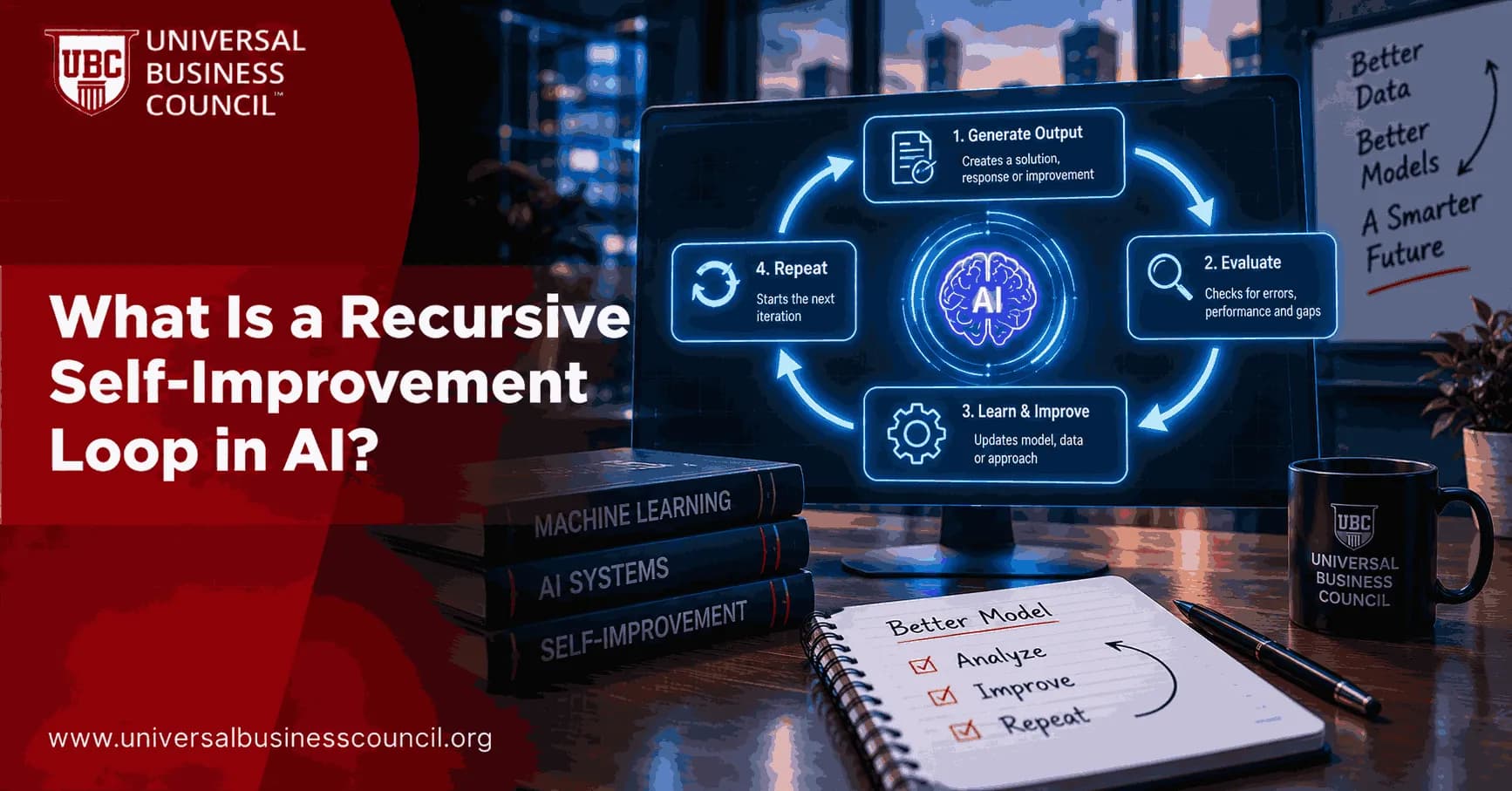
A recursive self-improvement loop is the actual working mechanism behind the broader concept of AI self-improvement, the repeating cycle of steps that lets a system get measurably better at something without a human manually implementing every single upgrade. It's easy to talk about "self-improving AI" in the abstract, but the loop itself is what makes the idea concrete and testable, since it can be diagrammed, measured, and compared across different real systems. Getting comfortable with this level of technical detail is part of what a well-rounded Marketing Certification increasingly covers for professionals working near AI products, since describing a "self-improving" feature accurately starts with understanding what loop, if any, is actually running underneath it.
This article lays out the loop in clear, bullet-point steps, shows how it plays out in a few different real systems, and covers what can cause the loop to break down.

The Loop in Four Simple Steps
Every version of this loop, no matter how advanced the system, tends to follow the same basic shape.
Understanding these steps with real technical precision, rather than a surface-level summary, is exactly what Artificial Intelligence Certifications are designed to build, typically covering the underlying evaluation and training concepts that make each step of this loop function correctly in practice.
Step 1, Evaluate: The system checks its own current performance against a defined goal or benchmark and identifies a specific weakness or gap
Step 2, Propose: The system generates a candidate change meant to address that gap, whether that's a code edit, a parameter adjustment, or a new piece of training data
Step 3, Test: The candidate change gets run against the same benchmark to see whether it actually helps or makes things worse
Step 4, Update: If the change helps, it becomes the new baseline version of the system; if it doesn't, it gets discarded, and the loop restarts from Step 1 using whichever version came out on top
Why "Loop" Is the Right Word, Not "Sequence"
A sequence implies a start and an end. A loop implies the process repeats, using its own output as the next input
Each pass through the loop uses the most recently updated version of the system as its new starting point, not the original
This is what creates the "recursive" part of recursive self-improvement, each cycle builds on the result of the last one rather than starting fresh every time
A loop can run for a handful of iterations or millions, depending on the system and the problem it's working on
Real Examples of This Loop in Action
Seeing the same basic four-step pattern across genuinely different systems makes it much easier to recognize.
Darwin Gödel Machine (Sakana AI): Evaluates its coding performance on a benchmark, proposes a rewrite of its own code, tests the rewrite against real GitHub-style coding problems, and keeps successful versions in a growing archive, a process that took its benchmark score from twenty to fifty percent
AlphaEvolve (Google DeepMind): Evaluates algorithm performance on a specific technical problem, proposes new candidate code using Gemini models, tests each candidate automatically, and keeps the strongest performers, sometimes across millions of cycles
Self-refine techniques in language models: Evaluates its own draft response for weaknesses, proposes a revision, tests that revision informally against the original critique, and updates to the better version, usually for just a handful of rounds before returns flatten out
What Keeps a Loop Running Well
A clear, checkable evaluation standard, so the "test" step actually produces a reliable answer rather than a guess
Enough diversity in the "propose" step, so the loop explores genuinely different ideas rather than making the same small tweak over and over
A way to keep or archive unsuccessful attempts, since some systems, like the Darwin Gödel Machine, benefit from returning to an earlier discarded branch later
Boundaries on what the loop is allowed to touch, keeping core safety checks and evaluation logic outside what the system itself can modify
Following how these design choices actually affect a loop's reliability requires ongoing technical literacy, and a well-rounded Tech Certification helps professionals track this kind of nuance rather than relying on a system simply being labeled "self-improving" at face value.
What Causes a Loop to Break Down
Weak verification: If the "test" step can't reliably tell a good change from a bad one, the loop can quietly reinforce mistakes instead of fixing them
Diminishing returns: Most documented loops show large gains early and much smaller gains later, rather than accelerating indefinitely
Model collapse: In loops that train on their own generated data too heavily, quality and diversity can degrade across cycles instead of improving
Narrow scope creep: A loop tuned for one specific benchmark can end up over-optimizing for that exact metric in ways that don't generalize to real-world performance
A Lower-Stakes Version of the Same Loop
One emerging application is AI microdrama, where generative AI helps bring serialized stories, characters, and fictional worlds to life
These platforms often run a simplified version of the same loop, evaluate how an episode performed with audiences, propose a change to character voice or pacing, test it in the next episode, and keep whatever resonates
It's a useful, low-stakes way to see the evaluate-propose-test-update pattern at work outside a purely technical research setting, without any of the code-level self-modification seen in systems like the Darwin Gödel Machine
Why the Distinction Between a Real Loop and a Marketing Claim Matters
Not every product calling itself "self-improving" is actually running a loop like the ones described here
Some products simply mean they get a new version periodically, built the normal way by human engineers, with no self-modification involved at all
Knowing what a genuine evaluate-propose-test-update loop looks like makes it much easier to tell the difference
Professionals who understand this distinction deeply, rather than taking marketing copy at face value, often build that foundation through a Deep Tech Certification, which covers exactly how to verify whether a claimed self-improvement loop is real, documented, and benchmarked, or just a name attached to routine updates
Final Thoughts
A recursive self-improvement loop is the concrete, repeatable cycle, evaluate, propose, test, update, that turns the idea of self-improving AI into something that can actually be built, measured, and compared across systems. Real examples like the Darwin Gödel Machine and AlphaEvolve show this loop working within specific, bounded domains, while also showing where it can break down if verification is weak or scope isn't carefully controlled. Understanding the loop at this level of detail is what separates a genuine grasp of the technology from simply repeating the phrase "self-improving AI" without knowing what's actually happening underneath it.
FAQs
1. What is a recursive self-improvement loop in AI?
A recursive self-improvement (RSI) loop is a theoretical process in which an AI system identifies ways to improve its capabilities, develops or implements an improvement, evaluates the result, and uses the improved system to pursue further improvements. The process can repeat across multiple iterations. Each successful iteration could potentially provide the foundation for the next one.
2. What does RSI stand for in artificial intelligence?
RSI stands for Recursive Self-Improvement. It describes the concept of an AI system repeatedly contributing to improvements in its own capabilities or in the systems used to create its successors. The term “recursive” refers to the repeated improvement cycle.
3. How does a recursive self-improvement loop work?
A simplified RSI loop can be represented as:
Identify → Design → Implement → Test → Evaluate → Improve → Repeat
The AI identifies a limitation, proposes a change, implements or helps implement it, and tests the result. If the modification produces a verified improvement, the new system can become the starting point for another cycle.
4. What are the main components of an RSI loop?
An RSI loop generally requires an AI system, an improvement mechanism, development or training infrastructure, an evaluation system, and clearly defined objectives. Depending on the design, it may also involve automated experimentation, code-generation tools, simulation environments, or human oversight. These components determine how much of the improvement process can be automated.
5. Is a recursive self-improvement loop the same as AI self-training?
No. AI self-training generally involves learning from additional data, which may include data generated by the model. An RSI loop is broader and can involve changes to algorithms, code, model architecture, training methods, research processes, and other components of AI development.
6. Can current AI systems perform an RSI loop?
Current AI systems can perform or assist with individual stages that resemble an RSI loop, such as coding, debugging, algorithm optimization, experimentation, and evaluation. However, fully autonomous RSI, where an AI independently drives successive generations of increasingly capable AI, is not established as a general current capability.
7. Can AI improve its own algorithms?
AI systems can generate and evaluate candidate algorithms, particularly when automated testing provides clear performance measurements. Google DeepMind's AlphaEvolve, for example, uses Gemini-powered models, automated evaluators, and evolutionary search to discover and optimize algorithms. This demonstrates iterative algorithmic improvement within defined objectives rather than unrestricted autonomous RSI.
8. Can an AI loop improve its own code?
An AI agent can generate, test, debug, and refine software code when provided with suitable development tools. An automated loop can repeatedly evaluate candidate code and retain successful modifications. However, improving software code is only one possible component of recursive self-improvement.
9. Can an RSI loop create a better AI model?
In theory, an RSI system could contribute to developing a more capable successor by improving algorithms, training methods, architecture, or other components. The successor could then contribute to another improvement cycle. Creating a broadly superior model would require reliable training and evaluation rather than simply generating a modification.
10. What role does evaluation play in an RSI loop?
Evaluation determines whether a proposed change actually improves the system. Candidate algorithms, models, or strategies can be tested against predefined benchmarks, simulations, or functional requirements. Reliable evaluation is critical because an AI could otherwise mistake a narrow optimization or flawed change for a genuine improvement.
11. Why is automated testing important for recursive self-improvement?
Automated testing allows an AI system to rapidly check large numbers of proposed changes. This can make iterative development more efficient by filtering out modifications that fail predefined requirements. Strong testing also reduces the chance that unsuccessful changes will automatically propagate into later iterations.
12. Could recursive self-improvement make AI development faster?
Potentially. An RSI system could automate coding, experimentation, algorithm discovery, testing, and optimization, allowing more development cycles to occur within the same period. If improvements also increase the AI's ability to conduct AI research, the process could potentially become more efficient over successive iterations.
13. What is the difference between a bounded improvement loop and full RSI?
A bounded improvement loop operates within specific goals, tools, resources, and constraints. For example, an AI might optimize an algorithm for a particular benchmark while humans control the broader development process. Full RSI implies substantially greater autonomy and repeated improvement of the AI system or its successors across generations.
14. Could an RSI loop use AI-generated training data?
Yes. An AI system could generate synthetic examples that are filtered, evaluated, and incorporated into a training process. This can provide additional data for particular tasks. However, repeated use of AI-generated data can introduce or reinforce errors, so quality control and independent evaluation are important.
15. Could an RSI loop improve AI reasoning?
Potentially. An AI development system could experiment with model architectures, training methods, inference strategies, reasoning techniques, or evaluation procedures. If an approach produces reliable improvements, it could be incorporated into a subsequent system. Current AI systems can assist with these activities but do not demonstrate unrestricted autonomous improvement of their own reasoning.
16. Could recursive self-improvement lead to AGI?
RSI could potentially contribute to the development of Artificial General Intelligence (AGI) if advanced AI systems become capable of performing substantial AI research and engineering. A system that can improve algorithms and training methods could potentially accelerate progress toward broader capabilities. However, RSI is not a formal requirement for AGI.
17. Could an RSI loop lead to artificial superintelligence?
It is one theoretical possibility. If an AI could repeatedly and reliably improve its own capabilities or those of its successors, cumulative improvements could potentially produce systems substantially more capable than their predecessors. Whether this could result in Artificial Superintelligence (ASI) remains uncertain.
18. What could cause an RSI loop to fail?
An RSI loop could fail because proposed changes are incorrect, evaluation is unreliable, resources are insufficient, or improvements do not generalize beyond specific benchmarks. Diminishing returns and hardware or computational limitations could also restrict progress. Repeated training on low-quality generated data may cause degradation instead of improvement.
19. What are the risks of an autonomous RSI loop?
Potential risks include alignment problems, unexpected capability changes, cybersecurity vulnerabilities, reduced transparency, and difficulties maintaining human oversight. As AI systems gain greater control over their own development, it could become more difficult to predict and verify the effects of later modifications.
20. Is a fully autonomous recursive self-improvement loop possible?
It is a theoretical possibility, but it has not been established as a general capability of current AI systems. Today's AI can automate increasingly sophisticated portions of coding, research, experimentation, and algorithm optimization. A fully autonomous RSI loop would require an AI to reliably control and repeat a much broader set of improvement processes with substantially reduced human intervention.
Related Articles
View All
Artificial Intelligence
Recursive Self-Improvement in AI: Benefits, Risks, Challenges, and Future Impact
Explore recursive self-improvement in AI, including its potential benefits, technical challenges, safety risks, and possible impact on the future of artificial intelligence.
Artificial Intelligence
How Could Recursive Self-Improvement Accelerate AI Development?
Explore how recursive self-improvement could accelerate AI development through faster experimentation, automated research, model optimization, and repeated capability gains.

Artificial Intelligence
Could Recursive Self-Improvement Lead to Artificial Superintelligence?
Explore whether recursive self-improvement could lead to artificial superintelligence, how repeated capability gains might accelerate AI development, and what technical and safety challenges could emerge.
Trending Articles
The Role of Blockchain in Ethical AI Development
How blockchain technology is being used to promote transparency and accountability in artificial intelligence systems.
AWS Career Roadmap
A step-by-step guide to building a successful career in Amazon Web Services cloud computing.
Top 5 DeFi Platforms
Explore the leading decentralized finance platforms and what makes each one unique in the evolving DeFi landscape.