

RSI vs Self-Learning AI: How Are They Different?
Ask ten people what "AI improving itself" means and you will likely get ten different answers, ranging from a spam filter getting better at catching junk mail to a system rewriting its own source code. That range of answers is exactly the problem. Recursive self-improvement, RSI, and self-learning AI get treated as near-synonyms in everyday conversation, yet they describe genuinely different capabilities with very different practical and safety implications. Getting this distinction right matters for anyone evaluating a vendor's claims, a research paper's findings, or a news headline about the latest AI breakthrough. Professionals who need to communicate this kind of nuanced technical distinction clearly often build that skill through a Marketing Certification, which helps translate a genuinely technical difference into language a non-specialist audience can actually follow without losing accuracy.
Rather than starting from theory, the clearest way to separate these two concepts is to look at what question each one is actually answering, then work through concrete signals that reveal which one a specific system is actually demonstrating.

The Core Question Each Concept Is Actually Answering
Self-learning AI and recursive self-improvement sound similar because both involve a system changing itself based on data or experience. They diverge sharply once you ask what, specifically, is changing.
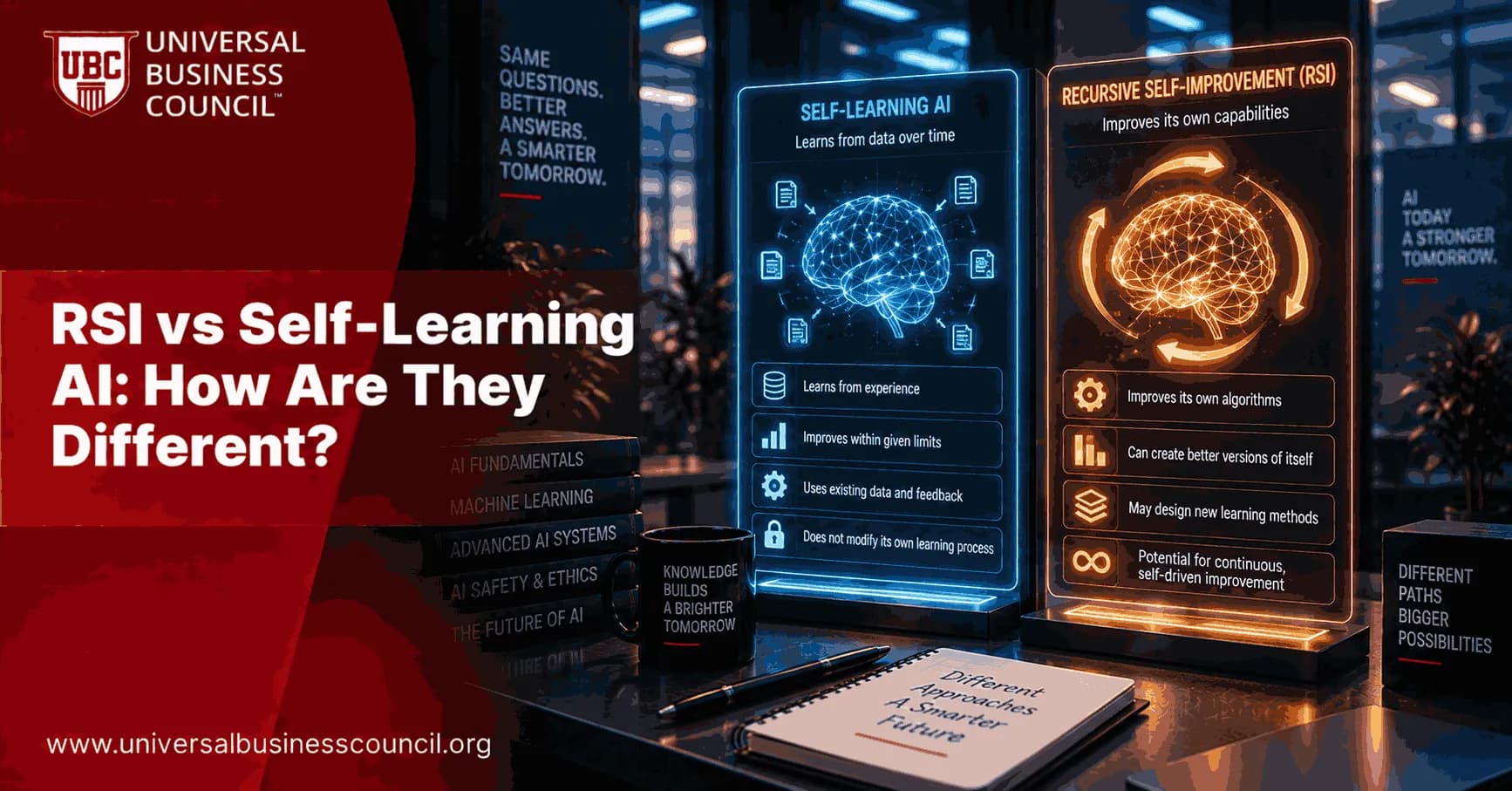
Self-learning AI answers the question: can this system get better at the task it was built to do, using data or experience, without a human manually updating its rules or parameters each time?
Recursive self-improvement answers a different, harder question: can this system improve the process that produces its improvements, meaning its own architecture, training method, or improvement strategy, not just its output on a fixed task?
A useful shorthand: self-learning changes what the system knows or how well it performs a defined job. RSI changes how the system improves itself in the first place, a meta-level shift rather than a performance-level one.
Nearly every AI system deployed commercially today, from fraud detection models to recommendation engines to large language models, demonstrates some form of self-learning. Very few systems have demonstrated anything resembling genuine RSI under a strict technical definition.
A Direct Comparison of How These Two Concepts Actually Differ
Placing the two side by side across several practical dimensions makes the distinction concrete rather than abstract.
Scope of change: self-learning adjusts internal parameters, weights, or learned patterns within a fixed architecture. RSI implies the architecture, training process, or improvement strategy itself can change.
Frequency in real systems: self-learning is standard practice across the AI industry, running continuously inside production systems most people interact with daily without realizing it. RSI in its full form remains rare and is the subject of active, ongoing research specifically aimed at determining how close any system has actually come to it.
Human role during operation: self-learning typically runs inside a framework and objective a human team defined once, then lets the system optimize continuously within that boundary. RSI, particularly in stronger interpretations, implies a progressively smaller human role in defining what counts as an improvement at all.
Predictability of gains: self-learning tends to produce steady, often diminishing returns bounded by the fixed architecture and available data volume. RSI is theorized to potentially produce accelerating, compounding gains precisely because each improvement round could strengthen the system's capacity to generate the next one.
Risk profile: self-learning systems carry familiar, well-understood risks, such as learning biased patterns from flawed training data. RSI raises a distinct category of concern around whether human oversight can keep pace with a system that is changing its own underlying improvement mechanism, not just its outputs.
Practical Signals That Reveal Which One You Are Actually Looking At
When evaluating a specific claim about "AI that improves itself," a handful of concrete questions reliably separate genuine RSI from ordinary self-learning dressed up in more dramatic language.
Ask what specifically changed. If the answer is "the model's weights got updated based on new data," that is self-learning. If the answer is "the system rewrote part of its own code or training pipeline," that is closer to genuine RSI.
Ask who defined success. Self-learning systems almost always optimize against a fixed, human-defined metric. Systems demonstrating stronger RSI characteristics may have some latitude in defining or refining what counts as an improvement, though full autonomy over this remains rare even in advanced research systems.
Ask whether the loop is closed. Self-learning typically improves performance on a task without that improvement feeding back into the system's own development process. Genuine RSI implies the improvement specifically strengthens the system's future capacity to improve, not just its current task performance.
Ask how the gain was verified. Reliable RSI research ties improvement claims to objective, checkable outcomes, such as code that measurably runs faster or passes more tests. Claims resting purely on a system's own self-assessment deserve real skepticism, since a system can appear to improve while simply getting better at satisfying a flawed evaluation. Building the applied technical skill to ask and answer these questions correctly is exactly what structured learning through Artificial Intelligence Certifications is designed to provide, moving past surface-level vocabulary into genuine technical evaluation.
Where Real Systems Illustrate Each Category Clearly
Concrete, real-world examples make this distinction far easier to hold onto than definitions alone.
Fraud detection systems at banks and payment processors continuously retrain on new transaction data, adjusting their internal parameters to catch evolving fraud patterns without a human manually rewriting detection rules each week. This is self-learning: a fixed architecture getting better at a stable task through ongoing exposure to new data.
Recommendation engines used by streaming and e-commerce platforms similarly update continuously based on user behavior, refining what they show individual users without ever touching their own underlying algorithm design. Again, this is self-learning operating exactly as intended.
The Darwin Gödel Machine, a research system that reads and rewrites its own Python codebase, empirically testing each change and keeping only the modifications that measurably improve its coding benchmark performance, sits much closer to genuine RSI, since it is improving its own improvement mechanism rather than simply getting better at a single fixed task.
Evolutionary coding systems that have been used to optimize the training kernels for their own successor models represent another concrete RSI-adjacent example, since the improvement directly feeds back into building a more capable next-generation system rather than only improving current performance.
One Emerging Application Riding the Same Underlying Model Progress
The capability gains behind both self-learning systems and more advanced RSI research are not confined to fraud detection dashboards and research papers. The same underlying model progress surfaces in far more accessible, everyday products as well.
One emerging application is AI microdrama, where generative AI helps bring serialized stories, characters, and fictional worlds to life. Tools in this category benefit indirectly from the same broader wave of self-learning and generative model improvements described throughout this article, showing how gains made through relatively ordinary self-learning techniques still ripple outward into genuinely useful, entirely different creative applications.
Building the Technical Depth to Tell These Apart Confidently
Distinguishing self-learning from genuine RSI in a specific, real-world system is not always obvious from a press release or product description alone, since vendors and researchers alike sometimes use exciting-sounding language loosely.
Developing the applied technical skill to look past terminology and evaluate what a system is actually doing under the hood requires hands-on familiarity with how these systems are built, trained, and evaluated. A Tech Certification helps build exactly this kind of practical technical literacy, giving professionals the ability to assess a specific claim about AI self-improvement on its real technical merits rather than its marketing framing.
Why Getting This Distinction Right Matters Beyond Semantics
This is not simply a vocabulary exercise. Confusing ordinary self-learning with genuine recursive self-improvement has real consequences for how organizations, policymakers, and the public calibrate their expectations and concerns.
Treating every self-learning system as evidence of imminent, dramatic RSI creates unwarranted alarm about technology that has operated safely and predictably for years. Conversely, dismissing genuine, published RSI research as "just more of the same self-learning" risks underestimating a capability that frontier labs themselves treat as a distinct, formally defined risk threshold in their own safety frameworks. Building the broader technical foundation needed to track this distinction accurately as research continues to evolve benefits from education spanning multiple emerging technology domains at once. A Deep Tech Certification helps professionals build exactly this kind of wider grounding, equipping them to follow developments in both categories critically rather than relying on whichever label a headline happens to apply.
The Bottom Line on RSI vs Self-Learning AI
Self-learning AI and recursive self-improvement both involve a system changing based on data or experience, but they operate at fundamentally different levels. Self-learning improves performance on a fixed task within a fixed architecture, the kind of capability already running inside fraud detection systems, recommendation engines, and most production AI deployed today. Recursive self-improvement improves the system's own capacity to improve, a meta-level capability demonstrated so far only in narrow, bounded, heavily human-supervised research systems like the Darwin Gödel Machine. Knowing which of these two categories a specific system, claim, or headline actually belongs to is the single most useful habit for cutting through confusion in this fast-moving area of AI development.
FAQs
1. What Is Recursive Self-Improvement (RSI)?
Recursive Self-Improvement (RSI) describes an AI system repeatedly improving its own capabilities and then using those improvements to drive further improvements. The defining feature is the recursive improvement loop.
2. What Is Self-Learning AI?
Self-learning AI refers to systems that can learn from new data, feedback, interactions, or experience without requiring every behavior to be manually programmed. The system updates or adapts its knowledge or behavior based on learning signals.
3. What Is the Main Difference Between RSI and Self-Learning AI?
The key difference is what the AI is improving. Self-learning AI primarily learns from information or experience, while RSI involves repeatedly improving the AI's capabilities, algorithms, training processes, or other mechanisms that enable further improvement.
4. Is Every Self-Learning AI System an RSI System?
No. A system can continuously learn from new data without changing the mechanisms responsible for its own development. RSI requires a recursive process in which improvements contribute to subsequent improvements.
5. Is RSI a Form of Self-Learning?
RSI may use self-learning techniques, but the concepts are not interchangeable. Self-learning can be one component of an RSI system, while RSI describes a broader and more recursive improvement process.
6. How Does Self-Learning AI Work?
A self-learning system typically receives new data or feedback, identifies patterns, adjusts its parameters or behavior, and produces improved results. The learning process does not necessarily involve redesigning the AI itself.
7. How Does Recursive Self-Improvement Work?
A potential RSI cycle looks like:
Identify weakness → develop improvement → implement change → test → evaluate → retain improvement → repeat
The improved system then becomes part of the next cycle.
8. Can Large Language Models Be Self-Learning AI?
Yes. LLM-based systems can learn from additional training data, reinforcement learning, feedback, or interaction histories. However, learning from new information alone does not mean that an LLM is recursively improving itself.
9. Can Large Language Models Achieve RSI?
LLMs can perform several tasks relevant to RSI, including coding, debugging, research, experiment design, and evaluation. However, fully autonomous recursive self-improvement has not been reliably demonstrated in current LLMs.
10. What Is an Example of Self-Learning AI?
An AI agent that learns better strategies from its own gameplay experience is an example of self-learning. The system becomes better at the task through experience, but this does not necessarily mean it is redesigning the underlying AI that performs the learning.
11. What Is an Example of RSI?
An AI system that identifies a weakness in its own development process, proposes a new algorithm, implements it, tests the result, and then uses the improved system to discover another improvement would represent a more direct RSI scenario.
12. Can Self-Learning AI Improve Its Own Code?
A self-learning system can potentially generate or modify code if it has the necessary capabilities and tools. However, code modification becomes part of RSI only when it is incorporated into a broader, repeated process of improving the system itself.
13. What Role Does Reinforcement Learning Play in RSI?
Reinforcement learning can provide feedback that helps an AI discover better strategies or behaviors. In an RSI system, this learning mechanism could support the repeated evaluation and improvement of capabilities.
14. Can AI Use Its Own Data for Self-Improvement?
Yes. AI-generated or self-generated data can be used for additional training and evaluation. However, without independent quality controls, repeated use of AI-generated data can reinforce errors or reduce the quality of future models.
15. Does Self-Learning Require Human Intervention?
Not necessarily for every individual learning step. Some systems can adapt automatically once their learning process and objectives have been established. However, humans may still define the objectives, training environment, safety limits, and evaluation methods.
16. Does RSI Require Human Intervention?
Current RSI-related systems generally operate within externally defined objectives, infrastructure, and evaluation frameworks. Fully autonomous RSI would require substantially greater independence, including the ability to determine improvements, implement them, and validate them with limited human involvement.
17. What Are the Main Barriers to RSI?
Major barriers include reliable self-evaluation, computing requirements, long-term planning, objective specification, verification, and safety. An AI must reliably distinguish genuine improvements from changes that merely optimize a narrow evaluation.
18. Can Self-Learning Lead to Recursive Self-Improvement?
Potentially. Self-learning could provide an AI with experience and feedback that supports an RSI process. However, additional capabilities are required for the system to improve the mechanisms that enable its own future improvement.
19. Is RSI Happening in AI Today?
Bounded forms of AI-driven improvement are already being explored. For example, Google DeepMind's AlphaEvolve combines Gemini models with automated evaluators and evolutionary search to discover improved algorithms, while OpenAI is developing increasingly automated AI research workflows. These examples represent components of self-improvement rather than proof of unrestricted autonomous RSI.
20. What Is the Simplest Way to Understand RSI vs Self-Learning AI?
Think of self-learning AI as "AI learning from experience" and RSI as "AI improving the process that makes the AI better, repeatedly." Self-learning focuses primarily on adapting from information or feedback, while RSI focuses on recursive improvement across successive cycles.
Related Articles
View All
Artificial Intelligence
RSI vs Recursive Self-Training: How Are They Different?
Learn how recursive self-improvement differs from recursive self-training, including what each process changes, how they work, and why the distinction matters in AI development.

Artificial Intelligence
Gemini 4 Argon: Features, Pricing, and Availability
Gemini 4 Argon is Google’s new flagship AI model for coding, science, finance, law and security. See its main features, API and subscription pricing, and where you can access it today.

Artificial Intelligence
What Is Meta Muse Wonder? Features and How It Works
Meta Muse Wonder is a new frontier AI model built for agents with Active Memory and Active Focus. Learn what it is, how it works, its features, pricing and how to access it.
Trending Articles
The Role of Blockchain in Ethical AI Development
How blockchain technology is being used to promote transparency and accountability in artificial intelligence systems.
AWS Career Roadmap
A step-by-step guide to building a successful career in Amazon Web Services cloud computing.
Top 5 DeFi Platforms
Explore the leading decentralized finance platforms and what makes each one unique in the evolving DeFi landscape.