

RSI vs Recursive Self-Training: How Are They Different?
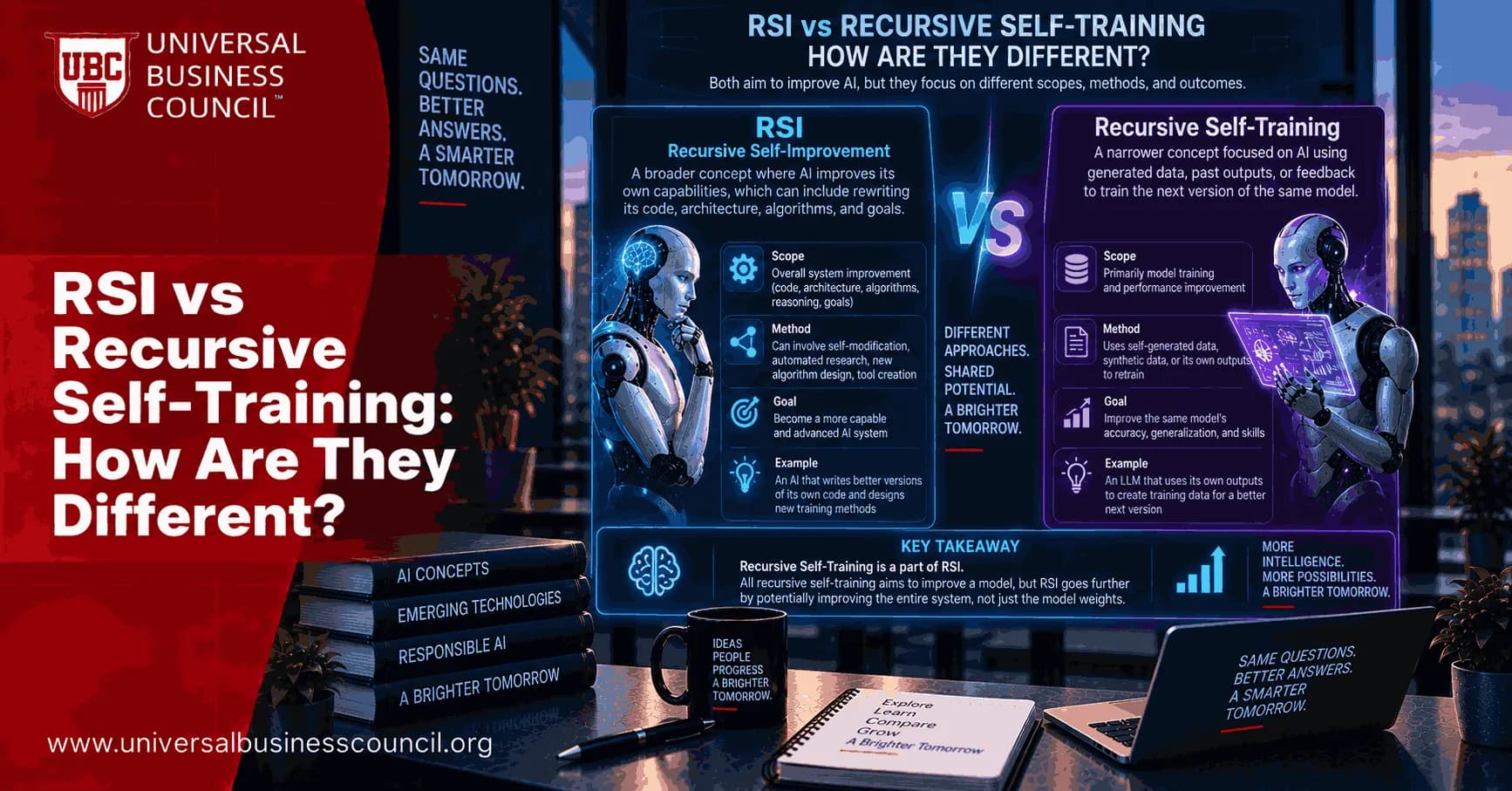
RSI, short for recursive self-improvement, and recursive self-training get treated as synonyms in a lot of casual AI discussion, but the gap between them is exactly why some AI claims sound more dramatic than the underlying technology actually supports. One term describes a widely used, well-established engineering practice already running inside production AI systems today. The other describes a much larger, largely unrealized capability that research labs are actively working toward but haven't fully achieved. Getting this distinction right matters for anyone trying to evaluate AI claims accurately, and it's the kind of clarity professionals build through a Marketing Certification, which helps ensure AI capabilities get represented honestly rather than blurred together for a punchier headline.
This article lays out exactly how RSI and recursive self-training differ, using clear comparisons and specific real-world examples of each.

Quick Definitions Before Comparing Them
Getting the terminology straight upfront makes the rest of the comparison much easier to follow.
Building a solid technical foundation for evaluating these definitions properly is where Artificial Intelligence Certifications prove genuinely useful, since they typically cover the training methods and architectural concepts needed to judge which category a specific AI system actually belongs to.
Recursive Self-Training
A process where a model's own generated outputs, or outputs from earlier versions of itself, become training data for a newer version
Operates within a fixed model architecture, adjusting weights and behavior rather than redesigning the system itself
Already standard practice across the AI industry, used in techniques like synthetic data generation and distillation
Human researchers still define the training objectives, filter the data, and approve each new version before deployment
RSI (Recursive Self-Improvement)
A broader, more theoretical concept where a system enhances its own overall capability, then uses that enhancement to drive further, potentially larger improvements
Implies the system could modify its own architecture, redefine its objectives, or discover entirely new improvement strategies independently
Sakana AI has formalized research specifically under this name, launching a dedicated RSI Lab focused on building systems that function more like autonomous researchers
Remains bounded in every publicly documented example so far, with human-defined benchmarks and oversight still firmly in place
Side-by-Side Comparison
Breaking the distinction down point by point makes the practical difference much clearer.
What changes: Self-training changes model weights and output quality. RSI would change the system's architecture, methods, and potentially its own objectives.
Who sets the goal: Self-training relies on humans to define what "better" means. RSI, in its full theoretical form, implies the system identifying its own improvement targets.
Current status: Self-training is deployed at scale across the AI industry right now. RSI has documented, narrow examples but no fully open-ended, autonomous version demonstrated publicly.
Verification method: Self-training uses human-designed evaluation metrics and quality filters. True RSI would require the system to verify its own progress independently, something no current system reliably does.
Known failure mode: Self-training risks model collapse, where quality degrades across generations trained on synthetic data. RSI carries broader safety concerns, including unpredictable behavior shifts across repeated self-modification cycles.
Real-world examples: Self-training shows up in distillation pipelines and synthetic data generation used by major AI labs. RSI shows up in narrower, benchmarked research systems like the Darwin Gödel Machine and AlphaEvolve.
Why the Confusion Between Them Persists
Part of the reason these terms blur together comes down to how AI progress gets communicated publicly.
"Self-improving AI" makes for a far more compelling headline than "AI system fine-tuned on synthetic data with human oversight"
Genuine self-training results often get described using self-improvement language, inflating public perception of how autonomous a system actually is
Research labs sometimes use "recursive self-improvement" as an aspirational framing for their broader mission, even when specific published results represent narrower, bounded achievements
This creates a pattern where accurate, incremental engineering progress gets reported alongside language borrowed from far more expansive theoretical claims
Recognizing this pattern requires ongoing technical literacy, and professionals who build that through a well-rounded Tech Certification tend to read past inflated framing more reliably than those relying on headline summaries alone.
Where Each Concept Actually Shows Up Today
Grounding the comparison in real, documented examples makes the distinction concrete rather than abstract.
Recursive self-training in practice: large language model providers routinely use model-generated synthetic data, AI-based evaluation, and distillation to train newer, more efficient model versions
RSI in practice: Sakana AI's Darwin Gödel Machine rewrites its own codebase and improved its benchmark score from twenty percent to fifty percent on real coding tasks, while Google DeepMind's AlphaEvolve refines algorithms across domains including its own training pipeline
Both categories involve genuine, measurable progress, but only self-training has moved fully into standard industry practice, while RSI remains an active, narrower research frontier
A Creative Example of Iterative Refinement
Outside of pure research, similar refinement principles show up in commercial creative tools as well. One emerging application is AI microdrama, where generative AI helps bring serialized stories, characters, and fictional worlds to life. These platforms often adjust character voice and plot pacing across episodes based on audience response data, which functions more like recursive self-training applied to storytelling, refining outputs within a fixed creative framework, rather than anything resembling the architectural self-modification associated with RSI research.
Why Getting This Distinction Right Actually Matters
This isn't just a semantic exercise. The difference between these two concepts shapes real decisions.
Businesses evaluating AI vendor claims need to know whether "self-improving" language describes deployed technology or aspirational research framing
Policymakers drafting AI oversight frameworks need accurate terminology to regulate the right capabilities rather than reacting to inflated claims
Technical teams building on AI models benefit from understanding which improvements they can rely on today versus which remain experimental
Public understanding of AI progress becomes more accurate when these terms are used precisely rather than interchangeably
Professionals who want to evaluate this distinction with real rigor, separating deployed capability from research-stage ambition, often pursue a Deep Tech Certification, which provides the technical depth needed to read AI announcements critically rather than taking dramatic framing at face value.
Final Thoughts
Recursive self-training is a real, widely deployed engineering practice with known benefits and a well-documented failure mode in model collapse. RSI describes a broader, more ambitious goal that current research has made genuine but narrow progress toward, without yet achieving the fully autonomous, open-ended version the term implies. Treating deployed self-training results as evidence of full RSI is the most common source of confusion in this space, and keeping the two clearly separated is essential for anyone trying to track AI progress accurately rather than reacting to headlines.
FAQs
1. What Is Recursive Self-Improvement (RSI)?
Recursive Self-Improvement (RSI) is the concept of an AI system repeatedly improving its own capabilities, processes, or components and then using those improvements to drive further improvement.
2. What Is Recursive Self-Training?
Recursive self-training refers to repeatedly using an AI model's own generated outputs, predictions, labels, or experiences as training material for the same model or subsequent versions. The process can create a feedback loop between generation, training, and retraining.
3. What Is the Main Difference Between RSI and Recursive Self-Training?
The main difference is scope. Recursive self-training primarily focuses on repeatedly training a model using AI-generated information, while RSI is broader and can involve improving algorithms, code, architectures, training methods, reasoning processes, or research capabilities.
4. Is Recursive Self-Training a Form of RSI?
It can be a component of RSI, but it is not automatically RSI. Recursive self-training becomes more closely related to RSI when the training process itself contributes to broader improvements that enable subsequent improvement cycles.
5. How Does Recursive Self-Training Work?
A simplified process is:
Generate outputs → select or evaluate data → retrain model → generate improved outputs → repeat.
The model's new outputs can then become additional training material for another cycle.
6. How Does Recursive Self-Improvement Work?
A broader RSI process could look like:
Identify weakness → research solution → modify system → test → evaluate → implement improvement → repeat.
Unlike self-training, RSI does not have to focus exclusively on training data.
7. Can LLMs Use Recursive Self-Training?
Yes. LLMs can generate synthetic examples, answers, code, explanations, or preference data that can be used to train or fine-tune later versions. However, the quality of generated data must be carefully controlled.
8. Can Recursive Self-Training Make an AI Better?
It can improve performance on certain tasks when the generated training data is useful and accurately filtered. However, improvement is not guaranteed, and repeatedly learning from model-generated data can introduce errors or reduce diversity.
9. Can Recursive Self-Training Cause Model Collapse?
Potentially. Research has found that repeatedly training models on their own generated data can cause a loss of information and degradation when the synthetic data lacks sufficient grounding in original or external data. This is one reason independent data and quality controls are important.
10. Does RSI Require Self-Training?
No. An AI could potentially improve through better algorithms, code optimization, automated experimentation, architecture search, or other mechanisms without training directly on its own outputs.
11. Does RSI Require an AI to Modify Itself?
Not necessarily in the narrow sense of modifying its model weights. RSI can include improvements to the processes, algorithms, tools, or systems that contribute to future AI development.
12. Can Recursive Self-Training Improve an AI's Capabilities Across Generations?
Yes. One model can generate training material that is used to produce a subsequent model with improved performance. If this cycle is repeated, it can create a generational feedback loop, although this does not automatically qualify as full RSI.
13. What Role Does Synthetic Data Play in Recursive Self-Training?
Synthetic data is often central to recursive self-training. An AI generates examples that can be filtered, evaluated, and incorporated into training data for a later model.
14. What Role Does Automated Evaluation Play in Both Approaches?
Evaluation determines whether generated outputs or system modifications are useful. In recursive self-training, it helps filter training examples; in RSI, it can determine whether broader changes to the AI actually improve its capabilities.
15. Can Recursive Self-Training Improve the AI That Generates the Data?
Potentially. If generated data is accurate and useful, training on it can improve specific capabilities. However, the system needs external validation because an AI can reinforce its own errors when it learns primarily from its own outputs.
16. What Are the Main Risks of Recursive Self-Training?
Key risks include error amplification, model collapse, reduced data diversity, feedback loops, and optimization toward flawed evaluation criteria. These problems can become more significant when generated data is repeatedly reused.
17. What Are the Main Risks of Recursive Self-Improvement?
RSI introduces a broader set of potential concerns, including unreliable self-evaluation, uncontrolled capability changes, security vulnerabilities, objective misalignment, and reduced human oversight.
18. Can Recursive Self-Training Lead to Recursive Self-Improvement?
It could contribute to an RSI process, particularly if better training allows a model to become more capable at designing and implementing further improvements. However, self-training alone does not guarantee recursive improvement of the AI development process.
19. Are AI Systems Already Using These Techniques?
Yes. AI systems already use synthetic data, self-play, automated evaluation, reinforcement learning, and iterative optimization. For example, Google DeepMind's SIMA 2 can generate experience through self-directed play that is subsequently used in training later versions, while AlphaEvolve uses Gemini models and automated evaluation to search for improved algorithms.
20. What Is the Simplest Way to Understand RSI vs Recursive Self-Training?
Think of recursive self-training as "AI repeatedly learning from AI-generated training material", while RSI is "AI repeatedly improving the systems and processes that make AI better."
Recursive self-training can be one component of RSI, but RSI has a much broader scope and does not depend solely on self-generated training data.
Related Articles
View All
Artificial Intelligence
RSI vs Self-Learning AI: How Are They Different?
Learn how recursive self-improvement differs from self-learning AI, including how each system adapts, what changes over time, and why the distinction matters in AI development.

Artificial Intelligence
Recursive Self-Improvement in AI: Benefits, Risks, Challenges, and Future Impact
Explore recursive self-improvement in AI, including its potential benefits, technical challenges, safety risks, and possible impact on the future of artificial intelligence.
Artificial Intelligence
How Could Recursive Self-Improvement Accelerate AI Development?
Explore how recursive self-improvement could accelerate AI development through faster experimentation, automated research, model optimization, and repeated capability gains.
Trending Articles
The Role of Blockchain in Ethical AI Development
How blockchain technology is being used to promote transparency and accountability in artificial intelligence systems.
AWS Career Roadmap
A step-by-step guide to building a successful career in Amazon Web Services cloud computing.
Top 5 DeFi Platforms
Explore the leading decentralized finance platforms and what makes each one unique in the evolving DeFi landscape.