

Why Could Recursive Self-Improvement Be Important for AGI?
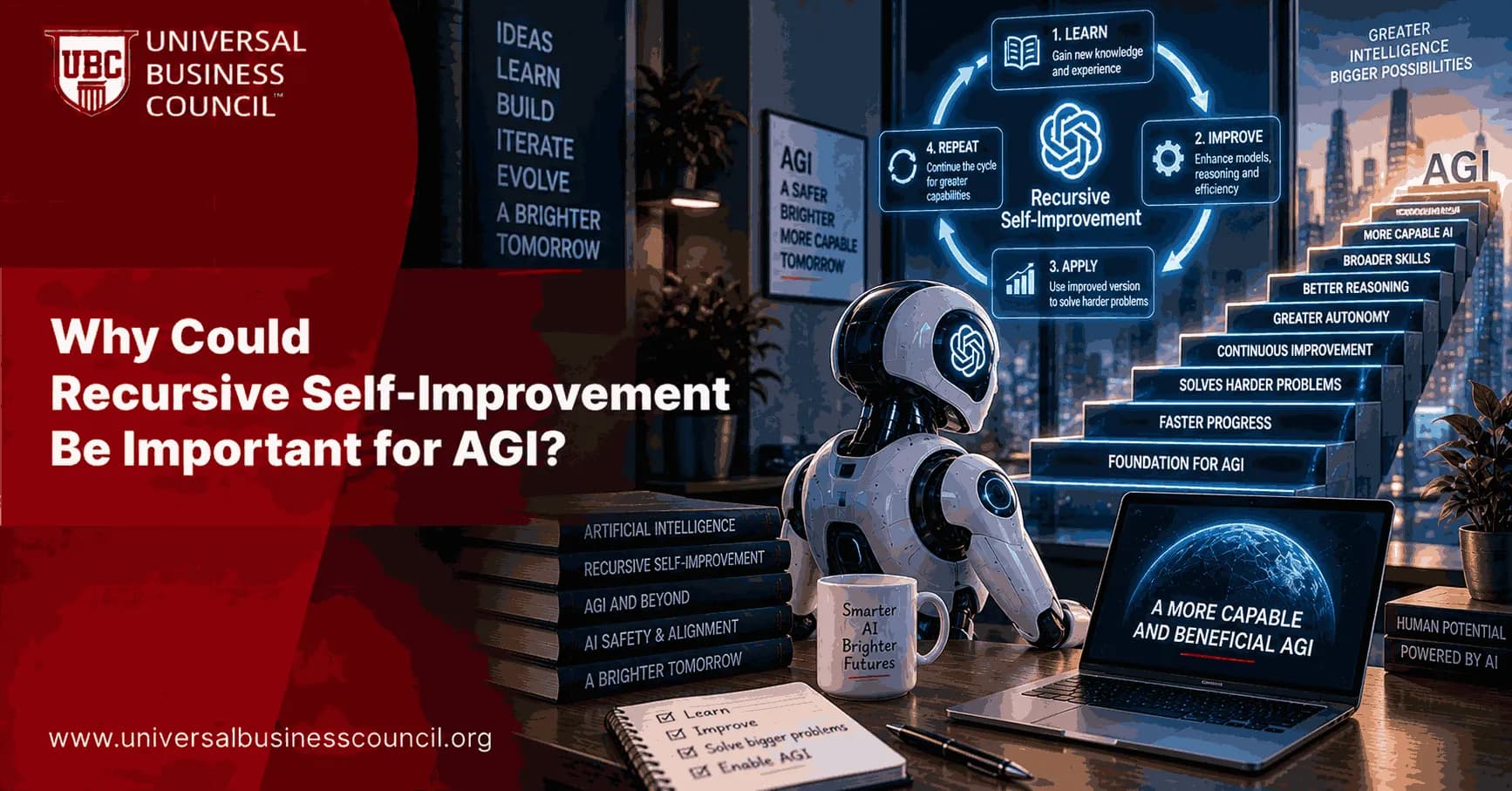
Artificial general intelligence refers to a hypothetical AI system capable of matching or exceeding human level performance across essentially any intellectual task, rather than excelling narrowly at one specific domain like image recognition or language generation. Recursive self-improvement matters enormously to this conversation because it represents one of the most discussed potential pathways for how a system might actually cross that threshold, and more importantly, what might happen in the period immediately after it does. Building a genuine understanding of why these two concepts connect so closely requires more than surface level familiarity with AI trends, and professionals who round out their expertise with a Marketing Certification alongside their technical AI knowledge often find it valuable, since explaining AGI adjacent concepts like this one clearly to non specialist audiences has become a genuinely important skill as public interest in the topic grows.
The Core Connection Between RSI and AGI
Recursive self-improvement matters for AGI discussions for a few distinct, interconnected reasons worth separating out clearly:

A potential pathway to reaching AGI: some researchers theorize that a sufficiently capable AI system, even one short of full general intelligence, could accelerate its own development toward AGI by contributing meaningfully to its own successor's design.
A multiplier once AGI is reached: if a system does achieve general intelligence, its ability to improve itself further could compound extremely quickly, since a system matching human research ability could theoretically work on AI research around the clock without the limitations that slow down human teams.
A key factor in takeoff speed debates: much of the disagreement among researchers centers not on whether recursive self-improvement could happen after AGI, but on how fast that improvement curve might move once it starts.
A central consideration in safety planning: governance and safety researchers treat the RSI-AGI connection as a reason to establish careful oversight mechanisms well before any system approaches general intelligence, rather than waiting until after the fact.
Professionals building deep expertise in this space, including those pursuing Artificial Intelligence Certifications, study these interconnected dynamics closely, since understanding AGI risk scenarios requires grasping how recursive improvement specifically could change the pace of AI development in ways that narrow, task specific AI improvements simply cannot.
Fast Takeoff Versus Slow Takeoff Scenarios
Researchers generally frame the AGI and recursive self-improvement relationship around two broad scenarios:
Fast takeoff: this scenario envisions a compressed timeline, potentially weeks or even days, between an AI system reaching roughly human level general capability and that system rapidly self-improving far beyond human intelligence, driven by the compounding nature of the improvement loop.
Slow takeoff: this scenario expects a more gradual transition, spanning months or years, shaped by real world bottlenecks like computing hardware availability, physical infrastructure, and the continued need for extensive testing and validation at each stage of improvement.
Why the distinction matters practically: a fast takeoff scenario leaves far less time for human oversight, safety testing, and corrective intervention, which is why so much AI safety research focuses specifically on identifying early warning signs before a system reaches the threshold where rapid self-improvement becomes possible.
What Would Actually Need to Be True for This to Happen
Several specific technical conditions would need to hold for recursive self-improvement to meaningfully accelerate progress toward or beyond AGI:
The AI system would need genuine understanding of its own architecture, not just the ability to generate code that resembles improvements without verifying their actual effect.
Each improvement cycle would need to produce gains large enough to justify the computational cost of implementing and testing it, rather than diminishing returns setting in quickly.
The system would need some degree of autonomy in directing its own research priorities, rather than requiring human researchers to define every next step.
Physical infrastructure, including computing hardware and energy availability, would need to scale fast enough to support increasingly capable systems without becoming a hard bottleneck.
A broader Tech Certification helps professionals evaluate these technical prerequisites critically, distinguishing which conditions current AI systems have genuinely begun to meet from which remain firmly speculative.
AI Innovation Beyond AGI Research
The broader wave of generative AI advancement extends well beyond AGI focused research labs and safety debates. One emerging application is AI microdrama, where generative AI helps bring serialized stories, characters, and fictional worlds to life, a genuinely different use case from frontier AGI research but one built on many of the same underlying machine learning advances. Seeing generative AI reach this far into creative industries, alongside the far more consequential questions being asked about AGI and self-improving systems, highlights just how broadly this technology is already reshaping different corners of the world at once.
Why This Question Deserves Serious, Careful Study
Even among researchers who disagree sharply on timelines, there is broad consensus that the relationship between recursive self-improvement and AGI deserves serious study well before it becomes an urgent practical concern. Reasons this matters include:
Major AI labs have publicly referenced this dynamic when explaining why they build safety evaluations into model development well ahead of deploying more capable systems.
Policymakers increasingly cite the possibility of rapid post-AGI improvement when debating regulatory thresholds tied to model capability rather than waiting for deployment to trigger oversight.
Understanding the nuance here helps separate legitimate, carefully reasoned technical concern from either dismissive skepticism or exaggerated, sensationalized claims that can distort public understanding in either direction.
Building real fluency in this area benefits from combining AGI specific study with a wider grounding in complex technical systems, and a Deep Tech Certification complements that AGI focused knowledge well, since evaluating claims about self-improving systems draws on the same rigorous, evidence based thinking used to assess other emerging technologies that sound more dramatic in headlines than they currently are in practice. As AI capabilities continue advancing steadily, professionals who understand both the genuine theoretical importance of this connection and its current practical limitations are best equipped to engage with AGI discussions thoughtfully rather than reactively.
FAQs
1. Why could recursive self-improvement be important for AGI?
Recursive self-improvement (RSI) could be important for Artificial General Intelligence (AGI) because an advanced AI might eventually contribute to improving the algorithms, training methods, software, and systems that determine its capabilities. If each improvement enables the system to contribute to further improvements, AI development could potentially become increasingly automated.
2. What is recursive self-improvement in AI?
Recursive self-improvement is the theoretical process in which an AI system improves its own capabilities or helps create an improved successor. The improved system can then contribute to another cycle of improvement. This creates a feedback loop that could potentially produce cumulative capability gains.
3. Does AGI require recursive self-improvement?
No. Recursive self-improvement is not a formal requirement for AGI. AGI refers to broad general-purpose intelligence, whereas RSI describes a mechanism through which an AI system could improve itself or its successors. AGI could theoretically be developed without autonomous RSI.
4. How could RSI help accelerate AGI development?
An AI capable of performing AI research could potentially automate tasks such as coding, debugging, experiment design, algorithm discovery, and model evaluation. Repeated automation of these tasks could reduce the time needed for some development cycles. The actual effect would depend on the AI's reliability, available computing resources, and evaluation methods.
5. Could an AGI improve the technology used to build AGI?
In theory, yes. A sufficiently capable AGI could potentially analyze existing AI architectures, identify weaknesses, propose alternative algorithms, and help test new approaches. If these improvements produced a more capable successor, that successor could potentially contribute to additional AI research.
6. What is the difference between AGI and recursive self-improvement?
AGI describes a type or level of AI capability, while RSI describes a process of improvement. AGI concerns whether an AI can perform a broad range of intellectual tasks. RSI concerns whether an AI can repeatedly contribute to improving itself or the systems that produce its capabilities.
7. Could RSI allow AGI to improve its reasoning abilities?
Potentially. An advanced AI research system could experiment with training methods, model architectures, reasoning strategies, and evaluation techniques. If these changes reliably improved reasoning, subsequent systems could potentially become better at AI research itself. However, current AI systems do not demonstrate unrestricted autonomous improvement of their own reasoning capabilities.
8. Could recursive self-improvement make AGI development faster?
It could potentially accelerate parts of AI development by increasing the amount of automated research and experimentation. AI systems can already assist with coding, algorithm optimization, and scientific research. A more autonomous system could potentially connect these capabilities into repeated improvement cycles.
9. Could AI create a better version of an AGI system?
An advanced AI could potentially assist with creating a more capable successor through algorithm design, code generation, data creation, training optimization, and evaluation. However, producing a better successor in one particular capability is different from independently creating a broadly superior AGI. Reliable measurement across many capabilities would be necessary.
10. What role does AI-assisted research play in recursive self-improvement?
AI-assisted research provides some of the building blocks needed for automated improvement. AI can help generate hypotheses, write and debug code, analyze experiments, and discover algorithms. These capabilities can be integrated into development workflows, although human researchers or automated controls may still define objectives and evaluate the results.
11. How could automated evaluation support RSI for AGI?
Automated evaluation can test whether a proposed modification improves an AI system. Candidate models or algorithms can be compared against predefined benchmarks, simulations, or functional tests. Reliable evaluation helps prevent an improvement loop from accepting changes that merely optimize a narrow metric or introduce new problems.
12. Could RSI create an intelligence feedback loop?
Yes, in theory. If an AI becomes better at AI research, its improved research abilities could help produce a more capable AI, which could then become even better at AI development. This creates a potential positive feedback loop. Whether such a loop would produce rapid capability growth depends on many technical constraints.
13. Could recursive self-improvement lead from AGI to ASI?
RSI is one possible pathway discussed in research about the transition from AGI to Artificial Superintelligence (ASI). If an AGI could reliably improve the mechanisms responsible for its capabilities, those improvements could potentially contribute to increasingly capable successors. This remains a theoretical possibility rather than a guaranteed outcome.
14. What is the difference between AI automation and autonomous RSI?
AI automation involves using AI to perform specific tasks according to predefined instructions, objectives, or workflows. Autonomous RSI would involve AI having substantially greater control over identifying, implementing, evaluating, and repeating improvements to itself or its successors. Therefore, automated AI research can contribute to RSI without being equivalent to full RSI.
15. Could recursive self-improvement reduce human involvement in AI development?
Potentially. More capable AI systems could automate increasing portions of software engineering, experimentation, algorithm discovery, and model optimization. Humans could continue to define objectives, establish constraints, evaluate results, and manage deployment. The eventual balance between automation and human involvement would depend on technical and governance decisions.
16. What challenges could limit RSI in AGI?
Important challenges include computing requirements, reliable self-evaluation, algorithmic bottlenecks, data quality, diminishing returns, and difficulties modifying complex AI systems. A system could also produce changes that improve one benchmark while harming other capabilities. These limitations could prevent an RSI loop from producing continuous rapid improvement.
17. What are the risks of recursive self-improvement for AGI?
Potential risks include alignment problems, unexpected capability changes, cybersecurity vulnerabilities, and difficulties maintaining meaningful human oversight. Greater autonomy over AI development could make later system changes harder to predict and verify. Safety testing and independent evaluation could therefore become increasingly important.
18. Is recursive self-improvement already happening in AGI?
There is no established evidence that fully autonomous RSI is currently occurring in an AGI system. Today's AI systems can perform increasingly sophisticated AI research and engineering tasks, but these capabilities should not automatically be interpreted as autonomous recursive self-improvement. OpenAI stated in September 2026 that fully autonomous RSI is not happening today.
19. Could RSI accelerate AI progress indefinitely?
There is no basis for assuming indefinite acceleration. Computing constraints, hardware limitations, energy requirements, diminishing returns, and increasingly difficult research problems could all limit improvement. Even if recursive improvement becomes practical, its rate could vary substantially between development cycles.
20. Why might RSI become important after AGI?
If AGI can perform substantial portions of AI research and development, it could potentially become an active participant in improving future AI systems. Recursive improvement could therefore provide a mechanism for continued capability development beyond the initial achievement of AGI. However, whether this happens, how quickly it happens, and how much autonomy is involved remain open research questions.
Related Articles
View All
Artificial Intelligence
How Could Recursive Self-Improvement Accelerate AI Development?
Explore how recursive self-improvement could accelerate AI development through faster experimentation, automated research, model optimization, and repeated capability gains.

Artificial Intelligence
Could Recursive Self-Improvement Lead to Artificial Superintelligence?
Explore whether recursive self-improvement could lead to artificial superintelligence, how repeated capability gains might accelerate AI development, and what technical and safety challenges could emerge.
Artificial Intelligence
How Could Recursive Self-Improvement Shape the Future of AI?
Explore how recursive self-improvement could shape the future of AI by accelerating capability growth, transforming AI research, and introducing new technical, safety, and governance challenges.
Trending Articles
The Role of Blockchain in Ethical AI Development
How blockchain technology is being used to promote transparency and accountability in artificial intelligence systems.
AWS Career Roadmap
A step-by-step guide to building a successful career in Amazon Web Services cloud computing.
Top 5 DeFi Platforms
Explore the leading decentralized finance platforms and what makes each one unique in the evolving DeFi landscape.