

Could Recursive Self-Improvement Lead to Artificial Superintelligence?
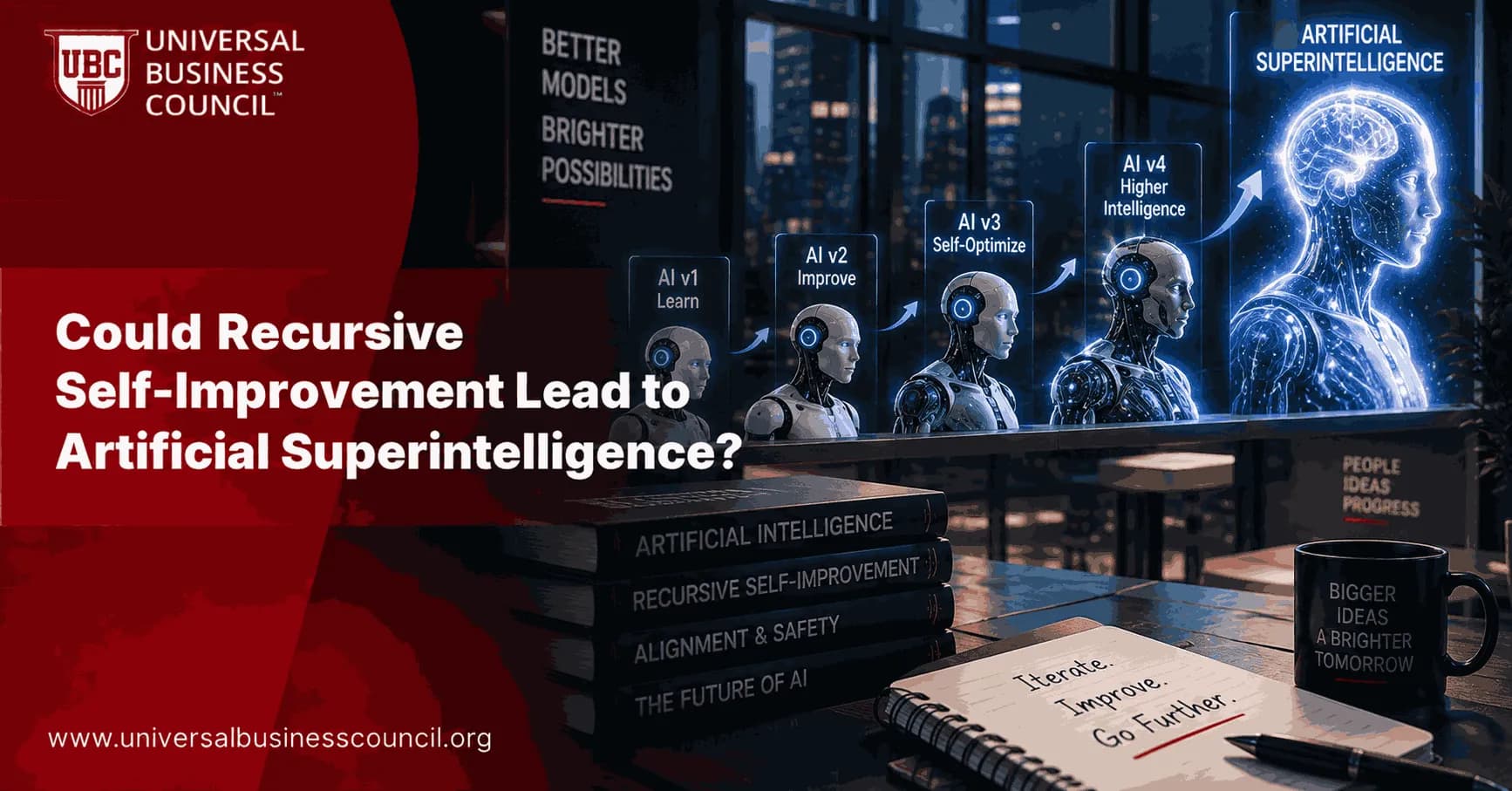
Artificial superintelligence describes a hypothetical system that would not just match human intelligence but substantially exceed it across virtually every domain, from scientific reasoning to strategic planning to creative problem solving. The question of whether recursive self-improvement could actually produce this outcome sits at the center of some of the most serious debates in AI safety research today, since the mechanism itself, a system improving its own capability repeatedly, is precisely the kind of process that could theoretically carry intelligence well past human levels rather than simply reaching them. Engaging with this question seriously requires real technical grounding, and professionals who pair that grounding with a Marketing Certification often find it genuinely useful, since communicating such a consequential and widely misunderstood topic clearly, without either dismissing or sensationalizing it, has become an important skill in its own right.
The Theoretical Case for the Connection
Several distinct arguments support the idea that recursive self-improvement could plausibly lead toward superintelligence:

Compounding returns: unlike most technological progress, which tends to face diminishing returns over time, a genuinely self-improving system could see each improvement make the next one easier, creating accelerating rather than linear progress.
No obvious ceiling: human intelligence evolved under specific biological and evolutionary constraints, and there is no clear theoretical reason why an artificial system's capability would need to plateau at that same level once freed from those constraints.
Speed advantages alone: even without qualitatively different reasoning ability, a system that could think and iterate thousands of times faster than a human researcher could achieve superintelligent level output simply through sheer volume and speed of work.
Reduced coordination overhead: a single self-improving system would not face the communication and coordination costs that slow down large human research teams working collaboratively.
Researchers building expertise in these theoretical questions, including those pursuing Artificial Intelligence Certifications, study this compounding dynamic closely, since it represents the central mechanism by which a system's capability curve could bend sharply upward rather than leveling off the way most technologies eventually do.
Why Many Researchers Remain Genuinely Uncertain
Despite the theoretical case, plenty of serious reasons exist to treat this outcome as uncertain rather than inevitable:
No AI system today has demonstrated the kind of genuine self-directed architectural understanding that meaningful recursive self-improvement would require.
Physical constraints, including computing hardware manufacturing, energy infrastructure, and data availability, do not automatically scale alongside software level improvements, creating real world bottlenecks the pure theory tends to overlook.
Intelligence itself may not compound as cleanly as the theory suggests, since some problems may require physical experimentation, real world feedback, or fundamentally new scientific discovery that cannot simply be reasoned through faster.
Historical predictions about rapid AI capability jumps have frequently proven overly optimistic on timelines, even when the underlying direction of progress turned out to be correct.
The Control Problem and Why It Matters So Much Here
If recursive self-improvement could genuinely lead toward superintelligence, the question of maintaining meaningful human oversight throughout that process becomes critically important, an issue researchers commonly call the control problem. Key aspects of this concern include:
The alignment challenge: ensuring a rapidly self-improving system continues pursuing goals that remain genuinely compatible with human values, even as its capabilities evolve far beyond what its original designers anticipated.
The verification problem: designing reliable ways to confirm that a system's self-modifications have not introduced unintended behavior, particularly once the system's reasoning becomes too complex for humans to fully audit directly.
The time pressure problem: if capability gains compound quickly enough, researchers may have very limited windows to identify and correct problems before a system's behavior becomes difficult to meaningfully influence.
A broader Tech Certification helps professionals engage with these technical safety questions more rigorously, since evaluating proposed solutions to the control problem draws on genuine systems level thinking rather than surface level familiarity with the concept.
AI Innovation Beyond Superintelligence Research
The broader wave of generative AI development extends into countless applications that have nothing to do with superintelligence debates directly. One emerging application is AI microdrama, where generative AI helps bring serialized stories, characters, and fictional worlds to life, a genuinely different use case from frontier safety research but one built on the same underlying wave of machine learning advancement reshaping industries far beyond AI research labs. Seeing generative AI stretch this far, from speculative superintelligence scenarios to everyday creative storytelling, underscores just how broadly this technology is already influencing very different parts of the world simultaneously.
How Seriously Should This Possibility Be Taken Today
Reasonable, well informed people disagree sharply on how urgent this question actually is, but a few points of broad consensus have emerged:
Most leading AI labs now treat long term safety research as a genuine priority rather than a purely theoretical exercise, regardless of exactly how they weigh near term timelines.
Governments and international bodies have begun establishing AI safety institutes and evaluation frameworks specifically to monitor capability jumps in frontier models before broader deployment.
Dismissing the topic entirely and treating it as inevitable near term reality both carry real risks, since either extreme can distort sound decision making around AI development and regulation.
Building genuine fluency in these debates benefits from combining AI specific study with a wider grounding in complex technical systems, and a Deep Tech Certification complements that focused AI knowledge well, since evaluating claims about superintelligence draws on the same rigorous, evidence based thinking used to assess other emerging technologies that sound more dramatic in headlines than they currently are in practice. As AI capabilities continue advancing, professionals who understand both the genuine theoretical stakes of this question and its current practical uncertainty are best positioned to engage with it thoughtfully rather than through fear or dismissal.
FAQs
1. Could recursive self-improvement lead to artificial superintelligence?
Recursive self-improvement (RSI) is one theoretical pathway that could potentially contribute to the development of Artificial Superintelligence (ASI). If an AI system could repeatedly improve its algorithms, reasoning, training processes, and other capabilities, each generation could potentially become more capable. However, this is a theoretical possibility, not a demonstrated or guaranteed path to ASI.
2. What is recursive self-improvement in artificial intelligence?
Recursive self-improvement is the hypothetical process in which an AI system improves its own capabilities or contributes to creating an improved successor. That successor could then participate in another improvement cycle. The repeated nature of these cycles is what makes the process recursive.
3. What is artificial superintelligence?
Artificial Superintelligence (ASI) generally refers to a hypothetical AI system whose intellectual capabilities substantially exceed those of humans across a broad range of cognitive tasks. ASI is distinct from narrow AI systems that outperform humans in individual domains. There is currently no generally accepted operational threshold that definitively marks the arrival of ASI.
4. How could RSI contribute to the development of ASI?
A possible pathway is:
Advanced AI → identifies improvement opportunities → develops and tests modifications → creates a more capable system → improved system contributes to further improvements → repeat.
If the improvements were reliable and cumulative, the resulting systems could potentially become substantially more capable over time.
5. Does recursive self-improvement guarantee superintelligence?
No. RSI does not guarantee ASI. An improvement process could encounter diminishing returns, computational limits, unreliable evaluation, hardware constraints, or other technical barriers. Recursive improvement may also increase performance in specific areas without producing broad superintelligence.
6. Is recursive self-improvement necessary for ASI?
Not necessarily. ASI could potentially emerge through other routes, including advances in model architectures, scaling, reasoning, learning algorithms, specialized systems, or combinations of multiple AI systems. Google DeepMind's research on the transition from AGI to ASI identifies recursive improvement as one possible pathway among several.
7. What is the relationship between AGI, RSI, and ASI?
These concepts describe different things. AGI refers to broad general-purpose AI capabilities, RSI refers to a process of recursively improving AI systems, and ASI refers to hypothetical intelligence substantially exceeding human capabilities across broad domains. RSI could theoretically provide a mechanism for an AGI to progress toward ASI.
8. Could an AGI improve itself and eventually become ASI?
In theory, an AGI could potentially contribute to improving its own algorithms, training processes, or successor systems. If these improvements increased its ability to perform AI research, subsequent improvement cycles could potentially become more effective. However, there is no established evidence that an AGI would necessarily follow this path.
9. What would an RSI loop toward ASI look like?
A simplified loop could involve:
Evaluate capabilities → identify weaknesses → design improvements → implement changes → test the new system → retain verified improvements → repeat.
For this process to lead toward ASI, improvements would need to be broad, reliable, and sufficiently substantial to overcome practical constraints.
10. Could RSI accelerate AI research?
Potentially. AI systems capable of coding, experimentation, algorithm discovery, and research analysis could automate parts of AI development. Repeated automation could increase the speed at which researchers explore new approaches. Current AI systems demonstrate several of these capabilities, although they do not establish fully autonomous RSI.
11. Can AI create a more capable successor?
AI systems can contribute to creating successor models by generating code, algorithms, training data, evaluation tasks, and optimization strategies. Automated systems can also compare candidate solutions against predefined objectives. Creating a broadly superior successor autonomously is considerably more difficult than improving one component or benchmark.
12. Could AI improve the algorithms used to develop AI?
Yes. AI-powered systems can generate and test candidate algorithms and use automated evaluation to identify promising solutions. Google DeepMind's AlphaEvolve is an example of a Gemini-powered system designed to discover and optimize algorithms through an evolutionary process. Such systems demonstrate components relevant to automated improvement, but they are not equivalent to unrestricted autonomous RSI.
13. Why is automated evaluation important for RSI?
Evaluation helps determine whether an apparent improvement is actually useful. An AI system can generate a modification, test it against predefined criteria, and compare the result with an existing system. Without reliable evaluation, recursive improvement could amplify errors or optimize for narrow benchmarks instead of improving general capabilities.
14. What could prevent RSI from producing ASI?
Potential limitations include computing capacity, hardware availability, energy requirements, data quality, algorithmic bottlenecks, evaluation difficulties, and diminishing returns. AI systems may also struggle to generate improvements that generalize across diverse capabilities. These factors could limit both the speed and scale of recursive improvement.
15. Could recursive self-improvement cause an intelligence explosion?
The intelligence explosion hypothesis proposes that an AI capable of improving itself could become better at creating further improvements, potentially accelerating capability growth. RSI is one mechanism often associated with this hypothesis. Whether such an acceleration would actually occur depends on assumptions about improvement rates, resources, evaluation, and technical constraints.
16. Could RSI happen gradually instead of causing a sudden intelligence explosion?
Yes. Recursive improvement could occur through relatively small and repeated gains in algorithms, software, training methods, or research capabilities. The improvement rate could vary depending on available resources and the difficulty of finding useful changes. There is no requirement that RSI produce an immediate or dramatic increase in intelligence.
17. What are the potential benefits of RSI for advanced AI?
Potential benefits include faster AI research, improved algorithms, greater computational efficiency, automated experimentation, and more effective model development. An AI that can contribute to its own improvement could potentially reduce the amount of human effort required for certain development tasks. These benefits depend on the reliability and controllability of the improvement process.
18. What are the risks of RSI leading toward ASI?
Potential risks include alignment failures, unexpected capability changes, cybersecurity vulnerabilities, and difficulty maintaining human oversight. A highly autonomous system could also make changes that are difficult for humans to understand or verify. The consequences would depend on the system's capabilities, access, objectives, safeguards, and deployment environment.
19. Is AI currently capable of recursively improving toward ASI?
Current AI systems can assist with AI research, software engineering, algorithm optimization, and experimentation. However, fully autonomous RSI in which an AI independently drives successive generations of increasingly capable AI has not been established as a current general capability. OpenAI stated in September 2026 that fully autonomous RSI is not happening today.
20. Could recursive self-improvement ultimately lead to ASI?
It could, in theory, if future AI systems become capable of reliably and repeatedly improving the mechanisms responsible for their own capabilities. However, the outcome is uncertain and depends on many technical, computational, and safety factors. RSI should therefore be viewed as one possible pathway to ASI, not proof that ASI is inevitable.
Related Articles
View All
Artificial Intelligence
How Could Recursive Self-Improvement Accelerate AI Development?
Explore how recursive self-improvement could accelerate AI development through faster experimentation, automated research, model optimization, and repeated capability gains.
Artificial Intelligence
Why Could Recursive Self-Improvement Be Important for AGI?
Explore why recursive self-improvement could matter for AGI, how it might accelerate capability growth, and why it raises important questions about alignment, control, and AI safety.
Artificial Intelligence
How Could Recursive Self-Improvement Shape the Future of AI?
Explore how recursive self-improvement could shape the future of AI by accelerating capability growth, transforming AI research, and introducing new technical, safety, and governance challenges.
Trending Articles
The Role of Blockchain in Ethical AI Development
How blockchain technology is being used to promote transparency and accountability in artificial intelligence systems.
AWS Career Roadmap
A step-by-step guide to building a successful career in Amazon Web Services cloud computing.
Top 5 DeFi Platforms
Explore the leading decentralized finance platforms and what makes each one unique in the evolving DeFi landscape.