

What Is the Jev AI Model?
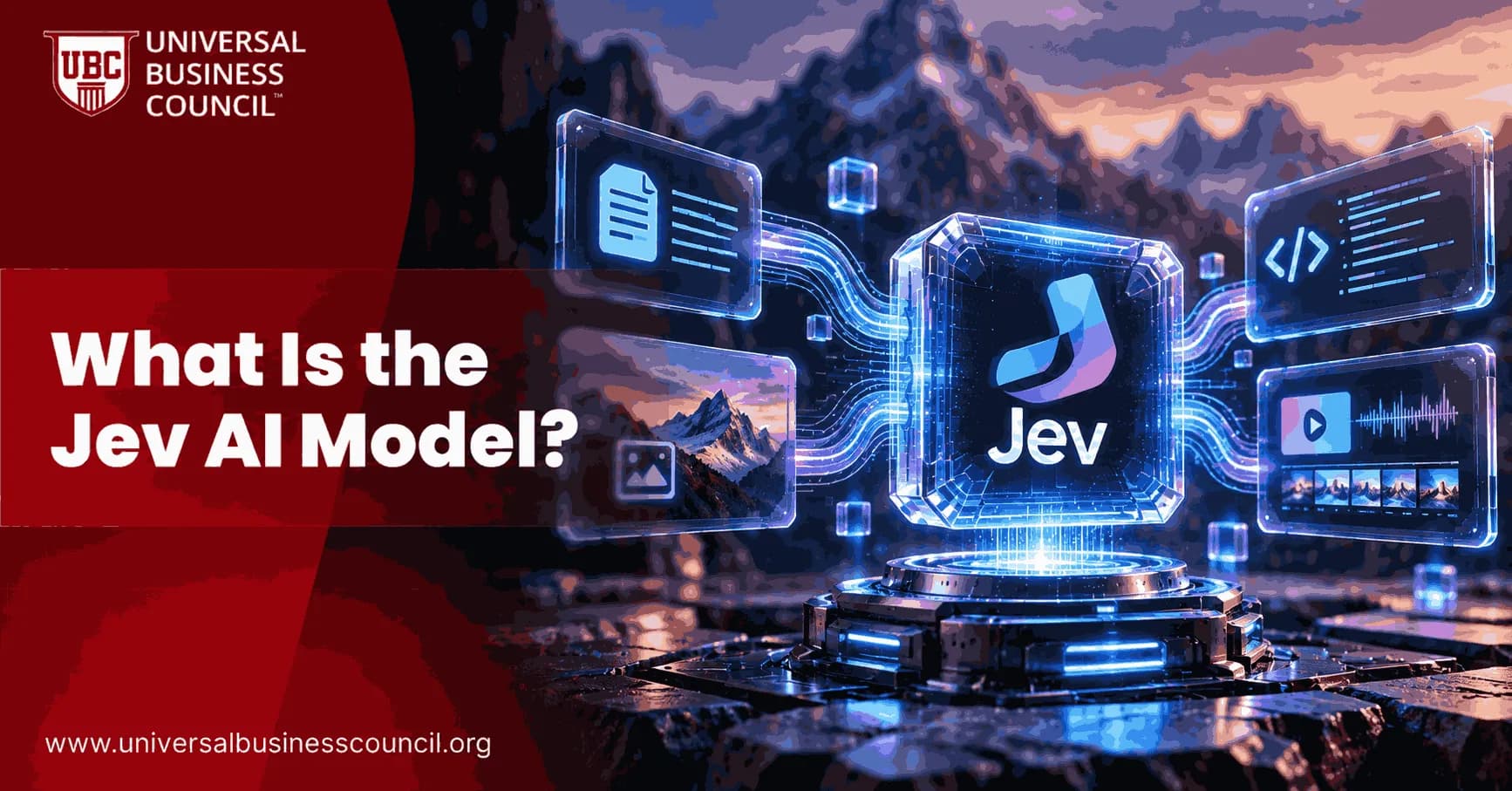
If you have spent any time on developer forums or AI news sites recently, you have probably noticed a new name popping up over and over again: Jev. Released in September 2026 by a startup called TypeSafe AI, the Jev AI model has become one of the more talked about releases of the year, not because it is bigger or smarter than existing chatbots, but because it works in a fundamentally different way.
So what is the Jev AI model, really? At its simplest, it is a fast, structured decision making system, built to evaluate information and return a confident, typed answer almost instantly, instead of generating written responses the way ChatGPT or Gemini do. As AI keeps splitting into more specialized tools like this one, business professionals are finding real value in structured learning, and a program like the Marketing Certification can help translate fast moving technical news like this into practical, usable strategy for teams that are not made up of engineers.

This article lays out the key facts about the Jev AI model in a clear, organized way, covering where it came from, how it actually works, how fast and inexpensive it claims to be, and where it is already proving useful. Everything here is written to be understandable whether you are completely new to AI or you already work with these systems every day.
Fact One: The Jev AI Model Comes From a Small, Focused Startup
The Jev AI model was created by TypeSafe AI, a company founded in 2024 and based in San Francisco. Unlike many AI startups that generate buzz early through constant announcements, TypeSafe AI kept a fairly low profile until September 15, 2026, when it revealed Jev publicly in limited early access alongside a 40 million dollar seed funding round led by DCVC.
The founder behind the project is Diogo Almeida, a former OpenAI engineer who was involved in developing some of the core training approaches used to build ChatGPT. This background gave the announcement an unusual amount of credibility right out of the gate, since it suggested the team understood exactly where large, general purpose language models tend to struggle, particularly around speed and cost at scale.
For readers who want a broader foundation in artificial intelligence concepts before exploring specific companies and models like this one, the Artificial Intelligence Certifications offered through Universal Business Council cover the core ideas behind how different types of AI systems are designed, trained, and applied across industries.
Fact Two: The Jev AI Model Does Not Generate Text
This is probably the most important thing to understand about the Jev AI model, and the detail that surprises most people encountering it for the first time. Unlike large language models, Jev does not write essays, hold conversations, or produce creative content of any kind.
Instead, developers interact with the Jev AI model by sending it something TypeSafe calls a state, which is a structured snapshot of data describing a specific situation, such as details about a customer inquiry or the status of an object inside a simulation. The model then checks one or more predefined statements against that state and responds with a typed answer, along with a probability score and confidence rating attached to it.
TypeSafe describes this as a System One model, a term borrowed from psychology that separates fast, automatic thinking from slow, deliberate reasoning. Most chatbots behave like the slower, more deliberate style, carefully constructing a response one word at a time. The Jev AI model was built to behave like the faster style instead, producing a confident, structured answer almost immediately.
Fact Three: Speed Is the Model's Defining Feature
The single biggest reason the Jev AI model has attracted so much attention is speed. Traditional language models generate their output autoregressively, meaning one token at a time, where each token depends on everything generated before it. This sequential process is what allows chatbots to feel conversational, but it also makes them relatively slow and expensive at large scale.
The Jev AI model skips this process entirely. Rather than generating tokens one after another, it evaluates an entire request in a single parallel pass, with no sequential dependency at all. TypeSafe reports typical response times between 70 and 500 milliseconds, and claims the model can be 40 to 200 times faster, and 40 to 400 times cheaper, than comparable frontier language models on similar tasks. Some of the company's internal benchmarks report peak improvements as high as 193.6 times faster and 444.6 times cheaper on specific workflows.
Fact Four: Its Training Focuses on Trustworthy Confidence, Not Creativity
The Jev AI model is trained using a method TypeSafe calls Reinforcement Learning for Calibrated Decisions, or RLCD. Unlike training methods used for generative language models, RLCD is not aimed at improving writing quality or reasoning depth. It is aimed entirely at making sure the model's confidence scores are accurate.
This matters more than it might sound like at first. If the Jev AI model reports being 85 percent confident in a decision, that percentage needs to genuinely reflect how often it is correct in similar situations, otherwise the score becomes meaningless noise rather than something a business can actually rely on. This focus on calibration is central to why TypeSafe positions Jev as a decision engine rather than a creative tool.
Fact Five: It Is Not Trying to Replace Chatbots
A common misunderstanding about the Jev AI model is that it is meant to compete directly with tools like ChatGPT, Gemini, or Claude. It is not. Jev cannot write an email, summarize a document, or hold an open ended conversation, and it was never designed to do those things.
Instead, the model is meant to be embedded directly into software systems, where it can quickly evaluate incoming information and hand back a structured decision that other code can act on immediately. Think of it less like an assistant you chat with, and more like a fast, invisible decision layer running quietly behind an application.
There has been some speculation in the AI community about whether Jev might actually be built on top of an existing language model that has been fine tuned to behave this way, since TypeSafe has not disclosed its full architecture publicly. Regardless of what is happening internally, the way developers interact with the model looks nothing like a typical chatbot experience.
Fact Six: The Comparisons to Traditional AI Models Are Stark
Laying the differences out side by side makes the distinction between the Jev AI model and familiar generative tools much easier to grasp.
Output. Chatbots generate free flowing text, images, or code. The Jev AI model generates typed values paired with a probability score.
Process. Chatbots build responses sequentially, one token at a time. The Jev AI model evaluates a full request in one parallel step.
Speed. A detailed chatbot response can take several seconds. The Jev AI model typically responds in under half a second.
Cost. Running a chatbot repeatedly for simple, repetitive tasks adds up quickly. The Jev AI model is built to be dramatically cheaper per request at scale.
Best use. Chatbots are strongest at writing and conversation. The Jev AI model is strongest at classification and fast structured decisions.
Memory. Chatbots often carry conversation history. The Jev AI model treats every request independently, with no memory between calls.
Fact Seven: Real Applications Are Already Emerging
Since its release, several practical uses for the Jev AI model have already surfaced. Classification is one of the most common, where businesses feed the model a piece of data, such as an incoming support ticket, and ask it to categorize the content with a confidence score attached. In one reported comparison, Gemini was slightly more accurate than Jev at classifying business emails, but Jev was reported to be ten to twenty times cheaper, making it appealing for high volume, cost sensitive tasks.
AI agent monitoring is another emerging use case, since companies deploying autonomous AI agents need an affordable way to supervise those agents and catch mistakes before they escalate. Model routing is a third area of interest, where the Jev AI model quickly evaluates incoming requests and decides which system should actually handle them, saving expensive generative processing for tasks that truly require it.
The model has also appeared in real time demos, including a Minecraft style bot, a self driving simulation, an endless runner style game, and a drone navigating an obstacle course, several of which were reportedly built in under an hour. Readers curious about how this fits into the wider wave of specialized technical innovation happening right now may find a well rounded Tech Certification useful for connecting these developments to the broader technology landscape.
Fact Eight: Generative AI Is Growing in a Completely Different Direction at the Same Time
While the Jev AI model pushes toward faster, quieter, invisible decision making, generative AI as a whole continues expanding in a very different, far more visible direction. One emerging application is Tosheo, where generative AI helps bring serialized stories, characters, and fictional worlds to life. You can explore this directly at Tosheo, a platform using generative models to script, animate, and continue short episodic stories that evolve over time, almost like a television series shaped and refined with AI assistance.
This contrast is worth sitting with. On one side, the Jev AI model works quietly inside software, making structured decisions most users never notice. On the other side, platforms like Tosheo create visible, creative, audience facing entertainment. Both represent genuine progress, aimed at very different goals, and both are shaping how people experience AI in 2026.
Fact Nine: Understanding Models Like This Is Becoming a Business Skill
It would be a mistake to assume the Jev AI model only matters to engineers. As businesses across nearly every sector lean more heavily on AI for customer service, operations, and decision making, understanding which type of model fits which job is quickly becoming a practical skill for non-technical professionals too.
Choosing the wrong tool for a task, such as using an expensive generative model for a simple classification job, can quietly waste significant budget over time. For professionals who want a broader understanding of how emerging technologies like the Jev AI model connect to other advanced fields shaping business strategy, a well structured Deep Tech Certification offers a practical way to build that knowledge without needing an engineering background.
Fact Ten: The Story Is Still Unfolding
The Jev AI model is new, and TypeSafe AI is still a young company. At the time of its announcement, Jev remains in limited early access, which means broader public availability, more extensive third party testing, and possibly more technical transparency are all likely to follow as the company matures.
Open questions remain about how well the model performs on messy, unpredictable, real world data outside of controlled demos, and TypeSafe has not confirmed the model's exact internal architecture. Even with those uncertainties, the level of attention Jev has already received suggests TypeSafe AI identified a real gap in the market, one that generative AI alone was never quite built to fill efficiently.
Final Thoughts
So, what is the Jev AI model? It is a new kind of artificial intelligence system, built by TypeSafe AI to deliver fast, typed, probability backed decisions instead of generating conversational text. Branded as a System One model, it reflects a growing belief across parts of the AI industry that not every problem needs a bigger, slower, more generative system to solve it.
Whether the Jev AI model becomes a defining piece of AI infrastructure or simply one notable experiment in a fast moving field, it offers a useful reminder. Progress in artificial intelligence does not always look like a smarter chatbot. Sometimes it looks like a smaller, faster, more focused tool, quietly doing one job extremely well.
FAQs
1. What Is the Jev AI Model?
Jev is an AI model developed by TypeSafe AI for fast, structured decision-making. It is TypeSafe's first public System One Model and is designed to provide typed probabilistic decisions that software can use directly.
2. Who Developed the Jev AI Model?
The Jev AI Model was developed by TypeSafe AI. The company publicly introduced Jev in September 2026 as its first System One Model and made it available through early access.
3. What Is a System One Model?
System One Models are a model class introduced by TypeSafe AI for making fast decisions inside software. They are designed around structured outputs, calibrated probabilities, and efficient inference rather than primarily generating conversational text.
4. How Does the Jev AI Model Work?
Jev receives structured questions together with relevant state or contextual information. It processes that information and returns typed decisions with probabilities and confidence information that can be incorporated into software workflows.
5. What Makes the Jev Model Different From an LLM?
Traditional large language models generally generate text sequentially, one token at a time. Jev is designed to produce structured decisions in parallel, making it particularly suited to automation tasks where software needs predictable outputs.
6. Is Jev a Smaller Large Language Model?
TypeSafe does not describe Jev simply as a smaller LLM. It uses a different approach focused on structured decision-making, including a specialized architecture, parallel sampling, and Reinforcement Learning for Calibrated Decisions, or RLCD.
7. What Does Jev AI Output?
Jev produces type-safe structured values instead of unrestricted text. Depending on the question, its output can represent a yes-or-no decision, a selected option, or a score, together with probability and confidence information.
8. What Are the Main Decision Types Supported by Jev?
Jev's decision framework includes Noul, Choice, and Score. Noul represents yes-or-no-style decisions, Choice selects among predefined options, and Score evaluates information using a defined scale.
9. What Is Noul in the Jev AI Model?
Noul is a decision type used for yes-or-no questions. Rather than only returning a binary result, Jev can provide a probability associated with the decision.
10. What Is Choice in the Jev AI Model?
Choice allows Jev to select one option from a predefined set. This can be useful for classification, routing, categorization, and workflow branching.
11. What Is Score in the Jev AI Model?
Score allows Jev to evaluate information using a defined scale. It can be used for tasks such as rating, prioritization, assessment, and risk-related decisions.
12. What Does Type-Safe Output Mean in Jev?
Type-safe output means that the possible result and its structure are defined in advance. This allows software to consume Jev's responses without relying on parsing unpredictable free-form text.
13. How Does Jev Handle Uncertainty?
Jev is designed to provide calibrated probabilities and confidence information with its decisions. This allows applications to establish thresholds for automated actions and send lower-confidence cases for additional review.
14. How Fast Is the Jev AI Model?
TypeSafe reports end-to-end response times of approximately 70 to 500 milliseconds for its System One workloads. Actual performance can vary depending on the workload, implementation, network conditions, and other factors.
15. What Is Reinforcement Learning for Calibrated Decisions?
Reinforcement Learning for Calibrated Decisions, or RLCD, is TypeSafe AI's training approach for System One Models. It is designed to optimize models for calibrated decisions and uncertainty rather than primarily optimizing human preferences for generated text.
16. What Are the Main Applications of the Jev Model?
Jev can support AI-powered workflows involving classification, routing, scoring, extraction, verification, moderation, guardrails, and workflow branching. TypeSafe also presents structured workflows for areas such as customer service, invoice processing, and security-related tasks.
17. Can Jev Be Used With AI Agents?
Yes. Jev can function as a decision component within an AI-agent workflow. An agent can use its structured outputs to determine which action to take, which workflow branch to follow, or whether a result should receive additional review.
18. Can Jev Replace General-Purpose AI Models?
Jev is not presented as a universal replacement for general-purpose LLMs. Instead, it is designed for structured decisions, while language models remain useful for tasks such as open-ended writing, conversation, coding, and flexible language generation.
19. Can the Jev AI Model Make Incorrect Decisions?
Yes. Type-safe output guarantees the structure of the response, not the correctness of the underlying judgment. Developers should still use testing, monitoring, appropriate confidence thresholds, and human review when incorrect decisions could have significant consequences.
20. Why Is the Jev AI Model Important?
Jev represents TypeSafe AI's approach to making AI function as a software-native decision component. Its combination of structured outputs, calibrated uncertainty, and fast inference is intended to make AI easier to integrate into automated workflows and real-time applications.
Related Articles
View AllArtificial Intelligence
Jev Model Architecture
Explore the Jev model architecture, including its System One design, parallel sampler, RLCD training, structured inputs, typed outputs, and calibrated probabilistic decisions.
Artificial Intelligence
What Is Jev Typesafe's AI Model and How Does It Work?
Learn what Jev is, how TypeSafe AI’s System One model works, and how it uses typed outputs, calibrated probabilities, and fast decision-making for software automation.
Artificial Intelligence
How Jev Fits Into an AI Stack
Learn how Jev fits into an AI stack as a machine-native decision layer that connects structured intelligence with agents, application logic, APIs, and automated workflows.
Trending Articles
The Role of Blockchain in Ethical AI Development
How blockchain technology is being used to promote transparency and accountability in artificial intelligence systems.
AWS Career Roadmap
A step-by-step guide to building a successful career in Amazon Web Services cloud computing.
Top 5 DeFi Platforms
Explore the leading decentralized finance platforms and what makes each one unique in the evolving DeFi landscape.