

Best Chief AI Officer Certification
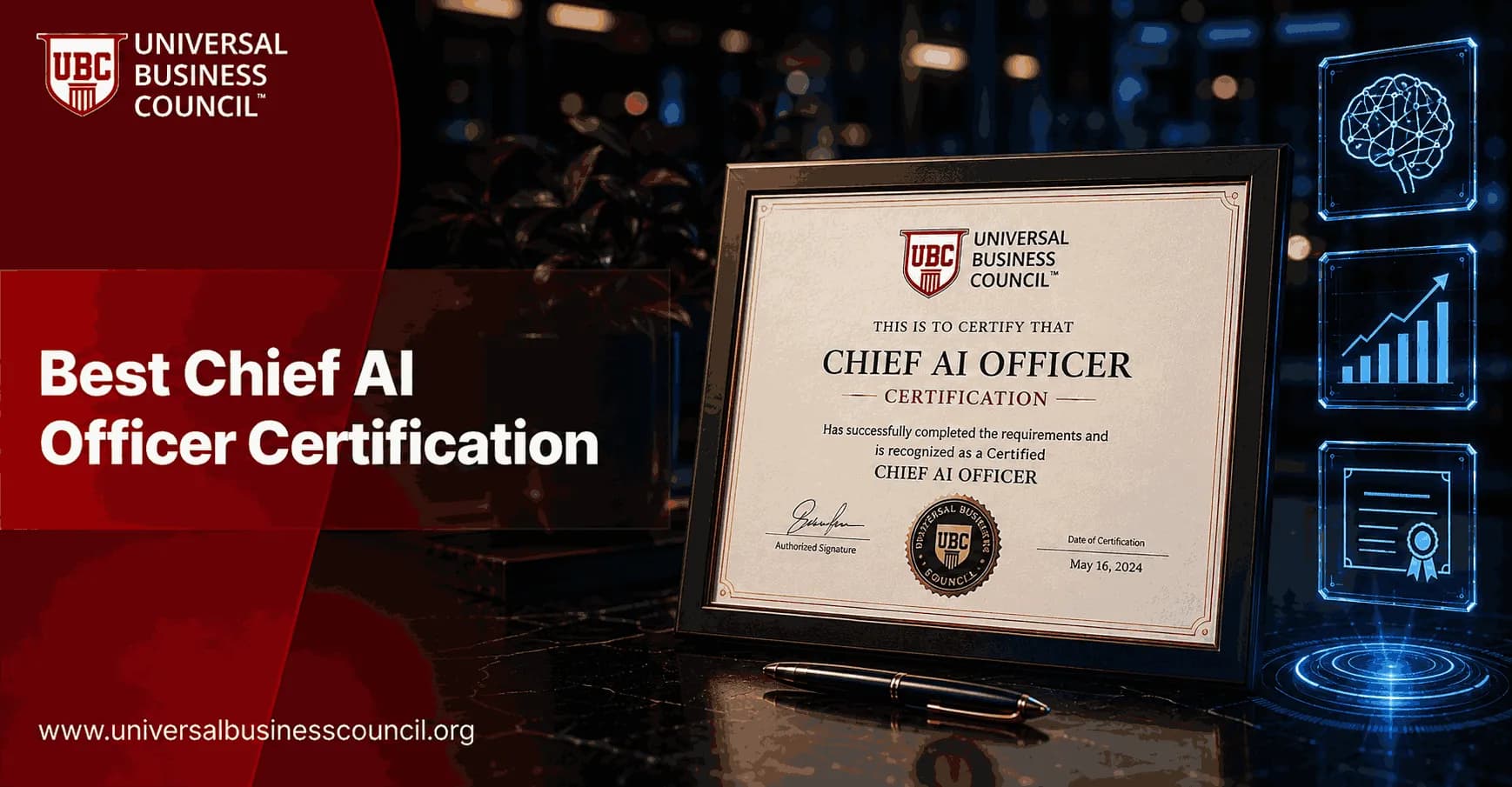
The Chief AI Officer has become one of the most sought-after leadership roles in the world. Organisations across healthcare, finance, technology, retail, and government are building dedicated AI leadership functions faster than the talent supply can keep up. As a result, professionals at every stage of their career are searching for the best Chief AI Officer Certification to help them enter, advance within, or lead this field with formal credibility and verified knowledge.
This guide is written for everyone, from complete beginners who have just heard the term CAIO for the first time, to experienced technology executives positioning themselves for a board-level AI leadership appointment. It explains what makes a certification genuinely valuable, compares the key qualities to look for, maps a clear learning pathway, and helps you make a confident, well-informed decision.

The starting point for professionals pursuing the most recognised, professionally aligned credential is the Certified Chief AI Officer (CAIO) from Universal Business Council. This credential is built specifically around the strategic, governance, and executive leadership dimensions of the CAIO role, and it is designed to be accessible to both technical and non-technical professionals who are ready to take on AI leadership responsibilities at the organisational level.
Why a Chief AI Officer Certification Matters in 2026
The CAIO role is no longer a niche experiment. The US Office of Management and Budget mandated that every federal agency designate a Chief AI Officer by May 2024, and over 80 agencies complied. IBM reports that 26% of large enterprises globally now have a dedicated CAIO. Meanwhile, around 60% of organisations worldwide have a senior executive with AI as their primary responsibility, particularly in healthcare, technology, and financial services.
The demand is real and growing. However, the supply of qualified candidates is not keeping pace. This gap creates a significant opportunity for professionals who can demonstrate formal AI leadership competency through a recognised credential.
A Chief AI Officer Certification matters because it does three things simultaneously. First, it closes specific knowledge gaps that experience alone may not address. Second, it signals to hiring committees, boards, and clients that your AI leadership knowledge has been formally assessed rather than simply claimed. Third, it provides a structured vocabulary and framework that helps you communicate more effectively with both technical teams and executive stakeholders.
Research from the International Association of Privacy Professionals found that holding a single AI-related certification correlates with 13% higher pay compared to non-certified peers. Holding multiple credentials from complementary domains raises that premium to 27%. These figures reflect something important: the value of certification compounds when credentials are chosen strategically rather than randomly.
Who Should Pursue a Chief AI Officer Certification?
The CAIO role attracts professionals from diverse backgrounds, and the right certification supports all of them. However, the specific gaps each group needs to close are different.
Technology executives including Chief Technology Officers, Chief Information Officers, and Chief Data Officers moving into expanded AI roles typically have strong infrastructure and data knowledge but need to build governance, ethics policy, regulatory compliance, and board communication skills. A CAIO certification focused on these dimensions closes the gap efficiently.
Consultants and strategic advisors who work with enterprise clients on AI transformation programmes benefit from CAIO certification because it validates that their guidance is grounded in formal, current knowledge. This strengthens credibility during proposals, client conversations, and board presentations.
Senior managers and directors building toward their first C-suite appointment benefit from CAIO certification as a signal of readiness. In a market where demand far exceeds supply, a recognised credential demonstrates intent, preparation, and structured knowledge to hiring committees reviewing candidates without a full CAIO track record.
AI and machine learning practitioners who have deep technical expertise but want to transition into leadership benefit from CAIO training to build executive communication, business strategy, and governance knowledge that technical depth alone does not provide.
Business professionals from legal, finance, marketing, or operations backgrounds who are taking on AI strategy responsibilities within their organisations benefit from CAIO certification because it provides the strategic and governance framework that makes AI leadership credible and effective without requiring a computer science background.
What the Best Chief AI Officer Certifications Cover
Not all Chief AI Officer Certification programmes deliver the same depth or focus. Understanding what distinguishes excellent programmes from superficial ones helps you choose wisely. The sections below describe the content areas that the strongest CAIO credentials cover and explain why each one matters.
This is also where exploring the full spectrum of Artificial Intelligence Certifications from a recognised body helps you map your learning journey. The CAIO credential sits at the top of a broader AI certification ecosystem. Foundational AI credentials establish your technical vocabulary and conceptual framework. The CAIO certification then applies that knowledge at the executive leadership level.
AI Strategy and Enterprise Roadmap Development
The first and most central content area in any strong CAIO programme is AI strategy. This covers how to assess an organisation's current AI maturity, how to identify the highest-value AI use cases across business functions, and how to build a prioritised, sequenced roadmap that connects AI investments to measurable business outcomes.
A beginner does not need to understand model architecture to learn AI strategy. The focus is on asking the right questions: Where does AI create competitive advantage? Which processes produce the highest ROI from automation? How does AI investment interact with existing technology strategy? How do you build the business case that persuades the board to fund the next AI initiative?
Strong CAIO programmes include frameworks and templates for answering these questions. The best ones give you tools you can apply in your own organisation immediately after completing the programme.
AI Governance, Risk Management, and Compliance
Governance is increasingly the defining dimension of the CAIO role. As AI deployment has scaled across industries, the risks of getting it wrong have become board-level concerns. Model bias, data privacy violations, algorithmic transparency failures, and regulatory non-compliance all carry financial, reputational, and legal consequences that boards must now account for explicitly.
The EU AI Act, which came into force in 2024 and began enforcing high-risk obligations on large organisations in August 2026, is the most comprehensive AI regulation in the world. It creates specific compliance requirements including risk classification, documentation, transparency, and human oversight obligations. A CAIO who cannot read and apply the EU AI Act is not yet equipped for roles in organisations that operate in or sell to European markets.
Beyond the EU AI Act, the NIST AI Risk Management Framework provides a structured approach to governing AI systems at the enterprise level. Its GOVERN function specifically requires executive-level risk accountability. ISO 42001, the international standard for AI management systems, sets out how top management must demonstrate leadership for AI governance including policy definition, resource allocation, and strategic alignment.
A strong CAIO certification covers all three of these frameworks in practical terms, not just as background reading. It teaches you how to apply them in governance committee meetings, vendor evaluations, and board reporting.
Ethical AI and Responsible Deployment
Ethics sits at the centre of effective AI leadership, not as a philosophical exercise but as a practical operational discipline. Bias in AI systems can harm customers, expose organisations to discrimination claims, and generate regulatory penalties. Transparency failures erode public trust and invite legislative scrutiny. Privacy violations involving training data or inference outputs create liability under GDPR, CCPA, and similar frameworks.
A quality CAIO certification teaches you how to identify and mitigate these risks at every stage of the AI model lifecycle, from data collection through to deployment monitoring and model retirement. It also covers how to establish organisational policies for ethical AI use, how to communicate those policies to employees, and how to create the internal accountability structures that make ethical commitments operational rather than aspirational.
AI ROI, Financial Modelling, and Value Realisation
One of the most common failure modes for enterprise AI programmes is an inability to demonstrate return on investment. Pilots get launched, produce interesting outputs, and then stall when budget committees ask for proof of business value. A CAIO who can quantify AI ROI, attribute value to specific implementations, and build financial models that satisfy CFO scrutiny is significantly more effective than one who understands AI conceptually but cannot make the business case.
Strong CAIO certification programmes include financial tools specifically designed for AI investments. These cover how to estimate cost savings from process automation, how to model revenue uplift from AI-driven customer experiences, how to account for risk-adjusted returns when AI systems are imperfect, and how to report progress to boards in the financial language that executives trust.
Talent Strategy and AI Organisational Design
Building and leading an effective AI function is a distinct management discipline. The CAIO must hire AI engineers, data scientists, ethics specialists, and ML operations professionals in a market where demand far outstrips supply. They must design team structures that prevent AI work from becoming siloed within IT, create internal upskilling programmes that build AI literacy across non-technical departments, and foster a culture of responsible experimentation.
CAIO certification programmes that cover organisational design and talent strategy equip you to solve these challenges structurally rather than reactively. This section of the curriculum is particularly valuable for professionals coming from technical backgrounds who have deep AI knowledge but limited experience managing interdisciplinary executive-level teams.
Board Communication and Executive Stakeholder Management
The CAIO must communicate with two fundamentally different audiences simultaneously. Technical teams need precision, specificity, and respect for their expertise. Boards and senior executives need clarity, relevance to business outcomes, and translation of technical risk into financial and reputational terms they can act on.
This dual communication requirement is one of the hardest aspects of the CAIO role to learn through experience alone. CAIO certification programmes that include board presentation practice, executive communication frameworks, and training in translating AI complexity into board-ready language provide an accelerant that experience builds only slowly.
How to Evaluate and Choose the Right Chief AI Officer Certification
With multiple Chief AI Officer Certification programmes now available globally, making the right choice requires applying clear evaluation criteria. The following framework helps you compare options systematically rather than being swayed by marketing claims.
Match the Programme to Your Specific Skills Gap
The most important selection criterion is specificity. Choose the programme that closes the specific gap in your current profile. If your background is deep in machine learning and your weakness is governance and board communication, a programme focused on governance frameworks, regulatory compliance, and executive communication delivers the highest return. If your background is strategy and consulting, a programme that builds genuine technical AI literacy in the context of executive decision-making serves you better.
Buying the gap-closer rather than the most prestigious logo is the advice consistently offered by CAIO hiring specialists. A credential that addresses your actual weakness is always more valuable than a brand-name programme that reinforces what you already know.
Look for CPD Accreditation and Professional Standards Recognition
CPD accreditation confirms that the programme meets established continuing professional development standards recognised across industries. Programmes with CPD accreditation have been reviewed against objective quality criteria, not just designed and launched by the issuing body. This matters because it gives hiring committees and clients an independent signal of programme quality.
Additionally, look for programmes that produce verifiable credentials. The best certifications include a unique certificate number that employers and clients can verify directly on the issuing body's website. This third-party verification distinguishes a genuine credential from a self-reported qualification that cannot be checked.
Prioritise Applied Learning Over Passive Content Delivery
The most valuable CAIO programmes end with a portfolio of work products rather than just a certificate of completion. This might include an AI governance framework you designed, an ROI model you built, a board presentation you constructed, or a risk register you completed for a real or hypothetical organisation. These artefacts do two things simultaneously: they deepen your learning by requiring application rather than passive consumption, and they give you concrete evidence of capability to share during hiring conversations.
Programmes that consist entirely of video lectures and multiple-choice assessments are significantly less effective at building the applied competency that CAIO roles actually demand.
Consider Programme Format and Time Commitment Honestly
Self-paced online programmes offer the greatest flexibility and are well-suited to working professionals who cannot commit to fixed class schedules. Live programmes with cohort interaction and expert Q&A sessions build vocabulary, network, and collaborative learning more effectively but require greater time commitment. In-person or hybrid programmes from university executive education units add the prestige of an academic credential and the network of a cohort, but at significantly higher cost and time investment.
The best format depends on your schedule, your learning style, and what you are optimising for. A self-paced programme with lifetime access lets you complete at your own pace without expiry pressure. A live programme builds peer relationships and direct access to practitioners that self-paced learning cannot replicate.
Building a Complete AI Leadership Profile Beyond a Single Certification
A single CAIO credential is a strong foundation. However, the professionals commanding the highest salaries and the most senior roles in AI leadership consistently hold complementary credentials that validate breadth across adjacent domains.
Technology Infrastructure Knowledge
AI systems are built on and run within technology infrastructure. Cloud platforms, data engineering pipelines, API management systems, and deployment architecture all shape how AI performs in production. A CAIO who understands technology infrastructure makes better decisions about build versus buy tradeoffs, vendor selection, and implementation sequencing than one who must rely entirely on technical teams for every infrastructure question.
A Tech Certification in areas such as cloud architecture, DevOps principles, AI systems fundamentals, or data platform management provides the infrastructure literacy that strengthens every dimension of the CAIO role. It lets you engage credibly with engineering teams, evaluate vendor claims critically, and ensure that governance decisions are technically implementable rather than theoretically sound but practically unworkable.
IAPP research cited earlier in this article shows that the salary premium for AI professionals comes from combining credentials rather than holding a single credential. A CAIO certification paired with a verified technology infrastructure credential consistently outperforms either credential held alone in terms of career value and compensation.
Building Your Full Credentials Stack
The strongest AI leadership profiles in 2026 combine a CAIO credential with verified technology knowledge and, where the role demands it, deep expertise in the underlying technology systems that AI intersects with.
In regulated industries and technically complex environments, AI does not operate in isolation. It intersects with blockchain systems for model provenance and audit trails, with cryptographic frameworks for privacy-preserving AI, with federated learning architectures for distributed data governance, and with decentralised systems for AI marketplace applications. Understanding these intersections at a foundational level gives AI executives the technical literacy to govern them effectively.
A Deep Tech Certification in areas such as blockchain, distributed systems, or cryptographic data security provides this foundational knowledge. For CAIOs operating in financial services, healthcare, supply chain, or government, where the convergence of AI with distributed and cryptographic systems is increasingly common, this credential adds a layer of technical depth that differentiates candidates at the senior level.
Introducing Technology Learning From an Early Age
Technology learning can begin well before students enter higher education or professional roles. Designed to encourage technology learning among school students, the World Tech Olympiad (WTO) brings together participants from Class 2 to Class 12 through different technology-focused challenges. Its areas include robotics, AI, programming, computational thinking, and cybersecurity, with competition levels structured to suit different age groups and abilities.
The Olympiad supports participation through separate routes for families and educational institutions. Parents can enroll their children directly, while schools can register as institutions and facilitate participation for students who meet the eligibility requirements. Early exposure to these areas can help students build problem-solving, computational thinking, and technology skills that may provide a useful foundation for more advanced AI learning and future technology careers.
The Learning Pathway to Becoming a Certified Chief AI Officer
A clear, step-by-step progression helps professionals at every level understand exactly where to begin and how to advance.
Step 1 Build Your AI Foundation
If you are new to artificial intelligence, the first step is building a solid conceptual foundation. This means understanding what machine learning is, how large language models work, what the difference between supervised and unsupervised learning is, and how AI systems create and destroy value. You do not need to code to build this foundation. However, you do need to be able to discuss AI systems knowledgeably with both technical and non-technical stakeholders.
Step 2 Develop Governance and Strategy Knowledge
Once you have a solid AI foundation, the next step is developing the governance and strategy knowledge that the CAIO role specifically requires. This is where structured certification adds the most value because governance and strategy knowledge is difficult to acquire through informal reading alone. It requires frameworks, case studies, regulatory analysis, and practice applying structured tools to real scenarios.
Step 3 Earn Your CAIO Credential
With foundation and governance knowledge in place, you are ready to pursue the Certified Chief AI Officer (CAIO) credential from a recognised professional body. At this stage, the certification consolidates your knowledge into a formally assessed, verifiable credential that you can present to boards, hiring committees, and enterprise clients with confidence.
Step 4 Complement with Technology and Deep Tech Credentials
After earning your core CAIO credential, build breadth by adding a Tech Certification to validate your technology infrastructure knowledge and a Deep Tech Certification to validate your understanding of the distributed and cryptographic systems that increasingly intersect with enterprise AI deployments.
Additionally, returning to the broader landscape of Artificial Intelligence Certifications lets you identify specialisation areas that complement your CAIO credential. Governance-focused AI credentials, industry-specific AI compliance programmes, and advanced AI strategy certifications all strengthen your profile as the AI leadership field continues to mature.
Step 5 Maintain Currency Through Continuing Professional Development
The AI landscape evolves faster than almost any other technology domain. Regulatory frameworks update, new model capabilities emerge, governance best practices shift, and the competitive landscape transforms year over year. A credential earned in 2024 may already reflect outdated governance standards by 2026. Therefore, treating CAIO certification as a one-time achievement rather than the beginning of a continuous professional development commitment is a significant mistake.
Frequently Asked Questions
1. What is the best Chief AI Officer Certification in 2026?
The best Chief AI Officer Certification depends on your specific background and the skills gap you need to close. The Certified Chief AI Officer (CAIO) from Universal Business Council is a strong choice for professionals seeking a recognised credential that covers AI strategy, governance, ethics, ROI management, and board communication in a professionally assessed format.
2. Do I need coding skills to earn a Chief AI Officer Certification?
No. Most CAIO certification programmes are designed for non-technical professionals as well as technical ones. They focus on AI strategy, governance, ethics, regulatory compliance, and executive communication rather than programming or model development.
3. How long does it take to earn a Chief AI Officer Certification?
Duration varies by programme format. Self-paced online programmes typically take between four and twelve weeks of part-time study. Live executive programmes with in-person components may run over several months but with fewer contact hours per week.
4. Is a Chief AI Officer Certification worth the investment?
For professionals in the right situation, yes. The CAIO role commands base salaries averaging $352,612 in the US according to Glassdoor 2026 data, with enterprise packages reaching $1 million or more. A certification that closes a genuine skills gap and helps you earn a role with that compensation profile delivers exceptional return on investment.
5. What is the EU AI Act and why should a CAIO understand it?
The EU AI Act is the world's first comprehensive AI regulation, enforcing high-risk obligations on large organisations from August 2026. A CAIO who cannot read and apply the Act is not adequately prepared for roles at organisations operating in or selling to EU markets, which includes most multinational companies.
6. What salary can a certified CAIO expect?
The average US CAIO base salary is approximately $352,612 based on Glassdoor March 2026 data. Fortune 500 total compensation packages frequently range between $350,000 and $650,000, with the largest enterprises budgeting up to $1.5 million for senior appointments.
7. What does the Certified Chief AI Officer (CAIO) credential cover?
The CAIO credential from Universal Business Council covers AI strategy and roadmap development, governance and risk management, ethical AI policies, regulatory compliance, ROI quantification, talent and organisational strategy, vendor evaluation, and board-level communication of AI risk and opportunity.
8. Can professionals from non-technical backgrounds earn a CAIO certification?
Yes. CAIO certifications are specifically designed to be accessible from diverse professional backgrounds. Legal, finance, marketing, operations, and consulting professionals all pursue and earn CAIO credentials. The content focuses on leadership and governance rather than technical model development.
9. What is the NIST AI Risk Management Framework?
The NIST AI RMF is a structured voluntary framework for managing AI risk at the enterprise level. Its GOVERN function requires executive-level accountability for AI risk management. Demonstrable fluency with this framework is a core expectation for CAIO candidates in US enterprises and federal agencies.
10. How does a CAIO certification differ from a general AI certification?
General AI certifications cover technical concepts such as machine learning, deep learning, and AI model building. CAIO certifications focus on executive leadership including AI strategy, governance, ethics policy, regulatory compliance, ROI measurement, and board communication. The audience, content depth, and career outcomes are fundamentally different.
11. What is ISO 42001 and why does it matter for the CAIO role?
ISO 42001 is the international standard for AI management systems. It requires top management to demonstrate leadership and commitment to the AI management system including policy definition, resource allocation, and strategic alignment. CAIOs in internationally operating organisations are increasingly expected to understand and implement this standard.
12. Should I pursue multiple AI certifications alongside my CAIO credential?
Yes. Research shows that holding multiple complementary credentials correlates with a 27% salary premium over non-certified peers, compared to 13% for a single credential. Combining a CAIO credential with a technology infrastructure certification and a deep tech credential creates a profile that is significantly stronger than any single certification alone.
13. What is a fractional Chief AI Officer?
A fractional CAIO provides AI leadership on a part-time or contract basis. This model suits organisations in the $1 million to $50 million revenue range where full-time CAIO salary and equity are not yet justified. CAIO certification strengthens credibility for fractional roles just as it does for full-time appointments.
14. What is the difference between a CAIO and a CTO?
A Chief Technology Officer manages an organisation's technology infrastructure across all domains. A Chief AI Officer has a single, dedicated mandate covering AI strategy, governance, implementation, risk, and value creation. The CAIO's entire focus is artificial intelligence, making it a distinct role from the broader technology leadership of a CTO.
15. How do I verify that a CAIO certification is genuine?
Look for programmes that issue certificates with unique verification numbers that can be checked on the issuing body's website. Programmes with CPD accreditation or ANSI membership offer additional independent quality assurance. Always research the issuing organisation before enrolling.
16. What governance credentials should a CAIO hold?
AI governance credentials focused on the EU AI Act, the NIST AI Risk Management Framework, and ISO 42001 are the frameworks that boards and regulators actually recognise. For regulated industries including financial services, healthcare, and government, demonstrable ability to apply these frameworks in practice matters more than any generic leadership credential.
17. Can a CAIO certification help me transition from engineering to leadership?
Yes. CAIO certification specifically addresses the gaps that technical professionals face when moving into leadership roles. It builds executive communication, board presentation skills, business strategy frameworks, and governance knowledge that engineering experience does not automatically develop.
18. What industries are most actively hiring certified CAIOs?
Healthcare, financial services, technology, and government are the most active sectors. Retail, energy, and legal services are also growing rapidly. In regulated industries, governance and compliance knowledge is often weighted more heavily than general AI leadership credentials.
19. How often should I renew or update my CAIO certification?
Plan to update your credentials or pursue continuing professional development every 12 to 18 months. The EU AI Act enforcement timeline, NIST RMF updates, and emerging AI governance standards all change frequently enough that credentials older than two years may not reflect current regulatory expectations.
20. What is the best way to prepare before enrolling in a CAIO certification programme?
Review the full syllabus and identify which modules address your specific skills gaps. Familiarise yourself with the EU AI Act, NIST AI RMF, and ISO 42001 at a high level before beginning. Additionally, read recent published CAIO job descriptions for the types of roles you are targeting so you arrive at the programme with a clear picture of what real employers expect the CAIO role to deliver.
Related Articles
View All
Chief Ai Officer
Is Chief AI Officer Certification Worth It?
A Chief AI Officer certification can be valuable for professionals seeking structured training in AI strategy, governance, leadership, and enterprise implementation. Explore whether CAIO certification is worth it, who benefits most, what employers may value, and how to evaluate programs before enrolling.
Chief Ai Officer
Chief AI Officer Trends in 2026
Chief AI Officer trends in 2026 reflect the shift from experimental AI programs toward enterprise-wide execution. CAIOs are increasingly focused on agentic AI, measurable ROI, governance, security, workforce transformation, model and vendor strategy, and integrating AI into core business operations.
Chief Ai Officer
What Should a Chief AI Officer Report to the Board?
A Chief AI Officer should give the board a clear view of how AI is creating business value while exposing the organization to new risks. Effective board reporting should cover AI strategy, investments, ROI, major initiatives, adoption, governance, regulatory exposure, security, incidents, and progress against measurable objectives.
Trending Articles
The Role of Blockchain in Ethical AI Development
How blockchain technology is being used to promote transparency and accountability in artificial intelligence systems.
AWS Career Roadmap
A step-by-step guide to building a successful career in Amazon Web Services cloud computing.
Top 5 DeFi Platforms
Explore the leading decentralized finance platforms and what makes each one unique in the evolving DeFi landscape.