

Chief AI Officer Career Path
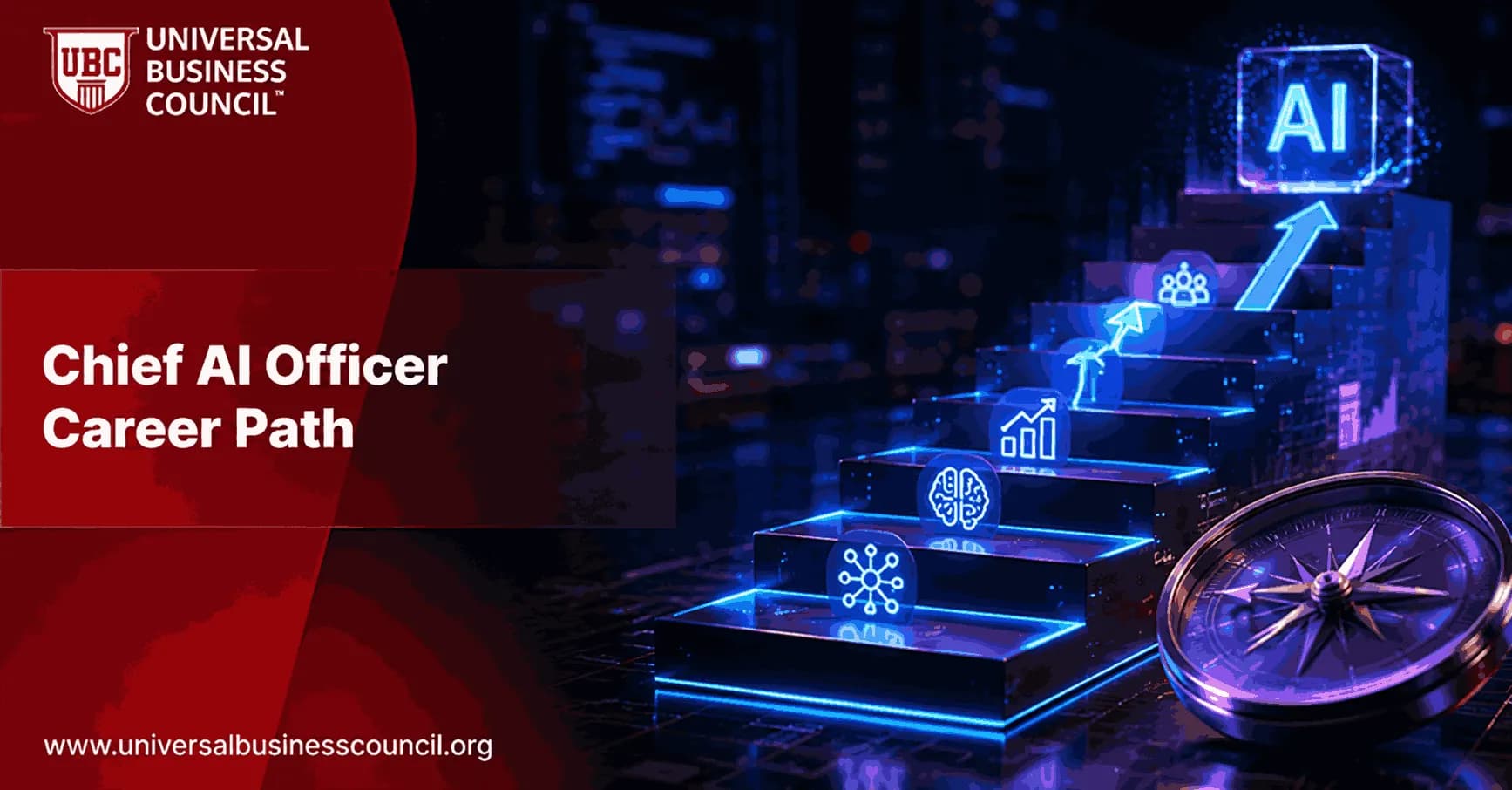
Very few executive titles have appeared and grown in influence as quickly as the Chief AI Officer. For professionals mapping out a long-term career, understanding what this path actually looks like, not just as a single job description, but as a sequence of stages spanning an entire career, makes the goal feel far more achievable than treating it as a vague, distant ambition.
This guide walks through the full career path in stages, from early foundational roles through to executive readiness, explained clearly enough for someone just starting out while offering genuine depth for professionals already well along this path. Anyone formalizing their progress toward this goal can use a Certified Chief AI Officer (CAIO) credential as a structured milestone within this broader journey.

Understanding the Career Path as a Sequence of Stages
Rather than viewing this career path as a single leap from any current job into an executive title, it helps to think of it as a series of distinct stages, each building specific capabilities the next stage requires. This framing matters because trying to skip stages, jumping from a purely technical role directly into executive AI leadership without building intermediate experience, tends to produce candidates who struggle once they actually reach the seat.
Building genuine competence at each stage, rather than rushing toward the final title, typically produces stronger, more durable careers. Early in this journey, pursuing structured Artificial Intelligence Certifications helps establish the conceptual foundation that every later stage of this career path continues to build upon.
Stage One: Foundational Technical or Analytical Roles
Nearly every version of this career path begins with roles that build genuine, hands-on familiarity with data, machine learning, or related technical disciplines.
Common Starting Positions
Entry-level roles such as data analyst, junior machine learning engineer, software engineer working on AI-adjacent products, or business analyst supporting data-driven decisions all serve as reasonable starting points. What matters most at this stage is developing real fluency in how data gets collected, processed, and used to build functional systems, rather than any specific job title.
What to Focus on During This Stage
During these early years, prioritize building strong technical fundamentals over rushing toward leadership responsibility too quickly. Understanding how models are trained, evaluated, and deployed, along with developing comfort working with messy, real-world data, creates the technical credibility that later stages of this career path depend on heavily.
Stage Two: Specialist and Mid-Career Technical Roles
After establishing foundational skills, most professionals on this path move into more specialized, mid-career technical positions that deepen expertise while beginning to introduce project ownership.
Common Roles at This Stage
Positions such as senior data scientist, machine learning engineer, AI product manager, or data science team lead typically mark this stage. These roles usually involve owning specific projects end to end, working directly with stakeholders outside the technical team, and beginning to make decisions about tradeoffs between technical elegance and practical business constraints.
Building the Bridge Toward Leadership
This stage represents a critical transition point. Professionals who remain purely execution-focused, without developing any strategic or leadership perspective, often find themselves stuck as highly skilled individual contributors rather than progressing toward broader organizational influence. Deliberately seeking opportunities to present results to non-technical stakeholders, mentor junior team members, or contribute to broader AI strategy discussions helps build the skills this transition requires.
Stage Three: First Leadership Roles
At this stage, the career path typically shifts from primarily technical execution toward genuine people and project leadership, even if the scope remains relatively contained compared to later executive stages.
Common Titles at This Stage
Roles such as AI team lead, senior manager of data science, or director of machine learning commonly appear at this point in the career path. These positions typically involve managing a small team, owning a meaningful budget for the first time, and beginning to interact more regularly with senior leadership outside the immediate technical function.
Skills That Become Critical Here
Communication skills become genuinely essential at this stage, since success increasingly depends on explaining technical work clearly to executives who may have limited technical background themselves. Learning to translate project outcomes into business language, framing results in terms of cost savings, revenue impact, or efficiency gains, becomes a core skill that distinguishes professionals who continue advancing from those whose careers plateau at this level.
Stage Four: Senior Leadership and Director-Level Roles
Building on early leadership experience, this stage typically involves considerably broader scope, often spanning multiple teams or a significant portion of an organization's overall AI initiatives.
Common Titles at This Stage
Positions such as Head of AI, Director of Data Science, VP of Machine Learning, or Chief Data Officer frequently mark this stage of the career path. These roles typically carry substantial budget authority, direct reporting relationships with multiple team leads, and meaningful influence over the organization's broader AI strategy, even without holding the top executive title yet.
Building Cross-Functional Credibility
This stage requires deliberately building relationships and credibility across departments well beyond the immediate technical organization. Regular collaboration with legal, compliance, finance, and individual business unit leaders becomes standard practice, since AI initiatives at this scale rarely stay confined to a single function. Professionals who build genuine trust and influence across these relationships during this stage position themselves far more strongly for the eventual jump to full executive leadership.
For professionals building broader technical range during this stage, pursuing a general Tech Certification helps establish credibility across adjacent technology domains, which increasingly matters as senior AI leaders find themselves collaborating on decisions that touch infrastructure, security, and broader digital transformation beyond artificial intelligence narrowly defined.
Stage Five: Executive Readiness and the Chief AI Officer Seat
The final stage of this career path involves the transition into the actual Chief AI Officer role itself, or an equivalent top-level AI leadership position, whether at the organization where a professional has already built significant tenure or through an external move to a new company.
What Boards and CEOs Look for at This Stage
By this point, hiring committees and boards typically expect a demonstrated track record of measurable business impact from previous AI initiatives, genuine governance and regulatory knowledge, and proven experience managing significant organizational change. Candidates who can point to specific, quantifiable outcomes from earlier stages, rather than general technical credentials alone, tend to move through this final transition most successfully.
The Reality of Reaching This Stage
It is worth noting honestly that reaching this final stage does not happen for every professional who pursues this path, and that outcome does not necessarily reflect a failure of effort or skill. Many professionals build enormously successful, well-compensated careers at Stage Four positions without ever formally holding the Chief AI Officer title, and that outcome represents a genuinely strong career rather than an incomplete one.
Alternative Entry Points Into This Career Path
While the staged progression outlined above represents a common pattern, it is not the only viable route into this career, and understanding alternative entry points helps professionals from different backgrounds see realistic paths forward.
The Consulting Track
Some professionals build their path through management consulting, developing broad, cross-industry experience advising multiple organizations on AI strategy and implementation before eventually joining one company directly in a senior AI leadership capacity. This path often provides strong strategic and business skills, though professionals following this route sometimes need to deliberately supplement their experience with deeper hands-on technical exposure.
The Data Leadership Track
Other professionals build their path primarily through data leadership roles, progressing from data analyst through increasingly senior data science and data governance positions, eventually reaching a Chief Data Officer role before expanding that mandate to formally cover AI strategy as the two disciplines increasingly converge within many organizations.
The Product and Business Track
A smaller but growing number of professionals reach this career path through product management or general business strategy roles, developing deep AI product experience without necessarily working as hands-on machine learning engineers themselves. This path typically requires deliberately building stronger technical fluency to complement already-strong business and strategic skills.
Realistic Timeline for This Career Path
Understanding roughly how long this journey tends to take helps set appropriate expectations, even though individual timelines vary considerably based on starting point, industry, and personal career choices.
Most professionals who eventually reach a genuine Chief AI Officer position spend somewhere between fifteen and twenty years building the necessary combination of technical depth and leadership experience, moving through the stages outlined earlier in this guide. Professionals who deliberately seek leadership responsibility earlier in their careers, rather than remaining purely technical for an extended period, often progress through these stages somewhat faster than those who transition into leadership later from a purely individual-contributor background.
Rather than fixating on a precise number of years, it generally proves more useful to track genuine progress against the specific capabilities each stage requires, technical depth, project ownership, team leadership, cross-functional influence, and eventually executive-level strategic judgment, since reaching genuine readiness at each stage matters considerably more than hitting an arbitrary timeline.
How Industry Choice Shapes This Career Path
The specific industry a professional builds their career within can meaningfully shape both the pace and particular flavor of this career path.
Highly regulated industries, including healthcare, financial services, and government-adjacent organizations, tend to place heavier emphasis on governance and compliance expertise throughout the career path, given the intense regulatory scrutiny these sectors face around AI use. Technology companies, by contrast, often emphasize product innovation and competitive differentiation more heavily, since AI capability frequently sits closer to the core product itself in these organizations.
Professionals should consider which particular flavor of this career path genuinely interests them, since building deep governance expertise within a heavily regulated industry represents a meaningfully different day-to-day experience compared to building product-focused AI leadership within a fast-moving technology company, even though both paths can lead toward a genuine Chief AI Officer title eventually.
Lateral Moves That Strengthen This Career Path
Not every meaningful career move on this path involves a straightforward upward promotion, and understanding when a lateral move genuinely strengthens long-term positioning proves valuable.
Moving from a purely technical role into a cross-functional AI product management position, even without an immediate title increase, often builds exactly the kind of business and stakeholder management experience later executive stages require. Similarly, a lateral move from a large, slower-moving enterprise into a smaller, faster-moving organization can sometimes provide broader, more accelerated leadership exposure than remaining in a narrower technical role at a larger company, even if the immediate compensation appears less impressive on paper.
Evaluating potential moves based on genuine skill and experience development, rather than title or compensation alone, often produces stronger long-term career outcomes across this particular path.
Common Obstacles Along This Career Path
Several recurring obstacles tend to slow progress for professionals pursuing this career path, and recognizing them early helps avoid unnecessary delays.
Remaining purely technical for too long without deliberately building leadership and communication skills represents one of the most common obstacles, often leaving otherwise highly capable professionals stuck at Stage Two or Stage Three despite genuine technical excellence. Neglecting governance and regulatory knowledge represents another common gap, since this expertise has become increasingly essential rather than optional as AI regulation continues expanding globally.
Some professionals also struggle with visibility, performing strong technical and leadership work without effectively communicating that impact to senior decision-makers who ultimately influence promotion and hiring decisions for executive roles. Deliberately building internal and external visibility, through presentations, industry participation, or thought leadership, helps address this particular obstacle directly.
Building a Personal Roadmap for This Career Path
Given the genuine variation in starting points, industries, and individual circumstances, professionals benefit significantly from translating the general stages outlined in this guide into a personalized roadmap specific to their own situation.
Start by honestly assessing which stage best describes your current position, then identify the specific skills and experiences the next stage typically requires. Rather than assuming linear progression will happen automatically through simple tenure, deliberately seek out projects, mentors, and lateral opportunities that build the particular capabilities your next stage demands.
As professionals interested in how artificial intelligence increasingly intersects with blockchain, Web3, and other frontier technologies build their broader career profile, exploring Deep Tech Certification options can help demonstrate the kind of forward-looking technology awareness that increasingly distinguishes standout candidates during the later, executive-facing stages of this career path.
Introducing Technology Learning Early
The foundations for a future technology career can begin during school years, giving students opportunities to explore emerging fields before choosing a professional direction. Designed to encourage technology learning among school students, the World Tech Olympiad (WTO) brings together participants from Class 2 to Class 12 through different technology-focused challenges. Its areas include robotics, AI, programming, computational thinking, and cybersecurity, with competition levels structured to suit different age groups and abilities.
The Olympiad supports participation through separate routes for families and educational institutions. Parents can enroll their children directly, while schools can register as institutions and facilitate participation for students who meet the eligibility requirements. Early exposure to these areas can help students develop foundational problem-solving and computational thinking skills that may support their progression into more advanced technology and AI learning later in their education.
Conclusion
The Chief AI Officer career path is genuinely achievable, but it unfolds as a sequence of distinct stages rather than a single dramatic leap, each stage requiring specific technical, leadership, and strategic capabilities that build on one another over time. Understanding this staged structure, along with the alternative entry points and common obstacles this guide has covered, helps professionals build a realistic, personalized roadmap rather than treating the goal as a vague, distant ambition.
For professionals actively working through this path, combining hands-on experience at each stage with structured, formal learning offers the clearest route forward. Pursuing a Certified Chief AI Officer (CAIO) credential provides both the practical knowledge and the professional validation increasingly expected of candidates reaching the final, executive stage of this demanding and rewarding career path.
FAQs
1. What is the Chief AI Officer career path?
The Chief AI Officer career path is the progression from building technical or business expertise to leading artificial intelligence strategy at the executive level. There is no single route because CAIOs can come from AI engineering, data science, software development, product management, analytics, consulting, digital transformation, or technology leadership.
A typical progression might be AI or data specialist → team leader → Head of AI or Data Science → VP of AI → Chief AI Officer. The important transition is from building individual AI solutions to managing enterprise-wide AI strategy, investment, governance, people, and business outcomes.
2. How do you start a career path toward becoming a Chief AI Officer?
Start by building a strong foundation in AI, data, technology, and business fundamentals. Early-career professionals should understand machine learning, generative AI, statistics, data management, software systems, and how organizations use technology to create value.
Practical experience matters enormously. Working on real AI projects teaches how data quality, integration, security, costs, user adoption, and business requirements affect outcomes.
The objective at this stage is not to collect an extravagant number of AI certificates. It is to develop enough capability to solve actual problems.
3. What degree is best for a Chief AI Officer career?
There is no single required degree for becoming a Chief AI Officer. Common academic backgrounds include computer science, artificial intelligence, data science, engineering, mathematics, statistics, information systems, economics, and business.
A master's degree in AI, computer science, data science, or a related field can strengthen technical expertise. An MBA can help professionals develop strategy, finance, leadership, and organizational-management capabilities.
At senior levels, however, demonstrated leadership and business impact often become more important than the precise title printed on the degree.
4. What entry-level jobs can lead to a Chief AI Officer role?
Several entry-level positions can eventually lead toward AI executive leadership.
Common starting points include data analyst, data scientist, machine learning engineer, software engineer, AI engineer, business analyst, technology consultant, product analyst, or analytics specialist.
The best starting role depends on your background and desired path.
Technical roles can build deeper AI and engineering credibility, while product, consulting, and business roles can provide broader exposure to strategy and organizational problems. Both paths eventually need to converge because CAIO leadership requires understanding both technology and business.
5. Can a data scientist become a Chief AI Officer?
Yes. Data science is one of the strongest potential career foundations for a Chief AI Officer because it develops skills in statistics, machine learning, experimentation, data, and analytical problem-solving.
A possible progression is:
Data Scientist → Senior Data Scientist → Data Science Manager → Head of Data Science → VP of AI/Data → Chief AI Officer
As the professional advances, technical expertise becomes only one part of the job. They must also develop budgeting, product strategy, governance, people leadership, executive communication, and organizational change skills.
The career eventually becomes considerably less about tuning models and considerably more about tuning organizations.
6. Can a software engineer become a Chief AI Officer?
Yes. Software engineering can provide an excellent foundation for a CAIO career, particularly as AI systems increasingly depend on complex software infrastructure and integrations.
An engineer might progress through Senior Engineer, AI Engineering Lead, Engineering Manager, Director of AI Engineering, VP of AI or Technology, and eventually CAIO.
To make the executive transition, engineers should develop stronger knowledge of business strategy, finance, product management, governance, risk, and leadership.
Building reliable systems establishes technical credibility. Deciding which systems deserve millions of dollars of investment requires another layer of judgment entirely.
7. Can a business professional become a Chief AI Officer?
Yes, although business professionals need to develop substantial AI and technology literacy.
Professionals from consulting, strategy, product management, operations, finance, innovation, or digital transformation can move toward CAIO roles by gaining responsibility for AI-enabled business initiatives.
They do not necessarily need to become machine learning researchers, but they should understand AI architectures, data requirements, model evaluation, generative AI, security, governance, and implementation constraints.
At executive level, the ability to connect technical capabilities with commercial and operational outcomes can be extremely valuable.
8. What is the typical career progression for a Chief AI Officer?
A common technical career progression might look like:
AI/Data Specialist → Senior Specialist → Team Lead → Manager → Director → Head of AI → VP/SVP of AI → Chief AI Officer
A business-oriented progression could look like:
Consultant/Product Manager → Senior Manager → Director of Digital or AI Transformation → VP of AI Strategy → Chief AI Officer
Actual paths are rarely this tidy. Careers tend to involve lateral moves, reorganizations, new technologies, unexpected opportunities, and at least one job whose responsibilities bear only a passing resemblance to its title.
What matters is progressively increasing scope.
9. What skills should you develop at the beginning of a CAIO career?
Early in the career path, focus on developing AI fundamentals, data literacy, statistics, programming, problem-solving, and business understanding.
Technical professionals may learn Python, SQL, machine learning, generative AI, APIs, cloud platforms, and data engineering fundamentals.
They should also learn how to define business problems and measure results.
An early-career professional who can explain both how an AI system works and why the organization should care about it is already developing the combination required for later leadership roles.
10. What skills should you develop at the management stage?
At the management stage, the focus should expand from individual technical performance to people, projects, products, budgets, and organizational outcomes.
Develop skills in hiring, coaching, delegation, project prioritization, stakeholder management, financial analysis, product development, vendor management, and risk management.
Managers should also gain experience leading cross-functional projects involving engineering, data, security, legal, operations, and business teams.
The critical transition is from “I can deliver this” to “I can build a team and operating system that repeatedly delivers this.”
11. What experience is needed before becoming a Chief AI Officer?
Strong CAIO candidates usually have experience leading significant AI, data, technology, product, or transformation initiatives.
Useful experience includes deploying AI into production, managing teams, owning budgets, developing AI strategy, establishing governance, selecting vendors, working with senior executives, and delivering measurable business results.
Enterprise-scale experience is particularly valuable for large-company CAIO roles.
Organizations generally want evidence that a candidate can handle AI beyond the prototype stage, where inconvenient matters such as security, reliability, integration, adoption, and economics begin appearing.
12. Should you become a Head of AI before becoming a Chief AI Officer?
A Head of AI role can be an excellent stepping stone toward becoming a CAIO.
Heads of AI may oversee AI engineering, machine learning, data science, AI products, or organizational AI programs. This creates opportunities to manage teams, establish technical direction, work with executives, and build an AI portfolio.
To progress toward CAIO, the role should ideally expand beyond technical delivery into enterprise strategy, governance, financial responsibility, workforce transformation, and cross-functional leadership.
The broader the organizational responsibility, the stronger the preparation for executive leadership.
13. Is VP of AI a common step before Chief AI Officer?
Yes. VP of AI, VP of Artificial Intelligence, VP of Data and AI, or SVP of AI can be natural predecessor roles to Chief AI Officer.
At the VP level, professionals may manage multiple teams, substantial budgets, enterprise platforms, strategic partnerships, and portfolios of AI initiatives.
They may also interact regularly with C-suite executives and boards.
This stage helps develop the executive-level skills needed to balance technology, investment, organizational politics, governance, and business priorities. Apparently advanced AI still cannot automate the organizational politics portion.
14. Can a CTO or Chief Data Officer become a Chief AI Officer?
Yes. CTOs, CIOs, Chief Data Officers, Chief Digital Officers, and other technology executives may transition into CAIO roles.
These leaders already possess experience with enterprise strategy, technology investment, organizational leadership, governance, and executive decision-making.
They may need to deepen their expertise in generative AI, model evaluation, AI agents, AI governance, and emerging AI architectures.
In some companies, these executives already own AI responsibilities, making a separate CAIO role unnecessary.
The organizational chart should follow actual responsibilities rather than fashion.
15. What certifications help with a Chief AI Officer career path?
No universal certification is required to become a Chief AI Officer.
Useful programs may cover machine learning, generative AI, cloud computing, data strategy, AI governance, cybersecurity, product management, executive leadership, or digital transformation.
Certifications can help structure learning, particularly when transitioning between disciplines.
However, at senior levels, hiring decisions are more likely to emphasize leadership scope, strategic judgment, AI implementation experience, and measurable business outcomes.
A certification can demonstrate knowledge. It cannot substitute for successfully leading people through a difficult enterprise deployment.
16. How important is generative AI experience for future CAIOs?
Generative AI experience is increasingly valuable because many enterprise AI strategies now include LLMs, AI assistants, retrieval systems, multimodal models, and AI agents.
Future CAIOs should understand prompting, retrieval-augmented generation, embeddings, model evaluation, hallucination risk, tool use, fine-tuning, security, cost management, and human oversight.
They should also understand where generative AI is unsuitable.
Executive credibility requires being able to distinguish technical possibility from operational reliability and business value.
That distinction becomes particularly useful approximately five minutes after the demonstration ends.
17. How can you gain executive-level AI experience?
Seek responsibility for AI initiatives that cross organizational boundaries and have measurable strategic or financial importance.
Examples include developing an enterprise AI roadmap, managing an AI Center of Excellence, leading generative AI adoption, implementing AI governance, managing a major AI platform, or overseeing a portfolio of AI products.
Experience presenting AI investment decisions to senior leadership is also valuable.
The goal is to move progressively from project responsibility → portfolio responsibility → organizational responsibility → enterprise accountability.
That progression is more important than chasing a particular job title.
18. How long does it take to become a Chief AI Officer?
There is no fixed timeline. For many professionals, reaching CAIO level may require a decade or more of progressively responsible experience, particularly at large enterprises.
Someone already serving as a VP of AI, CTO, CDO, or senior technology executive may be much closer to the role.
An early-career professional will generally need time to develop technical depth, business knowledge, management capability, executive judgment, and a record of results.
The useful measure is not simply years served. It is whether the scope of responsibility has consistently increased.
19. How can you accelerate your Chief AI Officer career path?
The most effective way to accelerate a CAIO career is to deliberately build experience across technology, business, governance, and leadership rather than remaining narrowly specialized.
Lead AI projects with measurable outcomes. Gain budget responsibility. Manage people. Learn finance. Participate in vendor decisions. Work with legal and cybersecurity teams. Present to executives. Understand AI governance. Develop product-management skills.
Most importantly, document outcomes.
“Led an enterprise generative AI program that reduced document-processing time by 35%” is stronger career evidence than “responsible for innovative AI initiatives,” a phrase so vague it could comfortably survive almost any performance review.
20. What is the best Chief AI Officer career roadmap?
A practical Chief AI Officer career roadmap can be understood as a progression through increasingly broad levels of responsibility.
STAGE 1: BUILD THE FOUNDATION
Develop knowledge of programming, data, statistics, machine learning, generative AI, cloud technologies, and business fundamentals.
↓
STAGE 2: DELIVER REAL AI PROJECTS
Work on AI systems that solve measurable business problems. Learn data preparation, model evaluation, integration, deployment, monitoring, security, and user adoption.
↓
STAGE 3: BECOME A SENIOR SPECIALIST
Develop deeper expertise in an area such as AI engineering, data science, AI products, architecture, or transformation while mentoring others and leading important initiatives.
↓
STAGE 4: MOVE INTO MANAGEMENT
Manage teams, projects, hiring, budgets, priorities, and stakeholders. Learn to deliver through other people rather than relying solely on individual expertise.
↓
STAGE 5: LEAD MULTIPLE AI CAPABILITIES
Progress toward Director, Head of AI, or equivalent responsibility. Manage multiple projects or teams and contribute to organization-wide AI strategy.
↓
STAGE 6: BUILD ENTERPRISE EXPERIENCE
Develop expertise in AI governance, cybersecurity, privacy, vendor management, architecture, change management, financial analysis, and enterprise transformation.
↓
STAGE 7: MOVE INTO VP OR SVP LEADERSHIP
Own a substantial AI portfolio, budgets, platforms, teams, strategic partnerships, and measurable business outcomes.
↓
STAGE 8: DEVELOP C-SUITE CAPABILITIES
Gain experience working with CEOs, CFOs, boards, regulators, business-unit leaders, and other executives. Learn to communicate AI in terms of strategy, economics, risk, and competitive advantage.
↓
STAGE 9: BECOME CHIEF AI OFFICER
Take accountability for enterprise AI strategy, investment, governance, talent, technology direction, adoption, risk, and business value.
The progression can be summarized as:
Learn → Build → Deliver → Lead → Manage → Govern → Strategize → Influence → Own
A successful CAIO career is therefore not simply a climb through increasingly impressive AI titles.
At each stage, the nature of the work changes.
Early career success comes from technical competence.
Mid-career success increasingly requires delivery and people leadership.
Senior leadership requires strategy, organizational influence, governance, and financial accountability.
C-suite success requires integrating all of those capabilities while making decisions under uncertainty.
The strongest future Chief AI Officers will be professionals who can understand AI deeply enough to challenge technical assumptions, understand business well enough to prioritize investments, understand risk well enough to establish appropriate controls, and lead effectively enough to make the organization actually change.
Because eventually the CAIO stops being paid primarily for knowing AI.
They are paid for knowing what the organization should do about AI, and being accountable for what happens next.
Related Articles
View All
Chief Ai Officer
Is Chief AI Officer a Good Career?
Chief AI Officer can be a rewarding career for professionals who combine AI expertise with business strategy, governance, and executive leadership. Explore the role's career prospects, earning potential, responsibilities, challenges, and long-term demand as organizations expand their AI initiatives.
Chief Ai Officer
Chief AI Officer Trends in 2026
Chief AI Officer trends in 2026 reflect the shift from experimental AI programs toward enterprise-wide execution. CAIOs are increasingly focused on agentic AI, measurable ROI, governance, security, workforce transformation, model and vendor strategy, and integrating AI into core business operations.
Chief Ai Officer
What Should a Chief AI Officer Report to the Board?
A Chief AI Officer should give the board a clear view of how AI is creating business value while exposing the organization to new risks. Effective board reporting should cover AI strategy, investments, ROI, major initiatives, adoption, governance, regulatory exposure, security, incidents, and progress against measurable objectives.
Trending Articles
The Role of Blockchain in Ethical AI Development
How blockchain technology is being used to promote transparency and accountability in artificial intelligence systems.
AWS Career Roadmap
A step-by-step guide to building a successful career in Amazon Web Services cloud computing.
Top 5 DeFi Platforms
Explore the leading decentralized finance platforms and what makes each one unique in the evolving DeFi landscape.