

Chief AI Officer Responsibilities
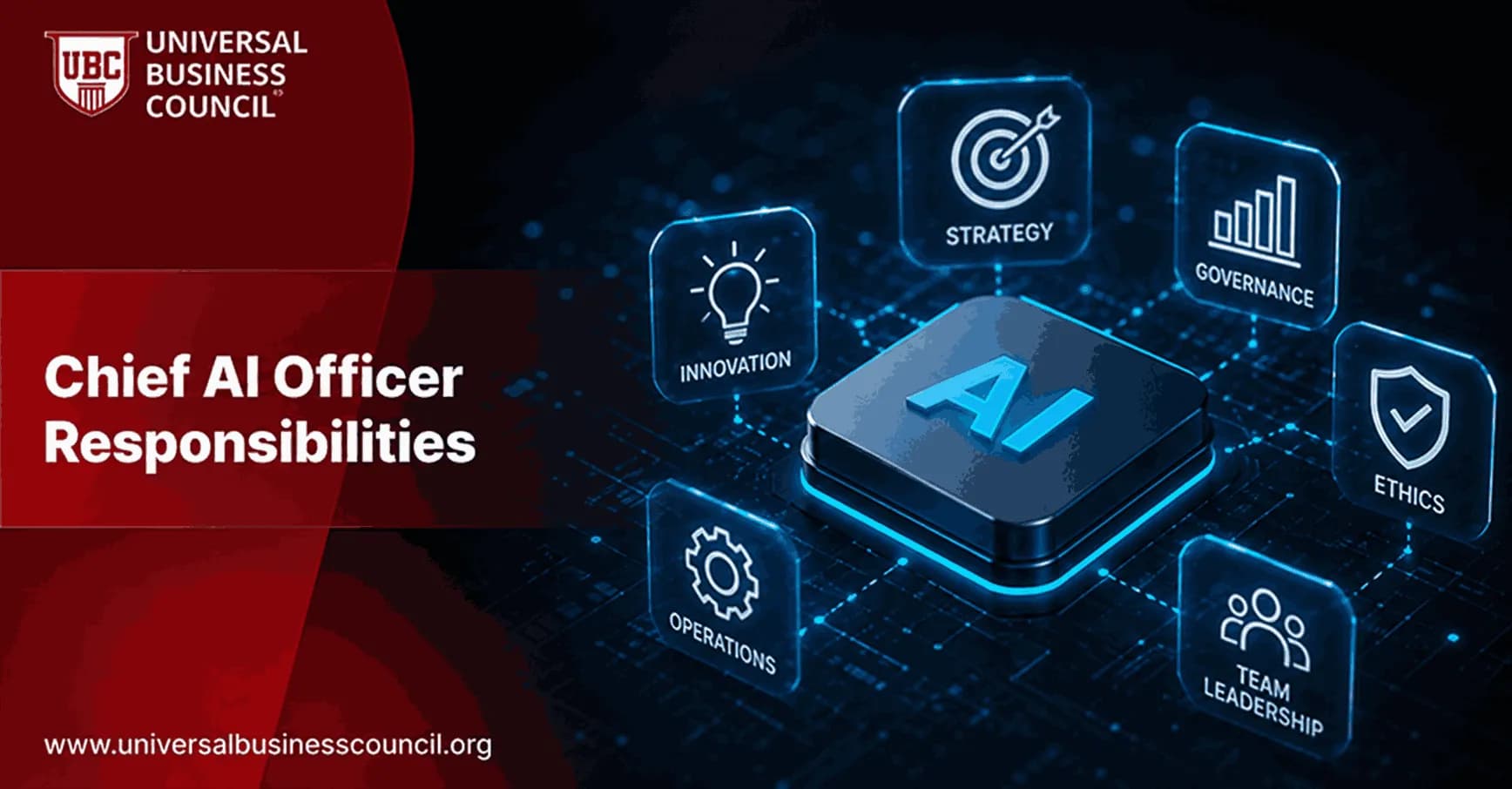
Understanding Chief AI Officer Responsibilities in detail matters for very different groups of people at the same time. Boards need to know what to expect from this hire. Candidates need to know what they are actually signing up for. Employees need to understand who owns which decisions when AI touches their work. This guide walks through the full scope of what falls under this role, broken down clearly enough for a beginner to follow while remaining detailed enough for an experienced executive evaluating the position.
For anyone preparing to take on these responsibilities professionally, a Certified Chief AI Officer (CAIO) credential offers a structured, recognized way to build and demonstrate readiness across the full range of duties this article covers.

Why These Responsibilities Are Hard to Pin Down
Before listing specific duties, it helps to understand why this role's scope varies so much from one organization to another. Unlike more established executive titles with decades of shared industry precedent, the Chief AI Officer position is still being actively defined, and its responsibilities often depend heavily on company size, industry, regulatory exposure, and how much genuine authority the organization is willing to grant.
This variability means two people holding the identical job title at different companies might spend their days on almost entirely different tasks. Establishing a strong foundation through structured Artificial Intelligence Certifications helps ensure that regardless of how a specific organization shapes the role, the person filling it brings a consistent baseline of knowledge across strategy, governance, and technical fundamentals.
Strategic Responsibilities
At the highest level, a Chief AI Officer owns the organization's overall direction for artificial intelligence, translating scattered enthusiasm about AI into a coherent, prioritized plan.
Setting the AI Vision
This involves defining what role AI should play in the company's broader competitive strategy, distinguishing between areas where AI offers genuine transformative potential and areas where the technology remains more hype than substance for that particular business. A clear vision prevents the common trap of chasing every trending AI capability without a coherent underlying strategy.
Prioritizing Use Cases
With limited time, budget, and technical talent, deciding which AI initiatives deserve investment is one of the most consequential responsibilities in the role. This means evaluating potential use cases against factors like expected business impact, technical feasibility, data availability, and regulatory risk before committing resources.
Aligning AI Investment With Business Goals
Every significant AI initiative should tie back to a measurable business objective, whether that means reducing operational costs, improving customer experience, or creating entirely new revenue opportunities. A Chief AI Officer is responsible for ensuring this connection stays explicit rather than allowing AI spending to drift toward technology for its own sake.
Governance and Compliance Responsibilities
As AI regulation continues expanding across major global markets, governance has grown into one of the most demanding and consequential parts of this role.
Building Ethical AI Frameworks
Establishing clear guidelines for responsible AI use, addressing concerns like algorithmic bias, data privacy, and transparency, falls squarely under this responsibility. These frameworks need to be specific enough to guide real decisions, not vague statements of good intention that fail to influence actual project choices.
Ensuring Regulatory Compliance
Depending on the organization's industry and geographic footprint, this can involve navigating multiple overlapping regulatory frameworks simultaneously. The Chief AI Officer typically bears responsibility for ensuring AI systems meet applicable legal requirements before deployment, rather than treating compliance as an afterthought addressed only when problems surface.
Managing AI-Related Risk
This includes identifying where AI systems could cause harm, whether through biased outcomes, security vulnerabilities, or unreliable performance, and establishing safeguards before those risks materialize into actual incidents. Clear escalation paths for AI-related problems, ensuring serious issues reach appropriate decision-makers quickly, also fall under this responsibility.
Operational Responsibilities
Beyond strategy and governance, a significant portion of the role involves the practical work of actually keeping AI initiatives running smoothly across the organization.
Managing the AI Project Portfolio
Overseeing every active AI initiative across the business prevents duplicated effort, conflicting priorities, and disconnected pilot projects that never scale beyond isolated experiments. This responsibility requires maintaining visibility across the entire organization rather than focusing narrowly on a single department's AI efforts.
Model and System Lifecycle Oversight
AI systems require ongoing attention after initial deployment, including monitoring performance over time, managing how models get updated or retrained, and catching quiet performance degradation before it meaningfully affects business outcomes. This responsibility distinguishes mature AI operations from organizations that deploy AI systems and then largely forget about them.
Vendor and Platform Management
Since most organizations rely on external AI tools and platforms rather than building everything internally, evaluating vendors, negotiating contracts, and making build-versus-buy decisions falls under this responsibility. This requires balancing technical fit, cost, and long-term strategic alignment when selecting external partners.
Financial and Budget Responsibilities
Managing significant financial resources responsibly represents another core dimension of this role, one that directly connects to the strategic responsibilities discussed earlier.
Budget Planning and Allocation
Determining how much to invest in AI initiatives overall, and how to distribute that budget across competing priorities, requires balancing ambition against realistic organizational capacity. Overcommitting to too many initiatives simultaneously often produces worse outcomes than focusing resources on fewer, well-executed priorities.
Measuring and Reporting Return on Investment
Boards and CEOs increasingly expect clear evidence that AI spending produces measurable value. This responsibility involves defining appropriate success metrics for each initiative, tracking performance against those metrics consistently, and communicating results transparently, including when results fall short of initial expectations.
Justifying Continued Investment
Beyond reporting results, this role often involves making the ongoing business case for sustained AI investment, particularly during periods when results take longer to materialize than initially hoped. This requires balancing genuine transparency about challenges with maintaining organizational confidence in the overall AI strategy.
Talent and Team Leadership Responsibilities
Since AI strategy ultimately depends on the people executing it, talent-related responsibilities occupy substantial time within this role, even though they receive less public attention than strategy or governance work.
Building the AI Team
This includes hiring AI engineers, data scientists, and related specialists, often in a highly competitive talent market where skilled candidates have numerous options. Partnering with academic institutions or training programs to build a longer-term talent pipeline frequently falls under this responsibility as well.
Developing Organization-Wide AI Literacy
Beyond building a specialized AI team, a Chief AI Officer typically bears responsibility for improving general AI understanding across the broader workforce. This might involve organizing training programs, workshops, or resources that help non-technical employees understand both AI's capabilities and its limitations well enough to use these tools effectively and responsibly.
Retaining Key Talent
In a field where skilled AI professionals face constant recruitment pressure from competitors, creating meaningful career paths and a compelling working environment becomes a genuine responsibility rather than simply an HR concern handled elsewhere. Losing key technical talent can significantly set back an organization's broader AI strategy.
For professionals building toward this responsibility area specifically, pursuing a broader Tech Certification helps develop the kind of cross-domain technical credibility that supports effective communication and trust-building with technical teams during hiring and retention efforts.
Cross-Functional Collaboration Responsibilities
Because AI initiatives rarely stay confined to a single department, working effectively across the organization represents a distinct and demanding responsibility category of its own.
Partnering With Other Executives
Close, ongoing collaboration with the CTO, CDO, CIO, chief information security officer, and legal counsel ensures AI initiatives integrate smoothly with broader technology, data, and compliance strategies rather than operating as an isolated function disconnected from the rest of the organization.
Supporting Business Unit Leaders
Individual departments often have specific operational challenges that AI could potentially address, but they frequently lack the technical expertise to identify or implement appropriate solutions independently. Part of this responsibility involves working directly with business unit leaders to translate their operational needs into viable, well-scoped AI initiatives.
Communicating With the Board
Regular reporting to the board or executive leadership on AI strategy, progress, risks, and results represents a consistent, recurring responsibility. This requires translating complex technical and operational detail into clear, business-relevant language that supports informed board-level decision-making.
Day-to-Day Responsibilities in Practice
Beyond these broader categories, it helps to understand what an actual day or week might realistically involve for someone holding this role, since abstract responsibility categories can feel disconnected from daily reality.
A typical week might include reviewing performance data from active AI systems already in production, meeting with department leaders to evaluate potential new use cases, discussing a governance concern raised by legal counsel about a specific AI application, interviewing candidates for open AI team positions, and preparing materials for an upcoming board presentation on AI strategy progress. The role rarely follows a predictable daily routine, since priorities shift constantly based on emerging opportunities, technical issues, or organizational needs.
How Responsibilities Shift as Organizations Mature
An organization's AI maturity level significantly shapes which responsibilities receive the most attention at any given time. Early in an organization's AI journey, a Chief AI Officer typically spends disproportionate time on foundational work, including establishing initial governance frameworks, building the core AI team, and identifying promising pilot use cases worth testing.
As AI initiatives mature and scale across the organization, responsibilities shift toward optimization, expanding successful pilots into broader production systems, refining governance frameworks based on lessons learned, and increasingly focusing on measuring and communicating return on investment to sustain continued organizational support. Understanding this natural progression helps set realistic expectations for what the role should prioritize at different stages of an organization's overall AI journey.
Responsibilities That Are Often Overlooked
Certain responsibilities receive far less attention in public discussion of this role despite being genuinely important to long-term success.
Managing internal skepticism and resistance to AI adoption often proves more time-consuming than the technology decisions themselves, since employees may reasonably worry about job security, workflow disruption, or simply distrust unfamiliar tools. Handling this organizational psychology skillfully represents a real, if underappreciated, responsibility.
Similarly, managing external perception and reputation around the organization's AI use, particularly as public scrutiny of corporate AI practices increases, falls partly under this role's scope even though it rarely appears explicitly in formal job descriptions. Finally, staying genuinely current with a rapidly evolving field, rather than relying on knowledge that quickly becomes outdated, represents an ongoing responsibility that never truly concludes throughout someone's tenure in this position.
How These Responsibilities Differ From Adjacent Roles
Understanding where Chief AI Officer responsibilities end and other executive roles begin helps clarify genuine ownership within an organization, reducing the kind of ambiguity that can otherwise create friction between overlapping positions.
A Chief Technology Officer typically retains responsibility for the organization's broader technology infrastructure and engineering function as a whole, while the Chief AI Officer's responsibilities concentrate specifically on AI strategy, governance, and value delivery within that broader technical environment. A Chief Data Officer generally owns data quality, governance, and infrastructure responsibilities, while the Chief AI Officer focuses on how that data actually gets applied through AI models and specific use cases. Clarifying these boundaries explicitly, ideally in writing, helps prevent the kind of responsibility gaps or duplicated efforts that commonly arise when multiple executive roles touch related but distinct areas of AI and technology strategy.
Preparing to Take On These Responsibilities
For professionals aiming toward this role, understanding the full breadth of responsibilities outlined in this guide provides a clearer picture of what genuine preparation should involve, beyond simply accumulating technical AI knowledge alone.
Deliberately seeking experience across strategic planning, governance and compliance, team leadership, and cross-functional collaboration, rather than concentrating exclusively on technical depth, builds the well-rounded foundation this role genuinely requires. Professionals interested in how AI increasingly intersects with blockchain, Web3, and other frontier technologies can further strengthen their readiness through Deep Tech Certification options, building the kind of broad, forward-looking technology perspective that increasingly distinguishes strong candidates for this expanding executive role.
Encouraging Technology Learning From an Early Age
Building technology awareness early can help students develop skills that may become valuable as they progress toward future careers in AI and other emerging fields. Designed to encourage technology learning among school students, the World Tech Olympiad (WTO) brings together participants from Class 2 to Class 12 through different technology-focused challenges. Its areas include robotics, AI, programming, computational thinking, and cybersecurity, with competition levels structured to suit different age groups and abilities.
The Olympiad supports participation through separate routes for families and educational institutions. Parents can enroll their children directly, while schools can register as institutions and facilitate participation for students who meet the eligibility requirements. Exposure to these areas at an early stage can help students build foundational problem-solving and technology skills that may support more advanced learning as they progress through their education.
Conclusion
Chief AI Officer Responsibilities span far beyond a narrow technical mandate, covering strategy, governance, operations, budget management, talent leadership, and extensive cross-functional collaboration all at once. This genuinely broad scope explains why the role remains challenging to fill effectively and why organizations increasingly seek candidates who demonstrate strength across multiple responsibility categories rather than deep expertise in only one.
For professionals working to build genuine readiness across this full range of responsibilities, combining hands-on experience with structured, formal learning offers the clearest path forward. Pursuing a Certified Chief AI Officer (CAIO) credential provides both practical knowledge and professional validation increasingly expected of candidates stepping into this demanding, high-impact executive position.
FAQs
1. What are the main responsibilities of a Chief AI Officer?
A Chief AI Officer (CAIO) is responsible for defining and executing an organization’s artificial intelligence strategy. The role typically covers AI investment, governance, technology direction, use-case prioritization, talent, adoption, risk management, and measurement of business results.
The CAIO connects business strategy with AI capabilities. Rather than pursuing AI because competitors have mentioned it in earnings calls, the executive determines where AI can create measurable value and what capabilities are required to deliver it responsibly.
2. Is the Chief AI Officer responsible for developing an AI strategy?
Yes. Developing and maintaining the enterprise AI strategy is generally one of the CAIO’s most important responsibilities.
The strategy should identify where AI can support growth, productivity, customer experience, innovation, operational efficiency, and risk management. It should also establish priorities, required capabilities, investment levels, governance principles, and measurable outcomes.
A strong AI strategy answers not only where the organization should use AI, but also where AI provides insufficient value or creates unacceptable risk.
3. How does a Chief AI Officer identify AI opportunities?
The CAIO works with business leaders to identify processes, products, customer experiences, and decisions that could benefit from AI.
Potential opportunities may involve automation, prediction, personalization, knowledge retrieval, document processing, fraud detection, forecasting, software development, customer service, and decision support.
Each opportunity should be evaluated against business value, technical feasibility, data readiness, cost, implementation complexity, risk, and scalability.
This keeps the AI portfolio focused on business problems rather than technology looking desperately for somewhere to live.
4. Is a Chief AI Officer responsible for AI use-case prioritization?
Yes. Organizations can usually generate far more AI ideas than they can responsibly implement, so portfolio prioritization is a core CAIO responsibility.
The CAIO may evaluate use cases according to expected financial value, customer impact, strategic importance, feasibility, data availability, time to value, implementation cost, risk, and scalability.
High-value, feasible opportunities may receive early investment, while uncertain initiatives may remain experiments until stronger evidence exists.
Prioritization helps prevent limited AI talent and budgets from being scattered across dozens of disconnected pilots.
5. What is the Chief AI Officer’s role in AI governance?
The CAIO commonly helps establish and operate the organization’s AI governance framework.
Responsibilities may include maintaining an AI system inventory, establishing risk classifications, defining approval processes, setting evaluation standards, requiring appropriate documentation, establishing human oversight, and monitoring deployed AI systems.
Governance is typically shared with legal, privacy, compliance, cybersecurity, data governance, risk management, and internal audit.
The objective is enough control to manage meaningful risk without making every low-risk AI tool survive an archaeological expedition through corporate approvals.
6. How does a Chief AI Officer manage AI risks?
The CAIO helps establish mechanisms for identifying, evaluating, mitigating, and monitoring AI-related risks.
These can include hallucinations, inaccurate outputs, bias, privacy violations, cybersecurity vulnerabilities, intellectual-property concerns, data leakage, model drift, vendor dependency, regulatory exposure, and inappropriate automation.
Controls should generally be proportional to the potential consequences of failure.
Higher-impact AI applications may require stronger testing, documentation, human oversight, access controls, monitoring, and escalation procedures than low-risk internal productivity applications.
7. Is a Chief AI Officer responsible for responsible AI?
Responsible AI is frequently an important part of the CAIO’s mandate, although accountability is normally distributed across several functions.
The CAIO may establish principles and operational requirements covering fairness, transparency, privacy, safety, explainability where appropriate, accountability, human oversight, and responsible data use.
The practical challenge is turning these principles into concrete requirements for design, testing, deployment, and monitoring.
A beautifully written responsible AI policy has limited operational value if nobody can explain what an engineering team must actually do differently on Monday morning.
8. What is the Chief AI Officer’s role in generative AI?
The CAIO may oversee enterprise adoption of generative AI, large language models, AI assistants, intelligent search, multimodal systems, and AI agents.
Responsibilities can include selecting appropriate models and platforms, establishing usage policies, setting evaluation requirements, managing sensitive-data exposure, defining human-review standards, and controlling costs.
The CAIO also determines which generative AI applications should move from experimentation into production.
A compelling demonstration is evidence that something can work. It is not yet evidence that it should become an enterprise system.
9. Is the Chief AI Officer responsible for AI technology architecture?
The CAIO usually influences AI architecture, although implementation responsibility may be shared with the CTO, CIO, enterprise architecture, data, and engineering teams.
The CAIO helps define requirements for models, AI platforms, cloud infrastructure, APIs, data pipelines, retrieval systems, MLOps, observability, security, and integration.
Architecture decisions should support scalability, interoperability, governance, reliability, and cost control.
The goal is to avoid creating dozens of isolated AI solutions that cannot share data, controls, or infrastructure.
10. What responsibility does a Chief AI Officer have for data?
AI depends heavily on reliable and appropriately governed data, making data strategy an important concern for the CAIO.
The Chief Data Officer or another executive may formally own enterprise data, but the CAIO should help define the data requirements necessary for AI systems.
This includes considerations involving data quality, availability, access, lineage, privacy, labeling, security, representativeness, and integration.
When AI performance is poor, the model is not always the culprit. Sometimes the organization has simply discovered that decades of neglected data management have consequences.
11. Does a Chief AI Officer manage AI teams?
In many organizations, yes. A CAIO may lead or coordinate teams involving AI engineers, machine learning engineers, data scientists, AI product managers, MLOps specialists, governance professionals, researchers, and automation experts.
Some companies centralize these capabilities in an AI Center of Excellence. Others embed AI teams within business units while maintaining central standards and platforms.
The CAIO determines or influences the operating model so that specialist talent can be deployed efficiently without creating unnecessary duplication.
12. What is the Chief AI Officer’s responsibility for AI talent?
The CAIO may develop an enterprise AI talent and capability strategy covering recruitment, retention, training, career development, and workforce planning.
This includes determining which capabilities should exist internally and which can reasonably come from vendors or partners.
The CAIO may also work with HR to create AI literacy and role-specific training for nontechnical employees.
AI transformation requires both specialists who can build systems and employees who know how to use those systems correctly. Deploying the technology and ignoring the second group is a reliable method for producing expensive shelfware.
13. How does a Chief AI Officer drive AI adoption?
The CAIO helps move AI from technical deployment to actual use within business workflows.
This may involve change management, employee communication, training, workflow redesign, executive sponsorship, user support, adoption measurement, and feedback mechanisms.
The organization should measure whether employees are using AI appropriately and whether usage produces the intended business outcomes.
Adoption is not the number of licenses purchased. A software invoice can confirm procurement activity with admirable precision, but it says remarkably little about transformation.
14. What is the Chief AI Officer’s role in AI vendor management?
The CAIO may help evaluate model providers, AI platforms, cloud services, software vendors, consultants, and strategic technology partners.
Vendor assessment can consider technical capability, model quality, security, privacy, reliability, integration, scalability, data handling, contractual terms, support, cost, and strategic dependency.
The CAIO also contributes to build-versus-buy decisions.
Organizations should understand what capabilities they are outsourcing, how easily they can switch providers, and what happens to their data and workflows if the vendor relationship changes.
15. Is a Chief AI Officer responsible for AI budgets?
The CAIO often owns or significantly influences AI investment and budget decisions.
AI costs may include model usage, cloud infrastructure, computing resources, software licenses, data acquisition, engineering, integration, cybersecurity, governance, training, vendor services, evaluation, and monitoring.
The CAIO should allocate resources across a portfolio of opportunities rather than treating every experiment as equally deserving of funding.
Budget responsibility also means understanding total cost of ownership, because pilot costs have a charming tendency to become substantially larger when thousands of employees begin using the system.
16. How does a Chief AI Officer measure AI ROI?
The CAIO should establish measurable baselines and expected outcomes before scaling major AI initiatives.
Depending on the use case, benefits may include revenue growth, cost reduction, productivity gains, cycle-time improvement, improved conversion, fewer errors, increased capacity, or better customer outcomes.
A simplified calculation is:
AI ROI = (AI Benefits − Total AI Costs) ÷ Total AI Costs × 100
The calculation should include implementation and ongoing operating costs rather than conveniently counting only the model subscription.
Not every AI benefit will be purely financial, but significant investments should have explicit success criteria.
17. What KPIs is a Chief AI Officer responsible for?
CAIO performance metrics should cover business value, operational execution, adoption, technology performance, and governance.
Examples may include realized AI financial value, portfolio ROI, production deployment rate, adoption, time from pilot to production, model performance, customer outcomes, productivity gains, AI incident rates, governance compliance, and system reliability.
Metrics should distinguish activity from outcomes.
The number of AI experiments launched measures experimentation. It does not prove that those experiments created value, a distinction that tends to become less popular near annual budget season.
18. How does a Chief AI Officer work with other executives?
The CAIO must work closely with the CEO, CFO, CTO, CIO, CDO, CISO, CHRO, legal leadership, risk executives, and business-unit leaders.
The CEO helps establish strategic direction. The CFO validates investments and financial outcomes. Technology leaders provide infrastructure and engineering capabilities. The CDO supports data foundations. The CISO addresses cybersecurity. Legal and risk functions help establish appropriate controls. HR supports workforce transformation.
The CAIO connects these functions around a coherent enterprise AI agenda.
19. What are the Chief AI Officer’s responsibilities to the board?
The CAIO may brief the board on the organization’s AI strategy, major investments, competitive implications, material risks, governance framework, regulatory developments, workforce impact, and performance.
Board communication should focus on decision-relevant information rather than excessive technical detail.
The CAIO should help directors understand:
Where is AI creating value?
What are the most significant risks?
Are appropriate controls operating?
How much is being invested?
Are results consistent with expectations?
The board needs governance clarity, not an emergency seminar on neural-network architecture.
20. What is the complete list of Chief AI Officer responsibilities?
The complete Chief AI Officer responsibilities can be understood as an end-to-end executive operating model.
BUSINESS STRATEGY
Understand the organization’s priorities, competitive position, customer needs, operational challenges, and risk environment.
↓
AI STRATEGY
Translate those priorities into an enterprise AI vision, roadmap, investment strategy, and capability plan.
↓
USE-CASE PORTFOLIO
Identify, evaluate, prioritize, fund, and govern AI opportunities according to value, feasibility, risk, and strategic importance.
↓
DATA AND TECHNOLOGY
Ensure the organization has appropriate data, models, infrastructure, integrations, platforms, security, and engineering capabilities.
↓
AI GOVERNANCE
Establish policies, risk classifications, approval requirements, evaluation standards, documentation, human oversight, monitoring, and accountability.
↓
AI DELIVERY
Move valuable use cases from discovery through prototypes, pilots, production deployment, integration, and scaling.
↓
TALENT AND OPERATING MODEL
Build AI teams, define responsibilities, establish Centers of Excellence where appropriate, and develop enterprise AI literacy.
↓
CHANGE AND ADOPTION
Redesign workflows, train employees, manage organizational change, and measure whether AI is actually being used effectively.
↓
VENDOR AND ECOSYSTEM MANAGEMENT
Select appropriate technology partners, manage dependencies, and make disciplined build-versus-buy decisions.
↓
FINANCIAL MANAGEMENT
Manage AI budgets, evaluate total cost of ownership, validate benefits, and prioritize investments based on measurable value.
↓
PERFORMANCE AND RISK MONITORING
Track business outcomes, technical performance, adoption, incidents, model behavior, compliance, and emerging risks.
↓
EXECUTIVE AND BOARD GOVERNANCE
Provide senior leadership with clear information about AI opportunities, investment performance, competitive developments, and material risks.
The responsibility chain can therefore be summarized as:
Strategy → Prioritization → Governance → Build → Deploy → Adopt → Measure → Scale → Monitor
A successful CAIO should ultimately be accountable for four fundamental outcomes:
AI creates measurable business value.
AI systems operate within appropriate risk controls.
Employees and business units can adopt AI effectively.
Successful capabilities can scale across the organization.
That is a considerably more demanding mandate than simply being “the AI person” in executive meetings.
The Chief AI Officer exists to turn rapidly evolving AI technology into a coherent, governed, scalable, and economically useful enterprise capability.
Everything else, including the increasingly impressive collection of AI acronyms, is supporting machinery.
Related Articles
View All
Chief Ai Officer
Chief AI Officer Trends in 2026
Chief AI Officer trends in 2026 reflect the shift from experimental AI programs toward enterprise-wide execution. CAIOs are increasingly focused on agentic AI, measurable ROI, governance, security, workforce transformation, model and vendor strategy, and integrating AI into core business operations.
Chief Ai Officer
What Should a Chief AI Officer Report to the Board?
A Chief AI Officer should give the board a clear view of how AI is creating business value while exposing the organization to new risks. Effective board reporting should cover AI strategy, investments, ROI, major initiatives, adoption, governance, regulatory exposure, security, incidents, and progress against measurable objectives.
Chief Ai Officer
How Should CEOs Work With a Chief AI Officer?
CEOs and Chief AI Officers should work together to connect AI strategy with business priorities, investment decisions, organizational transformation, and responsible governance. Learn how CEOs can give CAIOs the authority, resources, executive access, and accountability needed to turn AI initiatives into measurable enterprise value.
Trending Articles
The Role of Blockchain in Ethical AI Development
How blockchain technology is being used to promote transparency and accountability in artificial intelligence systems.
AWS Career Roadmap
A step-by-step guide to building a successful career in Amazon Web Services cloud computing.
Top 5 DeFi Platforms
Explore the leading decentralized finance platforms and what makes each one unique in the evolving DeFi landscape.