

Chief AI Officer vs CDO
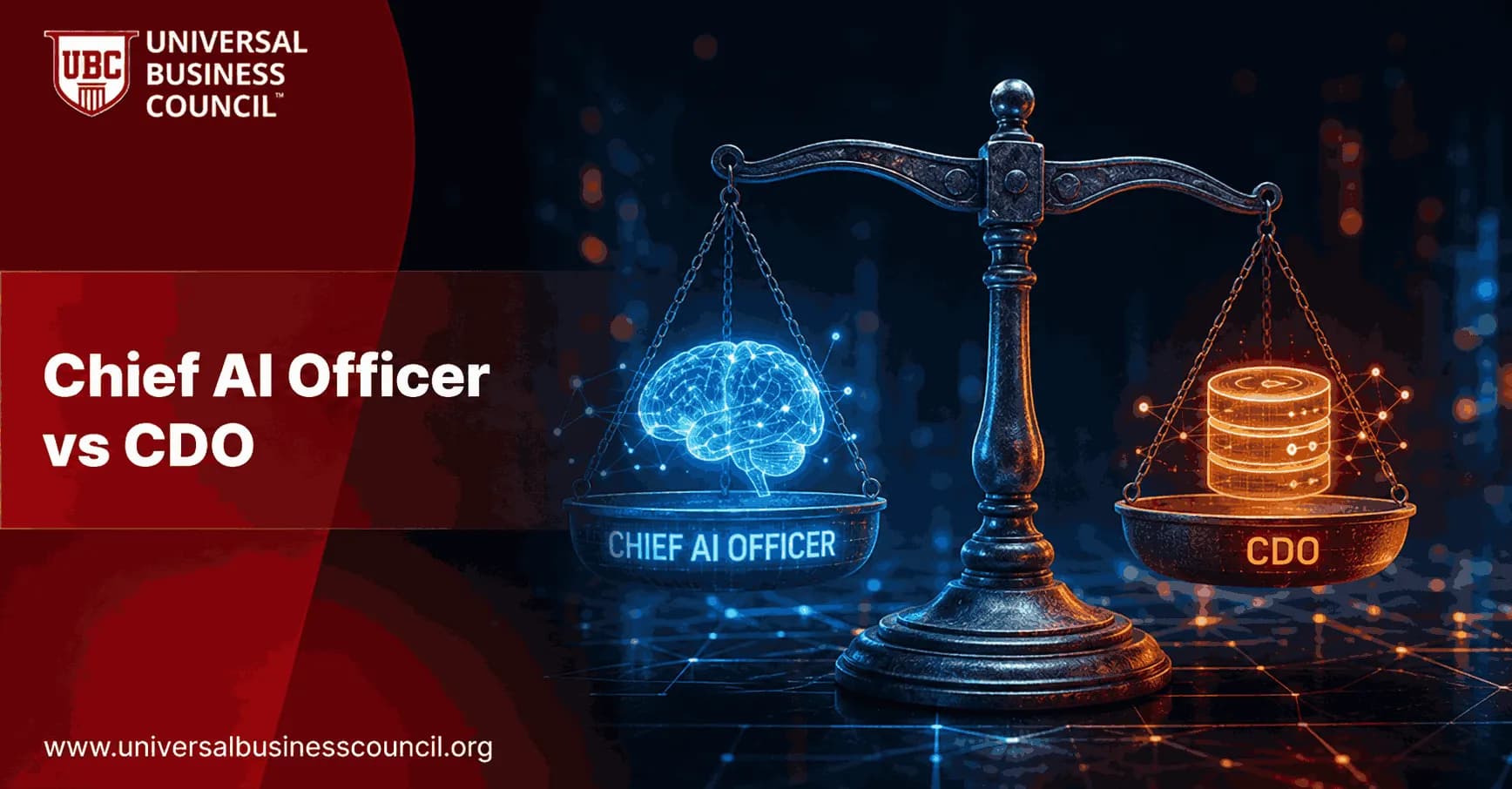
Chief AI Officer vs CDO is not simply a comparison between two executive titles. It is a comparison between two increasingly important leadership responsibilities: using artificial intelligence to create business value and managing enterprise data as a strategic asset.
A Chief AI Officer, or CAIO, generally focuses on AI strategy, adoption, governance, AI investments, and the business outcomes generated by AI. A Chief Data Officer, or CDO, typically owns enterprise data strategy, data governance, data quality, analytics, security, and the broader effort to turn organizational data into business value. The exact boundaries vary by company.

The distinction is becoming more important because AI cannot operate effectively without reliable data. At the same time, data teams increasingly need AI to extract greater value from structured and unstructured information. IBM's recent research describes a growing connection between CDO priorities and AI capabilities, while current industry analysis shows that organizations are increasingly combining data, engineering, product, and governance responsibilities.
For professionals who want to develop executive-level AI leadership capabilities, a Certified Chief AI Officer (CAIO) pathway can provide a structured foundation for understanding AI strategy, governance, implementation, and organizational transformation.
What Is a Chief AI Officer?
A Chief AI Officer is a senior executive responsible for helping an organization develop, implement, govern, and scale artificial intelligence.
The position is relatively new compared with traditional C-suite roles. Its emergence reflects the growing strategic importance of AI across products, operations, customer experience, workforce productivity, risk management, and innovation. IBM describes the CAIO as an executive focused on the development, strategy, and implementation of AI technologies.
A CAIO may be responsible for:
Developing the organization's AI strategy
Identifying and prioritizing AI use cases
Managing an AI investment portfolio
Establishing AI governance
Coordinating AI implementation
Managing responsible AI practices
Supporting AI talent development
Measuring AI business outcomes
Working with technology, data, security, legal, and business leaders
Communicating AI strategy to executive leadership and employees
The CAIO does not necessarily build AI models personally. The role is usually about orchestration, accountability, strategy, and translating AI capabilities into business results.
What Is a Chief Data Officer?
A Chief Data Officer is an executive responsible for maximizing the business value of an organization's data.
The CDO typically develops the enterprise data strategy and oversees areas such as data governance, data quality, analytics, data management, security, accessibility, and data-related compliance.
A CDO may be responsible for questions such as:
What data does the organization have?
Who owns each data domain?
Can employees access the right data?
Is the data accurate and complete?
How should sensitive information be protected?
What standards should govern data?
How can data improve decision-making?
How can proprietary data create competitive advantage?
Is the organization's data ready for AI?
The CDO therefore provides much of the foundation upon which successful AI programs depend.
Chief AI Officer vs CDO: The Key Difference
The simplest distinction is:
The CAIO primarily asks how the organization should use AI to achieve strategic outcomes.
The CDO primarily asks how the organization should manage and use data to create reliable business value.
These responsibilities overlap significantly.
For example, suppose a company wants to build an AI system that predicts customer churn.
The CAIO may focus on:
Why the company should build the system
What business outcome it should produce
Which AI approach should be used
How the system should be deployed
How employees will use its predictions
How AI performance should be monitored
Whether the investment is generating value
The CDO may focus on:
Which customer datasets are available
Whether customer records are accurate
How data should be governed
Whether data can legally and securely be used
How information is integrated
Whether the historical data is representative
How data quality will be maintained
Neither role can succeed independently if the organization wants to scale AI responsibly.
Chief AI Officer vs CDO Responsibilities
Area | Chief AI Officer | Chief Data Officer |
Primary focus | Artificial intelligence strategy | Enterprise data strategy |
Business objective | Create value through AI | Create value through data |
AI use cases | Usually leads prioritization | Provides data foundation |
Data governance | Collaborates and applies AI requirements | Typically owns enterprise data governance |
Data quality | Depends on trusted data | Major responsibility |
AI governance | Major responsibility | Supports data-related controls |
AI implementation | Often coordinates or oversees | Enables through data capabilities |
Analytics | Uses analytics for AI decisions | Often owns enterprise analytics strategy |
AI talent | AI and transformation talent | Data and analytics talent |
Data security | Works with security and data leaders | Major data responsibility |
Business transformation | Major responsibility | Increasingly important |
Executive reporting | AI outcomes and risks | Data outcomes and value |
This table is a useful starting point, but companies do not always divide responsibilities this neatly. Some organizations combine the CAIO and CDO positions. Others place AI under the CTO, CIO, or CDO.
Why the Roles Are Becoming More Closely Connected
The relationship between AI and data has changed the traditional boundaries between the two roles.
AI systems depend on data for training, retrieval, evaluation, personalization, prediction, and decision support. If the underlying information is incomplete, inconsistent, inaccessible, or poorly governed, AI performance can suffer.
Deloitte's recent analysis of the CDO role describes data quality, governance, security, and responsible data management as essential foundations for AI. McKinsey similarly notes that the CDO mandate is expanding toward ensuring that data can be reused, traced, and governed consistently across AI systems.
This means a CAIO and CDO may need to work together throughout the AI lifecycle.
Before an AI Project
The CDO can assess data readiness while the CAIO evaluates the business case and AI opportunity.
During Development
The CDO can help provide governed, high-quality datasets, while the CAIO ensures that model development remains aligned with the intended business outcome.
During Deployment
The CAIO may oversee AI adoption and performance, while the CDO helps ensure that data pipelines, lineage, access controls, and data quality remain reliable.
After Deployment
Both executives may monitor different aspects of the system. The CAIO can focus on business value and AI performance, while the CDO monitors data integrity, governance, and data-related risks.
Chief AI Officer vs CDO: Who Owns AI Strategy?
In an organization with a dedicated CAIO, the CAIO would typically be the primary executive responsible for enterprise AI strategy.
The CDO still has an important role because AI strategy cannot be separated from data strategy.
For example, an AI strategy may identify customer personalization as a high-priority opportunity. The CDO then needs to determine whether the company has sufficient customer data, appropriate consent, reliable identity resolution, suitable governance, and the technical ability to make that data available.
IBM's research on CAIOs emphasizes collaboration between CAIOs and CDOs around data strategy, data quality, AI governance, and analytics.
So the answer is not "CAIO owns AI and CDO has nothing to do with it." The better model is shared strategic alignment with clearly defined accountability.
Chief AI Officer vs CDO: Who Owns Data Strategy?
The CDO typically owns enterprise data strategy.
That can include data architecture, governance, quality, security, stewardship, literacy, analytics, and policies for creating business value from data.
However, AI requirements increasingly influence data strategy.
For example, generative AI and AI agents may require organizations to make previously isolated information accessible, searchable, traceable, and governed. This means the CDO must understand how AI will consume data, while the CAIO must understand whether the organization's data capabilities can support AI ambitions.
IBM's 2025 CDO research found that 81% of surveyed CDOs prioritize investments that accelerate AI capabilities and initiatives, demonstrating how closely data strategy and AI strategy are becoming connected.
Chief AI Officer vs CDO: Who Owns AI Governance?
This depends on the organization's governance model.
A CAIO may lead governance specifically related to AI systems, including:
AI use policies
Model evaluation
Responsible AI standards
Human oversight
AI risk assessment
AI vendor evaluation
Model monitoring
Generative AI controls
The CDO may own governance over the data used by those systems, including:
Data quality
Data access
Data classification
Data lineage
Data privacy
Data retention
Data ownership
Data security
The two areas overlap.
For example, if an AI system uses sensitive customer information, the CAIO may be accountable for determining whether the AI application is appropriate, while the CDO helps determine whether the underlying data can be accessed and used under the organization's data policies.
How Their Skills Differ
The two roles require overlapping but distinct skill sets.
Chief AI Officer Skills
A CAIO generally needs strong knowledge of:
Artificial intelligence
Machine learning
Generative AI
AI agents
AI governance
AI risk
Product strategy
Business transformation
Technology strategy
Financial modeling
Change management
Executive communication
The CAIO also needs enough technical knowledge to challenge AI architecture, model performance, vendor claims, and implementation assumptions.
Chief Data Officer Skills
A CDO generally needs strong knowledge of:
Data strategy
Data governance
Data architecture
Data quality
Data management
Analytics
Data security
Privacy
Data stewardship
Metadata
Data integration
Business intelligence
Data monetization
The CDO must understand how data moves through the organization and how reliable information can support business decisions.
Which Role Is More Senior?
There is no universal answer.
Both are C-suite roles, and their relative authority depends on organizational structure.
In one company, the CAIO may report directly to the CEO and control a significant AI budget. In another, the CAIO may report to the CTO or CIO.
Similarly, CDOs can report to the CEO, COO, CIO, or another executive depending on the company.
IBM notes that CAIO reporting structures vary and that the role can overlap with the CDO, CIO, CTO, and CISO.
Therefore, job title alone does not determine seniority. Reporting line, budget authority, decision rights, organizational scope, and executive mandate matter more.
Can One Person Be Both CAIO and CDO?
Yes.
A company may combine the roles when its AI and data functions are closely connected or when maintaining separate executive positions does not make sense.
A combined Chief Data and AI Officer, sometimes abbreviated CDAO, can oversee:
Data strategy
AI strategy
Data governance
AI governance
Analytics
Data quality
AI implementation
Responsible AI
Data and AI talent
This structure can reduce organizational friction, but it also creates a very broad executive mandate.
The combined role must have enough authority and resources to manage both foundational data responsibilities and strategic AI transformation.
When Should a Company Hire a Chief AI Officer?
A dedicated CAIO becomes more useful when AI moves from experimentation into enterprise strategy.
Potential signals include:
AI is becoming central to products or services.
Multiple departments are deploying AI independently.
AI investments are growing quickly.
Leadership lacks a unified AI roadmap.
AI governance is becoming difficult to coordinate.
AI projects need executive sponsorship.
The organization is moving from pilots to production.
AI creates significant regulatory or reputational risk.
The board wants clear accountability for AI.
IBM similarly identifies factors such as AI's strategic importance, complexity, and the number of stakeholders involved as reasons an organization may benefit from dedicated CAIO leadership.
When Should a Company Strengthen the CDO Role?
The CDO becomes especially important when an organization struggles with data fragmentation, inconsistent definitions, poor data quality, weak governance, limited accessibility, or increasing demand for AI-ready information.
A company may need stronger CDO leadership if:
Different departments use conflicting versions of the same data.
Data quality problems affect business decisions.
AI projects cannot access required information.
Sensitive data lacks clear ownership.
Data governance is inconsistent.
Data infrastructure does not scale.
Analytics teams spend excessive time preparing data.
Leadership cannot measure the value of data investments.
A strong CDO can turn data from a fragmented operational resource into a managed enterprise asset.
How CAIO and CDO Should Work Together
The most effective relationship is not a competition over ownership. It is a partnership with explicit decision rights.
A practical model could look like this:
CDO: "Here is the data we have, its quality, governance, ownership, and permitted uses."
CAIO: "Here are the AI opportunities, requirements, risks, and expected business outcomes."
Together: "Here is the AI initiative that is technically feasible, appropriately governed, and valuable to the business."
This relationship can become particularly important for generative AI and AI agents because these systems may interact with large amounts of enterprise information.
A successful partnership should establish:
Shared business objectives
Clearly documented responsibilities
Joint AI and data roadmaps
Common governance standards
Shared risk escalation
Consistent metrics
Executive-level communication
Chief AI Officer vs CDO in Generative AI
Generative AI makes the distinction especially interesting.
Consider an internal AI assistant that answers employee questions using company documents.
The CAIO may own:
AI use-case selection
Model strategy
User experience
AI evaluation
Adoption
Business value
AI risk
The CDO may own:
Document quality
Data classification
Access permissions
Metadata
Data lineage
Knowledge repositories
Retention policies
Data governance
If an employee receives an incorrect answer, both perspectives matter.
The CAIO needs to ask whether the AI application and retrieval system performed correctly.
The CDO needs to ask whether the underlying documents were accurate, current, correctly classified, and properly governed.
Chief AI Officer vs CDO in AI Governance
AI governance is becoming a shared executive responsibility because AI risk often crosses traditional organizational boundaries.
For example, consider an AI-powered hiring system.
The CAIO may evaluate:
Model performance
AI suitability
Human oversight
AI vendor
Deployment controls
Business outcomes
The CDO may evaluate:
Candidate data
Data quality
Data access
Data privacy
Data retention
Data governance
HR, legal, compliance, cybersecurity, and risk teams may also have responsibilities.
This is why governance should be designed around the AI system and its risks rather than around organizational titles alone.
How AI Certification Can Support CAIO Development
Professionals moving toward AI leadership need more than familiarity with popular AI tools. They need to understand how AI fits into business strategy, governance, risk, data, and organizational transformation.
A structured Artificial Intelligence Certifications pathway can support foundational and professional learning across AI concepts and applications.
For aspiring CAIOs, the most valuable development areas include:
AI strategy
Machine learning fundamentals
Generative AI
AI governance
Responsible AI
AI project management
Data strategy
Cybersecurity
Business transformation
Financial analysis
Certification should complement practical experience rather than replace it. The strongest executive profile combines formal learning with real-world AI project leadership.
Career Path: CAIO or CDO?
The better career direction depends on your interests and existing experience.
Choose a CAIO-oriented path if you enjoy:
AI technology
Innovation
Product strategy
Business transformation
AI governance
Emerging technology
Executive-level change
Turning AI capabilities into business outcomes
A CDO-oriented path may be more suitable if you enjoy:
Data strategy
Data governance
Analytics
Data architecture
Data quality
Privacy
Data management
Business intelligence
Turning information into organizational value
There is also significant overlap. A data leader can move toward AI leadership, and an AI leader benefits enormously from strong data expertise.
Introducing Technology Learning From an Early Age
Technology learning can begin well before students enter higher education or professional careers. Designed to encourage technology learning among school students, the World Tech Olympiad (WTO) brings together participants from Class 2 to Class 12 through different technology-focused challenges. Its areas include robotics, AI, programming, computational thinking, and cybersecurity, with competition levels structured to suit different age groups and abilities.
The Olympiad supports participation through separate routes for families and educational institutions. Parents can enroll their children directly, while schools can register as institutions and facilitate participation for students who meet the eligibility requirements. Early exposure to these areas can help students develop problem-solving, computational thinking, and technology skills that may provide a strong foundation for pursuing advanced education and future careers in AI, data, engineering, and other technology fields.
Chief AI Officer vs CDO: Which Role Is Better?
There is no universally better role.
The better role depends on the organization's needs and your professional strengths.
A CAIO is generally better positioned to lead an enterprise AI transformation when AI itself is the strategic priority.
A CDO is generally better positioned to build and govern the data foundation required for AI and data-driven decision-making.
In mature organizations, the ideal situation may be both.
AI without reliable data can produce unreliable outcomes. Data without effective AI and analytics may leave significant value unrealized.
Chief AI Officer vs CDO: A Simple Example
Imagine an online retailer wants to introduce an AI recommendation engine.
The CAIO asks:
Will personalized recommendations increase revenue or customer engagement?
The CDO asks:
Do we have reliable product, customer, transaction, and behavioral data to support the system?
The CAIO evaluates the AI solution, business case, deployment strategy, and performance.
The CDO evaluates data quality, governance, access, architecture, and security.
The product, engineering, marketing, cybersecurity, legal, and analytics teams then contribute their expertise.
This example shows why the two roles should not operate in isolation.
The Future of Chief AI Officer and CDO Roles
The boundary between AI and data leadership will probably continue to evolve.
AI systems are becoming increasingly dependent on enterprise data, while data strategies are increasingly designed around AI use cases. IBM's recent CDO research shows that data leaders are already prioritizing AI capabilities, while current research from McKinsey highlights the expanding need for governed, reusable, traceable data across AI systems.
At the same time, some organizations may consolidate responsibilities while others create increasingly specialized leadership roles.
The important trend is not whether every company eventually has both titles. It is whether organizations establish clear accountability for:
AI strategy + data strategy + governance + technology + business outcomes.
Technology-focused professionals can strengthen this broader capability through a Tech Certification pathway that complements AI and data leadership knowledge.
Final Takeaway
Chief AI Officer vs CDO is best understood as a comparison of two complementary leadership functions.
The CAIO focuses primarily on how an organization can use artificial intelligence to create measurable value while managing AI-specific risks.
The CDO focuses primarily on how an organization can manage, govern, protect, and use data as a strategic asset.
Neither role exists in a vacuum.
The CAIO needs trusted data. The CDO needs to understand how AI is changing the value of enterprise data. Together, they can help organizations move from disconnected AI experiments and fragmented data toward scalable, governed, measurable digital capabilities.
For organizations that operate heavily in emerging technologies, a Deep Tech Certification can provide additional technology-focused learning that complements AI, data, and executive transformation skills.
The most important question is therefore not "Should we choose a CAIO or CDO?"
It is:
"Who is accountable for turning our AI and data capabilities into trusted business outcomes?"
Once that responsibility is clear, the organization can decide whether it needs a CAIO, CDO, combined role, or another leadership structure.
FAQs
1. What is the difference between a Chief AI Officer and a CDO?
The main difference between a Chief AI Officer (CAIO) and a Chief Data Officer (CDO) is their primary focus. A CAIO leads artificial intelligence strategy, adoption, governance, investment, and business value, while a CDO generally leads enterprise data strategy, governance, quality, architecture, and accessibility.
Put simply, the CDO ensures the organization has trustworthy and usable data. The CAIO determines how AI can use data and other capabilities to create business value. Since AI without reliable data tends to produce very sophisticated nonsense, the two roles are closely connected.
2. What does a Chief AI Officer do compared with a Chief Data Officer?
A Chief AI Officer typically develops the enterprise AI strategy, prioritizes AI use cases, oversees AI platforms and initiatives, establishes responsible AI practices, manages AI risks, develops AI talent, and measures AI business outcomes.
A Chief Data Officer focuses on data strategy, data governance, data quality, metadata, lineage, master data, data architecture, access, analytics capabilities, and data-related compliance.
The CAIO is primarily concerned with using AI effectively. The CDO is primarily concerned with ensuring organizational data is managed as a reliable and valuable enterprise asset.
3. What are the main responsibilities of a Chief AI Officer?
A CAIO's responsibilities typically include creating the AI strategy and roadmap, identifying valuable use cases, managing the AI investment portfolio, overseeing generative AI and machine learning initiatives, establishing AI governance, and driving organizational adoption.
The role may also cover AI talent, vendor selection, model evaluation, AI agents, risk management, executive education, and AI ROI.
The CAIO is ultimately responsible for helping the organization move from AI experimentation toward scalable, governed, measurable business applications.
4. What are the main responsibilities of a Chief Data Officer?
A Chief Data Officer typically leads the organization's approach to managing, governing, and extracting value from data.
Responsibilities can include data governance, data quality, data architecture, metadata management, data lineage, master data management, data ownership, analytics strategy, and data literacy.
The CDO may also establish policies for data access, retention, classification, and appropriate use.
The objective is to make data trustworthy, accessible, secure, and useful enough to support operations, analytics, decision-making, and AI.
5. Does the Chief AI Officer report to the Chief Data Officer?
Sometimes, but there is no universal reporting structure.
A CAIO may report to the CDO when AI is organized as part of a broader data and analytics function. In other organizations, the CAIO may report directly to the CEO, CIO, CTO, or Chief Digital Officer.
The CDO and CAIO may also operate as peers.
Reporting lines should reflect actual responsibilities, budget authority, and strategic importance rather than merely arranging executive acronyms into aesthetically pleasing boxes.
6. Can the Chief Data Officer also be the Chief AI Officer?
Yes. Many organizations combine the responsibilities into a Chief Data and AI Officer (CDAO) role.
This structure can make sense because data and AI are deeply interconnected. A single executive can oversee data foundations while also leading AI strategy and adoption.
However, combining the roles creates a broad mandate. Large or AI-intensive organizations may need separate executives if data management and AI transformation are each sufficiently complex.
The right structure depends on organizational scale, maturity, industry, and strategic priorities.
7. What is a Chief Data and AI Officer?
A Chief Data and AI Officer combines leadership responsibility for enterprise data and artificial intelligence.
The role may oversee data governance, data platforms, analytics, machine learning, generative AI, AI governance, and AI strategy.
Combining the functions can create stronger alignment between data investments and AI requirements.
However, organizations should still define clear operational responsibilities underneath the executive. Combining two titles does not magically reduce the amount of work. Corporate typography remains disappointingly weak at capacity planning.
8. Which role is more technical, CAIO or CDO?
Both positions require technical literacy, but their areas of expertise differ.
A CAIO may require stronger knowledge of machine learning, generative AI, LLMs, AI agents, model evaluation, MLOps, AI platforms, model risk, and responsible AI.
A CDO may require deeper expertise in data architecture, databases, data engineering, governance, metadata, lineage, data quality, master data, analytics, and information management.
At executive level, neither role necessarily involves daily hands-on technical work. Technical credibility supports better strategic and investment decisions.
9. Who owns data for AI, the CAIO or CDO?
The CDO typically owns or governs enterprise data capabilities, while the CAIO defines the data requirements needed for AI initiatives.
For example, the CAIO may determine that an AI application requires accurate customer, transaction, or operational data. The CDO's organization may ensure that the required data is accessible, governed, documented, and sufficiently reliable.
This creates a natural partnership:
CDO → Trusted Data
CAIO → AI Capability
Business → Measurable Outcome
AI cannot compensate indefinitely for weak data foundations, regardless of how impressive the model's benchmark scores happen to look.
10. Who owns AI governance, the CAIO or CDO?
The CAIO often leads or co-leads AI-specific governance, including model inventories, risk classification, evaluation standards, human oversight, monitoring, and responsible AI practices.
The CDO typically leads or contributes to data governance, including data quality, ownership, lineage, metadata, access, classification, and appropriate data use.
The two governance systems should be connected because AI risk frequently begins with data.
Legal, cybersecurity, privacy, compliance, risk management, and internal audit may also participate depending on the organization and use case.
11. What is the difference between AI governance and data governance?
Data governance focuses on how organizational data is collected, classified, owned, accessed, maintained, protected, and used.
AI governance focuses on how AI systems are selected, developed, evaluated, approved, deployed, monitored, and retired.
Data governance may address whether customer information is accurate and appropriately accessible. AI governance may address whether a model using that information is sufficiently reliable, fair, secure, explainable where required, and subject to appropriate human oversight.
Strong enterprise AI generally requires both governance disciplines working together.
12. Who is responsible for generative AI, CAIO or CDO?
A dedicated CAIO will often lead the strategic adoption of generative AI, while the CDO may provide critical data and knowledge-management capabilities supporting those systems.
For example, an enterprise retrieval-augmented generation system may require the CAIO to define use cases, model choices, evaluation standards, and governance.
The CDO may ensure the documents and data used for retrieval have appropriate quality, ownership, metadata, permissions, and lifecycle controls.
Generative AI therefore makes coordination between AI and data leadership even more important.
13. Who is responsible for machine learning, CAIO or CDO?
Responsibility for machine learning varies by organizational structure.
In companies with a dedicated CAIO, machine learning strategy and AI model portfolios may fall under the CAIO.
In organizations where data science and machine learning sit within the data organization, the CDO may own these capabilities.
Some companies divide responsibility so the CDO owns data science and analytics while the CAIO owns enterprise AI strategy and newer AI platforms.
Whatever structure is chosen, overlapping accountability should be explicitly resolved. Models are difficult enough without organizational ambiguity being added as another feature.
14. What skills does a CAIO need compared with a CDO?
A CAIO typically needs skills in AI strategy, machine learning, generative AI, model evaluation, AI governance, responsible AI, product management, business transformation, financial analysis, and organizational adoption.
A CDO typically needs expertise in data strategy, data architecture, governance, quality, analytics, metadata, data engineering, regulatory requirements, and information management.
Both executives require leadership, strategic thinking, stakeholder management, financial judgment, technology understanding, and executive communication.
The CAIO specializes more heavily in AI transformation, while the CDO specializes in enterprise data capability.
15. How should a Chief AI Officer work with a Chief Data Officer?
The CAIO and CDO should jointly align AI ambitions with the organization's actual data capabilities.
The CAIO can define high-value AI use cases and their data requirements. The CDO can determine whether the required data exists, whether its quality is sufficient, and whether appropriate governance and access mechanisms are available.
Together, they can establish priorities for improving data foundations that directly support valuable AI initiatives.
This prevents the organization from spending months cleaning every imaginable dataset merely because “AI readiness” looked impressive on the transformation roadmap.
16. Who is responsible for AI ROI, the CAIO or CDO?
The CAIO is generally more directly responsible for measuring the business value generated by the AI portfolio.
The CDO may be accountable for the value, quality, accessibility, and effectiveness of enterprise data capabilities that enable those AI initiatives.
Business leaders should also own the operational outcomes produced by AI.
A useful accountability model is:
CDO → Data readiness and quality
CAIO → AI strategy and value realization
Business Leader → Adoption and business outcomes
Shared accountability helps prevent technology functions from claiming success merely because a technically functioning system reached production.
17. How does Chief AI Officer salary compare with Chief Data Officer salary?
Both CAIO and CDO roles can command substantial executive compensation in the United States, particularly at large enterprises and technology-intensive organizations.
CDO compensation is somewhat easier to benchmark because the role is more established. CAIO compensation remains less standardized because organizations define the position differently.
At companies where AI is strategically critical, CAIO compensation can be competitive with other senior technology and data executives.
Candidates should compare base salary, bonus, equity, reporting level, team size, budget authority, and organizational scope, rather than relying on title alone.
18. Is Chief AI Officer a better career than Chief Data Officer?
Neither career is universally better.
A CAIO career may be attractive to professionals interested in AI strategy, generative AI, machine learning, AI governance, products, and enterprise transformation.
A CDO career may appeal more to professionals interested in data strategy, analytics, governance, architecture, information management, and enterprise data transformation.
There is also considerable mobility between the two paths.
Experienced CDOs can become CAIOs or CDAOs by expanding their expertise in AI technology, governance, investment, and organizational adoption.
19. Will Chief AI Officers replace Chief Data Officers?
Chief AI Officers are unlikely to eliminate the need for data leadership because advanced AI increases rather than removes the importance of high-quality, governed data.
What may change is the organizational structure.
Some businesses may maintain separate CAIO and CDO roles. Others may combine them into a Chief Data and AI Officer position. Some may distribute AI responsibilities among the CTO, CIO, CDO, and business leaders.
The titles may change as organizations mature, but data strategy and AI strategy remain distinct capabilities that require clear ownership.
20. Chief AI Officer vs CDO: Which role does a company need?
Whether an organization needs a Chief AI Officer, Chief Data Officer, or Chief Data and AI Officer depends on its data maturity, AI ambitions, company size, regulatory environment, and existing leadership structure.
The major differences can be summarized as follows:
Area | Chief AI Officer (CAIO) | Chief Data Officer (CDO) |
|---|---|---|
Primary Focus | Artificial intelligence | Enterprise data |
AI Strategy | Typically leads | Supports or may lead |
Data Strategy | Defines AI requirements | Typically leads |
Generative AI | Often leads | Data enablement/support |
Machine Learning | Often leads | May own |
Data Governance | Collaborates | Typically leads |
AI Governance | Typically leads/co-leads | Collaborates |
Data Quality | Defines AI requirements | Typically owns |
Data Architecture | AI requirements | Major responsibility |
Model Evaluation | Major responsibility | May support |
AI Adoption | Often leads | Supports |
Analytics | May influence | Often owns |
AI ROI | Major focus | Contributes |
Board Focus | AI value and risk | Data value and governance |
For organizations early in their data journey, the priority may be:
CDO → Build trusted enterprise data foundations
For organizations with mature data and rapidly expanding AI investment:
CDO → Data Strategy and Governance
CAIO → AI Strategy and Transformation
For organizations wanting integrated leadership:
Chief Data and AI Officer → Data + Analytics + AI
The relationship can ultimately be expressed as:
DATA FOUNDATION
↓
CDO: Is our data trustworthy, accessible, governed, and useful?
↓
AI CAPABILITY
CAIO: How can AI use those foundations to create measurable value?
↓
GOVERNANCE
CAIO + CDO + Legal + Security + Risk
↓
BUSINESS ADOPTION
↓
MEASURABLE OUTCOMES
The simplest distinction is therefore:
CDO = Make enterprise data trustworthy and valuable.
CAIO = Turn AI into a governed and valuable enterprise capability.
The roles are complementary rather than inherently competitive.
After all, appointing an AI executive while ignoring the quality of the organization's data would be rather like hiring a Formula One driver and then filling the fuel tank with soup.
Related Articles
View All
Chief Ai Officer
Chief AI Officer Trends in 2026
Chief AI Officer trends in 2026 reflect the shift from experimental AI programs toward enterprise-wide execution. CAIOs are increasingly focused on agentic AI, measurable ROI, governance, security, workforce transformation, model and vendor strategy, and integrating AI into core business operations.

Chief Ai Officer
What Should a Chief AI Officer Report to the Board?
A Chief AI Officer should give the board a clear view of how AI is creating business value while exposing the organization to new risks. Effective board reporting should cover AI strategy, investments, ROI, major initiatives, adoption, governance, regulatory exposure, security, incidents, and progress against measurable objectives.
Chief Ai Officer
How Should CEOs Work With a Chief AI Officer?
CEOs and Chief AI Officers should work together to connect AI strategy with business priorities, investment decisions, organizational transformation, and responsible governance. Learn how CEOs can give CAIOs the authority, resources, executive access, and accountability needed to turn AI initiatives into measurable enterprise value.
Trending Articles
The Role of Blockchain in Ethical AI Development
How blockchain technology is being used to promote transparency and accountability in artificial intelligence systems.
AWS Career Roadmap
A step-by-step guide to building a successful career in Amazon Web Services cloud computing.
Top 5 DeFi Platforms
Explore the leading decentralized finance platforms and what makes each one unique in the evolving DeFi landscape.