

Chief AI Officer vs CIO
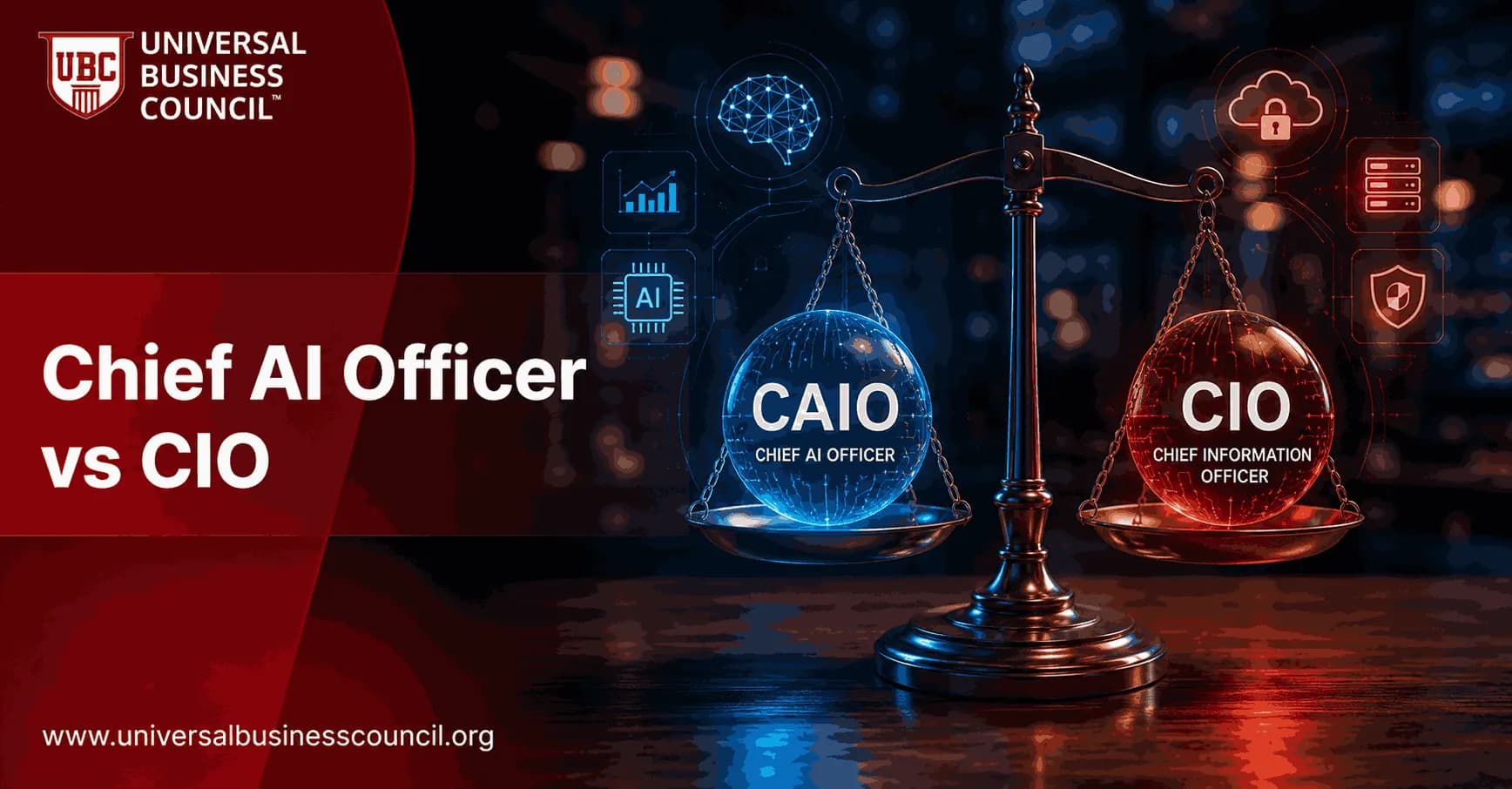
Two of the most important executive roles in modern organisations are often confused, merged, or incorrectly treated as interchangeable. The Chief AI Officer and the Chief Information Officer both sit at the top of the technology leadership structure, and both influence how technology shapes business outcomes. However, they serve fundamentally different purposes. The debate around Chief AI Officer vs CIO has moved from theoretical to urgent because organisations are now making real hiring decisions that determine who leads their AI future.
This guide explains both roles clearly, from the ground up. Whether you are a student exploring technology leadership careers, a mid-career professional deciding which path to pursue, or a senior executive defining your organisation's leadership structure, this article gives you the full picture in plain language.

Professionals aiming to formalise their expertise in AI leadership can explore the Certified Chief AI Officer (CAIO) credential from Universal Business Council, which validates the strategic, governance, and executive AI leadership competencies that define the CAIO role today.
What Is a Chief Information Officer?
The Chief Information Officer is one of the longest-established technology executive roles in the corporate world. The role emerged in the 1980s as organisations began relying on computer systems to run their operations. Today, the CIO is the executive responsible for managing and implementing an organisation's information technology strategy, systems, and operations.
In simple terms, the CIO makes sure that the technology that runs the business actually runs. They oversee the IT department, manage enterprise software systems, protect the organisation's digital infrastructure from security threats, and ensure that technology investments align with business goals.
More specifically, the CIO owns several core domains. First, they manage enterprise IT infrastructure, which includes everything from servers, cloud platforms, and network systems to the software applications that employees use every day. Second, they lead digital transformation programmes that move legacy systems to modern platforms. Third, they oversee cybersecurity in partnership with the Chief Information Security Officer. Fourth, they manage vendor relationships and technology procurement. Fifth, they develop and retain IT talent across the organisation.
The CIO role in 2026 has evolved considerably from its origins. According to compensation data from Glassdoor, the average CIO salary in the United States sits at approximately $319,390 per year. Median total cash compensation across the role ranges from $300,000 to $400,000, with significant variance based on company size, industry, and the scope of responsibilities the CIO carries. In the largest enterprises, total compensation including bonuses and equity can exceed $600,000.
The CIO who can demonstrate AI governance experience or a track record of deploying enterprise AI tools is now positioned to negotiate at the upper end of these ranges. CIOs with cybersecurity accountability alongside their information management responsibilities command a 15 to 25 percent compensation premium above infrastructure-focused peers.
The CIO is an inside-out role. Their primary orientation is internal. They keep the organisation's digital systems running reliably, securely, and efficiently, ensuring that the technology backbone supports every other business function. Stability, integration, and operational resilience define the CIO mindset.
What Is a Chief AI Officer?
The Chief AI Officer is one of the newest executive roles in the corporate world. It emerged formally in 2024 and 2025 as artificial intelligence moved from a specialised technical capability to a strategic business driver. The CAIO is the C-suite executive responsible for an organisation's entire artificial intelligence agenda: strategy, governance, implementation, risk, and value creation.
In simple terms, the CAIO determines how the organisation uses AI, where AI creates competitive advantage, what risks AI deployments create, and how the organisation stays on the right side of AI regulation. They own the AI roadmap, manage AI model risk, govern data use for AI training and inference, and ensure that AI investments produce measurable business outcomes.
The CAIO's mandate covers several specific domains. First, they develop and execute the enterprise AI strategy, identifying the highest-value AI use cases and building a prioritised roadmap that connects AI investments to business outcomes. Second, they own AI governance and risk management, including compliance with frameworks like the EU AI Act, the NIST AI Risk Management Framework, and ISO 42001. Third, they oversee the model lifecycle from data preparation through deployment and monitoring to eventual model retirement. Fourth, they build and lead the AI function, hiring AI engineers, data scientists, ethics specialists, and ML operations professionals. Fifth, they drive AI literacy across the organisation, ensuring that non-technical teams understand how to work productively with AI systems. Sixth, they communicate AI strategy, risk, and performance to the board in the language of business outcomes.
According to Glassdoor data from March 2026, the average US CAIO base salary is approximately $352,612. Fortune 500 total compensation packages frequently range between $350,000 and $650,000, and the largest enterprises budget up to $1.5 million for the role. IBM reports that 26 percent of large enterprises globally now have a dedicated CAIO. Additionally, 76 percent of CEOs plan to hire one, up from just 26 percent two years ago.
The CAIO is an outside-in role. Their primary orientation is transformation. They look at what AI makes possible for the business, for products, for customer experiences, and for competitive positioning, and they build the organisational capability to pursue it.
Chief AI Officer vs CIO: The Core Differences
Understanding Chief AI Officer vs CIO requires looking at how the roles differ across several dimensions simultaneously. These are not just two job titles for roughly similar work. They are two fundamentally different leadership mandates that happen to share some overlapping territory.
The most important dimension is focus. The CIO focuses on managing and optimising what already exists. Enterprise systems, IT infrastructure, software platforms, and digital operations all need to run reliably and securely. The CIO owns that reliability. The CAIO focuses on what AI makes newly possible. They are building something that does not fully exist yet: an AI-enabled enterprise with the governance, talent, and systems to deploy AI at scale and use it to create value.
The second dimension is time horizon. The CIO operates across short, medium, and long-term horizons simultaneously because keeping systems running is an ongoing operational responsibility. The CAIO operates primarily in the medium and long term. They are building AI strategy, governance frameworks, and organisational capability for how the business will operate two to five years from now, not just next quarter.
The third dimension is primary stakeholder. The CIO's primary stakeholders are internal: the IT department, business unit leaders who depend on reliable systems, the CISO, and the CFO who approves technology budgets. The CAIO's primary stakeholders span the entire C-suite, the board of directors, external regulators, and increasingly the organisation's customers and partners, because AI decisions affect all of them.
The fourth dimension is the nature of the risk they manage. The CIO manages operational risk: system downtime, security breaches, data loss, and technology failures. These risks are well-understood, and frameworks for managing them have matured over decades. The CAIO manages a newer and more complex category of risk: model bias, algorithmic transparency failures, AI-related regulatory non-compliance, reputational damage from AI errors, and the risk of being outcompeted by organisations that deploy AI more effectively.
The fifth dimension is what drives their success. The CIO succeeds when systems run well, projects are delivered on time and budget, and technology costs remain controlled. The CAIO succeeds when AI initiatives produce measurable business value, AI governance passes regulatory scrutiny, and the organisation builds a durable AI capability that improves over time.
Where the Roles Overlap
The Chief AI Officer vs CIO comparison is not a story of two roles with nothing in common. They overlap significantly in several important areas, and the quality of their partnership often determines whether an organisation's AI programme succeeds or stalls.
Both roles work with data at the enterprise level. The CIO owns the infrastructure that stores, moves, and protects data. The CAIO depends on that infrastructure to train and deploy AI models. When the data pipelines that the CIO manages are unreliable or poorly governed, the AI systems that the CAIO builds produce bad outputs. Strong data infrastructure is the foundation on which effective AI is built.
Both roles engage with cloud platforms and enterprise software. The CIO selects and manages cloud providers. The CAIO deploys AI systems on those platforms. Misalignment between the cloud strategy the CIO has implemented and the AI workloads the CAIO wants to run creates friction, cost, and performance problems. Alignment between these two mandates is operationally essential.
Both roles work on cybersecurity and AI security. The CIO oversees cybersecurity broadly. The CAIO must ensure that AI systems are not exploited through model manipulation, adversarial inputs, or data poisoning attacks. These disciplines are different, but they require coordination and shared governance standards.
Both roles contribute to digital transformation. The CIO is modernising legacy systems and moving the organisation to current technology platforms. The CAIO is embedding AI into those systems and processes to change how work gets done. These efforts must be sequenced and coordinated to avoid creating technical debt or AI deployments that do not integrate properly with the systems they are supposed to improve.
Where They Differ Most Sharply
Despite their overlaps, the Chief AI Officer vs CIO distinction is sharpest in three specific areas that matter most to boards and hiring committees.
The first area is AI strategy and value creation. The CAIO owns the question of how AI creates business value. This requires knowledge of machine learning model selection, AI use case evaluation, ROI quantification for AI investments, and the competitive dynamics of AI in the organisation's specific industry. The CIO rarely owns this. They may be involved in reviewing AI tools from a procurement and security perspective, but the strategic AI agenda belongs to the CAIO.
The second area is AI governance and regulatory compliance. The CAIO owns compliance with AI-specific regulations. The EU AI Act, which began enforcing high-risk obligations on large organisations from August 2026, creates specific requirements for risk classification, documentation, transparency, and human oversight of AI systems. The NIST AI Risk Management Framework requires executive-level accountability for AI risk. ISO 42001 requires top management commitment to the AI management system. These are CAIO-owned obligations, not CIO-owned ones, because they are specific to how AI systems behave and are governed rather than to how IT infrastructure operates.
The third area is AI ethics and responsible deployment. The CAIO owns the organisation's approach to ethical AI including how bias is identified and mitigated in AI models, how transparency is maintained in AI decision-making, how privacy is protected when AI systems process personal data for inference, and how the organisation communicates AI use to customers and regulators. This is a distinct discipline that the CIO role was not designed to encompass.
Do Organisations Need Both Roles?
This is one of the most common practical questions in the Chief AI Officer vs CIO debate. The answer depends on organisational size, AI ambition, and the specific industry in which the organisation operates.
Smaller organisations frequently assign both sets of responsibilities to a single executive, usually the CIO or CTO, until AI complexity justifies a separate appointment. This works when AI is not yet a core strategic differentiator and when the volume of AI governance work is manageable alongside other technology leadership responsibilities.
Larger organisations, especially those in regulated industries like banking, healthcare, and government, increasingly separate the roles because the complexity and regulatory exposure of each mandate justifies dedicated executive ownership. Research from Logicalis shows that 87 percent of companies are increasing AI budgets in 2026. However, only 14 percent have defined who is accountable for AI results at the C-suite level. That gap between investment and accountability is precisely the governance problem that creating a dedicated CAIO role is designed to solve.
Boards in highly regulated sectors like banking often favour the CIO for AI compliance because the CIO already owns the regulatory relationships and audit processes. Fast-moving sectors like retail and e-commerce often favour a dedicated CAIO for speed-to-market because AI capability is a competitive differentiator rather than primarily a compliance obligation.
The organisations achieving the best outcomes in 2026 are those that have defined both roles clearly, even if they are held by the same person, with explicit accountability for each set of responsibilities. When both the CIO and CAIO exist, their partnership is critical. A strong CAIO without a strong CIO partner finds that AI deployments lack the infrastructure, security, and data quality they need to operate reliably. A strong CIO without CAIO partnership finds that AI programmes lack the strategy, governance, and value orientation that transforms them from experiments into enterprise capabilities.
Career Paths Into Each Role
The Chief AI Officer vs CIO comparison also plays out in career terms, because the paths into these roles are different even when they share some common starting points.
The CIO path most commonly runs through IT management, enterprise architecture, or digital transformation leadership. Professionals who build careers managing IT departments, leading large-scale technology migrations, and developing enterprise security programmes typically progress into CIO roles. The credential landscape for CIOs emphasises IT governance, project management, cybersecurity, and enterprise systems knowledge.
The CAIO path is newer and therefore less linear. Three primary entry tracks appear consistently across CAIO hiring data. Technology executives including CTOs, CIOs, and Chief Data Officers transition to CAIO roles by building AI strategy and governance expertise on top of their technology leadership foundation. AI and machine learning practitioners transition by developing executive presence, business strategy fluency, and governance knowledge that complements their technical depth. Strategy and consulting professionals transition by building genuine technical AI literacy that allows them to evaluate, govern, and communicate about AI systems credibly.
For professionals targeting the CAIO role, building a well-rounded portfolio of credentials across AI leadership, technology infrastructure, and deep technology systems creates the strongest foundation. Exploring the full range of Artificial Intelligence Certifications from professionally recognised bodies helps professionals identify where to build depth and where complementary credentials add the most career value.
Introducing Technology Learning From an Early Age
Technology leadership skills can begin developing well before a student enters the professional world. Designed to encourage technology learning among school students, the World Tech Olympiad (WTO) brings together participants from Class 2 to Class 12 through different technology-focused challenges. Its areas include robotics, AI, programming, computational thinking, and cybersecurity, with competition levels structured to suit different age groups and abilities.
The Olympiad supports participation through separate routes for families and educational institutions. Parents can enroll their children directly, while schools can register as institutions and facilitate participation for students who meet the eligibility requirements. Early exposure to these areas can help students develop problem-solving, computational thinking, and technology skills that may provide a strong foundation for pursuing advanced technology education and future careers in AI, IT, and digital leadership.
Skills Each Role Requires
The skills comparison for Chief AI Officer vs CIO reveals both overlaps and important distinctions. Understanding the skills profile of each role helps professionals plan their development more precisely.
The CIO needs strong capabilities in IT infrastructure management, enterprise systems architecture, cybersecurity and risk management, vendor negotiation and management, IT budget management and financial governance, digital transformation programme leadership, and technology talent development. In 2026, AI governance from an IT infrastructure perspective has become an essential addition to this skills set. CIOs who can govern AI tool procurement, manage the IT security implications of AI deployments, and coordinate AI infrastructure with the CAIO's strategic agenda are significantly more effective than those who treat AI as someone else's problem.
The CAIO needs strong capabilities in AI strategy development and portfolio management, AI governance and regulatory compliance, machine learning model lifecycle understanding, AI ethics and responsible deployment frameworks, ROI quantification for AI investments, board-level communication of AI risk and opportunity, AI talent recruitment and team building, cross-functional change management, and vendor evaluation for AI platforms and tools.
Both roles require strong executive presence, stakeholder management skills, and the ability to translate complex technical concepts into business language that boards and non-technical stakeholders can understand and act on.
For CIO professionals seeking to strengthen their AI governance credentials and validate their technology leadership skills in a formally assessed format, a Tech Certification covering cloud infrastructure, AI systems management, or enterprise technology governance provides a recognised, verifiable signal of competency that hiring committees and boards can rely on.
The Salary and Compensation Comparison
Compensation data makes the Chief AI Officer vs CIO contrast concrete.
The average CIO salary in the US is approximately $319,390 per year based on Glassdoor data. Median total cash compensation ranges from $300,000 to $400,000. In large enterprises, total compensation including bonuses and equity can exceed $600,000. CIOs in financial services and technology companies earn at the top end of these ranges. Government and non-profit CIO roles pay significantly less.
The average CAIO base salary in the US is approximately $352,612 based on Glassdoor data from March 2026. Fortune 500 total compensation packages frequently range between $350,000 and $650,000. The largest enterprises budget up to $1.5 million for the role. The scarcity of qualified CAIO candidates relative to the demand from boards that want to hire one drives compensation above comparable CIO packages at comparable organisational sizes.
AI-fluent leaders across both roles command a 10 percent salary premium above peers without AI governance experience, according to research from Neumann Executive. For CIOs who take on AI governance responsibilities alongside their traditional IT mandate, compensation premiums of 15 to 25 percent are observed in compensation benchmarking data.
How Deep Technology Knowledge Strengthens Both Roles
Both the Chief AI Officer and the Chief Information Officer benefit from understanding the deeper technology systems that AI increasingly intersects with. Blockchain, distributed ledger systems, cryptographic data protection, federated learning architectures, and decentralised identity frameworks all have implications for how AI systems are governed, how AI model provenance is tracked, and how data used for AI training is protected and verified.
In financial services, healthcare, and government, where AI and distributed technology converge most directly, executives who understand both AI leadership and distributed systems bring a level of technical depth that differentiates them from candidates with narrower knowledge. Earning a Deep Tech Certification in areas such as blockchain or distributed systems provides the foundational knowledge of these intersecting domains that strengthens the governance and strategy decisions of both the CAIO and the CIO in technically complex environments.
Making the Right Decision for Your Organisation and Career
The Chief AI Officer vs CIO debate ultimately resolves to a question of fit: fit between the role and the organisation's stage of AI maturity, and fit between the credential and the professional's specific skills gaps.
For organisations, the right decision is to define explicitly what each role owns, whether those responsibilities sit with one executive or two, and to ensure that whoever owns the AI agenda has both the authority and the tools to govern it effectively. The gap between AI investment and AI accountability that exists at 86 percent of organisations in 2026 is a structural problem that leadership definition solves.
For professionals, the right decision is to build toward the role that best matches your existing strengths, build the skills that close your specific gaps, and validate that combined profile through recognised credentials that hiring committees and boards can verify. The Certified Chief AI Officer (CAIO) credential validates the AI leadership competencies that distinguish the CAIO role from every adjacent C-suite position. Complementing it with a Tech Certification for infrastructure knowledge, a Deep Tech Certification for distributed systems depth, and a broader exploration of Artificial Intelligence Certifications available in the market builds a complete executive profile that is genuinely rare and consistently in demand.
Frequently Asked Questions
What is the main difference between a Chief AI Officer and a CIO?
The CIO manages an organisation's information technology systems, infrastructure, and operations. The CAIO owns the organisation's AI strategy, governance, implementation, risk, and value creation. The CIO focuses on keeping technology running reliably. The CAIO focuses on transforming what AI makes possible for the business.
Can a CIO also be the Chief AI Officer?
Yes, particularly in smaller organisations or those in early stages of AI adoption. However, as AI complexity grows, the governance, regulatory compliance, and strategic depth required of the CAIO role increasingly justifies a dedicated appointment separate from the CIO function.
Which role pays more in 2026?
Both roles are well-compensated at comparable seniority levels. The average US CIO base salary is approximately $319,390. The average US CAIO base salary is approximately $352,612. At the largest enterprises, both roles can reach total compensation of $600,000 to $1.5 million when equity and bonuses are included. CAIO scarcity currently drives compensation slightly above comparable CIO packages.
Do companies need both a CAIO and a CIO?
Large organisations and regulated industries increasingly benefit from both roles because each mandate is complex enough to justify dedicated executive ownership. Smaller organisations often assign both sets of responsibilities to a single executive until AI programme complexity and regulatory exposure justify separation.
What does a CIO do day to day?
A CIO manages enterprise IT infrastructure and systems, oversees cybersecurity, leads digital transformation programmes, manages technology vendors, governs IT budgets, and develops IT talent. In 2026, AI governance from an infrastructure perspective has become an additional core responsibility for most CIOs.
What does a CAIO do day to day?
A CAIO develops and executes the enterprise AI strategy, governs AI risk and regulatory compliance, manages the AI model lifecycle, builds and leads the AI function, drives AI literacy across the organisation, evaluates AI vendors and platforms, and communicates AI performance and risk to the board.
Which role is more focused on regulatory compliance?
Both roles carry compliance responsibilities but in different domains. The CIO manages IT-related regulatory compliance including cybersecurity, data protection infrastructure, and system audit requirements. The CAIO manages AI-specific regulatory compliance including the EU AI Act, NIST AI RMF, and ISO 42001 obligations.
Is technical knowledge required to be a Chief AI Officer?
A CAIO does not need to write code or build models. However, they need sufficient technical AI literacy to evaluate AI systems critically, govern AI risks, and engage credibly with technical teams and vendors. Certification programmes specifically designed for the CAIO role develop this technical literacy in the context of executive leadership.
Is technical knowledge required to be a CIO?
Yes, to a greater degree than the CAIO. The CIO manages infrastructure, systems, and IT teams directly, which requires solid understanding of technology architecture, network systems, cloud platforms, and cybersecurity. However, the CIO role is also heavily strategic and managerial, not purely technical.
What certifications help CIOs strengthen their AI credentials?
CIOs building AI governance competency benefit from AI leadership credentials, governance framework training covering the EU AI Act and NIST AI RMF, and technology infrastructure certifications. A Tech Certification from a recognised body validates the infrastructure-level skills that complement growing AI governance responsibilities.
What certifications are most valuable for aspiring CAIOs?
The Certified Chief AI Officer (CAIO) credential from Universal Business Council is specifically designed for AI leadership roles. Complementary credentials in AI governance frameworks, technology infrastructure, and deep technology systems provide the breadth that CAIO hiring committees look for.
Which role has more board interaction?
Both roles interact with the board, but the nature differs. The CIO reports on technology performance, cybersecurity posture, and IT investment. The CAIO reports on AI strategy, AI risk exposure, regulatory compliance, and the business value generated by AI initiatives. Board interaction for the CAIO is typically higher frequency in 2026 given the board-level attention that AI governance now receives.
What is the EU AI Act and which executive owns compliance?
The EU AI Act is the world's first comprehensive AI regulation. It began enforcing high-risk obligations on large organisations in August 2026 and creates requirements for risk classification, documentation, transparency, and human oversight of AI systems. The CAIO typically owns compliance with AI-specific obligations, while the CIO manages the IT infrastructure compliance that supports those obligations.
How are the CIO and CAIO roles evolving together?
The boundary between the two roles is actively being negotiated in organisations worldwide. The CIO role is absorbing AI governance at the infrastructure level. The CAIO role is taking on more strategic accountability at the board level. Strong organisations define the boundary explicitly so both executives can operate effectively without either stepping on the other's mandate.
Can a Chief AI Officer become a CEO?
Yes. The CAIO path into the CEO role is emerging, particularly at organisations where AI is a core strategic differentiator. As AI becomes central to how businesses compete, executives who own AI strategy and demonstrate measurable business impact through AI are increasingly visible to boards as CEO candidates.
What industry hires the most Chief AI Officers?
Technology, financial services, and healthcare are currently the most active CAIO hiring sectors. Retail, energy, government, and legal services are growing quickly. Regulated industries where AI governance compliance is a board-level concern are particularly active.
What is the NIST AI Risk Management Framework?
The NIST AI RMF is a voluntary framework developed by the US National Institute of Standards and Technology for managing AI risks at the enterprise level. Its GOVERN function requires executive-level accountability for AI risk management and is increasingly treated as a standard expectation for CAIO candidates in US enterprises and federal agencies.
How does a CIO transition into a CAIO role?
CIOs transitioning to CAIO roles typically build on their technology infrastructure knowledge by adding AI strategy frameworks, AI governance credentials, regulatory compliance expertise specific to AI, and AI model lifecycle understanding. Formal AI leadership certification closes the knowledge gaps that CIO experience does not automatically address.
What is the difference between CAIO and CDO?
The Chief Data Officer owns data as a strategic business asset including data quality, lineage, governance, and master data management. The CAIO owns how AI uses data to create business outcomes, manage risk, and drive competitive advantage. Both roles depend on each other: good data governance is the cheapest AI risk control available, and AI initiatives that outpace data governance quality consistently underperform.
What is the future of the CIO role given the rise of the CAIO?
The CIO role is not being replaced by the CAIO. It is evolving. The keep-the-lights-on CIO is being replaced by the AI-fluent CIO who can govern AI tool procurement, manage AI infrastructure, and partner effectively with the CAIO on enterprise AI deployment. CIOs who develop AI governance competency are more valuable than at any point in the last twenty years.
Related Articles
View All
Chief Ai Officer
Chief AI Officer Trends in 2026
Chief AI Officer trends in 2026 reflect the shift from experimental AI programs toward enterprise-wide execution. CAIOs are increasingly focused on agentic AI, measurable ROI, governance, security, workforce transformation, model and vendor strategy, and integrating AI into core business operations.
Chief Ai Officer
What Should a Chief AI Officer Report to the Board?
A Chief AI Officer should give the board a clear view of how AI is creating business value while exposing the organization to new risks. Effective board reporting should cover AI strategy, investments, ROI, major initiatives, adoption, governance, regulatory exposure, security, incidents, and progress against measurable objectives.
Chief Ai Officer
How Should CEOs Work With a Chief AI Officer?
CEOs and Chief AI Officers should work together to connect AI strategy with business priorities, investment decisions, organizational transformation, and responsible governance. Learn how CEOs can give CAIOs the authority, resources, executive access, and accountability needed to turn AI initiatives into measurable enterprise value.
Trending Articles
The Role of Blockchain in Ethical AI Development
How blockchain technology is being used to promote transparency and accountability in artificial intelligence systems.
AWS Career Roadmap
A step-by-step guide to building a successful career in Amazon Web Services cloud computing.
Top 5 DeFi Platforms
Explore the leading decentralized finance platforms and what makes each one unique in the evolving DeFi landscape.