

How to Build an AI Adoption Strategy
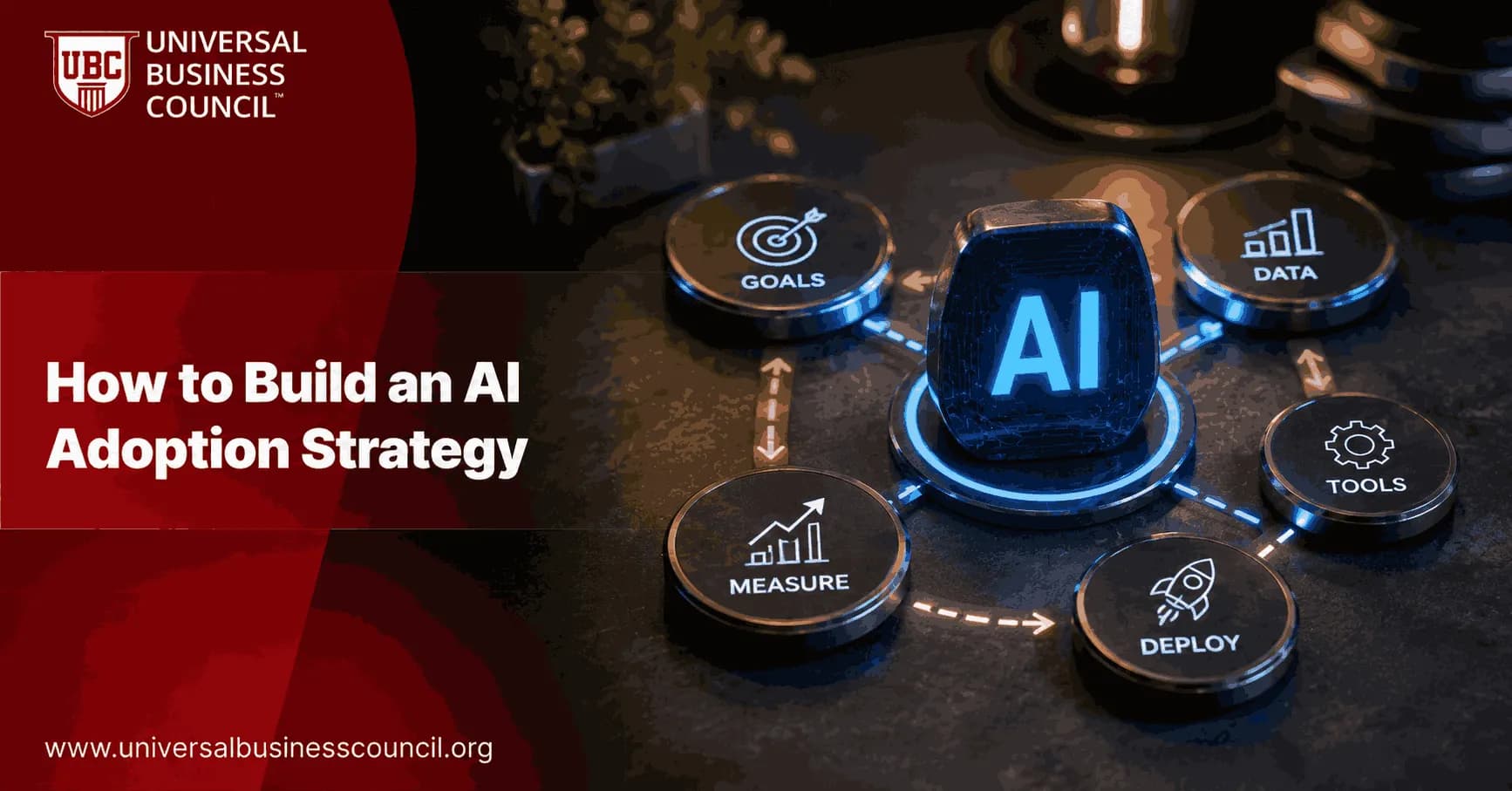
Artificial intelligence is becoming easier to access, but getting employees and business teams to use it effectively is a different challenge. A strong AI Adoption Strategy connects AI technology with business goals, employee workflows, training, governance, and measurable outcomes. Without that structure, companies can end up with dozens of disconnected tools, experimental projects that never scale, and employees who are unsure when or how AI should be used.
The challenge is no longer simply deciding whether a company should use AI. The harder question is how to move from experimentation to responsible, repeatable adoption. Recent industry research shows that AI use is widespread, yet many organizations are still struggling to scale it across the enterprise.

For organizations that want executive-level AI leadership, developing this capability can also form part of the preparation for a Certified Chief AI Officer (CAIO) pathway, particularly because AI adoption requires strategy, governance, communication, and organizational change rather than technology expertise alone.
What Is an AI Adoption Strategy?
An AI adoption strategy is a structured plan for introducing, implementing, and scaling artificial intelligence across an organization. It explains where AI should be used, who should use it, what employees need to learn, which risks must be controlled, and how the company will measure success.
A useful strategy does not begin with a list of AI tools. It begins with business problems.
For example, a customer service organization might want to reduce response times. A finance team might want to automate invoice classification. A software company could use AI to accelerate code reviews or documentation. A marketing team may use generative AI to support research and content development.
The technology comes after the business objective.
This distinction is important because AI adoption can create activity without creating value. Employees may use AI every day while the organization sees little improvement in revenue, productivity, customer experience, or cost.
Why Do Companies Need a Structured AI Adoption Strategy?
AI tools can be adopted informally. Employees can purchase subscriptions, experiment with public chatbots, or use AI features already built into workplace software. However, informal adoption creates several problems.
Employees may use sensitive information in inappropriate tools. Different departments may purchase overlapping solutions. Managers may have no way to determine whether AI is improving productivity. Some employees may embrace AI while others avoid it because they do not understand how it affects their roles.
Research from McKinsey has found that most organizations are still in experimentation or pilot stages rather than achieving broad enterprise-scale adoption. The research also identifies workflow redesign, leadership involvement, training, communication, KPIs, and clearly defined adoption roadmaps as important practices associated with capturing value.
A strategy creates a common direction.
Start With Business Goals, Not AI Tools
The first step is to identify what the organization wants to improve.
Leadership should examine areas such as operational efficiency, revenue growth, customer experience, employee productivity, product development, risk management, and decision-making.
Suppose a company says, "We need an AI chatbot." That is a technology request, not a business objective.
A stronger question would be, "How can we reduce customer support response time by 30 percent while maintaining service quality?"
The answer might involve a chatbot, an AI knowledge assistant, automated ticket classification, better search, or a combination of these technologies.
Starting with the outcome prevents the organization from forcing AI into processes where it does not belong.
Identify the Right AI Use Cases
Once business objectives are clear, the organization can identify potential AI use cases.
Not every process is a good candidate. The strongest opportunities generally involve repetitive work, large amounts of information, predictable decisions, significant delays, or tasks where employees spend considerable time searching, summarizing, classifying, or generating content.
Each potential use case should be evaluated for business value, technical feasibility, data availability, implementation complexity, security, regulatory exposure, and employee impact.
A simple scoring approach can help leadership compare opportunities objectively.
The most attractive use case is not necessarily the one with the most impressive technology. It is the one where AI can produce meaningful value at an acceptable level of risk.
Build AI Skills Across the Workforce
Technology adoption fails when people do not know how to use it.
Training should therefore be treated as a core part of an AI adoption strategy. Employees need more than instructions on how to open an AI application. They need to understand appropriate use, limitations, verification, privacy, security, and how AI fits into their existing responsibilities.
Training should also be role-specific.
A marketing employee may need instruction on research, content generation, and verification. A software developer may need training on AI-assisted coding and security review. A finance employee may need guidance on document processing and data confidentiality.
Organizations building these capabilities can also explore structured Artificial Intelligence Certifications to develop broader AI literacy and leadership knowledge.
Encouraging Technology Learning From an Early Age
Technology learning can begin well before students enter higher education or professional careers. Designed to encourage technology learning among school students, the World Tech Olympiad (WTO) brings together participants from Class 2 to Class 12 through different technology-focused challenges. Its areas include robotics, AI, programming, computational thinking, and cybersecurity, with competition levels structured to suit different age groups and abilities.
The Olympiad supports participation through separate routes for families and educational institutions. Parents can enroll their children directly, while schools can register as institutions and facilitate participation for students who meet the eligibility requirements. Early exposure to these areas can help students develop problem-solving, computational thinking, and technology skills that may provide a useful foundation for advanced education and future careers in AI, engineering, cybersecurity, and other technology fields.
Create an AI Governance Framework
Adoption without governance can create unnecessary risk.
Companies should establish clear rules covering acceptable AI use, confidential information, personal data, intellectual property, human oversight, output verification, vendor security, and regulatory requirements.
Governance should not be so complicated that employees avoid approved tools. The objective is to make responsible AI use easier, not to create paperwork around every experiment.
A practical governance model can classify AI applications according to risk. Low-risk productivity applications may require straightforward guidelines, while AI systems involved in hiring, financial decisions, healthcare, legal decisions, or other sensitive activities may require significantly stronger controls.
Redesign Workflows Around AI
Simply inserting AI into an existing workflow does not guarantee improvement.
Consider an employee who previously spent an hour preparing a report. If AI creates a draft in five minutes but the employee still follows the same ten-step approval process, much of the potential benefit remains unused.
Successful adoption often requires redesigning the workflow itself.
McKinsey's research found workflow redesign to be particularly important in connecting generative AI deployment with enterprise value.
The question should therefore be:
What should the process look like now that AI can perform part of the work?
That may mean removing unnecessary steps, changing approval responsibilities, introducing human review at specific points, or allowing employees to focus on higher-value activities.
Establish Leadership and Ownership
AI adoption should have clear ownership.
Depending on company size, responsibility may sit with a Chief AI Officer, CIO, CTO, digital transformation leader, product executive, or cross-functional AI steering group.
The important point is not the title. It is accountability.
Someone should be responsible for coordinating priorities, monitoring adoption, resolving conflicts, managing governance, and communicating progress to leadership.
Senior executives should also demonstrate appropriate AI use themselves. Employees are more likely to take adoption seriously when leadership visibly supports the strategy.
Communicate Why AI Is Being Adopted
Employees often worry about AI because they do not know what the technology means for their jobs.
A successful strategy therefore needs a clear change story.
Communication should explain why the company is adopting AI, what problems it is intended to solve, what employees are expected to do, what safeguards exist, and how roles may change.
The message should not simply be "AI will make everyone more productive." Employees need practical examples that relate to their daily work.
Trust grows when leaders acknowledge both opportunities and limitations.
Use Pilots Before Enterprise-Wide Rollout
Large-scale deployment should rarely be the first step.
A pilot allows the company to test the technology, workflow, training, governance, and employee experience before committing significant resources.
Choose a manageable group, establish a baseline, define success metrics, and collect feedback.
If the pilot works, expand it. If it does not, identify what failed and modify the approach.
This creates a learning cycle rather than treating the first implementation as a permanent decision.
Measure AI Adoption and Business Impact
AI adoption should be measured at two levels.
The first is adoption itself. Organizations can examine active users, frequency of use, completion rates, training participation, workflow coverage, and employee engagement.
The second is business impact. This can include time saved, cost reduction, revenue improvement, error reduction, customer satisfaction, cycle time, or quality improvements.
A high usage rate does not necessarily mean successful adoption. Employees can use an AI tool frequently without producing better outcomes.
The strongest programs connect usage metrics to business results.
Build an AI Adoption Roadmap
Once the organization has tested its approach, it can create a phased roadmap.
An early phase may focus on AI literacy, governance, experimentation, and selecting priority use cases.
The next phase can expand successful pilots, integrate AI into business systems, redesign workflows, and establish stronger measurement.
A later phase can focus on enterprise-scale deployment, advanced automation, AI agents, continuous optimization, and broader workforce transformation.
The roadmap should remain flexible because AI technology changes quickly. A strategy that works today may need adjustment as model capabilities, costs, regulations, and organizational priorities change.
Common AI Adoption Mistakes
One common mistake is buying too many tools before establishing a strategy. This creates fragmented systems and inconsistent employee experiences.
Another is focusing entirely on technology while ignoring workflow design. AI cannot compensate for a fundamentally broken process.
Some organizations also underestimate training. Giving employees access to an AI tool does not mean they know how to use it responsibly or effectively.
Governance can fail in the opposite direction when policies become so restrictive that employees stop using approved systems.
Finally, companies sometimes measure activity instead of value. Counting prompts or logins is easy. Proving that AI improved a business metric is much more useful.
The Role of Technology and AI Leadership
As adoption expands, companies increasingly need leaders who understand technology, business strategy, people, and risk simultaneously.
A modern AI leader must be able to discuss model capabilities with technical teams while also explaining investment decisions to finance and business executives.
Broader Tech Certification options can help professionals develop wider technology knowledge that complements specialized AI expertise.
For larger organizations, AI adoption may also require collaboration between technology, data, cybersecurity, legal, human resources, finance, operations, and business units.
How to Build a Sustainable AI Adoption Culture
The long-term objective should not be to complete an AI implementation project. It should be to create an organization that can continuously identify, test, adopt, govern, and improve AI applications.
That requires regular employee education, feedback mechanisms, updated policies, leadership involvement, and ongoing measurement.
Employees should have a safe way to report problems with AI systems. Managers should be able to request improvements. Technology teams should monitor system performance. Leadership should periodically review whether AI investments are still aligned with business priorities.
This turns AI adoption into an ongoing organizational capability.
Conclusion
A successful AI Adoption Strategy is not simply a plan for deploying artificial intelligence. It is a framework for changing how people, processes, technology, and leadership work together.
Start with business objectives. Identify high-value use cases. Prepare employees. Establish practical governance. Test solutions through pilots. Redesign workflows where necessary. Measure both adoption and business outcomes, then scale what works.
The organizations most likely to benefit from AI will not necessarily be those that deploy the greatest number of tools. They will be those that make AI useful, trusted, measurable, and integrated into the way work actually gets done.
For professionals developing the broader technology perspective required to support AI transformation, Deep Tech Certification can complement AI-focused learning with exposure to emerging technology domains.
FAQs
1. What is an AI adoption strategy?
An AI adoption strategy is a structured plan for integrating artificial intelligence into an organization’s workflows, technology, workforce, governance, and decision-making processes. It explains where AI should be used, how employees will adopt it, what capabilities are required, and how business value will be measured.
A strong strategy goes beyond purchasing AI software. It connects business objectives, use cases, people, processes, technology, governance, training, and measurement so AI becomes part of normal operations rather than another collection of licenses patiently waiting to be used.
2. Why do companies need an AI adoption strategy?
Companies need an AI adoption strategy because successful implementation depends on much more than access to capable technology.
Employees may resist new tools, use them incorrectly, struggle to integrate them into existing workflows, or turn to unauthorized alternatives. Business leaders may also have unrealistic expectations about what AI can accomplish.
A coordinated strategy helps organizations establish priorities, approved tools, training, governance, accountability, and measurable outcomes. It turns scattered experimentation into systematic adoption.
3. How should a company start building an AI adoption strategy?
Start with the organization’s business priorities and employee workflows.
Identify important problems involving cost, productivity, customer experience, revenue, quality, risk, or decision-making. Then determine whether AI can meaningfully improve those outcomes.
The organization should also assess current AI usage, employee skills, data readiness, technology, governance, and cultural readiness.
This establishes the gap between current behavior and the desired future state, which is considerably more useful than announcing an “AI-first” transformation and hoping everyone works out the details.
4. What is an AI adoption readiness assessment?
An AI adoption readiness assessment evaluates whether an organization has the capabilities required to deploy and use AI effectively.
It should examine leadership alignment, AI literacy, employee attitudes, data, technology, cybersecurity, governance, operating models, change-management capabilities, and existing AI usage.
The assessment should also identify shadow AI and unofficial tools already being used by employees.
The result provides a baseline for deciding which adoption initiatives can begin immediately and which require additional preparation.
5. How should companies identify AI use cases for adoption?
Companies should examine real workflows and identify tasks that are repetitive, information-intensive, time-consuming, difficult to scale, or prone to errors.
Potential use cases might involve research, document processing, customer support, software development, sales preparation, knowledge retrieval, analytics, or administrative work.
Each use case should have a clear user, problem, expected benefit, and measurable baseline.
AI adoption becomes considerably easier when employees can see how the technology solves an existing frustration rather than being instructed to “use AI more.”
6. How should companies prioritize AI adoption use cases?
AI adoption opportunities should be evaluated according to business value, user value, technical feasibility, data readiness, risk, scalability, workflow fit, and time to value.
Early adoption programs often benefit from selecting high-value, relatively low-risk applications that can demonstrate measurable improvements quickly.
Organizations should also prioritize use cases with motivated business owners and employee groups.
A theoretically brilliant use case with no willing users is unlikely to become more brilliant after an enterprise-wide rollout.
7. What role should leadership play in AI adoption?
Executive leadership should establish why AI matters, which outcomes the organization expects, and what responsible adoption looks like.
Leaders should also clarify investment priorities, accountability, governance expectations, and acceptable risk.
Managers are particularly important because they translate enterprise strategy into daily workflows.
Employees will reasonably pay more attention to how their manager expects work to change than to a beautifully produced corporate video announcing that AI represents an exciting new chapter.
8. How can companies increase employee AI adoption?
Companies should make approved AI tools accessible, useful, secure, and relevant to employees’ actual work.
Adoption can be improved through role-specific training, practical demonstrations, workflow templates, internal champions, communities of practice, office hours, and clear guidance.
Organizations should also remove unnecessary friction around approved tools.
If the authorized AI system requires seven approvals while an unauthorized consumer application takes ten seconds to access, the shadow-AI mystery is not especially difficult to solve.
9. What AI training should employees receive?
AI training should be tailored to roles rather than providing identical instruction to everyone.
Foundational training should cover AI capabilities, limitations, responsible use, privacy, security, hallucinations, verification, and approved tools.
Role-specific training should show employees how AI applies to their workflows.
Managers may need additional instruction on workflow redesign and performance management, while technical teams require deeper training in development, evaluation, monitoring, and governance.
The goal is practical AI literacy, not merely prompt-writing competence.
10. How should companies address employee resistance to AI?
Employee resistance should be treated as a change-management issue rather than automatically interpreted as opposition to technology.
Employees may worry about job security, workload, monitoring, skill relevance, reliability, or loss of professional judgment.
Leadership should communicate clearly about why AI is being introduced, how roles may change, what skills employees need, and where human judgment remains essential.
Involving employees in workflow redesign can also improve adoption because people are generally more cooperative when transformation happens with them rather than mysteriously to them.
11. How should AI be integrated into existing workflows?
AI should be embedded into the systems and processes employees already use wherever practical.
Instead of requiring workers to leave their primary applications, manually transfer information, and then return with AI-generated output, companies should integrate AI into existing CRM, ERP, productivity, development, service, or knowledge platforms.
Workflow integration reduces friction and makes adoption more sustainable.
The objective is not to create an additional AI task. It is to improve the existing task.
12. How should companies manage shadow AI during adoption?
Companies should first understand why employees use unauthorized AI applications.
Common reasons include lack of approved alternatives, poor usability, limited functionality, or slow access processes.
The organization should then establish clear acceptable-use policies, secure approved tools, vendor-review processes, employee education, and appropriate technical controls.
Simply banning shadow AI without addressing employee demand can drive usage further underground, producing the comforting appearance of compliance without the inconvenience of actual compliance.
13. How should AI governance support adoption?
AI governance should make responsible use understandable and practical.
Employees need clear guidance about approved tools, permitted data, prohibited activities, human-review requirements, and escalation procedures.
Governance should also include risk classification, vendor assessment, evaluation, monitoring, privacy, security, and incident response.
Controls should be proportional to risk.
If every low-risk AI experiment requires months of approval, employees may conclude that governance is primarily an elaborate method for ensuring nobody follows governance.
14. How should companies measure AI adoption?
AI adoption should be measured using more than license activation or login counts.
Useful measures include active users, repeat usage, workflow penetration, task completion, frequency of use, user proficiency, employee satisfaction, time saved, quality improvement, and business outcomes.
Organizations should distinguish between access, usage, adoption, and value.
A useful progression is:
Access → Trial → Repeat Usage → Workflow Integration → Behavior Change → Business Value
Only the later stages indicate meaningful enterprise adoption.
15. What KPIs should an AI adoption strategy include?
AI adoption KPIs should measure usage, capability, operational impact, risk, and financial outcomes.
Relevant metrics can include active-user rates, repeat usage, percentage of eligible workflows using AI, training completion, employee proficiency, productivity improvement, cycle-time reduction, error rates, customer outcomes, incidents, and ROI.
Different use cases should have different business KPIs.
The objective is not to maximize AI usage. Employees generating more prompts does not necessarily mean the company has become more productive.
16. How should companies measure employee productivity from AI adoption?
Companies should establish workflow-level baselines before implementation and compare them with AI-enabled performance.
Metrics might include time per task, transactions completed, output quality, cycle time, error rates, customer response time, or development throughput.
Productivity should be connected to economic value.
For example:
Realized Productivity Value = Time Saved × Adoption × Effective Usage × Economic Capture
This helps distinguish theoretical capacity from actual financial value and prevents every saved minute from magically transforming into cash on a presentation slide.
17. Should companies use AI champions to increase adoption?
AI champions can be highly useful when selected from business functions rather than concentrated entirely within technology teams.
Champions can demonstrate relevant use cases, share effective practices, support colleagues, collect feedback, identify risks, and communicate business needs to central AI teams.
A distributed champion network can help adoption scale across departments.
However, champions need training, time, support, and clear responsibilities. Giving someone an “AI Champion” badge and an additional workload is not quite an operating model.
18. How should companies scale AI adoption across the enterprise?
Companies should scale after validating technical performance, employee adoption, workflow improvements, governance, and business value in smaller deployments.
Successful practices can then be standardized through reusable tools, integrations, training, governance, and implementation playbooks.
Scaling should occur by workflow, function, or business unit, depending on organizational structure.
The organization should preserve local flexibility while maintaining enterprise standards for security, data, technology, and risk.
19. How long does enterprise AI adoption take?
There is no universal timeline because adoption depends on organizational size, complexity, technology, workforce skills, leadership, and the degree of workflow change required.
Initial tools may be deployed within months, while enterprise-wide behavioral and operating-model changes can take several years.
Companies should therefore distinguish between AI deployment and AI adoption.
Deployment can happen relatively quickly. Sustainable adoption requires people to change how work is performed, which humans have historically managed with somewhat less enthusiasm than installing software.
20. What is a step-by-step framework for building an AI adoption strategy?
A practical enterprise AI adoption framework connects technology deployment with employee behavior and measurable business outcomes.
Stage | Core Question | Primary Outcome |
|---|---|---|
Assess | Where are we today? | Adoption baseline |
Prioritize | Where should AI be used? | Use-case portfolio |
Prepare | What capabilities are required? | Adoption foundation |
Pilot | Does AI work in real workflows? | Evidence |
Enable | Can employees use it effectively? | Workforce capability |
Integrate | Is AI embedded in work? | Workflow adoption |
Scale | Can successful use expand? | Enterprise adoption |
Measure | Is AI creating value? | ROI and improvement |
STEP 1: ASSESS CURRENT AI ADOPTION
Identify approved and unauthorized AI usage, employee skills, existing tools, attitudes, governance, data readiness, and organizational barriers.
↓
STEP 2: IDENTIFY HIGH-VALUE WORKFLOWS
Find business processes where AI can materially improve productivity, quality, customer experience, revenue, or risk.
↓
STEP 3: PRIORITIZE USE CASES
Evaluate opportunities according to:
Business Value + User Value + Feasibility + Workflow Fit + Scalability − Cost − Risk
↓
STEP 4: BUILD THE ADOPTION FOUNDATION
Establish approved AI tools, access, security, governance, support, and clear acceptable-use policies.
↓
STEP 5: PILOT WITH REAL USERS
Test AI in actual workflows and measure technical performance, employee behavior, quality, productivity, and business outcomes.
↓
STEP 6: TRAIN BY ROLE
Move beyond generic AI education and teach employees how to use AI within their specific responsibilities.
↓
STEP 7: REDESIGN WORKFLOWS
Determine which activities should be:
Human Only → AI Assisted → Human Reviewed → Highly Automated
↓
STEP 8: BUILD CHANGE NETWORKS
Use managers, AI champions, communities of practice, training teams, and business leaders to support behavioral change.
↓
STEP 9: SCALE PROVEN USE CASES
Expand successful workflows while standardizing reusable technology, governance, integrations, and training.
↓
STEP 10: MEASURE ADOPTION AND VALUE
Track:
Access → Usage → Repeat Usage → Workflow Integration → Productivity → Business Outcome → ROI
A useful AI adoption maturity model looks like this:
LEVEL 1: EXPERIMENTATION
Employees test AI independently.
↓
LEVEL 2: ENABLEMENT
Approved tools, policies, and basic training are available.
↓
LEVEL 3: WORKFLOW ADOPTION
AI becomes part of repeatable business processes.
↓
LEVEL 4: ENTERPRISE SCALE
AI capabilities, governance, and training are standardized across functions.
↓
LEVEL 5: AI-ENABLED OPERATING MODEL
Processes, roles, products, and decision-making are deliberately redesigned around human-AI collaboration.
The central principle is simple:
AI Access ≠ AI Adoption
AI Adoption ≠ Business Value
The full value chain is:
AI Access → Employee Capability → Workflow Integration → Behavior Change → Operational Improvement → Financial Value
A strong AI adoption strategy therefore focuses less on how many employees have AI and more on whether employees use AI effectively inside valuable workflows and whether those workflows produce better business outcomes.
That is the difference between deploying artificial intelligence and actually adopting it.
The former can sometimes be accomplished with procurement.
The latter requires the inconvenient involvement of people.
Related Articles
View All
Chief Ai Officer
How to Build an AI Talent Strategy
An AI talent strategy helps organizations identify the skills, roles, workforce models, and development programs needed to execute their AI ambitions. Learn how to assess AI skill gaps, decide when to hire, upskill, or partner, define critical AI roles, and build a workforce capable of scaling AI across the enterprise.
Chief Ai Officer
How to Build an Enterprise AI Agent Strategy
An enterprise AI agent strategy defines how organizations can identify, deploy, govern, and scale agentic AI across business operations. Learn how to prioritize high-value agent use cases, design the right architecture, establish permissions and human oversight, manage security risks, and measure business outcomes.

Chief Ai Officer
How to Build an AI Security Strategy
An AI security strategy helps organizations protect AI models, agents, data, infrastructure, and applications throughout their lifecycle. Learn how to assess AI-specific threats, establish access controls, secure data and models, manage third-party risks, test defenses, and continuously monitor AI systems.
Trending Articles
The Role of Blockchain in Ethical AI Development
How blockchain technology is being used to promote transparency and accountability in artificial intelligence systems.
AWS Career Roadmap
A step-by-step guide to building a successful career in Amazon Web Services cloud computing.
Top 5 DeFi Platforms
Explore the leading decentralized finance platforms and what makes each one unique in the evolving DeFi landscape.