

How to Build an AI Roadmap for an Enterprise
Artificial intelligence is moving quickly from experimentation into core business operations. Companies are using AI to improve customer service, automate repetitive work, analyze large datasets, support employees, develop products, and make faster decisions. But successful adoption does not happen simply because an organization purchases AI tools. It requires a clear sequence of priorities, capabilities, investments, governance, and measurable outcomes.
An AI Roadmap for an Enterprise turns an organization's AI ambition into an actionable plan. It shows where the business wants to go, what needs to happen first, which AI initiatives deserve investment, and how the organization will move from experimentation to reliable production systems.

For senior leaders, the roadmap should connect AI directly to corporate strategy. For technical teams, it should clarify platforms, data, architecture, security, and implementation requirements. For employees, it should explain how AI will change workflows and what skills they need to develop.
Professionals preparing to lead these initiatives can also develop executive-level knowledge through a Certified Chief AI Officer (CAIO) pathway, particularly when their responsibilities include AI strategy, governance, adoption, and organizational transformation.
What Is an AI Roadmap for an Enterprise?
An AI roadmap is a structured plan that explains how an organization will develop and deploy artificial intelligence over a defined period.
It connects four important elements:
Business objectives: What does the organization want to achieve?
AI opportunities: Where can artificial intelligence create measurable value?
Organizational capabilities: What data, technology, people, processes, and governance are required?
Execution: What should happen first, what comes next, and how will progress be measured?
A roadmap is different from a list of AI projects.
A project list might say:
Build a chatbot.
Introduce an AI assistant.
Automate document processing.
Deploy predictive analytics.
A roadmap goes further. It explains why those initiatives matter, which one should come first, what dependencies exist, what risks need to be addressed, who owns each initiative, and how successful projects will scale.
That distinction becomes particularly important when an enterprise has dozens of AI experiments happening simultaneously.
Why Does an Enterprise Need an AI Roadmap?
AI adoption without coordination can create fragmented technology, duplicated investments, inconsistent governance, and disconnected data.
One department might purchase an AI application while another develops a similar capability internally. A third team may use an external AI service without understanding its data-handling implications. Meanwhile, employees may experiment with consumer AI applications without consistent organizational guidance.
An enterprise roadmap creates a common direction.
It can help leadership:
Prioritize high-value AI initiatives
Coordinate investment across departments
Identify technology and data dependencies
Establish governance before large-scale deployment
Develop the workforce
Reduce duplication
Manage AI-related risks
Track progress from pilot to production
Measure financial and operational outcomes
The roadmap should also remain flexible. AI technology changes rapidly, so an enterprise should not create a five-year plan that assumes today's models, vendors, or capabilities will remain unchanged.
A better approach is to establish a strategic direction while reviewing tactical priorities regularly.
Assess the Current State Before Building the Roadmap
A strong roadmap begins with an honest assessment of where the organization stands today.
Do not assume the company is either "AI ready" or "not ready." Readiness exists across multiple dimensions.
Evaluate AI Adoption
Identify where AI is already being used.
Look across departments such as:
Marketing
Sales
Finance
Human resources
Customer service
Operations
IT
Product development
Legal
Supply chain
Document both officially approved systems and informal employee adoption.
This creates an enterprise AI inventory and prevents leadership from planning in the dark.
Evaluate Data Readiness
AI applications depend heavily on data.
Assess:
Data quality
Data accessibility
Data ownership
Data integration
Data privacy
Data security
Metadata
Data lineage
Retention policies
A company can own enormous amounts of data and still struggle with AI if important information is fragmented, poorly documented, or difficult to access.
Evaluate Technology Readiness
Review the existing technology environment.
Consider:
Cloud infrastructure
APIs
Data platforms
Application architecture
AI and machine learning platforms
Security infrastructure
Integration capabilities
Computing capacity
Monitoring systems
The objective is not to buy everything needed for every possible future AI project. It is to identify the capabilities required for the highest-priority opportunities.
Evaluate People and Skills
AI adoption changes how people work.
Assess whether the organization has:
AI engineers
Data scientists
Data engineers
Machine learning specialists
Product managers
AI governance specialists
Security professionals
Business analysts
AI-literate employees
The skills assessment should also include non-technical employees. Most enterprise AI adoption depends on people using AI effectively inside everyday workflows.
Define the Business Vision for AI
Once the current state is understood, leadership needs to define what AI should accomplish.
This is where many organizations make a mistake.
They define the vision around technology:
"We want to become an AI-first company."
That statement may sound ambitious, but it does not tell employees what to do.
A stronger vision connects AI with business outcomes.
For example:
"Use AI to reduce operational processing time, improve customer response quality, strengthen decision-making, and create new digital products."
The specific vision will vary by organization.
A financial institution may prioritize fraud detection and customer service.
A manufacturer may prioritize predictive maintenance, quality control, and supply chain forecasting.
A healthcare organization may focus on administrative automation, scheduling, documentation, and patient support.
The roadmap should reflect the organization's actual competitive priorities.
Identify and Prioritize AI Use Cases
After defining the vision, create a broad list of potential AI opportunities.
Customer-Facing Use Cases
Examples include:
AI assistants
Personalized recommendations
Intelligent search
Customer sentiment analysis
Automated response generation
Conversational support
Operational Use Cases
Examples include:
Document processing
Workflow automation
Demand forecasting
Predictive maintenance
Quality inspection
Scheduling optimization
Employee Use Cases
Examples include:
Internal knowledge assistants
Meeting summarization
Research support
Coding assistance
Content generation
Data analysis
Strategic Use Cases
These may include:
AI-enabled products
New digital services
Intelligent decision systems
Advanced forecasting
Personalized customer experiences
AI-powered business models
Not every use case should enter the roadmap.
Create an AI Use-Case Scoring Model
A practical scoring framework can help executives compare opportunities.
Business Value
Estimate potential revenue growth, cost reduction, productivity improvement, customer value, or risk reduction.
Feasibility
Consider whether the organization has the required data, technology, talent, infrastructure, and process maturity.
Risk
Evaluate privacy, security, regulatory, operational, financial, ethical, and reputational risks.
Time to Value
Determine how quickly the organization could demonstrate meaningful results.
Scalability
Ask whether the solution could expand across departments, regions, products, or customer segments.
Strategic Fit
Determine whether the use case directly supports major business priorities.
A simple scorecard can rank opportunities without pretending that every AI project has the same value.
The highest-priority projects should generally combine meaningful business value with realistic implementation requirements.
Build the Roadmap Around Strategic Horizons
Instead of placing every initiative on one long list, organize the roadmap into stages.
Phase 1: Establish the Foundation
The first stage should create the conditions required for responsible AI adoption.
Typical priorities include:
AI governance
AI inventory
Data assessment
Security standards
AI policies
Workforce education
Technology assessment
High-value pilot selection
The objective is to create enough structure to experiment safely.
Phase 2: Prove and Scale
Once foundational capabilities exist, the organization can move successful experiments toward production.
Priorities may include:
Production architecture
Data integration
Model evaluation
Monitoring
Workflow redesign
User adoption
AI platform standards
Business-unit deployment
The important transition is from "Can this work?" to "Can we operate this reliably at scale?"
Phase 3: Transform the Enterprise
At higher maturity, organizations can move beyond isolated productivity improvements.
Potential initiatives include:
AI-native products
Intelligent enterprise workflows
AI agents
Predictive decision systems
Advanced automation
AI-powered customer journeys
New revenue models
The organization should only enter this stage when its technology, governance, data, and workforce capabilities can support it.
Establish AI Governance Alongside the Roadmap
Governance should not be treated as a final approval step.
It should be integrated throughout the roadmap.
A useful reference is the NIST AI Risk Management Framework, which organizes AI risk management around Govern, Map, Measure, and Manage. The framework is designed to help organizations incorporate trustworthiness into AI design, development, deployment, and use.
An enterprise AI roadmap should therefore consider:
AI policies
Risk classification
Data protection
Security requirements
Human oversight
Model evaluation
Monitoring
Incident response
Vendor assessment
Documentation
Audit requirements
Governance also needs ownership.
Employees should know who approves high-risk systems, who monitors production models, who handles incidents, and who can stop an AI deployment when necessary.
Build the Technology and Data Roadmap
AI initiatives rarely operate independently.
They depend on data platforms, applications, APIs, cloud infrastructure, identity systems, cybersecurity, monitoring, and integration.
For each major AI initiative, document its technical dependencies.
For example:
AI customer assistant
Requires:
Customer knowledge base
Retrieval system
Model access
Security controls
CRM integration
Evaluation framework
Monitoring
Human escalation
This dependency mapping prevents an organization from putting an AI project into the roadmap without identifying the infrastructure needed to make it work.
The same principle applies to data.
If an AI forecasting project requires clean historical sales data but that data is not currently integrated, the data work must appear on the roadmap.
Develop an AI Talent Roadmap
Technology cannot execute an AI strategy by itself.
Organizations need a talent plan covering both specialists and general employees.
Technical Specialists
Depending on the roadmap, the organization may need:
AI engineers
Machine learning engineers
Data scientists
Data engineers
MLOps professionals
AI security specialists
Business Professionals
Business teams need enough AI literacy to identify opportunities, evaluate outputs, understand limitations, and work with technical teams.
Executives
Senior leaders need to understand AI economics, risk, governance, technology dependencies, and strategic opportunities.
Professionals who want to strengthen their formal AI knowledge can explore Artificial Intelligence Certifications as part of their development path.
Create an Investment and Budget Roadmap
Every roadmap needs financial discipline.
AI costs can include:
Model usage
Cloud infrastructure
Data storage
Software licenses
Integration
Engineering
Security
Monitoring
Training
Consulting
Governance
Employee support
The financial model should distinguish between pilot costs and production costs.
A small experiment might require limited resources. A production AI system serving thousands or millions of users can introduce significantly higher infrastructure, monitoring, security, and support requirements.
For every major initiative, estimate:
Initial investment
Operating cost
Expected business benefit
Time to value
Scaling cost
Major risks
Exit or retirement cost
This gives executives a more realistic view of AI economics.
Build Clear Milestones and Ownership
A roadmap becomes useful when every major initiative has an owner.
Each roadmap item should ideally identify:
Business owner
Technical owner
Target outcome
Start date
Target milestone
Dependencies
Budget
Risk level
Success metrics
Current status
Avoid creating milestones that only describe activity.
"Deploy AI model" is an activity.
"Reduce claims-processing time by 30 percent while maintaining required accuracy" is an outcome.
The second is much more useful for executive decision-making.
Measure AI Roadmap Progress
An enterprise should track both delivery and business impact.
Business Metrics
Examples include:
Revenue generated
Cost reduction
Productivity improvement
Processing time
Error reduction
Customer satisfaction
Conversion rate
Retention
Risk reduction
Adoption Metrics
Track:
Active users
Workflow adoption
Employee participation
Customer usage
Repeat usage
Technical Metrics
Depending on the system, measure:
Accuracy
Reliability
Latency
Model performance
Failure rates
Availability
Cost per transaction
Governance Metrics
Track:
Approved AI systems
Risk assessments completed
Policy compliance
Incidents
Evaluation coverage
Monitoring coverage
The number of AI pilots should not be treated as the primary success metric.
A smaller portfolio that creates measurable business value is more useful than a large portfolio of experiments.
Integrate AI Into Existing Workflows
AI creates more value when it becomes part of normal work.
For example, rather than giving employees a separate AI application, an organization might integrate AI recommendations directly into its CRM.
Instead of creating a separate document-processing system, AI could become part of the existing accounts payable workflow.
This approach makes adoption easier because employees do not need to completely change how they work.
The roadmap should therefore include workflow redesign, training, change management, and user feedback rather than focusing exclusively on technology.
Add Change Management to the AI Roadmap
AI adoption can change responsibilities, workflows, decision-making, and job requirements.
Employees may worry about job security. Managers may not understand how responsibilities change. Some teams may adopt AI enthusiastically while others avoid it.
A practical change-management plan should include:
Executive communication
Employee education
AI usage policies
Role-specific training
Feedback channels
Adoption support
Workflow documentation
Leadership reinforcement
The goal is not to force employees to use AI.
The goal is to make the value, expectations, safeguards, and responsibilities clear.
Common AI Roadmap Mistakes
Treating the Roadmap as a Technology List
AI models and tools are only part of the strategy.
Trying to Do Everything at Once
Too many initiatives can overwhelm technology, data, governance, and people.
Ignoring Dependencies
A project cannot scale if critical data or infrastructure is missing.
Measuring Pilots Instead of Outcomes
The objective is business value, not the number of experiments.
Building Governance Too Late
Risk controls should be considered before deployment.
Underestimating AI Costs
Production systems can cost significantly more than prototypes.
Ignoring Employees
Technology adoption requires people to change how they work.
Making the Roadmap Too Rigid
AI capabilities evolve quickly. The roadmap should be reviewed and adjusted as evidence changes.
How Technology Skills Support an Enterprise AI Roadmap
AI leaders need to understand the broader technology environment surrounding their AI initiatives.
Cloud platforms, cybersecurity, software engineering, data engineering, automation, analytics, and emerging technologies can all affect the success of enterprise AI.
A broader Tech Certification pathway can complement specialized AI education by helping professionals understand the technology ecosystem in which enterprise AI operates.
This is particularly useful for managers who do not need to become full-time engineers but must make informed decisions about architecture, technology vendors, integrations, security, and implementation.
Introducing Technology Learning From an Early Age
Technology learning can begin well before students enter higher education or professional careers. Designed to encourage technology learning among school students, the World Tech Olympiad (WTO) brings together participants from Class 2 to Class 12 through different technology-focused challenges. Its areas include robotics, AI, programming, computational thinking, and cybersecurity, with competition levels structured to suit different age groups and abilities.
The Olympiad supports participation through separate routes for families and educational institutions. Parents can enroll their children directly, while schools can register as institutions and facilitate participation for students who meet the eligibility requirements. Early exposure to these areas can help students develop problem-solving, computational thinking, and technology skills that may provide a useful foundation for advanced education and future careers in AI, engineering, cybersecurity, and other technology fields.
How Emerging Technologies Fit Into the Roadmap
An enterprise roadmap may eventually connect AI with other emerging technologies.
Potential combinations include:
AI and automation
AI and IoT
AI and cybersecurity
AI and blockchain
AI and edge computing
AI and digital twins
AI and advanced analytics
However, these technologies should not be added simply because they are popular.
Every addition should answer a business requirement.
If an emerging technology does not improve the organization's strategic outcomes, it may belong outside the current roadmap.
Professionals who want broader exposure to emerging technology ecosystems can explore Deep Tech Certification options as part of their longer-term development.
How a Chief AI Officer Can Manage the Roadmap
A Chief AI Officer can coordinate the enterprise AI roadmap by connecting executive strategy with business-unit execution.
The CAIO may help:
Define AI priorities
Evaluate opportunities
Coordinate investment
Establish governance
Align technology and data teams
Develop AI talent
Track business outcomes
Communicate progress to leadership
Support responsible adoption
However, the CAIO should not become the approval point for every AI experiment.
A mature operating model gives business units enough freedom to innovate while maintaining enterprise standards for security, governance, data, architecture, and risk.
For professionals preparing for this level of responsibility, a Certified Chief AI Officer (CAIO) credential can complement practical experience in strategy, AI technology, governance, and organizational leadership.
What Should an Enterprise AI Roadmap Look Like?
A useful roadmap should be easy for executives and delivery teams to understand.
A simple structure can contain:
Roadmap Element | What It Shows |
Strategic priority | Why the initiative matters |
AI use case | What AI will accomplish |
Business owner | Who owns the outcome |
Technical owner | Who owns implementation |
Phase | Foundation, pilot, scale, or transformation |
Dependencies | Data, technology, people, or governance requirements |
Investment | Expected resources and costs |
Risk | Major concerns and controls |
KPI | How success will be measured |
Timeline | Major milestones |
Status | Current progress |
The roadmap should be reviewed regularly.
Some projects will accelerate because pilots perform better than expected. Others should be paused when data quality, cost, adoption, or risk makes the business case weaker than originally assumed.
That flexibility is a strength, not a weakness.
Conclusion
Building an AI Roadmap for an Enterprise is ultimately an exercise in prioritization.
The goal is not to deploy the most AI systems. It is to identify where artificial intelligence can create meaningful value and then build the organizational capabilities required to deliver that value responsibly.
Start with business goals. Assess current AI, data, technology, people, and governance capabilities. Identify use cases and prioritize them according to value, feasibility, risk, and strategic importance. Establish foundations before attempting large-scale transformation. Connect every initiative to an owner, milestone, dependency, investment requirement, and measurable outcome.
Most importantly, keep the roadmap adaptable.
AI technology will continue changing, so enterprises need a planning process that can respond to new capabilities, changing regulations, emerging risks, and evidence from real deployments. A well-designed roadmap provides direction without locking the organization into assumptions that may quickly become outdated.
FAQs
1. What is an enterprise AI roadmap?
An enterprise AI roadmap is a structured plan that shows how an organization will move from its current AI capabilities to its desired future state. It translates AI strategy into specific initiatives, priorities, investments, capabilities, owners, milestones, and measurable outcomes.
Unlike an AI strategy, which explains why and where the organization should use AI, the roadmap focuses on what happens next, in what sequence, and who is responsible. Without that distinction, companies tend to produce strategy decks of majestic ambition and rather less operational consequence.
2. How do you start building an AI roadmap for an enterprise?
Start with the company's business strategy and identify the outcomes AI is expected to improve. These might include revenue growth, productivity, customer experience, operational efficiency, innovation, risk reduction, or faster decision-making.
Next, assess existing AI projects, platforms, data capabilities, governance, talent, and adoption. This creates a baseline between the current state and desired future state.
The roadmap should close that gap rather than beginning with a predetermined collection of fashionable AI technologies.
3. What should an enterprise AI roadmap include?
A comprehensive AI roadmap should include business objectives, prioritized use cases, data requirements, technology capabilities, AI governance, security, talent, operating-model changes, adoption initiatives, investment requirements, KPIs, and implementation milestones.
It should also identify dependencies between initiatives.
For example, an AI customer-service initiative may depend on improving knowledge data, implementing secure model access, establishing evaluation standards, and integrating AI with existing service platforms.
Making dependencies visible helps prevent unrealistic implementation schedules.
4. How is an AI roadmap different from an AI strategy?
An AI strategy establishes the organization's direction, priorities, principles, and choices for artificial intelligence.
An AI roadmap converts that strategy into an execution sequence.
The distinction can be expressed simply:
AI Strategy = Where are we going and why?
AI Roadmap = What will we do, when, and in what order?
The strategy may identify customer-service automation as a priority. The roadmap defines the data preparation, platform implementation, pilot, evaluation, deployment, training, and scaling activities required to achieve it.
5. How should an enterprise assess its current AI capabilities?
Before creating the roadmap, conduct an AI maturity assessment across strategy, data, technology, governance, security, talent, operating model, adoption, and measurement.
The organization should inventory existing AI applications, machine learning models, generative AI tools, vendors, pilots, platforms, and relevant spending.
This assessment identifies capability gaps and duplication.
It can also reveal the delightful corporate phenomenon of three teams independently building versions of the same AI assistant while each believes it is conducting unique strategic innovation.
6. How do you identify AI use cases for the roadmap?
Begin with important business problems rather than AI technologies.
Look for workflows that are expensive, repetitive, slow, information-intensive, difficult to scale, or prone to errors. Opportunities may exist in customer service, sales, finance, HR, operations, software engineering, supply chains, marketing, compliance, and knowledge management.
Each proposed use case should define the current problem, affected users, expected improvement, required data, implementation complexity, risks, and measurable business outcome.
7. How should AI use cases be prioritized?
Enterprise AI use cases should be evaluated against consistent criteria such as business value, strategic alignment, technical feasibility, data readiness, implementation cost, risk, scalability, and time to value.
A simple conceptual framework is:
Priority Score = Value + Strategic Fit + Feasibility + Data Readiness − Cost − Risk
Organizations can assign different weights depending on strategic priorities.
The purpose is not mathematical perfection. It is preventing every department from declaring its own project “critical,” a word with astonishingly high inflation inside large organizations.
8. How should AI initiatives be sequenced on the roadmap?
AI initiatives should be sequenced according to value, readiness, dependencies, and risk.
Early phases should typically establish critical foundations and pursue selected high-value opportunities that can demonstrate results relatively quickly.
Later phases can scale proven applications, redesign larger workflows, introduce more advanced automation, and pursue strategically ambitious AI capabilities.
The sequencing should resemble:
Foundation → Validate → Deploy → Adopt → Scale → Transform
Organizations should avoid attempting enterprise-wide transformation before proving that the underlying capabilities work reliably.
9. What data initiatives should be included in an AI roadmap?
The roadmap should identify data improvements required by priority AI use cases.
These may involve data quality, access, integration, metadata, lineage, document management, knowledge bases, real-time data, permissions, privacy, and governance.
Data work should be connected directly to business priorities rather than becoming an unlimited “clean all enterprise data” program.
If the first three years of the AI roadmap consist entirely of preparing for AI, someone has probably mistaken infrastructure perfection for business progress.
10. What technology should be included in an enterprise AI roadmap?
Technology requirements depend on the selected use cases but may include foundation models, machine learning platforms, cloud infrastructure, APIs, RAG systems, vector search, AI agents, orchestration, evaluation tools, MLOps, observability, and security controls.
The roadmap should distinguish between shared enterprise capabilities and technologies required only for individual use cases.
Shared platforms can reduce duplication and accelerate future deployments, but excessive standardization too early can lock the organization into technology before requirements are properly understood.
11. How should generative AI fit into the roadmap?
Generative AI should be included where it addresses genuine business needs rather than treated as a separate transformation objective.
Early applications may involve knowledge search, document processing, employee assistants, coding support, customer-service assistance, or analytical workflows.
The roadmap should also include capabilities for grounding, evaluation, access controls, privacy, security, monitoring, cost management, and human review.
Success should be measured through workflow outcomes rather than how many employees have acquired access to an AI chatbot.
12. How should AI agents fit into an enterprise roadmap?
AI agents should generally enter the roadmap progressively as the organization develops sufficient technical and governance maturity.
Early agents may operate in constrained workflows with limited permissions and human approval. More autonomous systems can be considered after evaluation, monitoring, identity, security, and rollback mechanisms are established.
The roadmap should explicitly define autonomy levels.
An AI system drafting a purchase request and an AI system approving and executing that purchase are not remotely equivalent risk propositions, despite sharing fashionable terminology.
13. Where should AI governance appear on the roadmap?
AI governance should begin early, not after AI systems have already reached production.
Initial roadmap activities may include establishing an AI inventory, risk-classification framework, acceptable-use policies, vendor-assessment process, and evaluation requirements.
As AI adoption grows, governance can mature into more comprehensive monitoring, documentation, human-oversight, incident-management, and lifecycle-management processes.
Governance should scale with risk so controls remain strong without making low-risk experimentation unnecessarily difficult.
14. How should cybersecurity be integrated into an AI roadmap?
Cybersecurity should be incorporated into every roadmap phase.
AI introduces risks involving sensitive-data exposure, prompt injection, insecure integrations, excessive agent permissions, model vulnerabilities, supply-chain dependencies, and unauthorized access.
Security teams should participate in architecture, vendor selection, access-control design, deployment, and monitoring.
Security should therefore be treated as an implementation requirement rather than a final approval gate. Discovering fundamental security problems immediately before launch remains an inefficient corporate tradition worth retiring.
15. What talent initiatives belong on an AI roadmap?
The roadmap should identify the skills required to build, govern, operate, and use AI effectively.
Specialist needs may include AI engineering, machine learning, data engineering, AI architecture, AI product management, MLOps, evaluation, governance, and security.
The broader workforce may need AI literacy, role-specific training, and redesigned workflows.
Talent planning should also determine which capabilities should be hired internally, developed through training, purchased from vendors, or obtained through strategic partners.
16. How should an enterprise budget for its AI roadmap?
AI budgeting should include the full lifecycle cost of each initiative rather than only software licenses or model API charges.
Costs can include models, cloud infrastructure, data preparation, engineering, integration, security, governance, vendor services, training, change management, monitoring, and ongoing maintenance.
The roadmap should connect funding to milestones and evidence.
Organizations can use staged investment so promising projects receive additional funding after demonstrating feasibility, adoption, and business value instead of financing every experiment indefinitely.
17. What KPIs should an enterprise AI roadmap track?
Roadmap KPIs should measure delivery, adoption, technical performance, risk, and business outcomes.
Delivery metrics can track production deployments and milestone completion. Adoption metrics can measure active usage and workflow penetration. Technical indicators can measure accuracy, reliability, latency, and cost.
Business KPIs should measure outcomes such as revenue, productivity, cycle time, customer satisfaction, cost reduction, error reduction, or risk reduction.
The roadmap succeeds when business performance improves, not merely when technical milestones turn green.
18. How long should an enterprise AI roadmap be?
A practical enterprise AI roadmap often covers approximately 12 to 36 months, while providing substantially greater detail for the near term.
The first 90 days may contain specific actions and owners. The following 6-12 months can contain defined initiatives and milestones. Longer-term periods should remain more flexible because AI technology, regulations, vendor economics, and business priorities can change rapidly.
A three-year roadmap that specifies exactly which model the company will use in month 31 is displaying confidence that the AI market has done very little to deserve.
19. How often should an enterprise AI roadmap be updated?
The roadmap should be reviewed regularly rather than treated as a static planning document.
Quarterly portfolio reviews are useful for examining implementation progress, costs, risks, adoption, and business outcomes. Strategic assumptions should also be reconsidered when major technology, regulatory, competitive, or organizational changes occur.
Projects that demonstrate value can be accelerated. Weak projects can be redesigned or stopped.
The roadmap should provide strategic continuity while allowing implementation decisions to adapt to evidence.
20. What does a practical enterprise AI roadmap look like?
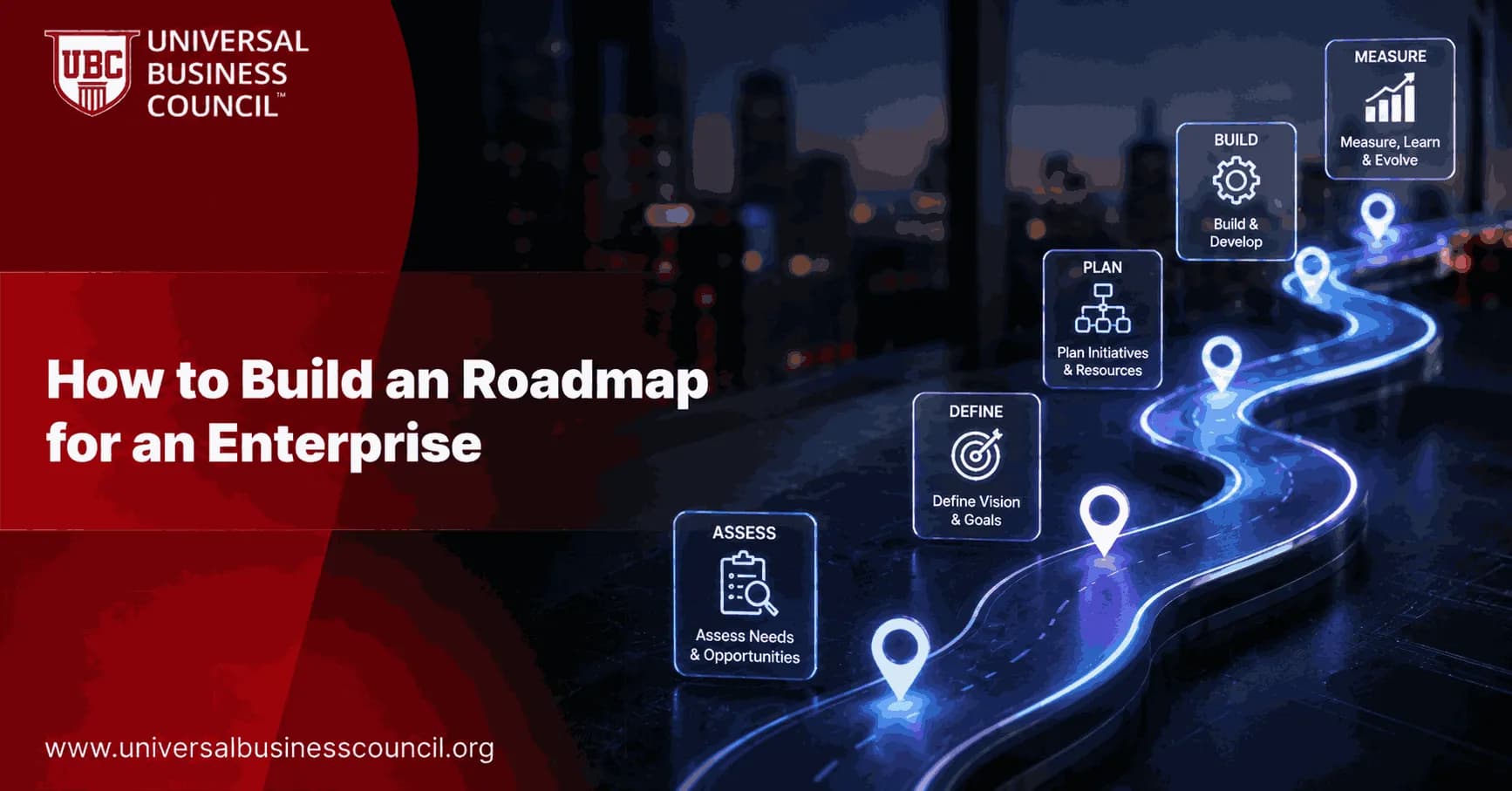
A useful enterprise AI roadmap can be organized into five phases:
Phase | Approximate Timing | Main Objective |
|---|---|---|
Assess | 0-3 months | Understand current state |
Foundation | 3-6 months | Build core capabilities |
Deploy | 6-12 months | Put priority AI into production |
Scale | 12-24 months | Expand proven capabilities |
Transform | 24-36 months | Create AI-enabled operating models |
PHASE 1: ASSESS, 0-3 MONTHS
Inventory existing AI applications, vendors, projects, platforms, and spending.
Assess AI maturity across strategy, data, technology, governance, security, talent, and adoption.
Identify immediate risks and duplicated investments.
Build a pipeline of potential AI use cases.
Establish baselines for important business metrics.
Outcome: Current-state assessment + prioritized opportunity pipeline
↓
PHASE 2: BUILD FOUNDATIONS, 3-6 MONTHS
Establish initial AI governance.
Define architecture and technology principles.
Select core models, platforms, and vendors where appropriate.
Address data gaps required for priority use cases.
Define the AI operating model and decision rights.
Launch workforce AI-literacy programs.
Outcome: Enterprise AI foundation + governance framework
↓
PHASE 3: DEPLOY, 6-12 MONTHS
Pilot and productionize high-priority use cases.
Implement evaluation and monitoring.
Integrate AI into real business workflows.
Train affected employees.
Measure adoption, technical performance, costs, and business outcomes.
Stop initiatives that fail agreed investment criteria.
Outcome: Proven production AI + measurable early value
↓
PHASE 4: SCALE, 12-24 MONTHS
Expand successful applications across teams, regions, products, or customer segments.
Develop reusable AI components and shared platforms.
Increase workflow automation.
Introduce carefully governed AI agents where appropriate.
Strengthen governance, monitoring, and operational capabilities.
Outcome: Repeatable enterprise-scale AI delivery
↓
PHASE 5: TRANSFORM, 24-36 MONTHS
Redesign end-to-end workflows around AI capabilities.
Develop AI-enhanced or AI-native products.
Explore new revenue models and customer experiences.
Increase automation where evidence supports greater autonomy.
Continuously optimize the AI portfolio according to value, cost, and risk.
Outcome: AI embedded in business strategy and operating models
The complete roadmap connects:
Business Strategy
↓
AI Maturity Assessment
↓
Opportunity Identification
↓
Use-Case Prioritization
↓
Data + Technology Foundations
↓
AI Governance + Security
↓
Talent + Operating Model
↓
Pilot
↓
Production
↓
Employee and Customer Adoption
↓
Scale
↓
Measurable Business Value
Every major roadmap initiative should answer six questions:
What business problem are we solving?
Who owns the outcome?
What capabilities and dependencies are required?
How much will it cost?
What risks must be controlled?
How will success be measured?
That turns an enterprise AI roadmap from a collection of dates into an actual management system.
The objective is not to put every conceivable AI initiative onto a three-year timeline. It is to create a disciplined path from AI experimentation to repeatable business value, while preserving enough flexibility to respond as models, vendors, economics, regulations, and organizational priorities change.
Because an AI roadmap should tell the company where it is going.
It should not pretend that anyone knows exactly what the AI landscape will look like three years from now.
Related Articles
View All
Chief Ai Officer
How to Build an Enterprise AI Agent Strategy
An enterprise AI agent strategy defines how organizations can identify, deploy, govern, and scale agentic AI across business operations. Learn how to prioritize high-value agent use cases, design the right architecture, establish permissions and human oversight, manage security risks, and measure business outcomes.
Chief Ai Officer
How to Build an Enterprise AI Business Case
An enterprise AI business case connects a proposed AI initiative to measurable business value, required investment, implementation risks, and strategic objectives. Learn how to define the problem, estimate costs and benefits, calculate expected ROI, evaluate risks, and present an AI proposal that executives can actually assess.
Chief Ai Officer
How to Build an AI Talent Strategy
An AI talent strategy helps organizations identify the skills, roles, workforce models, and development programs needed to execute their AI ambitions. Learn how to assess AI skill gaps, decide when to hire, upskill, or partner, define critical AI roles, and build a workforce capable of scaling AI across the enterprise.
Trending Articles
The Role of Blockchain in Ethical AI Development
How blockchain technology is being used to promote transparency and accountability in artificial intelligence systems.
AWS Career Roadmap
A step-by-step guide to building a successful career in Amazon Web Services cloud computing.
Top 5 DeFi Platforms
Explore the leading decentralized finance platforms and what makes each one unique in the evolving DeFi landscape.