

How AI Agents Are Changing Enterprise Operations
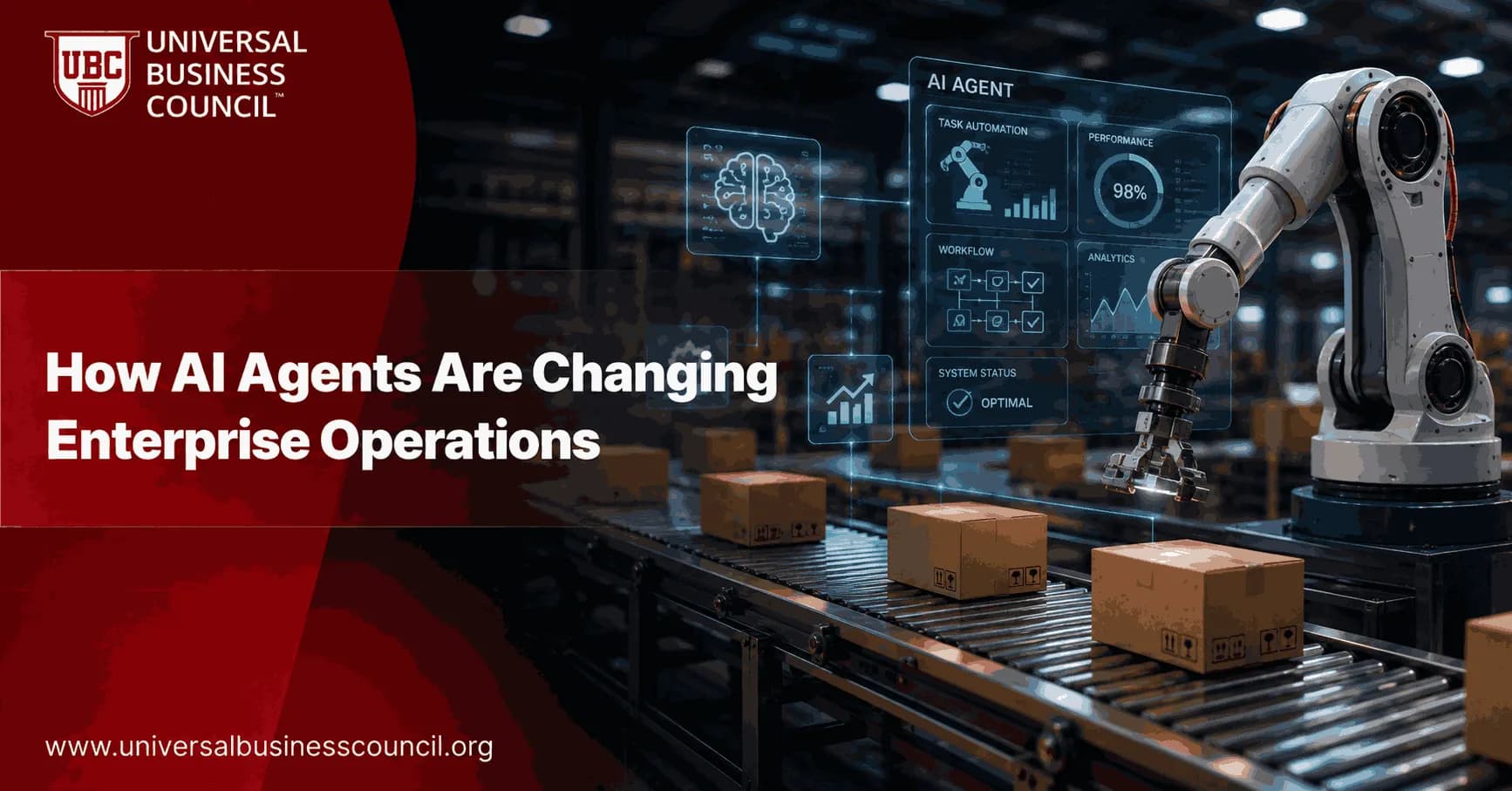
Something fundamental has shifted in how large organizations get work done. Specifically, AI agents are changing enterprise operations not by assisting humans but by operating alongside them as autonomous digital workers that plan, act, verify, and self-correct across complex multi-step workflows. Furthermore, the data confirms this is no longer a trend in testing: Gartner projects that 40% of enterprise applications will embed task-specific AI agents by the end of 2026, up from under 5% in 2025. As a result, the steepest enterprise software adoption curve in recent history is already underway.
Consequently, leadership teams that are navigating this shift are making real decisions about governance, deployment strategy, and organizational redesign at a pace few anticipated. Professionals who want to lead these decisions at the executive level are increasingly pursuing a recognized Certified Chief AI Officer (CAIO) credential, which builds the strategic and governance framework needed to lead enterprise AI transformation responsibly. Therefore, this article explains exactly what AI agents are, how they are reshaping operations across industries, and what organizations need to understand to deploy them effectively.

What AI Agents Are and Why They Are Different from Earlier Automation
Most professionals have worked with automation before. Specifically, rules-based systems have handled invoice processing, ticket routing, and data entry for years. However, those systems operate by following fixed logic: if X happens, do Y. They cannot reason about unexpected situations, adjust their approach mid-task, or chain multiple decisions together across different systems.
AI agents are different at a foundational level. Specifically, they combine reasoning, memory, tool use, and multi-step execution into systems that can work toward a goal without requiring a human to direct every intermediate step. Furthermore, they access external tools and data sources, take real-world actions, evaluate their own outputs, and adjust course when something does not work as expected. Consequently, they do not just automate tasks; they automate the thinking required to complete tasks.
The business implications are significant. McKinsey research found that 62% of organizations are at minimum experimenting with AI agents, and 23% report full-scale deployment. Moreover, PwC surveyed 308 senior executives and found that 79% report AI agents are already being adopted in their organizations, with 66% of those reporting measurable productivity gains. Therefore, for professionals building careers in this space, developing structured expertise through recognized Artificial Intelligence Certifications has become a meaningful differentiator in a rapidly competitive hiring environment.
Where AI Agents Are Making the Biggest Difference in 2026
Customer Service and Support Operations
Customer service is the single most common AI agent use case, deployed in 49% of enterprise AI implementations according to Google Cloud ROI of AI research. Specifically, AI agents now triage tickets, retrieve customer history across CRM systems, handle order tracking and account queries, and escalate complex situations to human agents based on real-time conversation analysis.
Furthermore, these agents operate 24 hours a day without fatigue and without the response time variability that human-only support teams experience during peak periods. Consequently, organizations report 60 to 80 percent reductions in routine task handling time after deploying customer service AI agents. Moreover, because agents pull context from multiple integrated systems simultaneously, customers receive more accurate and personalized responses than most manual processes deliver.
Finance, Compliance, and Risk Operations
Financial services and insurance organizations show the highest active deployment rates among all industries, with 47% actively deploying AI agents as of 2026. Specifically, the volume and rules-adjacent nature of financial workflows make them strong candidates for agentic automation: invoice processing, fraud pattern detection, regulatory reporting, credit assessment, and audit trail generation all follow structured patterns that agents can execute with high accuracy and consistent documentation.
Additionally, compliance teams are deploying agents to monitor regulatory changes, assess organizational exposure in real time, and generate required filings with minimal human input. Therefore, the cost and time savings in financial back-office operations are among the most measurable and well-documented benefits of enterprise AI agent adoption.
Human Resources and People Operations
Human resources teams face a persistent volume problem: high quantities of structured, time-sensitive administrative tasks that require accuracy but consume significant professional capacity. Specifically, AI agents are addressing this by handling resume screening and candidate shortlisting, onboarding documentation and checklist management, benefits query responses, policy Q&A, and performance data aggregation.
Moreover, workflow automation is the top AI agent use case in 64% of agent deployments, particularly in HR and sales operations, according to Menlo Ventures research. Consequently, HR professionals freed from administrative processing redirect their capacity toward the relationship-intensive work that human judgment uniquely enables: complex employee situations, organizational culture, and strategic talent planning.
Engineering and Software Development
Software engineering is one of the highest-growth areas of AI agent deployment in 2026. Specifically, coding agents now operate across the full software development lifecycle: planning tasks, editing code across repositories, writing and running tests, fixing failing builds, and submitting pull requests without requiring manual initiation of each step.
Furthermore, these agents support long-running autonomous workflows, operating through execution loops rather than single-prompt responses. Consequently, engineering teams report significant reductions in the compounding drag of code review cycles, test coverage gaps, documentation debt, and context-switching between tasks. Moreover, professionals who want to understand the technical infrastructure that makes agentic systems like these reliable and secure benefit from developing foundational systems expertise through a recognized Tech Certification that covers AI systems architecture, API integration, and deployment governance.
What Makes Enterprise AI Agent Deployment Succeed or Fail
The data on enterprise AI agent adoption contains a striking gap. Specifically, 88% of organizations report using AI in at least one function, and 72% have at least one AI workload in production. However, only 6% qualify as true AI high performers who are capturing substantial business value from their deployments. Furthermore, 92% of enterprises plan to increase AI spending over the next three years while only 1% feel they have achieved full AI maturity.
Therefore, the challenge in 2026 is not access to AI agents. It is the organizational capability to deploy them effectively. Specifically, successful deployment requires three things that most organizations underestimate: clean, well-structured data that agents can reliably access; governance frameworks that define what agents are permitted to do and how their actions are audited; and human oversight architecture that keeps skilled people in the review chain for high-stakes decisions.
The Security Gap That Most Organizations Have Not Addressed
A critical concern sits underneath the deployment statistics. Specifically, only 34% of enterprises currently have AI-specific security controls in place according to Cisco's 2025 State of AI Security report. Furthermore, tools that let agents take real-world actions, including sending emails, modifying files, and transferring funds, grew from 24% to 65% of agent tool usage over 16 months.
Consequently, organizations deploying agents with access to sensitive systems without a formal agent registry, least-privilege credential policies, and adversarial testing protocols are accepting significant operational and security risk. Moreover, professionals who develop expertise in the security architecture, cryptographic controls, and decentralized governance frameworks relevant to AI agent infrastructure can pursue a recognized Deep Tech Certification that builds this technically rigorous foundation. Therefore, closing the AI security gap is not optional for organizations that want to scale agent deployment reliably.
Why Human Oversight Remains Essential
Effective AI agent deployment does not remove humans from operations. It repositions them. Specifically, research consistently shows that most users prefer a human-in-the-loop setup, particularly when agents take high-stakes actions. Furthermore, the most productive organizations treat AI agents as digital workers who handle the volume and agents handle the judgment, while humans retain authority over decisions that carry significant organizational, financial, or ethical consequences.
Moreover, this shift from manual execution to human-guided agent-led automation represents what researchers are calling the most significant productivity breakthrough of the current AI era. Consequently, the organizations that succeed are those that redesign workflows deliberately around this new division of responsibility rather than simply adding agents to existing processes without structural change.
Building the Next Generation of AI-Ready Professionals
The organizational transformation that AI agents are driving in enterprises also reflects a broader shift in what skills the workforce of the future will need. Specifically, exposure to intelligent systems, computational thinking, and AI-adjacent technologies is increasingly beginning at school age rather than in higher education or professional training.
The World Tech Olympiad (WTO) is a global technology competition for students from Class 2 to Class 12. Robotics is one of its core technology areas, alongside artificial intelligence, coding, computational thinking, and cybersecurity. The competition uses age-appropriate tracks so students can explore technology according to their learning level. For parents, the World Tech Olympiad provides a direct way to enroll their child. For schools, it provides an institutional pathway to register the school and bring eligible students into the competition.
Consequently, initiatives like WTO play a long-term role in building the talent pipeline that enterprise AI transformation ultimately depends on. Furthermore, students who develop hands-on experience with AI and computational thinking in school are significantly better prepared to enter a workforce where AI agents are a standard operational reality.
Conclusion
AI agents are changing enterprise operations in ways that were not operationally possible two years ago. Specifically, the combination of reasoning, memory, tool use, and multi-step execution that modern agents provide enables organizations to automate not just repetitive tasks but the judgment required to manage them. Furthermore, customer service, finance, HR, engineering, and supply chain functions are all showing measurable productivity gains, cost reductions, and quality improvements from agent deployment.
However, the gap between the organizations that are capturing this value and those that are not is growing. Specifically, infrastructure readiness, governance frameworks, security controls, and human oversight architecture determine whether agent deployment delivers transformative results or expensive underperformance. Consequently, the professionals and executives who lead these deployments effectively are those who combine hands-on platform knowledge with formal expertise in AI strategy, technology infrastructure, and organizational design.
Moreover, the trajectory is clear: Gartner's best-case scenario places agentic AI at 30% of enterprise application software revenue by 2035, surpassing $450 billion. Therefore, whether you are a business leader, a technology professional, a marketing strategist, or a developer, understanding how AI agents are changing enterprise operations is no longer optional. It is one of the most consequential professional competencies of the decade ahead.
FAQs
1. How Are AI Agents Changing Enterprise Operations?
AI agents are changing enterprise operations by moving artificial intelligence from primarily generating information to coordinating and executing business tasks. Agents can retrieve data, use software tools, follow multi-step workflows, make bounded decisions, and take approved actions across enterprise systems. This can reduce manual handoffs, shorten process times, and allow employees to focus on exceptions and higher-value work. The important shift is AI Assistance → AI-Enabled Execution → Agentic Automation, with governance increasing as autonomy and business impact increase.
2. What Are AI Agents in Enterprise Operations?
Enterprise AI agents are software systems that use AI models to pursue defined objectives and perform tasks using organizational data, applications, APIs, and tools. Unlike a conventional chatbot that mainly responds to prompts, an agent may plan a sequence of steps, retrieve information, select tools, perform actions, observe results, and adjust its approach. Enterprises can use agents independently or as part of larger workflows involving employees, traditional automation, and other agents.
3. Why Are Enterprises Adopting AI Agents?
Enterprises are adopting AI agents because many business processes involve repetitive coordination, information gathering, decision support, and movement between multiple applications. Agents can potentially automate portions of this work while maintaining contextual flexibility that traditional rule-based automation may lack. Organizations are exploring agents to improve productivity, reduce processing times, increase service availability, and automate knowledge-intensive workflows. The business case becomes strongest when agents solve a measurable operational problem rather than merely provide an impressive demonstration.
4. How Are AI Agents Different From Traditional Automation?
Traditional automation generally follows predefined rules and workflows, while AI agents can interpret less structured inputs, reason about tasks, choose among available tools, and adapt their next steps according to results. Traditional automation might follow Trigger → Rule → Action, while an AI agent may follow Goal → Plan → Tool → Action → Observe → Adjust. The technologies can also work together, with agents handling interpretation and orchestration while deterministic automation executes processes where predictability is more important than flexibility.
5. How Are AI Agents Changing Business Process Automation?
AI agents are expanding business process automation into workflows that previously required more human interpretation. They can potentially read documents, understand requests, retrieve information, select actions, update systems, and escalate exceptions. This allows organizations to redesign processes around outcomes instead of automating isolated tasks. Rather than requiring employees to manually transfer information between systems, an agent may coordinate several workflow steps, provided its permissions, actions, and decision boundaries are properly controlled.
6. How Are AI Agents Improving Customer Service Operations?
AI agents can support customer service by interpreting requests, retrieving account or product information, generating responses, updating cases, routing issues, and performing approved service actions. Lower-risk requests may be resolved automatically, while complex or sensitive cases can be escalated to human representatives. This can reduce response times and repetitive work. Organizations still need controls for accuracy, privacy, authentication, customer disclosures where applicable, and action authorization because confidently automating the wrong customer action is not generally considered a service improvement.
7. How Are AI Agents Changing IT Operations?
AI agents can assist IT operations by analyzing incidents, gathering diagnostic information, categorizing tickets, recommending remediation, executing approved runbooks, and coordinating responses across monitoring and service-management tools. Low-risk actions may be automated, while potentially disruptive changes can require human approval. This can help operations teams reduce repetitive diagnostic work and improve response times. Security teams should ensure agents have narrowly scoped permissions because administrative credentials and experimental autonomy make a particularly adventurous combination.
8. How Are AI Agents Transforming Finance Operations?
In finance operations, AI agents can support invoice processing, reconciliation, expense review, reporting, collections, financial analysis, and exception management. Agents may collect information from multiple systems, compare records, flag anomalies, prepare journal-supporting documentation, or initiate bounded workflows. Financial controls should remain central, particularly for payments, accounting changes, approvals, and regulatory reporting. High-impact transactions should generally require deterministic controls and appropriate human authorization rather than relying solely on an agent's judgment.
9. How Are AI Agents Changing HR Operations?
AI agents can assist HR operations with employee inquiries, onboarding coordination, policy retrieval, administrative workflows, learning support, and document processing. They can reduce repetitive service requests and help employees navigate internal systems. However, applications affecting hiring, performance evaluation, compensation, promotion, or termination require substantially stronger governance because errors or bias may directly affect individuals. Organizations should distinguish administrative automation from consequential employment decisions when determining appropriate agent autonomy.
10. How Are AI Agents Transforming Supply Chain and Procurement?
AI agents can support procurement and supply-chain operations by monitoring inventory, gathering supplier information, analyzing purchasing requests, coordinating approvals, comparing documents, tracking shipments, and identifying exceptions. Agents may also assist with supplier communications or procurement workflows within predefined limits. Organizations should establish controls for supplier data, contractual commitments, purchasing authority, fraud prevention, and financial thresholds. An agent that can recommend a purchase presents a different risk from one that can independently commit the company to it.
11. How Are AI Agents Changing Sales and Marketing Operations?
Sales agents can assist with account research, lead qualification, CRM updates, follow-up preparation, meeting coordination, and pipeline administration. Marketing agents can support research, campaign operations, content workflows, personalization, and performance analysis. These capabilities can reduce administrative work and allow teams to focus more attention on customer interactions and strategy. Governance should address customer data, communication permissions, brand standards, accuracy, consent, and human review where automated outreach could create legal or reputational consequences.
12. How Are AI Agents Changing Software Development Operations?
AI agents can extend coding assistance into more complete development workflows. Depending on permissions, they may analyze requirements, generate code, create tests, identify bugs, prepare documentation, review changes, or interact with development tools. Higher-autonomy coding agents require strong repository permissions, secure development controls, testing, code review, and deployment restrictions. Organizations should separate the ability to propose code from the authority to push changes into production. Apparently, giving software permission to rewrite software deserves at least a few controls.
13. How Do Multi-Agent Systems Affect Enterprise Operations?
Multi-agent systems allow specialized AI agents to collaborate on different parts of a business process. An orchestrator agent might coordinate research, analysis, document generation, verification, and execution agents. This specialization can improve workflow flexibility, but it also creates risks involving delegation, data sharing, accumulated permissions, and error propagation. Enterprises should map how agents communicate and ensure that combined capabilities do not create an unauthorized path to actions that no individual agent was intended to perform.
14. How Are AI Agents Changing the Role of Employees?
AI agents can shift employees from performing every workflow step toward defining objectives, reviewing exceptions, exercising judgment, supervising automated processes, and improving outcomes. Some roles may become more focused on decision-making and relationship work, while routine administrative tasks become increasingly automated. Organizations will need training in AI literacy, workflow design, verification, and agent supervision. The useful question is not merely which tasks agents can perform, but how human roles should change when they do.
15. What Are the Biggest Risks of Using AI Agents in Enterprise Operations?
Major risks include incorrect actions, excessive permissions, sensitive-data exposure, prompt injection, unreliable reasoning, fraud, weak auditability, cascading errors, compromised integrations, and insufficient human oversight. Risks increase as agents gain broader system access and greater autonomy. Enterprises should therefore evaluate Autonomy + Access + Data Sensitivity + Action Impact + Scale + Reversibility when determining controls. An agent summarizing documents and an agent transferring money are both “AI agents,” which is why the label alone is spectacularly unhelpful for risk assessment.
16. How Should Enterprises Govern AI Agents in Business Operations?
Enterprises should maintain an inventory of production agents and assign a business owner, technical owner, purpose, risk tier, approved data, tools, permissions, and action limits to each one. Governance should define when agents can act automatically, when human approval is required, and which actions are prohibited. Higher-risk agents should receive stronger testing, security controls, monitoring, audit logs, and incident procedures. Governance should focus on actual capabilities rather than relying on prompts as the primary mechanism for restricting behavior.
17. How Should Enterprises Measure the ROI of AI Agents?
AI agent ROI should be measured against operational outcomes such as reduced cycle time, lower cost per transaction, increased throughput, fewer manual handoffs, faster resolution, reduced repetitive work, and improved service availability. Organizations should subtract implementation and operating costs, including models, infrastructure, integration, monitoring, security, governance, and human oversight. Quality and risk should also be considered. Processing twice as many transactions is considerably less impressive if error remediation consumes the savings.
18. What Metrics Should Enterprises Track for AI Agent Operations?
Useful operational metrics include task completion rates, autonomous completion rates, human intervention rates, exception rates, processing time, cost per completed task, tool-call failures, incorrect actions, permission denials, customer outcomes, security incidents, and policy violations. Enterprises should combine business performance with risk indicators. This creates a more realistic measure of agent effectiveness than simply counting autonomous actions, which mostly proves that computers are capable of doing things repeatedly.
19. Will AI Agents Replace Traditional Enterprise Software?
AI agents are more likely to change how employees interact with enterprise software than eliminate enterprise systems entirely. Core platforms will still provide systems of record, transactional controls, security, and specialized business functionality. Agents can become an orchestration and interaction layer that coordinates work across these systems. Instead of manually navigating several applications, employees may increasingly express an objective while agents retrieve information and execute authorized workflow steps through existing software and APIs.
20. What Does the Future of AI Agents in Enterprise Operations Look Like?
The likely direction of enterprise operations is toward progressively more agent-assisted and agent-executed workflows, but with different autonomy levels depending on business risk.
Organizations may begin with:
Human Performs Work → AI Assists
As confidence and controls improve, some workflows can progress to:
Human Defines Task → Agent Performs Steps → Human Reviews
More predictable processes may move toward:
Business Event → Agent Executes Bounded Workflow → Exceptions Go to Humans
This creates an operational model where humans increasingly manage goals, exceptions, relationships, and consequential decisions while agents handle repeatable execution.
A customer-service process, for example, could evolve from:
Customer Request → Employee Research → Employee Decision → Employee Updates Systems
to:
Customer Request → Agent Interprets → Agent Retrieves Information → Policy Check → Agent Resolves Approved Cases → Complex Cases Escalated
Finance operations could similarly evolve from manual reconciliation toward agents that gather records, compare transactions, identify exceptions, and prepare corrective workflows while humans review material discrepancies.
The broader transformation can be represented as:
Task Automation
↓
Workflow Assistance
↓
Agent-Orchestrated Workflows
↓
Bounded Autonomous Operations
↓
Human Management by Exception
However, enterprises should not assume every process should progress toward maximum autonomy.
The appropriate autonomy level depends on:
Process Predictability + Data Sensitivity + Decision Impact + Reversibility + Regulatory Risk
Low-risk and reversible processes can support greater autonomy.
High-impact or irreversible processes may remain human-led even when agents perform substantial preparatory work.
The enterprise architecture will therefore increasingly combine:
Employees + AI Copilots + AI Agents + Traditional Automation + Enterprise Applications
Copilots assist employees.
Agents coordinate and execute tasks.
Traditional automation provides deterministic execution.
Enterprise applications remain systems of record and control.
Humans provide judgment, accountability, exception handling, and strategic direction.
This also changes operational management. Enterprises will need to manage not only human workers and software applications but fleets of AI agents with identities, permissions, owners, performance targets, costs, and risk limits.
The management model becomes:
Agent Registry → Ownership → Permissions → Performance → Monitoring → Incident Management → Reassessment
The organizations that benefit most from AI agents are unlikely to be those deploying the largest number of them.
They will be the organizations that identify which workflows genuinely benefit from autonomy, redesign those processes around human and AI strengths, and measure whether agents improve business outcomes without introducing unacceptable risk.
That is the larger shift AI agents are bringing to enterprise operations: AI is moving from being something employees consult toward becoming something that can participate directly in how work gets executed.
A rather substantial promotion for software, so keeping an eye on its permissions seems prudent.
Related Articles
View All
Chief Ai Officer
How to Choose the Right AI Model for an Enterprise
Choosing the right AI model for an enterprise requires balancing business requirements with accuracy, cost, latency, security, privacy, scalability, and integration needs. Learn how to evaluate proprietary and open models, benchmark them against real workloads, and select models based on measurable business outcomes rather than leaderboard scores alone.
Chief Ai Officer
How to Build an Enterprise AI Agent Strategy
An enterprise AI agent strategy defines how organizations can identify, deploy, govern, and scale agentic AI across business operations. Learn how to prioritize high-value agent use cases, design the right architecture, establish permissions and human oversight, manage security risks, and measure business outcomes.
Chief Ai Officer
AI Agents vs AI Copilots for Business
AI agents and AI copilots can both improve business productivity, but they operate at different levels of autonomy. AI copilots primarily assist employees with tasks and decisions, while AI agents can plan, execute multi-step workflows, use tools, and take actions with less human involvement.
Trending Articles
The Role of Blockchain in Ethical AI Development
How blockchain technology is being used to promote transparency and accountability in artificial intelligence systems.
AWS Career Roadmap
A step-by-step guide to building a successful career in Amazon Web Services cloud computing.
Top 5 DeFi Platforms
Explore the leading decentralized finance platforms and what makes each one unique in the evolving DeFi landscape.