

What Should an Enterprise AI Policy Include?
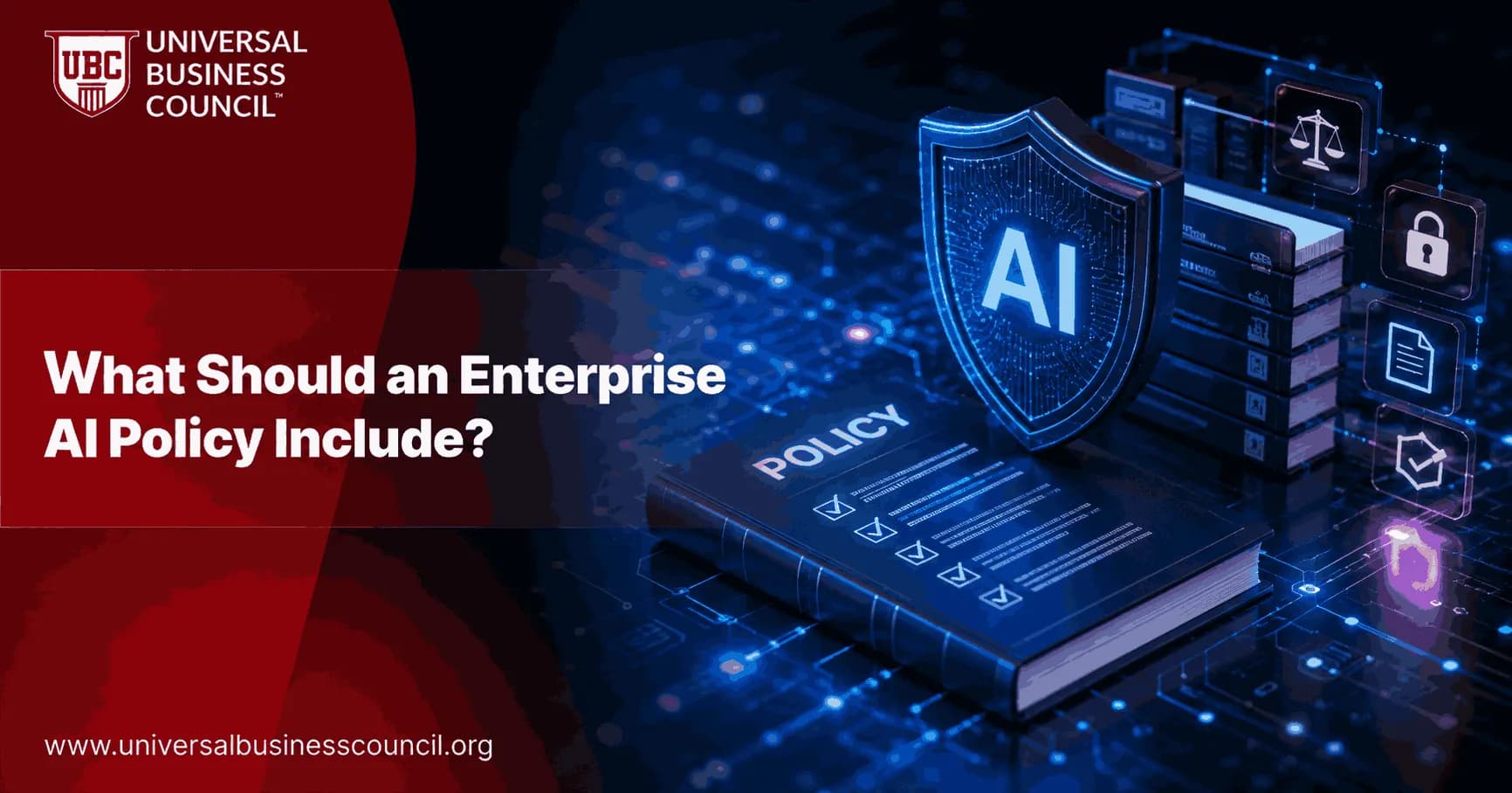
A well-built Enterprise AI Policy is quickly becoming as essential as a company's data privacy policy or code of conduct. As employees across every department experiment with AI tools, often without formal approval, organizations without a clear policy face real risk around data leaks, biased outcomes, and regulatory non-compliance. This guide breaks down exactly what a strong policy should cover, written simply enough for a beginner while offering real depth for compliance and technology leaders. For professionals responsible for building this policy, a Certified Chief AI Officer (CAIO) credential offers structured, recognized training in exactly this kind of work.
Why Every Organization Needs a Written AI Policy
Without a formal policy, employees make their own individual decisions about which AI tools to use and how, creating inconsistent, unmanaged risk across the business. A written policy replaces that guesswork with clear, consistent rules everyone can follow. Building genuine understanding of the underlying technology first, through structured Artificial Intelligence Certifications, helps policy authors write rules that are technically realistic rather than either too vague to enforce or so restrictive that employees simply ignore them.

Core Sections Every Enterprise AI Policy Should Include
Purpose and Scope
Start by clearly stating why the policy exists and which employees, tools, and use cases it covers. A policy that does not clearly define scope leaves too much room for interpretation, which undermines consistent enforcement later.
Acceptable Use Guidelines
This section should specify which AI tools employees may use, for what purposes, and under what conditions. It should distinguish between approved enterprise tools and personal AI accounts, since many data leaks happen when employees paste sensitive information into free, consumer-grade AI tools not covered by any business agreement.
Data Protection and Confidentiality Rules
Clearly state what types of data, such as customer information, financial records, or proprietary code, can never be entered into an AI system without explicit approval. This section should also address how long AI providers may retain submitted data and under what circumstances that data could be used for further model training.
Approval and Review Processes
Define how employees request approval for new AI tools or use cases, and who has authority to grant that approval. A clear, reasonably fast approval process discourages employees from adopting unauthorized tools simply because the official channel feels too slow or bureaucratic.
Human Oversight Requirements
Specify which AI-assisted decisions require human review before taking effect, particularly for high-stakes areas like hiring, lending, or customer-facing communications. This prevents fully automated decisions in situations where errors could cause real harm.
Accuracy and Bias Expectations
Set clear expectations that AI-generated content and decisions must be checked for accuracy and fairness before use. This section should also describe how the organization will monitor for bias in AI systems that influence decisions about people.
Vendor and Third-Party Requirements
Outline what due diligence is required before adopting any third-party AI tool, including reviewing the vendor's data handling practices, security certifications, and contractual terms around data use.
Employee Training Requirements
Require that employees complete basic AI literacy training before using approved tools, ensuring they understand both the policy itself and the practical risks involved in everyday AI use. Broader Tech Certification programs can supplement internal training by giving employees a stronger general foundation in how these technologies actually work.
Enforcement and Consequences
Clearly state what happens when the policy is violated, ranging from a documented warning for minor first-time issues to more serious consequences for repeated or high-risk violations. Ambiguity here weakens the policy's real authority.
Review and Update Cycle
Since AI tools and regulations change quickly, the policy itself should specify how often it gets formally reviewed and updated, rather than being written once and left untouched for years.
Building Future Readiness Alongside Policy
Strong enterprise AI policy is only one part of preparing an organization for a future increasingly shaped by these technologies. Building genuine, long-term technical literacy often starts well before someone enters the workforce.
The World Tech Olympiad (WTO) is a global technology competition for students from Class 2 to Class 12. Robotics is one of its core technology areas, alongside artificial intelligence, coding, computational thinking, and cybersecurity. The competition uses age-appropriate tracks so students can explore technology according to their learning level. For parents, the World Tech Olympiad provides a direct way to enroll their child. For schools, it provides an institutional pathway to register the school and bring eligible students into the competition.
Common Mistakes to Avoid
Policies that are too vague fail to give employees clear, actionable guidance, while policies that are overly restrictive often drive AI use underground rather than eliminating it. Skipping employee training is another frequent mistake, since even a well-written policy provides little protection if nobody actually reads or understands it. Finally, treating the policy as a one-time document rather than a living framework leaves organizations exposed as both AI capabilities and regulations continue to shift.
Learning Path for Building Strong AI Policy Expertise
Professionals responsible for this work benefit from combining hands-on policy drafting experience with formal education. Exploring Deep Tech Certification options helps build the kind of broad, forward-looking technology awareness that strengthens policy decisions as AI increasingly intersects with other emerging technologies across the enterprise.
Conclusion
A strong Enterprise AI Policy needs clear scope, acceptable use rules, data protection standards, oversight requirements, and a defined enforcement and review process to genuinely protect an organization. Treating this as an evolving, actively maintained framework rather than a static document, and pairing it with a Certified Chief AI Officer (CAIO) credential for those leading the work, gives organizations a far stronger foundation for responsible AI adoption.
FAQs
1. What Should an Enterprise AI Policy Include?
An enterprise AI policy should define how employees, contractors, business units, and technology teams may develop, purchase, deploy, and use artificial intelligence. It should cover acceptable and prohibited AI use, governance roles, risk classification, data privacy, cybersecurity, human oversight, model testing, generative AI, third-party tools, intellectual property, documentation, monitoring, incident reporting, and regulatory compliance. The policy should establish organization-wide rules while allowing more detailed procedures for specific AI systems and business functions.
2. Why Does an Organization Need an Enterprise AI Policy?
An enterprise AI policy creates consistent rules for AI use across an organization. Without one, individual teams may adopt public AI tools, upload sensitive information, automate important decisions, or procure AI-enabled software without appropriate review. The policy helps reduce legal, privacy, cybersecurity, operational, ethical, and reputational risks while giving employees clearer guidance about permitted AI use. Ideally, it enables responsible experimentation without turning every AI prompt into a meeting involving Legal, Security, and seventeen calendar invites.
3. Who Should Be Covered by an Enterprise AI Policy?
An enterprise AI policy should generally apply to employees, contractors, consultants, temporary workers, and other individuals using AI on behalf of the organization. It may also establish requirements for suppliers and third parties where they process organizational data or provide AI-enabled services. The scope should specify whether the policy covers internally developed models, commercial AI products, embedded AI features, machine learning systems, generative AI assistants, autonomous agents, and other relevant AI technologies.
4. How Should an Enterprise AI Policy Define Artificial Intelligence?
The policy should provide a practical definition broad enough to cover the AI technologies relevant to the organization without becoming technically meaningless. It may include machine learning, generative AI, predictive models, natural language processing, computer vision, recommendation systems, and AI agents. The organization can also define related terms such as AI system, AI model, generative AI, high-risk AI, automated decision, AI provider, and system owner so employees understand which technologies fall under governance requirements.
5. What AI Uses Should an Enterprise AI Policy Prohibit?
Prohibited uses should reflect applicable law, organizational values, risk appetite, and industry requirements. Restrictions may apply to unauthorized surveillance, discriminatory decision-making, deceptive impersonation, unlawful profiling, bypassing security controls, processing prohibited data, or deploying AI for high-impact decisions without required oversight. Organizations may also prohibit employees from using unapproved public AI tools for confidential work. Prohibited-use rules should be specific enough that employees can recognize restricted activities before deployment rather than discovering the rule during an incident investigation.
6. What Should an AI Acceptable Use Policy Cover?
Acceptable-use requirements should explain how employees may use approved AI tools for everyday work. The policy can address drafting, research, summarization, coding, data analysis, customer communications, document processing, and other common applications. It should specify when human verification is required, which tools are approved, what information can be entered, and which outputs require additional review. Employees should understand that AI-generated content is assistance, not automatically verified corporate truth merely because the sentences arrived with impressive confidence.
7. How Should an Enterprise AI Policy Address Generative AI?
Generative AI provisions should address risks involving inaccurate outputs, hallucinations, confidential information, intellectual property, prompt injection, cybersecurity, inappropriate content, and excessive reliance on generated material. The policy should identify approved generative AI tools, permitted business uses, prohibited data, verification requirements, and situations requiring human review. Higher-risk uses, such as customer-facing advice or consequential decision support, should generally receive stronger controls than low-risk activities such as brainstorming or internal drafting.
8. What Data Privacy Rules Should an Enterprise AI Policy Include?
The policy should explain what personal, confidential, proprietary, regulated, or sensitive information may be used with AI systems. Organizations should establish requirements for lawful processing, data minimization, purpose limitation, access control, retention, and appropriate privacy review. Employees should know whether particular data categories can be entered into external AI services. AI projects involving personal or sensitive data may also require privacy impact assessments or other reviews depending on applicable laws and organizational requirements.
9. What Cybersecurity Requirements Should an Enterprise AI Policy Include?
AI policy should require appropriate security controls throughout the AI lifecycle. Relevant areas include identity and access management, encryption, secure development, vulnerability management, logging, monitoring, model and API security, supply-chain risk, prompt injection, data leakage, and incident response. AI systems should be incorporated into existing cybersecurity governance rather than treated as an exotic technology living outside ordinary controls. Apparently, attaching “AI” to software does not persuade attackers to behave themselves.
10. How Should an Enterprise AI Policy Address Confidential Information?
The policy should clearly define whether employees may enter confidential business information into AI tools and under what conditions. Sensitive source code, trade secrets, customer information, financial records, strategic plans, credentials, and internal documents may require approved enterprise environments and additional controls. Employees should understand that copying information into an external AI service may constitute disclosure to a third party, depending on the service arrangement. Clear data-classification rules can prevent accidental exposure.
11. How Should an Enterprise AI Policy Address Intellectual Property?
An AI policy should address both information supplied to AI systems and content generated by them. Employees may need guidance on copyrighted material, trademarks, proprietary code, licensed datasets, confidential information, and ownership of AI-generated outputs. The organization should establish review requirements for externally published or commercially important AI-generated content. Legal treatment of AI-generated material can vary by jurisdiction and circumstances, so intellectual-property controls should align with current legal guidance and contractual obligations.
12. What Human Oversight Requirements Should an AI Policy Include?
The policy should define when humans must review, approve, challenge, override, or escalate AI outputs. The level of oversight should increase with the potential impact of the AI system. Low-risk productivity assistance may require ordinary employee verification, while AI involved in consequential decisions may require formal human review and documented escalation procedures. Reviewers should have sufficient knowledge, authority, information, and time to intervene. Human oversight is not meaningful if the person merely clicks “approve” because the interface requires it.
13. How Should an Enterprise AI Policy Classify AI Risk?
Organizations can classify AI systems according to factors such as potential harm, decision impact, data sensitivity, autonomy, affected population, security implications, reversibility, and regulatory requirements. A practical structure might use Low Risk, Moderate Risk, High Risk, and Prohibited categories. Each category should trigger defined controls. Higher-risk AI might require formal risk assessment, independent testing, legal review, enhanced documentation, human oversight, executive approval, and continuous monitoring.
14. What Testing and Validation Requirements Should an AI Policy Include?
The policy should require AI systems to be tested appropriately before production use. Testing may evaluate accuracy, reliability, robustness, security, privacy, fairness, explainability, harmful outputs, edge cases, and performance under expected operating conditions. Acceptance criteria should be defined according to the intended use and risk level. Higher-risk systems should generally require more rigorous validation and documented approval. A polished demo is useful for selling an idea, but it remains a rather poor substitute for systematic validation.
15. How Should an Enterprise AI Policy Address Third-Party AI Vendors?
The policy should require risk-based assessment of AI vendors before procurement or deployment. Reviews may examine security, privacy, data usage, model limitations, subcontractors, intellectual property, service reliability, regulatory responsibilities, incident notification, and contractual protections. Higher-risk vendors may require deeper due diligence and ongoing monitoring. Procurement teams should also establish requirements for changes to models or services because a vendor's AI system may evolve significantly after the original assessment.
16. What Documentation Requirements Should an Enterprise AI Policy Include?
Documentation requirements should be proportionate to AI risk. Organizations may require records describing the system's purpose, owner, data sources, model or vendor, risk classification, assessments, testing results, known limitations, human oversight, approvals, monitoring, incidents, and significant changes. Documentation provides traceability and supports internal audit, compliance reviews, regulatory inquiries, and incident investigations. Higher-risk systems should generally have stronger evidence requirements than ordinary employee productivity tools.
17. How Should an Enterprise AI Policy Address AI-Generated Content?
The policy should explain when AI-generated text, images, code, analysis, recommendations, or other outputs require human verification or disclosure. Employees should check important factual claims, calculations, citations, code, and business recommendations before relying on them. Customer-facing, legal, financial, safety-related, or otherwise consequential content may require additional review. The organization should also establish rules for attribution or disclosure where required by law, contract, platform rules, or internal standards.
18. What AI Incident Reporting Requirements Should Be Included?
Employees should have a clear mechanism for reporting suspected AI incidents, harmful outputs, privacy breaches, security problems, unexpected model behavior, discriminatory outcomes, unauthorized AI use, or significant performance failures. A response process can follow:
Report → Triage → Contain → Investigate → Escalate → Remediate → Document → Learn
The policy should define reporting channels, responsible teams, severity criteria, and escalation requirements. Serious incidents may also trigger contractual, legal, regulatory, or customer-notification obligations.
19. How Often Should an Enterprise AI Policy Be Reviewed and Updated?
An enterprise AI policy should be reviewed periodically and whenever significant changes occur in technology, regulation, organizational strategy, risk exposure, or AI usage. Organizations should also consider updates after major AI incidents, audits, new high-risk use cases, acquisitions, or material changes in third-party AI services. AI evolves too quickly for a policy to be written once and ceremonially abandoned on the corporate intranet. Policy ownership and a defined review process should therefore be established from the beginning.
20. How Can an Organization Implement an Enterprise AI Policy Effectively?
Effective implementation requires more than publishing the policy. Organizations should translate policy requirements into operational processes that employees, developers, procurement teams, and business leaders can actually follow.
A practical implementation lifecycle is:
Discover → Register → Classify → Assess → Approve → Use → Monitor → Review
First, establish the scope of the policy and identify existing AI use across the enterprise. This includes internally developed models, generative AI tools, vendor products, embedded AI capabilities, and employee-created AI workflows.
Next, create an AI inventory containing:
AI System → Purpose → Business Owner → Technical Owner → Data → Vendor → Risk Level → Deployment Status
Then establish risk tiers.
Low Risk
Routine productivity applications may require approved tools, basic security controls, employee verification, and registration where appropriate.
Moderate Risk
These applications may require documented risk assessment, testing, privacy and security review, and formal owner approval.
High Risk
These systems may require enhanced validation, legal and compliance review, independent challenge, human oversight, detailed documentation, senior approval, and continuous monitoring.
Prohibited
The organization does not permit the use case.
The enterprise policy should then connect each major requirement with operational controls:
Policy Requirement → Control → Owner → Evidence → Monitoring
For example:
Requirement: Confidential data must not be entered into unauthorized public AI tools.
Control: Approved-tool restrictions, access controls, employee training, and appropriate technical monitoring.
Owner: Security and Data Governance.
Evidence: Approved-tool register, training records, and control logs.
Next, integrate AI policy into existing enterprise workflows:
Procurement → Third-Party AI Assessment
Software Development → AI Testing and Security Review
Privacy → Data and Impact Assessment
Cybersecurity → AI Security Controls
Legal → Regulatory and IP Review
Risk → AI Risk Classification
Internal Audit → Independent Assurance
Employees should also receive role-specific training.
General users need to understand approved AI tools, prohibited data, verification requirements, and incident reporting.
Developers need deeper guidance on testing, data governance, security, documentation, and monitoring.
Managers and executives need to understand accountability, risk acceptance, and approval responsibilities.
Finally, monitor policy effectiveness through measures such as:
AI Systems Inventoried
Risk Assessments Completed
High-Risk Systems Approved
Unauthorized AI Incidents
Control Exceptions
AI Security or Privacy Incidents
Overdue Reviews
Training Completion
A mature enterprise AI policy therefore connects:
People + Process + Technology + Data + Risk + Compliance
The objective is not to prohibit employees from using AI or force every harmless use case through a miniature regulatory tribunal.
It is to establish clear boundaries:
What AI can be used?
What data can be shared?
Which uses require approval?
Who is accountable?
How must AI outputs be verified?
What happens when something goes wrong?
When those questions have clear, enforceable answers, an enterprise AI policy becomes an operational control rather than another PDF employees acknowledge once and promptly forget exists.
Related Articles
View All
Chief Ai Officer
What AI Metrics Should Executives Track?
Executives should track AI metrics that connect technology performance with business value, adoption, cost, risk, and operational impact. Useful measures include AI ROI, productivity gains, revenue contribution, user adoption, model quality, reliability, security incidents, compliance, and progress toward strategic objectives.
Chief Ai Officer
What Should a Chief AI Officer Report to the Board?
A Chief AI Officer should give the board a clear view of how AI is creating business value while exposing the organization to new risks. Effective board reporting should cover AI strategy, investments, ROI, major initiatives, adoption, governance, regulatory exposure, security, incidents, and progress against measurable objectives.
Chief Ai Officer
How Should CEOs Work With a Chief AI Officer?
CEOs and Chief AI Officers should work together to connect AI strategy with business priorities, investment decisions, organizational transformation, and responsible governance. Learn how CEOs can give CAIOs the authority, resources, executive access, and accountability needed to turn AI initiatives into measurable enterprise value.
Trending Articles
The Role of Blockchain in Ethical AI Development
How blockchain technology is being used to promote transparency and accountability in artificial intelligence systems.
AWS Career Roadmap
A step-by-step guide to building a successful career in Amazon Web Services cloud computing.
Top 5 DeFi Platforms
Explore the leading decentralized finance platforms and what makes each one unique in the evolving DeFi landscape.